CPT code 57283: Uterosacral ligament suspension billing guide
CPT code 57283: official descriptor and procedure overview CPT code 57283 descri...

Last Updated: Oct 15, 2026
G3440 is the CCSD code for closure of gastrostomy, the operation that takes down a gastric feeding stoma. It covers repair of the stomach wall and closure of the abdominal layers, however the original gastrostomy was formed.
Surgeons bill G3440 to UK private medical insurers such as Bupa, AXA Health, Aviva and Vitality. The CCSD schedule lists it under 11.2.0 Stomach, and its OPCS-4 equivalent is G34.4.
Let Pabau's smart automation suggest the right codes, reduce claim denials, and keep your practice compliant—effortlessly.
Automate repetitive tasks and focus on what matters most—your patients.
Reduce coding errors and ensure compliance with the latest regulations.
Clean claims, fewer denials, and faster reimbursements.
Powerful insights and reporting to help your practice thrive.
HIPAA compliant SOC 2 certified GDPR-compliant Trusted by 4,000+ clinics worldwide

CCSD Code G3440 covers closure of gastrostomy for UK private medical insurers such as Bupa, AXA Health, Aviva and Vitality.
The code covers stoma takedown, layered repair of the stomach wall and abdominal closure. A persistent fistula needing its own dissection may need a separate code.
UK insurers expect pre-authorization before an elective closure, and a claim without the authorization reference is usually rejected at first pass.
G3400 forms a gastrostomy and G3440 closes one, so the two codes never appear together on the same operative episode.
Pabau’s claims management software keeps the insurer, policy number and authorization code on the patient record, then sends the claim through Healthcode.
CCSD Code G3440 is the procedure code for closure of gastrostomy under the CCSD coding conventions used by UK private medical insurers. The official descriptor is Closure of gastrostomy. The code covers taking down a gastric stoma, repairing the stomach wall and closing the abdominal layers.
It applies whether the original gastrostomy was formed percutaneously, endoscopically or by open surgery. The CCSD schedule lists G3440 in chapter 11 (Abdomen), under 11.2.0 Stomach, and it maps to OPCS-4 code G34.4.
The surgeon’s fee is separate from the anesthetist’s and any assistant surgeon’s fee, which each clinician bills directly to the insurer.
Closure of gastrostomy involves three sequential stages that the operative report must document clearly to support the CCSD Code G3440 claim.
Technique varies by approach. Open cases involve a skin incision around the stoma site. Laparoscopic cases use port access to visualize and close the gastric defect internally before skin closure.
After a simple PEG removal, the tract often closes on its own and no surgery is needed. G3440 applies only when a surgeon performs a formal closure, not when a tube is just removed.
G3440 is performed when the original reason for the gastrostomy no longer applies and the stoma site requires formal surgical closure. Common clinical indications include:
Knowing the bundled scope of G3440 prevents unbundling errors that draw insurer queries and denials. The table below maps what the code covers and what is billed separately.
Several stomach codes in the CCSD schedule describe closely related work, and picking the wrong one is a common query trigger. G3400 forms the stoma that G3440 closes. G3520 and G3580 also close an opening in the stomach wall, but that opening is a perforated ulcer.
Always check descriptors against the current CCSD schedule before submitting. Adjacent code numbers do not guarantee adjacent procedure types, and the schedule is updated periodically. Feeding access formed in the jejunum instead of the stomach sits outside this group and is coded as G6000.
UK private medical insurers expect a valid ICD-10 diagnosis code on every CCSD claim. The diagnosis must reflect why the closure was performed, not the condition that led to tube placement. Insurers check diagnosis-procedure alignment, and a mismatched pairing is a common denial trigger.
UK insurers use the WHO edition of ICD-10, not the US ICD-10-CM, so check codes against that edition before submission. When the clinical picture involves several diagnoses, list the primary indication first.
Most gastrostomy closures need general anesthesia, so the anesthetist bills their own fee for the same date of service. The surgeon’s claim carries G3440, and the anesthetist sends a separate claim directly to the insurer. Both claims should carry the same patient details, date and authorization reference.
The CCSD technical guide sets the rules for coding several procedures performed on one patient at one time. Three situations come up with G3440:
Confirm billing rules with each insurer before submission. Bupa, AXA Health, Aviva and Vitality each publish their own guidance on how they apply the CCSD schedule.
UK private medical insurers classify gastrostomy closure as a planned surgical procedure, so they expect pre-authorization before the operating date. Each insurer runs its own pathway, but the core information requested is consistent.
Bupa, AXA Health, Aviva, Vitality and WPA each set their own pre-authorization protocols. Our guide to Bupa CCSD codes covers Bupa’s coding structure. The Aviva fee schedule lists its CCSD-coded tariffs.
Request written confirmation of the authorization reference through the insurer’s provider portal or by email before surgery. A verbal authorization with no reference leaves the claim open to denial if the insurer’s records do not match. Keep the confirmation on file with the operative documentation.
UK insurers query G3440 claims against the operative report when the claim looks unusual or a denial pattern triggers a review. A complete report reduces queries and supports resubmission after a denial. It should include these minimum elements:
Denials on G3440 claims follow a predictable pattern. Fixing each root cause before submission is faster than correcting it afterward.
Keep a denial log for G3440 claims and track each reason over a rolling 12-month period. A spike in ICD-10 mismatches usually points to a data-entry step in the billing workflow, not a clinical coding problem.
Not every gastrostomy site fistula is covered by CCSD Code G3440. The deciding factor is whether the fistula needed work beyond the standard closure steps. The diagram below sets that case beside a simple tube removal and a standard closure.
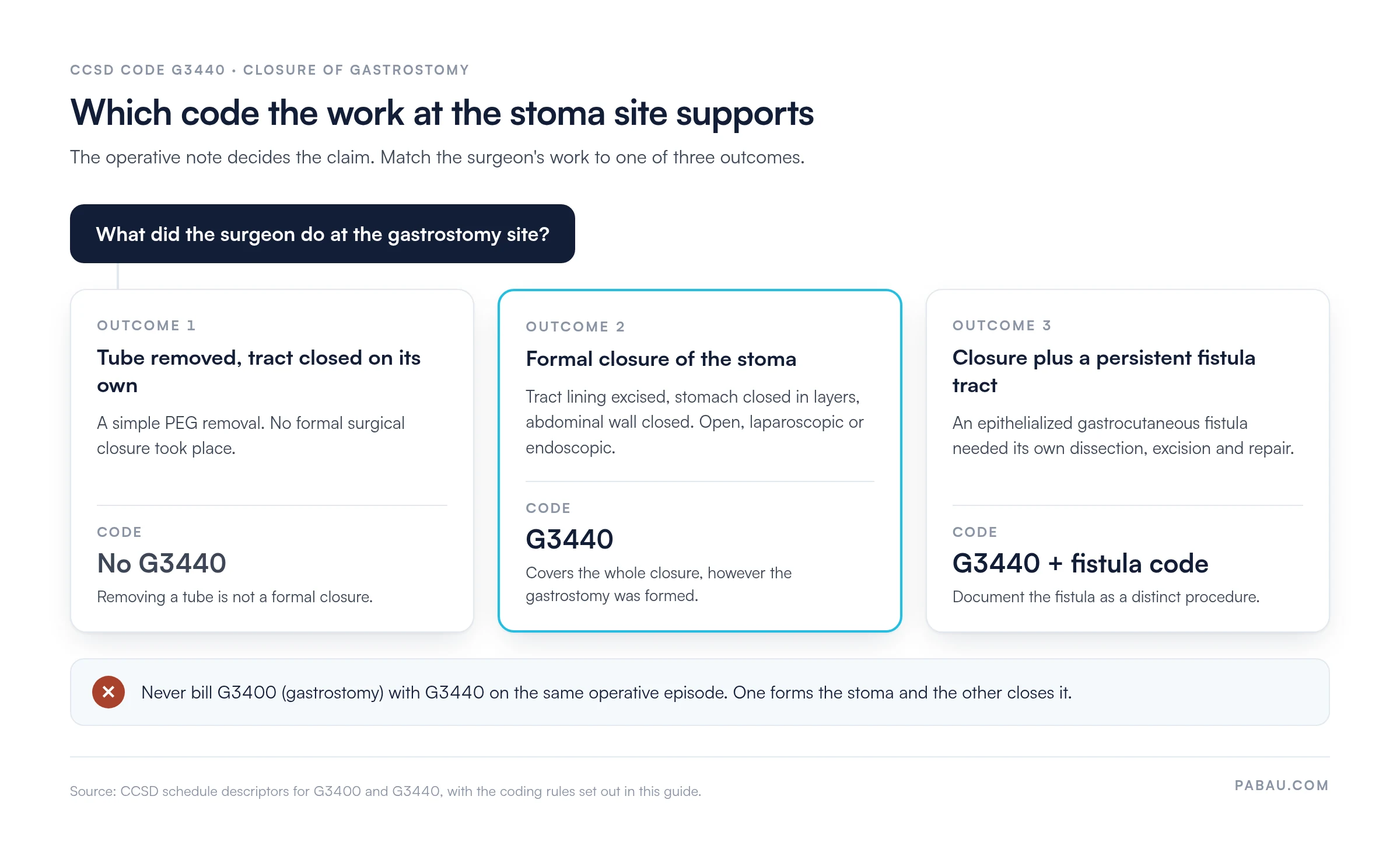
Simple closure applies when the stoma tract closes as part of the standard takedown. The surgeon excises the tract lining, closes the stomach in layers and closes the abdominal wall. G3440 covers this completely.
A separate code is needed when a persistent gastrocutaneous fistula has formed a discrete epithelialized tract. That tract needs its own dissection, excision and repair. The operative report must then document the fistula as a distinct finding, with the separate dissection plane and closure technique.
Billing the fistula repair under G3440 alone undervalues the surgical work. Billing a fistula code without that documentation triggers an unbundling denial. Check the applicable fistula repair code against the current CCSD schedule before you submit.
Many G3440 queries start with details stored in different places. The authorization reference sits in an email, the operative note in a hospital system, and the invoice gets typed up days later.
Pabau, the practice management platform we build, stores the patient’s insurer and policy number on their record. Its claims management software then routes each invoice to the right insurer. Before a claim goes out, Pabau checks that the membership number and authorization code are in place.
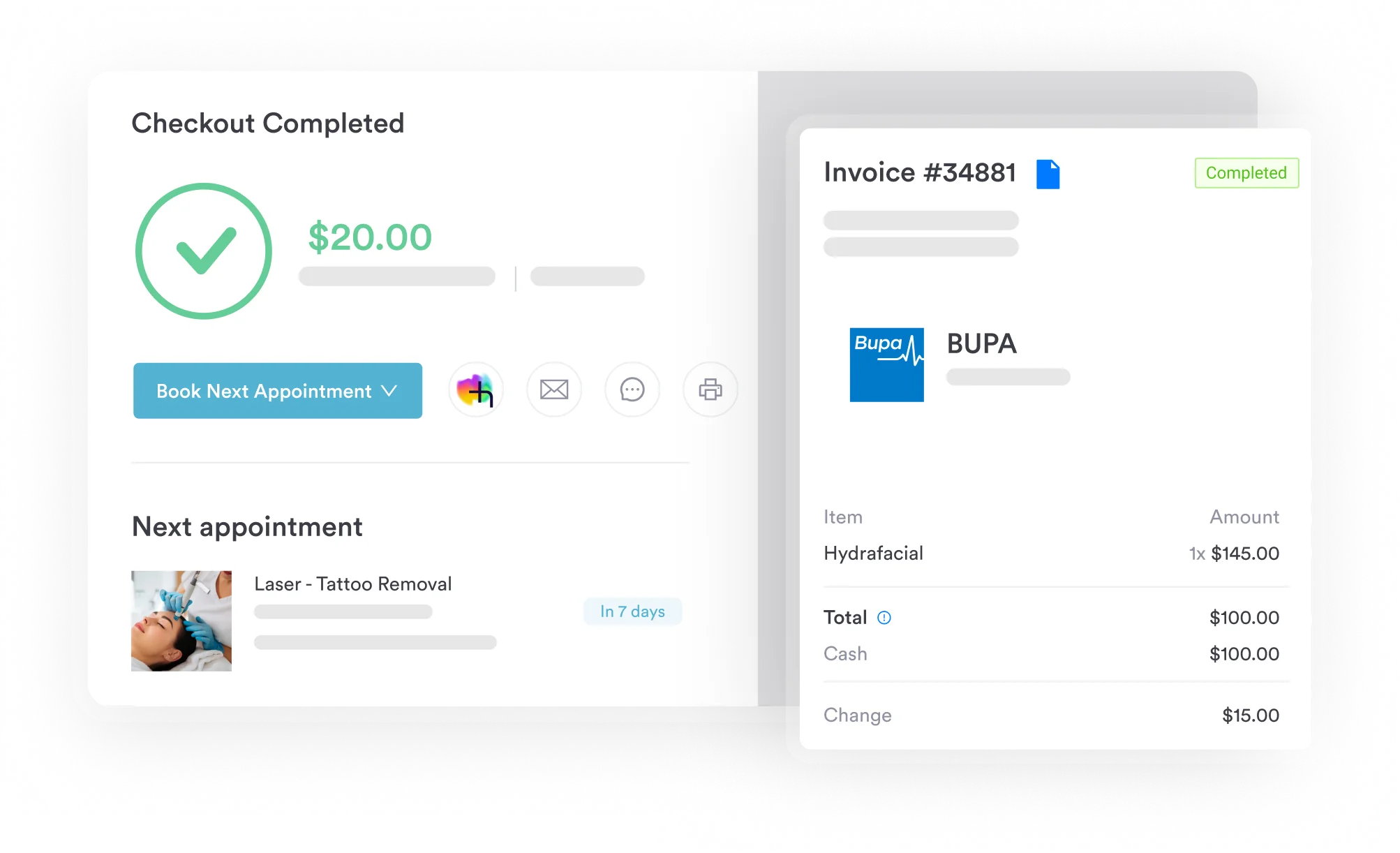
A G3440 claim in Pabau follows these steps:
A rejected G3440 claim surfaces straight away in that dashboard. Your team can fix it and resubmit inside the insurer’s window.

Pabau keeps the insurer, policy number and authorization code on the patient record, then checks them before each claim goes out through Healthcode. Your team spends less time answering claim queries.

Choosing G3440 is rarely the hard part. The operative note shows whether the surgeon closed a stoma or repaired a fistula, and the inclusions table settles what you can bill beside it.
The claim is won or lost before the patient reaches the operating room. Confirm the authorization reference, the ICD-10 code and the consultant’s recognition with the insurer before surgery. Then write the operative report against the documentation list above.
Book a demo to see how Pabau checks authorization codes before each G3440 claim reaches the insurer.

Checking what Bupa pays before you quote? Bupa procedure codes and fee schedule lists Bupa’s procedure codes alongside their scheduled fees.
Managing claims across several insurers? Pabau’s claims management software keeps policy numbers and authorization codes on each claim before it is sent.
CCSD Code G3440 covers closure of gastrostomy: taking down the gastric stoma, repairing the stomach wall in layers and closing the abdominal wall. It applies whether the gastrostomy was formed percutaneously, endoscopically or by open surgery. Anesthesia, assistant surgeon fees and fistula repair needing separate dissection are billed separately.
G3400 covers gastrostomy, which creates the stoma, while G3440 covers its closure. The two codes never appear together on the same operative episode, and billing both triggers a denial. Choose the code by whether the surgeon created or closed the gastric stoma.
Yes, UK private medical insurers such as Bupa, AXA Health, Aviva and Vitality expect pre-authorization for an elective G3440 closure. Send the membership number, CCSD code, ICD-10 code, planned date and facility, and the consultant’s GMC number. Put the authorization reference the insurer issues on the claim.
Yes, G3440 applies to gastrostomy closure however the original tube was placed. A PEG (percutaneous endoscopic gastrostomy) site that needs formal surgical closure qualifies. Simple tube removal, where the tract closes on its own without surgery, does not.
The most common reasons are a missing authorization reference and an ICD-10 code that does not fit a gastrostomy closure. Others include a fistula repair billed without supporting documentation, G3440 billed with G3400, and a consultant the insurer does not recognize. A denial log helps you fix each root cause in the workflow.
The report should include patient and policy identifiers, the consultant’s name and GMC number, and the date and facility. It also needs the clinical indication, surgical technique, intraoperative findings, blood loss, operative time and post-operative instructions. A fistula repair done at the same time must be described separately to support its own code.