HCPCS Code V2629: Ocular prosthesis billing guide
HCPCS Code V2629: Definition, descriptor, and code attributes HCPCS Code V2629 i...

Last Updated: Nov 6, 2026
G3400 is the CCSD code for gastrostomy, the open surgical formation of an opening between the stomach and the abdominal wall for long-term tube feeding. It sits in chapter 11 (Abdomen), section 11.2.0 Stomach, of the schedule UK private medical insurers use.
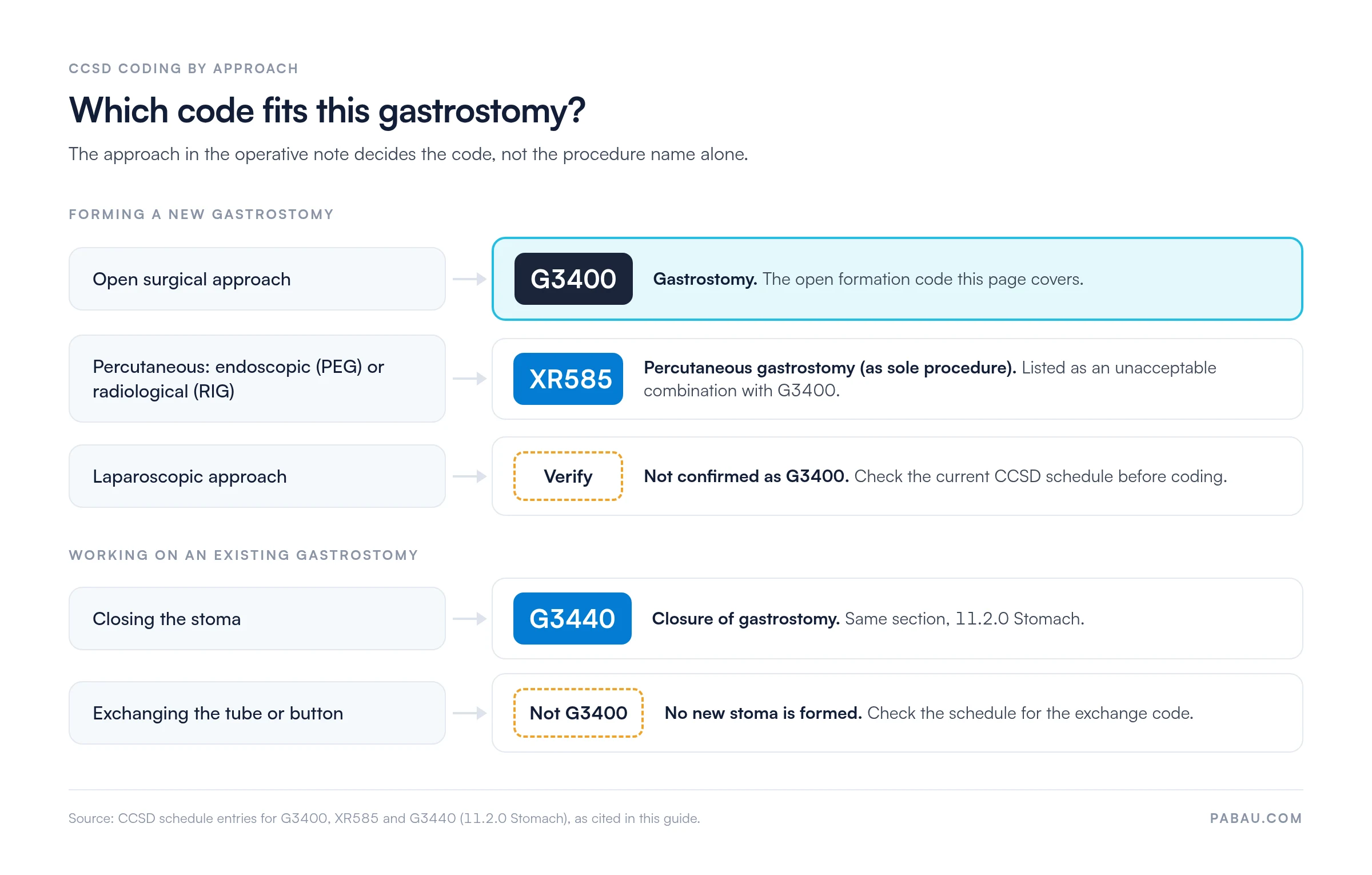
The approach decides the code. Percutaneous gastrostomy, whether endoscopic (PEG) or radiologically inserted, is XR585, which CCSD lists as an unacceptable combination with G3400. Tube replacement and closure are coded separately.
Let Pabau's smart automation suggest the right codes, reduce claim denials, and keep your practice compliant—effortlessly.
Automate repetitive tasks and focus on what matters most—your patients.
Reduce coding errors and ensure compliance with the latest regulations.
Clean claims, fewer denials, and faster reimbursements.
Powerful insights and reporting to help your practice thrive.
HIPAA compliant SOC 2 certified GDPR-compliant Trusted by 4,000+ clinics worldwide

CCSD Code G3400 covers open surgical formation of a gastrostomy, not tube replacement or closure.
Percutaneous gastrostomy, whether endoscopic (PEG) or radiologically inserted (RIG), is coded XR585, which CCSD lists as an unacceptable combination with G3400.
Dysphagia secondary to neurological conditions such as motor neurone disease and stroke is a common indication supporting medical necessity.
Bupa, AXA Health and Aviva generally require pre-authorisation before a gastrostomy, and a missing authorisation reference is a common denial reason, so confirm each policy.
Pabau, the practice management platform we build, stores each pre-authorisation as a case, carries the code through to the claim, and sends claims via Healthcode.
CCSD Code G3400 is the code for gastrostomy, the open surgical formation of an opening between the stomach and the abdominal wall. It sits in chapter 11 (Abdomen), section 11.2.0 Stomach, of the CCSD schedule. The Clinical Coding and Schedule Development Group maintains that code set for UK private medical insurers.
The approach decides the code, not image guidance alone. Open or surgical formation is G3400. Percutaneous formation, whether endoscopic (PEG) or radiological (RIG), is XR585, the CCSD code for percutaneous gastrostomy as a sole procedure. CCSD lists XR585 and G3400 as an unacceptable combination, so the two should not appear on the same episode.
The CCSD system is used by all major UK private medical insurers including Bupa, AXA Health, Aviva, Vitality Health, and WPA. Each insurer publishes its own fee schedule and pre-authorisation requirements against CCSD codes. CCSD Code G3400 can therefore attract different reimbursement rates and pre-auth workflows depending on the patient’s insurer. With claims management software such as Pabau, each insurer’s pre-authorisation is stored as a case and its code carries through to the claim.

Gastrostomy is the surgical formation of a stoma connecting the stomach directly to the exterior of the abdominal wall. The goal is a feeding tube that bypasses the mouth and oesophagus entirely. It delivers enteral nutrition, hydration and medication to patients who cannot swallow safely or sufficiently.
The procedure is performed under general or local anaesthesia depending on patient fitness and the chosen approach. A tube or button device is secured within the stomach lumen and exits through the abdominal wall. Post-procedure, the tube enables direct gastric administration of feeds and fluids, which can be managed by the patient or a carer at home.
Gastrostomy is a long-term intervention, not a temporary measure. Nasogastric tubes are the short-term alternative. When nutritional support is expected to last more than four weeks, guidance from the British Association for Parenteral and Enteral Nutrition (BAPEN) generally favours gastrostomy.
The approach used to form the gastrostomy is a frequent source of coding disputes and claim denials. Different techniques require different levels of skill, equipment, and clinical input, and the CCSD schedule reflects this through separate codes for distinct approaches.
Every operative note should settle two facts. Did the procedure create a new gastrostomy or replace a tube, and was the approach open or percutaneous? The diagram below maps each combination to its code. Verify the current CCSD schedule edition before submitting, because the Clinical Coding and Schedule Development Group updates descriptions and rules periodically.
Private insurers require evidence of clinical necessity before approving CCSD Code G3400. The operative note must link the procedure to a primary diagnosis that makes oral or nasogastric feeding insufficient or unsafe. The most commonly accepted indications fall into three broad categories.
Mapping each indication to its ICD-10 code strengthens the claim. Dysphagia secondary to cerebrovascular disease maps to R13.1 (dysphagia) with an additional code for the underlying stroke. Motor neurone disease maps to G12.2. Malnutrition codes begin at E40-E46 depending on severity. Including all relevant diagnosis codes, not only the primary, gives the insurer’s reviewing clinician the full clinical picture.
Inadequate documentation is a common reason CCSD Code G3400 claims are denied. Insurers audit operative notes against their clinical criteria, and a note missing a required element can be rejected at the review stage.
The operative note must capture the following elements as a minimum:
A standardised operative note template for gastrostomy turns these six elements into required fields. Digital clinical notes that prompt for each field stop an element being skipped under time pressure.
Build a gastrostomy-specific operative note template with mandatory fields for approach, indication, tube type and anaesthetic. Setting it up once takes less time than appealing a single documentation-based denial.
Gastrostomy is usually an elective procedure under UK private healthcare frameworks, and insurers generally require pre-authorisation before it proceeds. Rules vary by insurer and policy, so confirm them for each patient. A CCSD Code G3400 claim submitted without a valid authorisation reference is likely to be denied. Practices managing CCSD billing should establish a pre-auth workflow that runs parallel to the surgical booking process.
Pre-authorisation requirements change periodically. Practices should verify current rules directly through each insurer’s provider portal rather than relying on guidance that may be out of date. The Pabau Bupa CCSD billing guide covers Bupa-specific requirements in more detail, including common CCSD codes and Bupa’s invoicing rules.
Selecting the wrong code from the G3400 neighbourhood is a common source of mis-coding. The table below maps the principal adjacent codes and the key distinguishing factors. For codes outside this table, start from the CCSD codes library.
Closing a gastrostomy once tube feeding ends is a separate episode, billed under G3440 in the same stomach section.
When the procedure involves combined access (gastrostomy formed during a larger upper GI procedure, for example), check the CCSD unbundling rules before submitting additional codes. Insurers apply their own unbundling guidelines, which may disallow separate billing for components they consider included in the primary code fee.
Denials on CCSD Code G3400 claims tend to fall into five categories. Each is preventable with the right workflow in place before the procedure date.
A clean CCSD Code G3400 claim follows the same checklist before and after every procedure.
Set a 60-day billing review trigger for any G3400 claim that has not been settled. A claim still outstanding at day 60 often has an issue that needs follow-up before the submission window closes.
Many surgical teams track authorisation references in email threads or spreadsheets, then retype them onto each invoice. A reference lost between booking and billing turns a clean G3400 claim into a denial.
In Pabau, each insurer’s pre-authorisation is stored as a case. The case carries the authorisation code through to the claim. A claim without one is flagged, so your team can assign a case before it goes out. UK claims are then sent to insurers via Healthcode.
The result is fewer G3400 claims leaving without an authorisation code, and less time spent matching references to invoices.

Pabau stores each pre-authorisation as a case, carries the code through to the claim, and sends claims via Healthcode. See how it works for surgical teams.

The code decision for a gastrostomy is made before the procedure, when the approach is confirmed. An open gastrostomy is G3400. A PEG or radiologically inserted tube is XR585, and CCSD lists the two as an unacceptable combination.
Once the code is settled, two documents carry the claim: the authorisation reference and an operative note that records approach, indication and tube type. Set both up before the theatre date, because fixing either after a denial means an appeal and a longer wait for payment.
Pabau stores each pre-authorisation as a case and carries its code onto the claim, so the reference reaches the insurer with the invoice. Book a demo to see how it works for surgical and specialist private practice teams.

Need guidance on Bupa CCSD codes and billing requirements? Bupa CCSD codes and billing guide covers Bupa-specific CCSD invoicing rules, fee schedules, and submission requirements for UK private practice.
Closing a gastrostomy once feeding support ends? CCSD code G3440 covers coding and documentation for closure of gastrostomy in the same stomach section.
Coding another open operation on the stomach? CCSD code G3800 explains when open stomach operations not elsewhere classified apply.
CCSD Code G3400 covers the open surgical formation of a gastrostomy, a direct opening between the stomach and the abdominal wall for long-term enteral feeding. Percutaneous gastrostomy, whether endoscopic (PEG) or radiologically inserted, is coded XR585. Tube replacement, closure (G3440) and jejunostomy are also coded separately.
No. Tube replacement or exchange is a distinct procedure billed under a separate CCSD code. G3400 applies only when a new gastrostomy is being formed, not when an existing tube or button device is being changed.
Common denial reasons include missing pre-authorisation, insufficient medical necessity evidence in the operative note, the wrong approach code, and late submission outside the insurer’s timescale. A percutaneous procedure billed as G3400 instead of XR585 is a typical approach error. A pre-procedure billing checklist prevents all four.
Radiologically inserted gastrostomy (RIG) is a percutaneous procedure, so it is coded XR585, the CCSD code for percutaneous gastrostomy. PEG falls under XR585 too. G3400 covers open surgical formation of a gastrostomy. CCSD lists XR585 and G3400 as an unacceptable combination, so a percutaneous procedure billed as G3400 is likely to be queried or denied.