HCPCS Code K0900: Customized DME billing and coding guide
HCPCS Code K0900: Official descriptor and code overview HCPCS Code K0900 is a CM...

Last Updated: Nov 18, 2026
S4182 is the CCSD code for debridement and primary suture of a wound with involvement of deeper tissue in the head and neck. CCSD (Clinical Coding and Schedule Development) is the procedure schedule used by UK private medical insurers.
Deeper tissue means the wound reaches below skin and subcutaneous fat. A wound confined to those layers is coded S4212, and the same deeper repair on the trunk or limbs is S4183.
Let Pabau's smart automation suggest the right codes, reduce claim denials, and keep your practice compliant—effortlessly.
Automate repetitive tasks and focus on what matters most—your patients.
Reduce coding errors and ensure compliance with the latest regulations.
Clean claims, fewer denials, and faster reimbursements.
Powerful insights and reporting to help your practice thrive.
HIPAA compliant SOC 2 certified GDPR-compliant Trusted by 4,000+ clinics worldwide

CCSD code S4182 covers debridement and primary suture of a head or neck wound that reaches below skin and subcutaneous fat.
A wound confined to skin and subcutaneous fat is coded S4212 instead. The same deeper repair on the trunk or limbs is S4183.
AXA Health’s CCSD schedule grades S4182 as Intermediate, with a £400 fee. Bupa, Aviva and other UK insurers set their own fees.
Pabau, the practice management platform we build, records layered closure notes at the point of care and submits CCSD-coded claims through Healthcode.
S4182 is the CCSD code for debridement and primary suture of a wound with involvement of deeper tissue in the head and neck. AXA Health’s CCSD schedule lists S4182 under that descriptor, alongside S4183 for the trunk and limbs.
CCSD stands for Clinical Coding and Schedule Development, the procedure schedule that UK private medical insurers and hospitals use to code treatment.
The schedule is run by the CCSD Group. Its members include the insurers Aviva, AXA Health, Bupa and VitalityHealth. The private hospital groups Circle Health, HCA, Nuffield, Spire and Ramsay sit on it too. Claims carrying a CCSD code are usually sent electronically through Healthcode, the UK clearing service for private medical bills.
S4182 sits in Chapter 15 of the schedule (Skin), in sub-category 15.2, Repair. Three elements must all be present for the code to apply:
The head and neck qualifier limits S4182 to wounds of the scalp, face, ears and neck. The same procedure on the trunk or a limb is coded S4183.
Depth is the second boundary. The schedule pairs S4182 with S4212, debridement and primary suture without involvement of deeper tissue. S4212 covers wounds confined to skin and subcutaneous fat, so a wound that stops at the fat layer does not qualify for S4182.
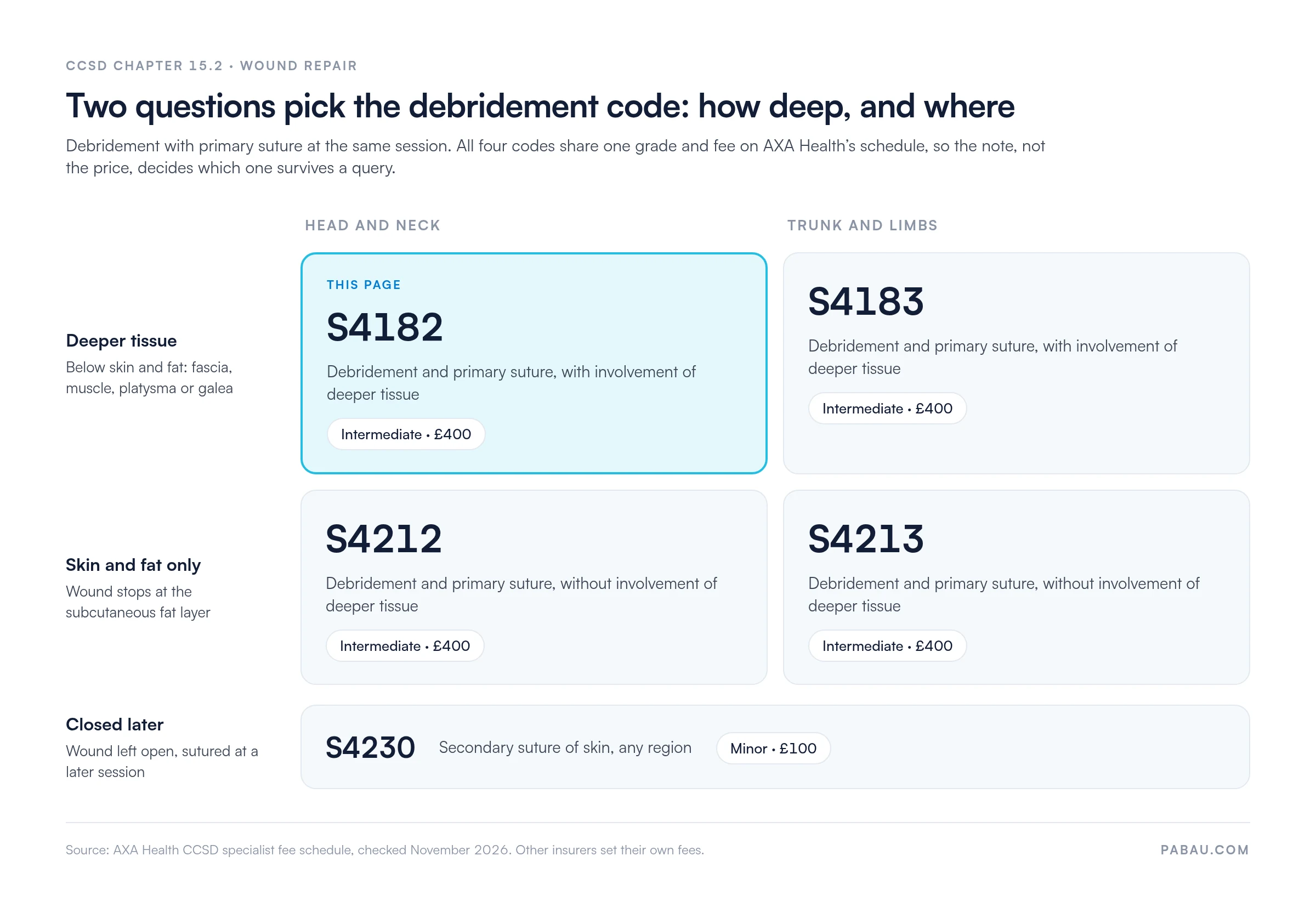
S4182 also excludes delayed closure. A wound left open and closed at a later session is a secondary suture, which has its own code, S4230. Put together, depth and region sort the four debridement codes into a simple grid.
Anatomical sub-sites that fall within the scope of S4182 include:
Deeper structures that meet the depth qualifier include the galea aponeurotica on the scalp. The superficial musculoaponeurotic system (SMAS) in the face counts as well. The platysma in the neck, fascial layers and muscle bellies count too.
Wounds of the oral cavity and intraoral mucosa are anatomically close but usually coded from other chapters of the schedule. When the site is borderline, check the current CCSD schedule or the insurer’s own code search before you submit.
S4182 fits wounds that need both debridement and a layered closure below the fat layer. Common presentations include:
Closure after a planned lesion excision is normally part of the excision code, not a separate S4182 claim. Check the insurer’s guidance where a case sits between the two.
S4182 is billed mainly by plastic and reconstructive surgeons, maxillofacial surgeons, ENT surgeons and general surgeons. Practice software that pre-fills the procedure code and enforces the note fields cuts billing errors at the point of care.
The clinical sequence for a wound coded as S4182 follows a set intraoperative pathway. Each step should appear in the operative note to support the claim.
The deeper-layer step is the clinical and coding anchor. If the note describes closure of skin and fat only, an insurer may query S4182 and pay it as S4212. Record every layer closed, the suture material and the depth reached.
Write the cause and depth of the wound into every S4182 note. A line such as “Dog bite to left cheek, grit and fat debrided, buccal muscle closed with 4/0 Vicryl” answers an insurer’s query early.
Two questions pick the right code in this group: did the wound reach below the fat layer, and where on the body is it? The table sets out the neighbouring codes with their grade and fee on AXA Health’s schedule.
On AXA Health’s schedule the four debridement codes share a grade and a fee, but the choice still matters. A code that does not match the note gets queried, and other insurers may price the codes differently.
Pabau’s Bupa CCSD codes reference covers more of the schedule. Our index of CCSD procedure codes lists the other code pages we publish.
UK insurers code diagnoses with WHO ICD-10, not the US ICD-10-CM. Every S4182 claim needs a diagnosis that matches the wound site, usually from category S01 (head) or S11 (neck). The WHO ICD-10 browser lists every code in both categories.
A diagnosis for a closed injury, or for a body region outside the head and neck, is a common reason for an automated rejection.
Each UK insurer publishes its own fees against CCSD codes. As one example, AXA Health’s CCSD schedule lists S4182 as an Intermediate procedure with a £400 fee. Other insurers set different figures, and every schedule is revised from time to time.
The main funders that pay on CCSD codes are Bupa, AXA Health, Aviva, VitalityHealth, Cigna, WPA, Healix and Allianz Care. Healix publishes its own fee schedule too. Where a specialist charges more than the insurer’s fee, the patient usually pays the shortfall. Agree it with the patient before treatment wherever the wound allows.
Most UK private medical insurers expect the patient to get pre-authorisation before treatment, and the authorisation number goes on the claim. Traumatic wounds are often urgent, so treatment may have to come first.
Contact the insurer as soon as possible after the procedure, and record in the notes why it could not wait. Some policies do not cover emergency treatment at all, so check the patient’s policy terms early.
Insurers query S4182 claims most often when the note does not show both debridement and deeper-tissue repair. The operative note should contain each of these elements:
Digital clinical forms with set fields for wound size, site and each layer closed capture this detail at the point of care. Nobody has to rebuild it from memory when a claim is queried. Structured patient records that link the note to the invoice give the insurer a clear audit trail.
S4182 may be done under local or general anaesthetic. An anaesthetist who gives a general anaesthetic bills the insurer separately, under their own fee. Hospital charges for theatre time, dressings and consumables usually go on the hospital’s invoice, not the surgeon’s.
CCSD asks for the single code that describes the whole operation, components included. Where several wounds are repaired in one session, check the insurer’s multiple-procedure rules before you add a second line. A review step that flags multi-code claims catches these errors before submission.
Most S4182 queries arise because the operative note does not support the code. The common ones are set out below, and Pabau’s guide to denial management covers the wider process.
S4182 claims rarely fail on the surgery. They fail because the note does not show the insurer what the surgeon did, or because the code was keyed in from memory afterwards.
Pabau’s claims management software lets a practice build CCSD-coded procedure templates. They prompt the clinician for wound size, sub-site, debridement and each layer closed before the invoice is raised. The claim then goes to the insurer through Healthcode from the same record.
For dermatology and plastic surgery practices that repair facial wounds often, keeping documentation and billing in one system saves rework. Pabau’s roundup of UK medical billing software compares the options for insurer billing.
Build an S4182 template with required fields for wound length, sub-site, debridement technique and each layer closed. The clinician completes it before leaving theatre, and billing staff raise the claim from the same record.

Pabau helps UK private practices record layered closure notes and authorisation numbers at the point of care, then submits CCSD-coded claims to insurers through Healthcode.

S4182 pays for two things done together: clearing a contaminated head or neck wound and closing it below the fat layer. If the note shows only one of them, the claim belongs to another code.
The fix costs a few lines. Write down the deepest layer reached, the debridement performed and each layer closed, before the patient leaves theatre. Book a demo to see how Pabau keeps that note and the Healthcode claim in one record.

Treating a skin cancer in the same region? CCSD code S0602 covers excision of skin cancer on the head and neck, with its own grading and documentation rules.
Was the wound infected or holding a collection? CCSD code 25000 explains how to bill incision and drainage for UK private patients.
Is the injury a burn rather than a laceration? CCSD code S5532 sets out the coding and claim steps for burn dressings in UK private practice.
Want operative notes that hold up to insurer queries? Clinical documentation software shows how structured notes capture wound size, depth and closure layers every time.
S4182 covers debridement and primary suture of a head or neck wound that reaches deeper tissue, below skin and subcutaneous fat. Both acts happen in one session: damaged or contaminated tissue is removed, then the wound is closed in layers.
All three describe debridement and primary suture. S4182 is for head and neck wounds that reach deeper tissue, and S4183 is the same repair on the trunk or limbs. S4212 is for head and neck wounds confined to skin and subcutaneous fat.
Each insurer sets its own fee. AXA Health’s CCSD schedule lists S4182 as an Intermediate procedure with a £400 fee. Check the patient’s insurer before quoting, because fees differ and schedules change.
The operative note should record wound size, the exact sub-site, what made debridement necessary and the technique used. It should also name every layer closed with its suture. Missing depth or debridement detail is the most common reason a claim is queried.
No, not in the way US CPT codes do. CCSD asks for the single code that describes the whole operation. Where several wounds are repaired in one session, the insurer’s multiple-procedure rules decide what can be billed.
UK insurers use WHO ICD-10. Most S4182 claims pair with an open-wound code from S01 for the head or S11 for the neck, matched to the sub-site. A dog bite can add the external-cause code W54.