CPT Code 99448: Interprofessional telephone consultation
CPT Code 99448: Official description and time-tier definition CPT Code 99448 is ...

Last Updated: Nov 18, 2026
S0655 is the CCSD (Clinical Coding and Schedule Development) code for removal of a benign lesion on the head and neck requiring flap closure. It excludes advancement flaps and lipoma.
CCSD is the procedure coding schedule used across UK private healthcare. A lesion closed directly or with an advancement flap is coded S0654, and a lipoma is coded S0656.
Let Pabau's smart automation suggest the right codes, reduce claim denials, and keep your practice compliant—effortlessly.
Automate repetitive tasks and focus on what matters most—your patients.
Reduce coding errors and ensure compliance with the latest regulations.
Clean claims, fewer denials, and faster reimbursements.
Powerful insights and reporting to help your practice thrive.
HIPAA compliant SOC 2 certified GDPR-compliant Trusted by 4,000+ clinics worldwide

S0655 covers removal of a benign lesion on the head or neck when the defect needs a flap other than an advancement flap.
A lesion closed directly or with an advancement flap is coded S0654, and a lipoma is coded S0656.
AXA Health lists S0655 as Intermediate complexity and treats local anaesthetic as part of the procedure, not a separate fee.
Pabau, our practice management platform, tracks pre-authorisation on the patient’s case and sends insurer invoices through Healthcode and Bupa.
CCSD code S0655 has this official descriptor: Removal of benign lesion on head and neck requiring flap closure (excluding advancement flap) (excluding lipoma). AXA Health’s specialist code schedule lists S0655 under that wording, as an Intermediate procedure.
CCSD stands for Clinical Coding and Schedule Development. It is the procedure and diagnostic-test coding schedule for the UK private healthcare sector. A group drawn from Bupa, Vitality, AXA Health and Aviva maintains it.
Any procedure that fits the descriptor maps to this code. That means a benign growth on the head, face, scalp or neck, closed with a rotation, transposition or interpolation flap. For how insurers apply CCSD codes in general, see our Bupa CCSD billing guide.
The code sits in CCSD chapter 15, skin and subcutaneous tissue, in section 15.1 Lesions of skin. Chapter 15 also covers nail surgery, where CCSD code S7010 describes wedge excision or avulsion of a nail with chemical ablation of the nail bed. S0655 covers the surgeon’s procedure only. The hospital bills its own facility charges, and an anaesthetist bills separately for any general anaesthetic. A lesion destroyed by laser rather than excised is coded elsewhere in the chapter, such as S0922 for a treated area up to 25 cm².
Surgeons performing a procedure billed under S0655 follow a standard sequence. They mark excision margins around the benign lesion with appropriate clinical clearance. They then excise the lesion in full and send the specimen for histology. If histology instead shows a skin cancer, the follow-up re-excision is coded by site, with the trunk and limbs taking S0605.
The surgeon assesses the defect’s size, site and the laxity of the surrounding skin. That decides which non-advancement flap will close it without tension and with an acceptable cosmetic result. Where nearby skin cannot close the defect, a staged distant flap may be needed, and its later stages are coded S1700.
The flap is designed, raised from adjacent tissue, rotated or transposed into the defect, and inset with layered sutures. The donor site is closed directly or left to heal by secondary intention, depending on the design. The patient receives wound care instructions and a histology review appointment.
S0655 covers the non-advancement local flap types. The table below summarises the included flap designs, how they move tissue, and common head and neck uses.
Practices coding rotation and transposition flaps across dermatology and plastic surgery lists benefit from a consistent pre-operative coding check. The flap type is clear in a good operative note, but a vague note is easy to miscode. Carrying the flap type from the clinical note straight into the code choice cuts this error.
The official descriptor excludes two scenarios from S0655. Billing the code for either one is a coding error, whatever the site or lesion type.
Removal of a lipoma is coded S0656 in the CCSD schedule, not S0655. Pair it with ICD-10 D17.0, benign lipomatous neoplasm of skin and subcutaneous tissue of head, face and neck. AXA Health lists S0656 as an unacceptable combination with S0655, so the two codes are not claimed together.
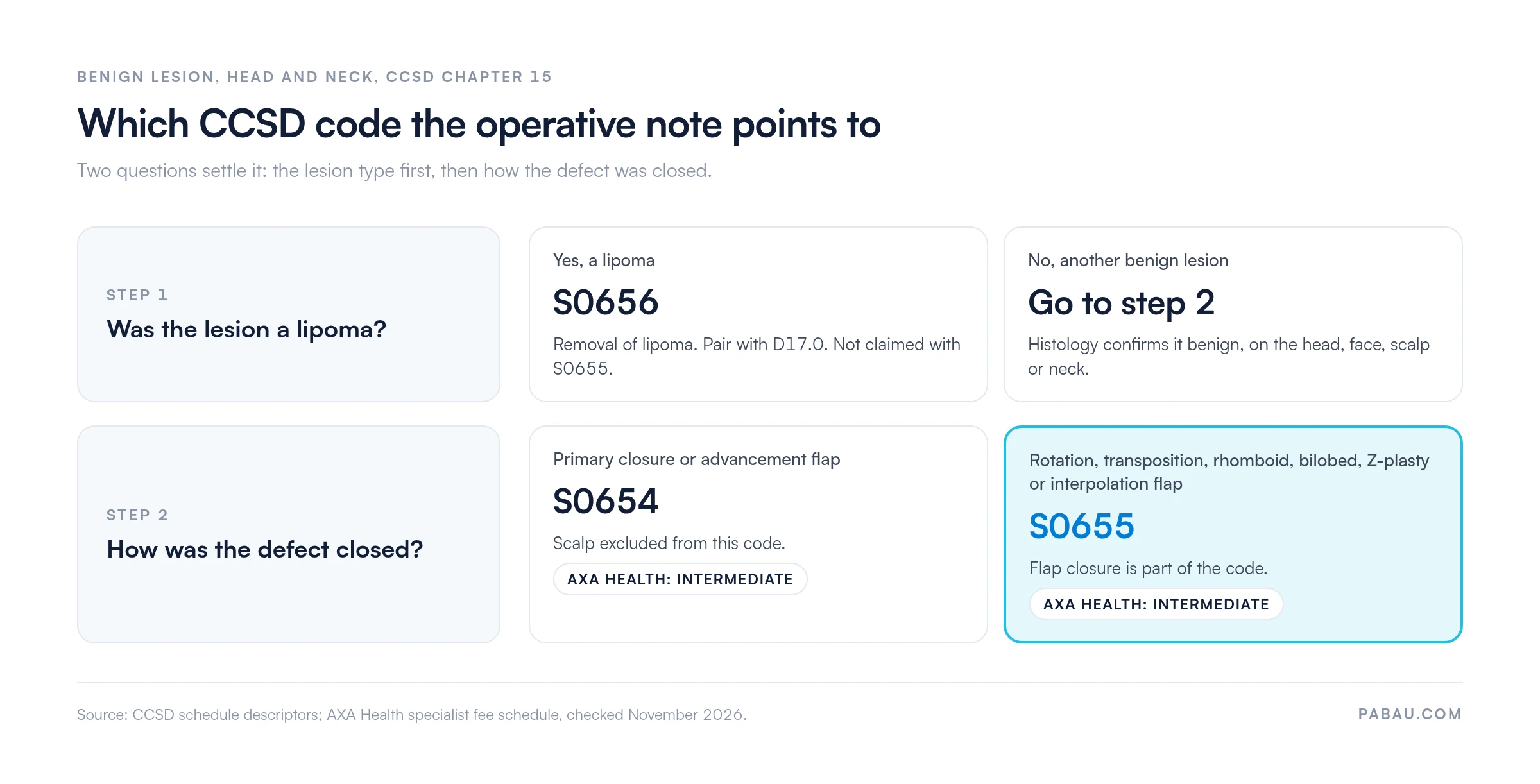
S0654 is S0655’s sibling code. Both cover removal of a benign head and neck lesion, and the method of closure decides between them. A traumatic head or neck wound that is debrided and closed by primary suture is a different procedure. When it reaches deeper tissue, it is coded procedure code S4182. The table sets S0655 against the codes coders most often confuse it with.
Note that S0654 excludes the scalp. A benign scalp lesion closed directly therefore falls outside S0654, so check the schedule before you code it. Whatever the site, the flap mechanism decides between S0654 and S0655, not the lesion type or size. The chart below puts the two questions in the order a coder should ask them.
UK insurers expect an ICD-10 diagnosis code alongside the CCSD procedure code. The diagnosis code supports medical necessity and tells the insurer what the lesion was.
A diagnosis that does not match the operative findings is a common cause of rejection. When the clinician records the diagnosis at the point of charting, billing staff are not left to assign it later.
Always confirm the ICD-10 code with the treating clinician. The code must reflect the pathology, not just the working clinical impression. Histology can change the picture: a lesion first coded D23.3 may prove to be a low-grade malignancy. In that case, correct the claim, because a malignant lesion has its own CCSD codes. A first excision of a malignant lesion on the head or neck, for example, is S0602. Never assign a benign code before histology is back.
Before you submit an S0655 claim, check three points. The ICD-10 code describes a benign lesion on the head or neck. The operative note names a non-advancement flap. The histology report is on file.
CCSD sets the codes, and each insurer sets its own fees against them. AXA Health’s specialist fee schedule lists S0655 as Intermediate complexity (checked November 2026). Its procedure fee is £210, and its general anaesthesia fee is £142.
Bupa, Aviva and Vitality publish their own schedules and benefit limits, so the figure differs by insurer. A specialist who charges more than the insurer pays leaves the patient with a shortfall. Tell the patient about it in writing before surgery.
Most UK private medical insurers expect pre-authorisation before a procedure. Requirements differ between insurers, policies and settings, so confirm them for each patient before you book. When you compare UK medical billing software, check that it records each authorisation reference against the patient’s case.
Most private medical insurance policies exclude cosmetic surgery. Benign lesion removal is therefore authorised only where there is a clinical reason, such as bleeding, infection, rapid growth, functional problems or diagnostic doubt. State that reason in the request.
Record the authorisation reference in the patient’s file before surgery, and quote it on the invoice. An invoice without one, where the insurer required it, is likely to be rejected.
Complete documentation is the difference between a paid claim and a rejected one. Insurers can ask for clinical records to check any CCSD claim, and S0655 is no exception. A digital operative form that prompts the surgeon for each data point during surgery puts the evidence on file before an insurer asks for it.
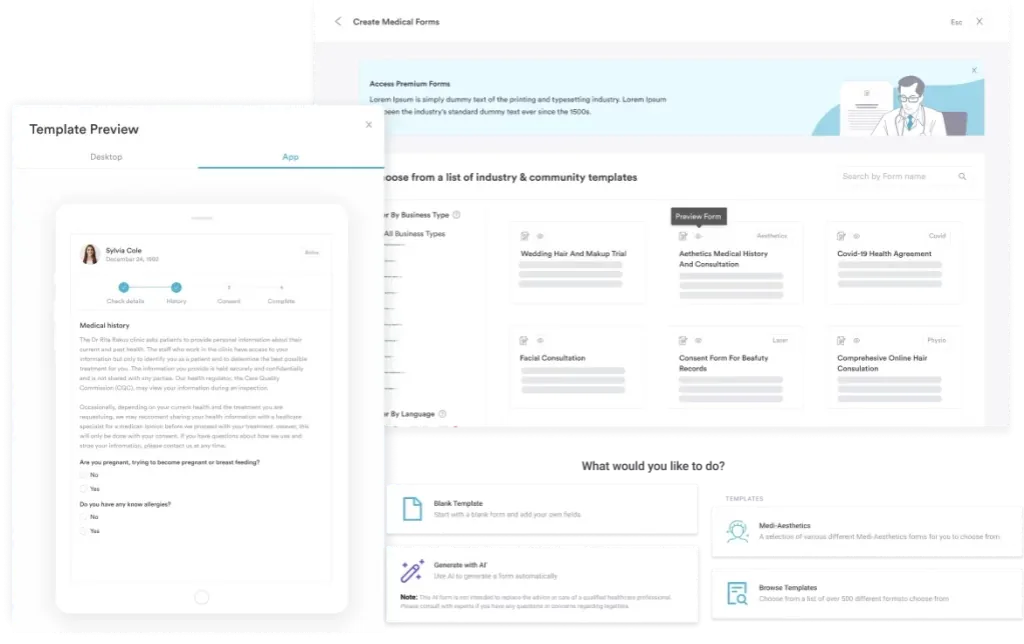
Operative note language directly affects coding accuracy. The surgeon, not the billing team, is responsible for naming the flap type. Sample documentation language:
S0655 is the surgeon’s primary procedure code, and a few rules govern what can go on the same claim. They come from the insurer’s schedule rather than from CCSD modifiers.
When you remove more than one lesion in a session, document each one separately: site, dimensions and flap type. A single combined entry gives the insurer grounds to pay only the primary procedure.
Rejections for benign lesion removal with flap closure follow predictable patterns. Fixing each one at the point of coding is faster than fixing it at appeal. For a wider process, see our guide to CCSD codes.
Today, many practices hold the operative note in one system and build the insurer invoice in another. The flap type, the diagnosis and the authorisation reference have to be copied across by hand, and that is where S0655 claims go wrong.
In Pabau, the practice software we build, the clinical record and the insurer invoice sit on the same patient file. The authorisation code, dates and sessions sit on the patient’s case, with a warning when one is missing. UK insurer invoices go out through Healthcode and Bupa from the same record, using Pabau’s claims management software.
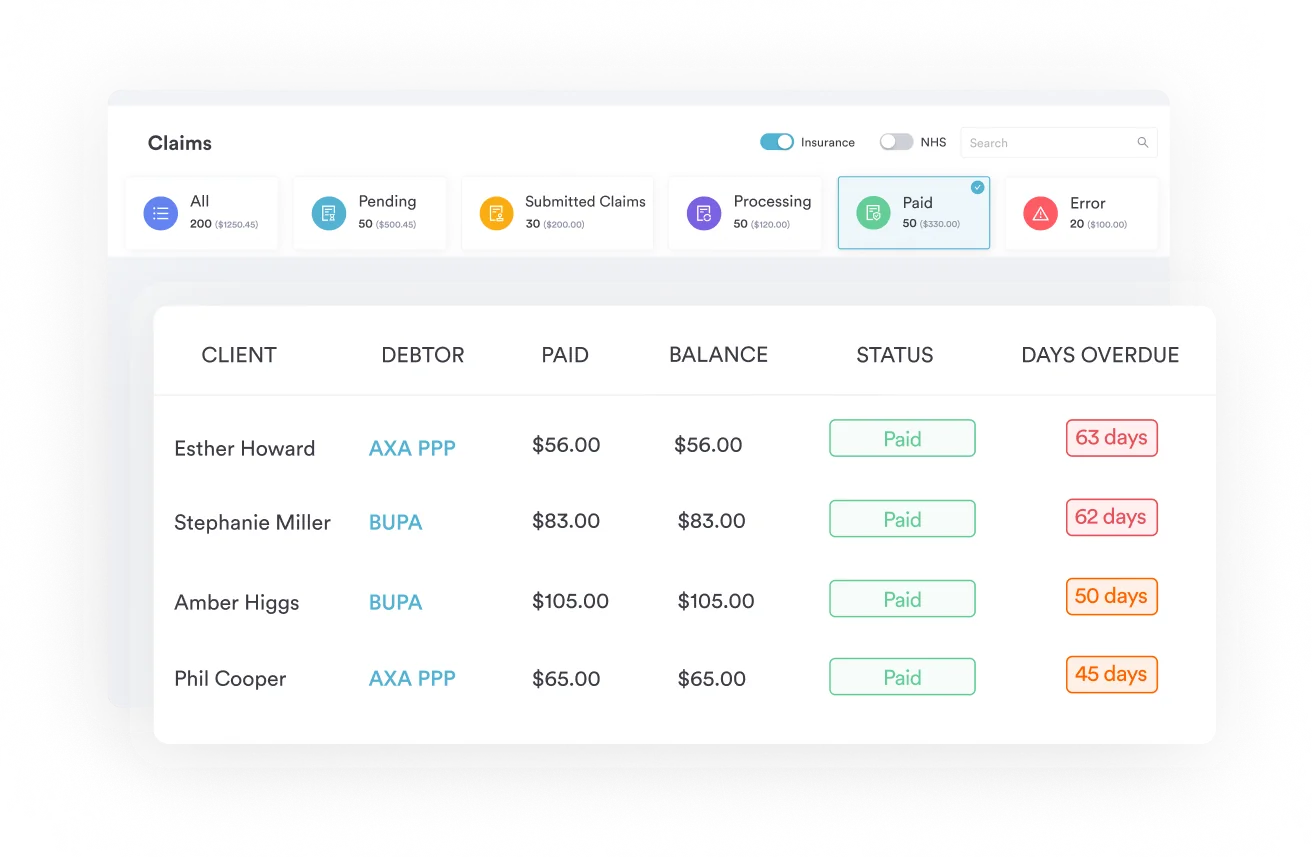
The result is fewer rejections for a missing reference or a mismatched code. Your billing team then spends less time on appeals.

Pabau keeps the operative note, the pre-authorisation reference and the CCSD code on one patient record. Insurer invoices then go out through Healthcode and Bupa without re-keying.

The operative note settles S0655 before the billing office ever sees the claim. If the note names a rotation, transposition or interpolation flap, the code follows. If it says “local flap”, or describes an advancement flap, the claim is already at risk.
So make the flap type, the lesion size and the clinical reason part of every note, and hold the claim until histology is back. That small discipline keeps S0654, S0655 and S0656 apart, and keeps insurer queries rare. Book a demo to see how Pabau keeps the note, the authorisation and the invoice on one record.

Was the flap a large stand-alone repair rather than lesion closure? CCSD code S2503 covers a local flap of 9 cm² or more, including graft or flap to the secondary defect.
Did the benign lesion sit in muscle or deeper tissue? CCSD code S0653 covers removal of a benign lesion below the skin and subcutaneous layer, excluding lipoma.
Checking what Bupa lists for S0655 and related codes? The Bupa procedure codes and fee schedule guide sets out how Bupa lists procedure codes alongside its fees.
Want an operation note that holds up to insurer review? Our free operation notes template gives you a structured way to record the procedure, findings and technique.
CCSD code S0655 covers removal of a benign lesion on the head or neck where the wound needs a non-advancement local flap. That includes rotation, transposition, rhomboid, bilobed, Z-plasty and interpolation flaps. It excludes lipoma and advancement flap closure, which have their own codes.
Both codes cover removal of a benign head and neck lesion, and the closure decides between them. S0655 is used when the defect needs a rotation, transposition or interpolation flap. S0654 is used for primary closure or an advancement flap, and it excludes the scalp.
A lipoma is a benign tumour of subcutaneous fat, not a skin-surface lesion like the D23.x neoplasms S0655 covers. CCSD codes its removal as S0656, removal of lipoma. Pair S0656 with ICD-10 D17.0, benign lipomatous neoplasm of skin and subcutaneous tissue of head, face and neck.
In most cases, yes. Bupa, AXA Health and Vitality expect pre-authorisation before treatment, and Aviva usually does. Requirements vary by policy, so confirm them for each patient before booking. Quote the authorisation reference on the invoice, because a claim without one is likely to be rejected.
Insurers can ask for clinical records, and the histology report is the proof that the lesion was benign. Keep it on file for every S0655 claim, and hold the claim until it is back. If histology shows a malignancy, the claim needs a malignant lesion code instead.
No. Most private medical insurance policies exclude cosmetic surgery, so a purely cosmetic removal is self-pay. To support a claim, record the clinical reason in the notes and the pre-authorisation request. Typical reasons are bleeding, infection, rapid growth, functional impairment or diagnostic doubt.