CPT Code 19361: Latissimus dorsi flap breast reconstruction
CPT code 19361: Official descriptor and payment basics CPT code 19361 is the Cat...

Last Updated: Nov 18, 2026
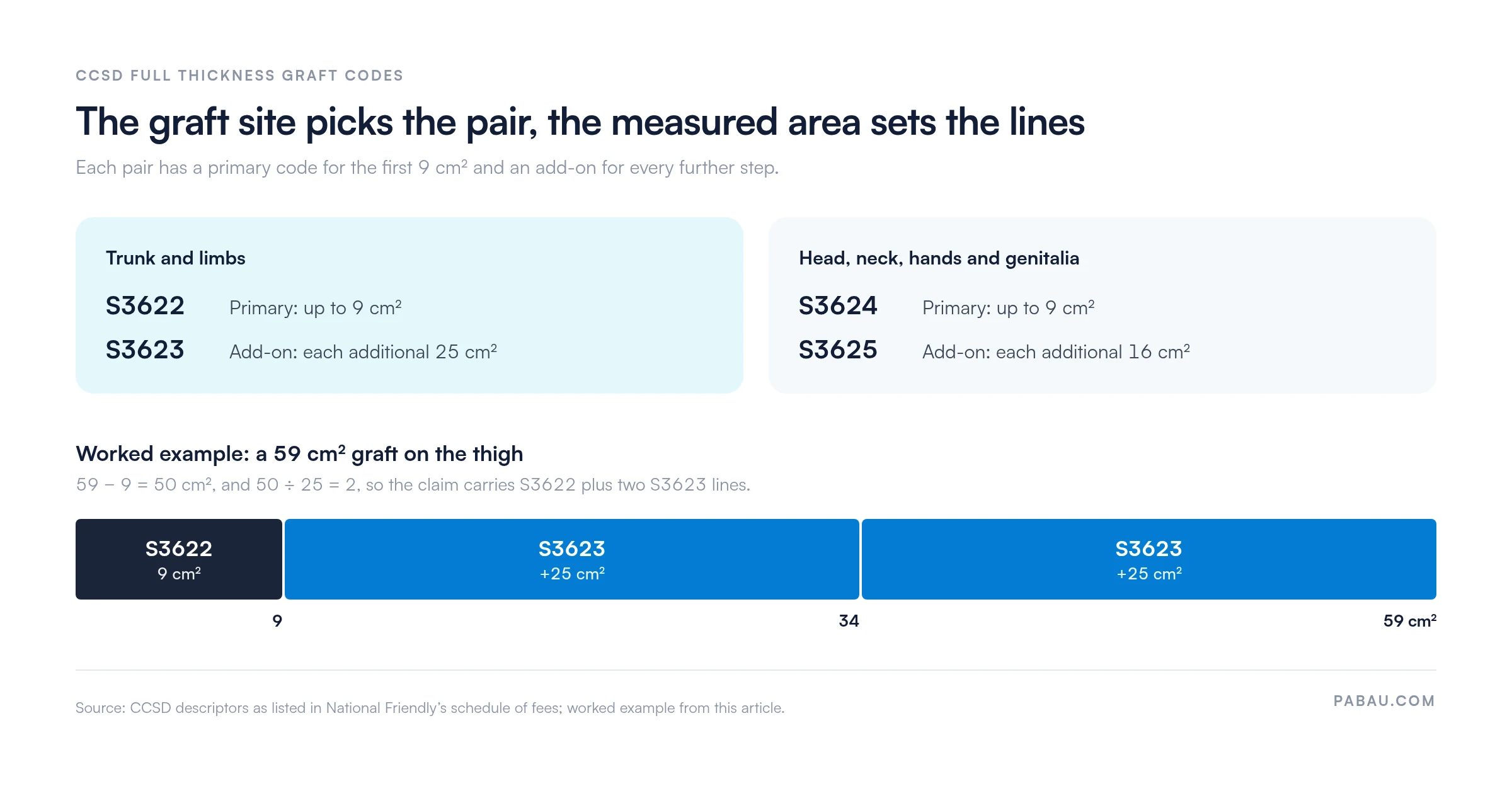
S3623 is the CCSD code for full thickness graft, trunk and limbs – each additional 25 cm2 in area. It is an add-on to S3622, which covers the first 9 cm² of the same graft, so it is never billed on its own.
Each S3623 line stands for one further 25 cm² of measured graft. Grafts on the head, neck, hands or genitalia use S3624 and S3625 instead. UK private medical insurers set their own fee and pre-authorisation rules for the code.
Let Pabau's smart automation suggest the right codes, reduce claim denials, and keep your practice compliant—effortlessly.
Automate repetitive tasks and focus on what matters most—your patients.
Reduce coding errors and ensure compliance with the latest regulations.
Clean claims, fewer denials, and faster reimbursements.
Powerful insights and reporting to help your practice thrive.
HIPAA compliant SOC 2 certified GDPR-compliant Trusted by 4,000+ clinics worldwide

S3623 is the CCSD add-on code for each additional 25 cm² of full thickness graft on the trunk and limbs.
It is billed with primary code S3622, which covers the first 9 cm². S3621 is not in the CCSD schedule, and S3620 has been inactive since January 2006.
Grafts on the head, neck, hands or genitalia use S3624 and S3625, so the recipient site decides the code pair.
UK private medical insurers such as Bupa, AXA Health, Aviva and Vitality set their own fees and pre-authorisation rules against the code.
The operative note must record the measured graft area, because insurers check the number of S3623 lines against it.
CCSD code S3623 is the UK private-sector code for a full thickness graft on the trunk and limbs, each additional 25 cm² in area. It is an add-on to S3622, which covers the first 9 cm². Insurer schedules such as National Friendly’s schedule of fees list the two codes side by side.
CCSD stands for Clinical Coding and Schedule Development. The CCSD Group, formed by Aviva, AXA Health, Bupa and VitalityHealth, maintains the schedule that UK private medical insurers use. S3623 sits in chapter 15.4.2, Free skin grafts, and our CCSD code library indexes the rest of the schedule.
Three features set S3623 apart from other skin graft codes:
A full thickness skin graft (FTSG) transfers the epidermis and the whole dermis from a donor site to a recipient wound bed. A split thickness graft takes only part of the dermis and leaves the donor site to re-epithelialise. On the trunk and limbs, a split thickness graft of up to 25 cm² is coded CCSD code S3500.
Plastic surgeons choose an FTSG when the cosmetic result or durable cover matters most. A graft may close the wound left by re-excision of a malignant skin lesion, which has its own CCSD code, S0605.
The steps that matter for billing:
Record the graft dimensions measured in theatre, not an estimate written afterwards. Insurers compare the stated area with the number of S3623 lines claimed.
S3623 belongs to a small family of free skin graft codes in chapter 15.4.2. The recipient site picks the pair, and the graft area decides whether the add-on applies.
There is no S3621 in the CCSD schedule, so a claim that pairs S3623 with it will fail. For other codes, the Bupa CCSD codes guide explains how the schedule maps to Bupa’s requirements. Where a tissue expander prepared the site, S4930 covers its removal.
The graft type is a clinical decision, and the operative note must name it. Coding from the wrong family is a common cause of insurer queries.
If the note says “full thickness” and the claim carries a split thickness code, the insurer may reject or recover it. When the note is unclear, ask the surgeon before submitting.
S3622 covers the first 9 cm² of graft on the trunk or limbs. Each further 25 cm² adds one S3623 line.
Worked example: a 59 cm² graft on the thigh.
Laid out as a bar, the 59 cm² graft splits into one S3622 unit and two S3623 units. The head and neck pair counts in smaller steps of 16 cm².
The descriptor does not say how a remainder smaller than 25 cm² is treated. The CCSD technical guide notes that each insurer has its own contractual rules on multiple codes, so ask the insurer before claiming a part unit.
Write the graft as length × width for each piece, then the total in cm². An insurer reviewer can then check the S3623 count in seconds.
CCSD sets the codes, and each insurer sets its own fee schedule against them. National Friendly’s schedule of fees rates S3622 as Intermediate at £410 and S3623 as Minor at £303.
Bupa, AXA Health, Aviva and Vitality publish their own schedules, so check each one before quoting a patient. Consultants can look up Bupa’s figures through the Bupa code search.
A specialist who charges more than the insurer pays leaves the patient with a shortfall. Explain it in writing before the procedure. When comparing UK medical billing software, check that it holds each insurer’s schedule against the code.
Most UK private medical insurers expect pre-authorisation before a skin graft. Requirements differ between insurers, policies and settings, so confirm them for each patient before booking theatre.
When you request authorisation, have the following ready:
The final graft area can exceed the planned one. If it does, tell the insurer before invoicing, and quote the authorisation reference on the invoice.
S3623 claims depend on detail recorded in theatre. Digital clinical forms that prompt for graft dimensions at the point of care keep the measurement from going missing.
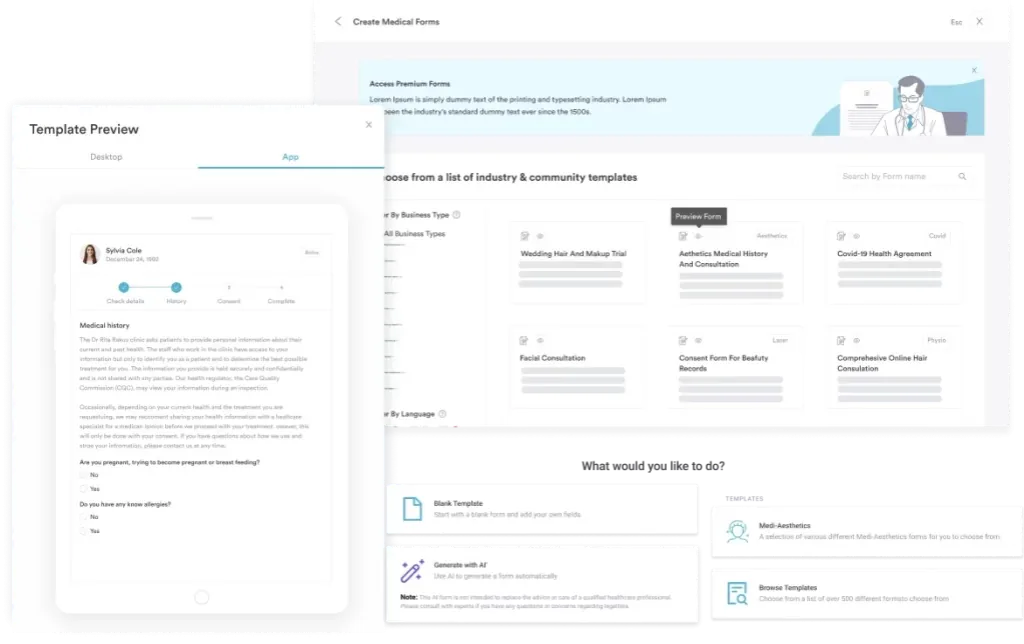
The documentation set for an S3623 claim:
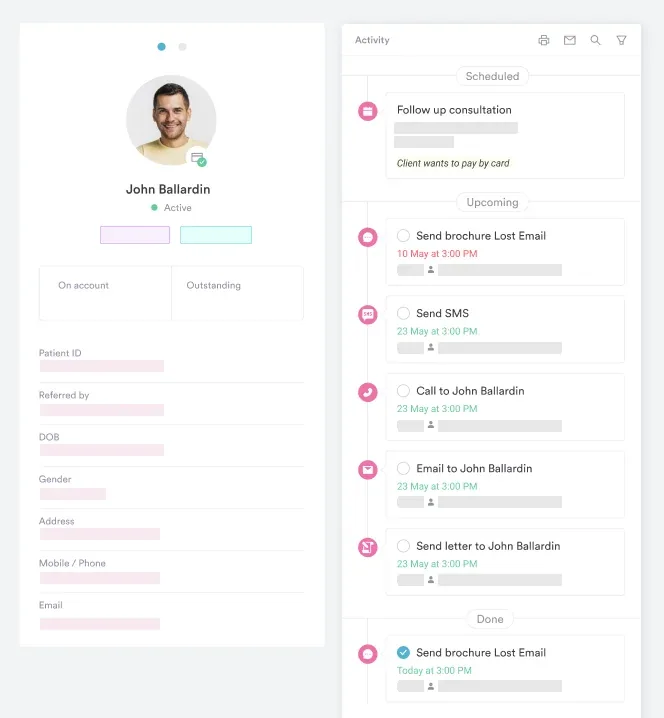
Structured patient records keep the operative note beside the claim, which makes an insurer query quick to answer.
The CCSD technical guide says no common intervention should routinely need more than one code. It also says insurers have different contractual rules on multiple codes. With that in mind:
UK insurers code diagnoses with WHO ICD-10, not the US ICD-10-CM. The diagnosis must describe a wound that needs a full thickness graft on the trunk or limbs.
Code the wound as it stands on the day of the graft. WHO ICD-10 has no seventh-character encounter extension, so none is added.
Before submitting, check that the diagnosis supports a full thickness graft. A superficial burn code next to S3623 is likely to prompt a query.
Plastic surgery practices billing S3623 need the measured graft area, the code pair and the authorisation reference on every claim. Pabau, the practice management platform we build, submits UK insurance claims through Healthcode and to Bupa.
With Pabau, your team can track each insurance claim from submission to payment. The operative note sits on the same patient record, ready if an insurer asks.
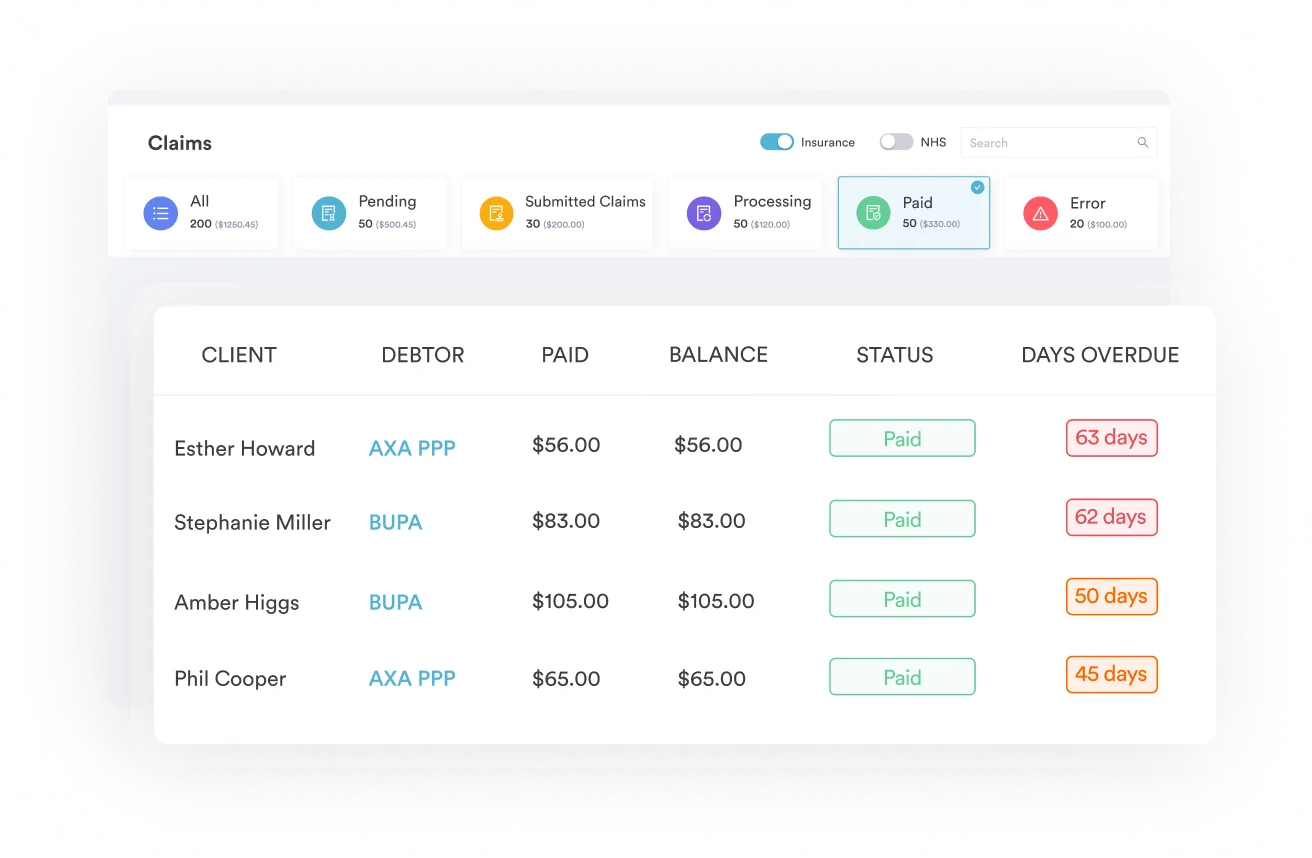

Pabau records graft measurements, authorisation references and ICD-10 codes at the point of care, then submits CCSD-coded claims through Healthcode.

S3623 pays for graft area, so the measurement in the operative note carries the claim. Get the 9 cm² baseline right, and the line count follows from simple arithmetic.
Before each invoice goes out, confirm S3622 is on it, the site is the trunk or a limb, and the insurer has authorised the procedure. Then check that insurer’s own fee, since schedules differ.
Book a demo to see how Pabau keeps graft notes and CCSD claims together for UK private practices.

Closing the defect with a flap instead? CCSD code S1700 covers the delay, division and inset stages of a distant flap, which you never bill with S3623 on the same site.
Preparing the wound bed before grafting? CCSD code S4183 explains debridement and primary suture of deeper tissue on the trunk and limbs, and the code to use when a graft covers the defect.
Treating a burn before it is ready to graft? CCSD code S5532 covers dressing a burn under 2% of body surface area, and when a burn needs referral for excision and grafting.
Grafting skin to the eyelid? CCSD code C1420 explains the eyelid graft code, with UK insurer fees and the codes that already include a graft.
CCSD code S3623 is the UK private-sector code for a full thickness graft on the trunk and limbs, for each additional 25 cm² in area. It is an add-on to S3622, which covers the first 9 cm².
Yes. S3623 is billed with S3622, “Full thickness graft, trunk and limbs – up to 9 cm² in area”. S3621 does not exist in the CCSD schedule, and S3620 has been inactive since January 2006.
Subtract the 9 cm² covered by S3622 from the measured graft area, then divide by 25. A 59 cm² graft gives S3622 plus two S3623 lines. Ask the insurer how it treats a remainder under 25 cm².
S3623 covers the trunk and limbs. Full thickness grafts on the head, neck, hands or genitalia use S3624 for the first 9 cm² and S3625 for each additional 16 cm².
Most UK private medical insurers, including Bupa, AXA Health, Aviva and Vitality, expect pre-authorisation before a skin graft. Requirements vary by insurer and policy, so confirm them for each patient and quote the reference on the invoice.
Not for the same recipient site, because a defect is closed by either a graft or a flap. Separate defects closed in one session may each carry their own codes, subject to the insurer’s rules.