CPT Code 19361: Latissimus dorsi flap breast reconstruction
CPT code 19361: Official descriptor and payment basics CPT code 19361 is the Cat...

Last Updated: Nov 18, 2026
S0605 is the CCSD code for secondary excision of malignant lesion - Trunk & Limbs. It covers a return operation at the site of a skin cancer on the trunk, arms or legs. The usual aim is a wider margin once histology from the first excision is back.
The code sits in CCSD chapter 15, Lesions of Skin. The first excision of the same lesion is coded S0603, and CCSD lists S0633 and S0643 as unacceptable combinations with S0605.
Let Pabau's smart automation suggest the right codes, reduce claim denials, and keep your practice compliant—effortlessly.
Automate repetitive tasks and focus on what matters most—your patients.
Reduce coding errors and ensure compliance with the latest regulations.
Clean claims, fewer denials, and faster reimbursements.
Powerful insights and reporting to help your practice thrive.
HIPAA compliant SOC 2 certified GDPR-compliant Trusted by 4,000+ clinics worldwide

CCSD code S0605 covers the secondary excision of a malignant skin lesion on the trunk or limbs, in chapter 15 of the CCSD Schedule.
The first excision of the same lesion is billed as S0603, and a re-excision on the head or neck uses S0604.
CCSD lists S0633 and S0643 as unacceptable combinations with S0605, so keep them off the same claim.
Keep the histology report from the first excision with the claim, because it is what justifies the second operation.
Pre-authorization rules vary by insurer and policy, so confirm cover for the re-excision itself before the patient is booked.
CCSD code S0605 is the UK private-insurance procedure code for the secondary excision of a malignant lesion on the trunk and limbs. It belongs to the CCSD Schedule, which the CCSD Group of insurers publishes as the standard procedure codes for UK private healthcare. Within that schedule, S0605 sits in chapter 15, Lesions of Skin.
“Secondary” means the surgeon is going back to a site that has already been excised. The usual reason is the histology from the first excision, which confirms a cancer or shows the margins weren’t clear. The first excision of that lesion is coded S0603, so S0605 only ever describes the return visit.
CCSD codes are used only in UK private billing. NHS trusts code with OPCS-4 and ICD-10, and US practices bill skin excisions under CPT, so none of those systems takes S0605. Our CCSD procedure codes library lists the rest of the schedule.
S0605 is a clinical procedure, not an aesthetic one. It pays for surgery at the site of a confirmed skin cancer on the trunk, arms or legs, after a first excision. The scope question is almost always about stage and site, so check both before you pick the code. A defect too large to close directly may need a split skin graft, coded S3500 on the trunk or limbs up to 25 cm². Where the surgeon uses a full thickness graft instead, S3622 covers the first 9 cm², and S3623 adds each further 25 cm².
When in doubt about scope, check the insurer’s own code list. Bupa’s code search tool lists its accepted procedure codes and guidance, and the other major insurers publish similar resources.
For S0605 the insurer is paying for a second operation on the same lesion. The record has to show why the first one wasn’t enough. Five documents do that job.
CQC standards require clinical records to be accurate, complete and stored securely. Keeping these documents in the patient record, rather than a separate billing file, means the version an insurer audits matches the one the surgeon wrote.
Audit your re-excision claims once a quarter. Pull five recent S0605 claims and check each one for the first excision’s histology report and signed consent. Then look for the operative note, any required referral and the pre-auth number. A missing document you find yourself costs a phone call, while one the insurer finds costs the whole claim.
CCSD splits malignant lesion excision by two questions: first excision or re-excision, and head and neck or trunk and limbs.
The grid below answers both and flags the two codes S0605 can’t sit beside. Lesions destroyed by laser rather than excised sit outside this grid, under codes such as S0922.
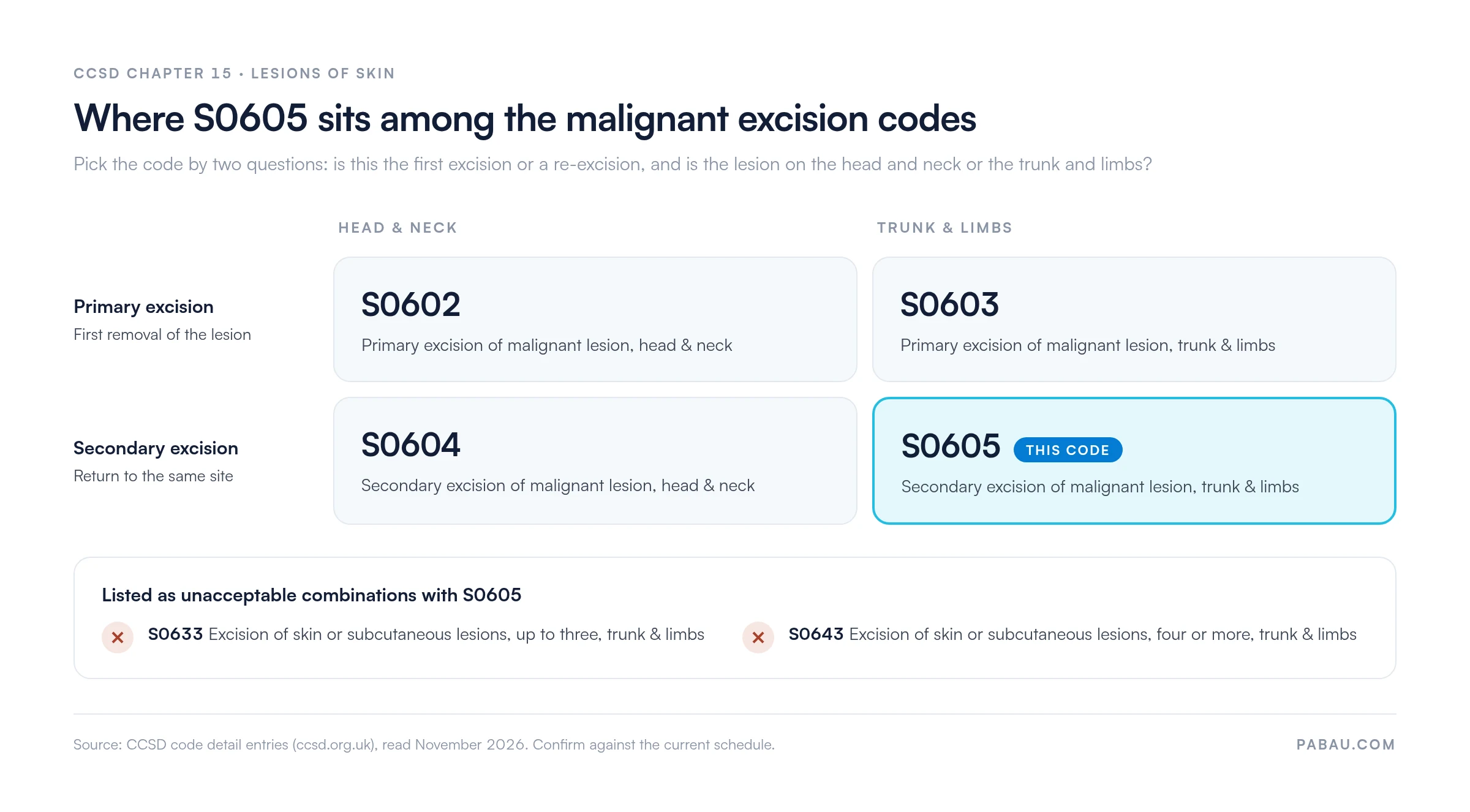
If the lesion is on the face or scalp, the head and neck pair applies, starting with S0602 for the first excision. Where the cancer is a melanoma, a sentinel lymph node biopsy carries its own code, S0608.
Not every skin cancer needs a second operation, either. Some superficial lesions are treated with photodynamic therapy, which is coded S0606 for up to three lesions.
Each UK private medical insurer publishes its own billing rules and pre-authorization process. The table sums up the major ones, but policies change, so check the current requirement with the insurer before treating. For Bupa specifically, our Bupa CCSD codes guide covers its fee schedule and submission rules.
One point catches practices out on re-excisions. An authorization for the first excision doesn’t automatically cover a second operation, so ask for a fresh one and quote the histology result.
Healthcode is the main electronic clearinghouse for UK private medical billing, and most practices send S0605 claims through it rather than on paper. A typical claim runs in six steps.
Denials on S0605 tend to come from a short list of causes. Most are preventable with the checklist above, and the table pairs each one with its fix.
Yes, alongside a consultation or an anesthetist’s fee, but not with S0633 or S0643, which CCSD lists as unacceptable combinations. The rules by code type:
The CCSD technical guide (updated October 2025) sets out the business rules for multiple codes on one claim. Read it before you bill any multi-procedure session under the CCSD Schedule.
Before you submit a multi-code claim, check each code against the insurer’s unbundling rules, which most insurers publish alongside their fee schedules. A rejected multi-code claim holds up payment for every procedure on that form, not just the queried code.
In many practices, the CCSD code gets picked at billing time, days after surgery. The histology report sits in an inbox and the pre-auth number lives on a booking note. Re-excision claims go wrong exactly there.
Pabau, the practice management platform we build, attaches the CCSD code to the service when the re-excision is booked. Its medical billing software stores the pre-auth number against the appointment. The operative note, consent and histology report sit on the same patient record.
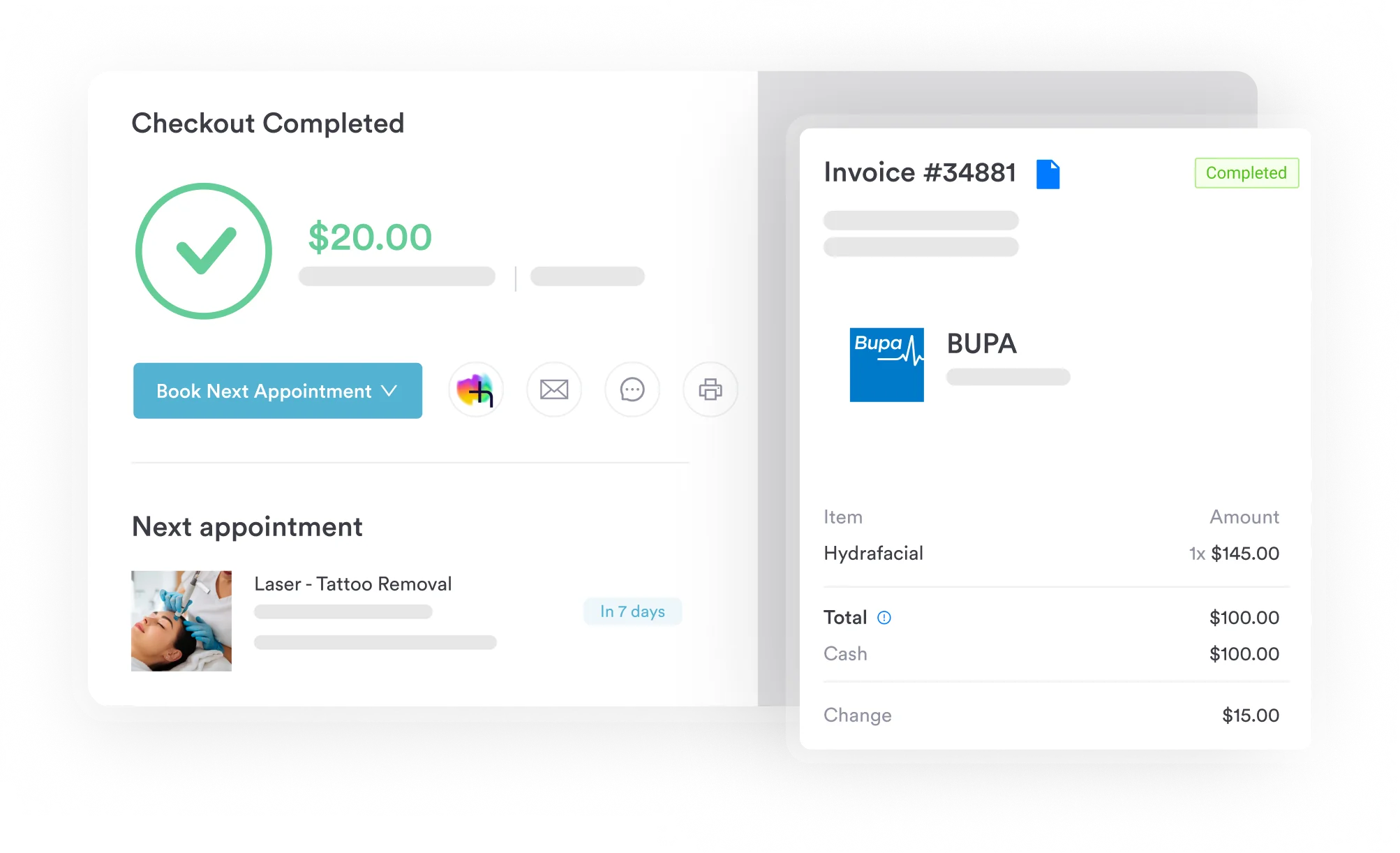
Claims then go to Healthcode from the patient record, with validation before submission and live status tracking afterward. Your team stops re-keying codes between systems, and a missing pre-auth number shows up before the claim leaves.

Pabau links CCSD codes, pre-auth numbers, histology and operative notes to one patient record, then submits the claim through Healthcode. Book a demo to see it with your own S0605 workflow.

S0605 is a narrow code, and that works in your favor. Confirm the stage and the site, attach the first histology report and get pre-auth for the second operation. Those steps prevent most denials before they start.
The trade-off is time at booking rather than time chasing queries later. A re-excision claim that leaves with its histology and authorization attached rarely comes back. Book a demo to see how Pabau keeps the code, the paperwork and the Healthcode claim for each re-excision in one place.

Billing Bupa for skin surgery? Bupa CCSD codes covers Bupa’s code requirements, fee schedules and submission rules for UK private practices.
Lesion on the face or scalp instead? CCSD code S0602 explains the primary excision code for malignant lesions on the head and neck.
Staging a melanoma after excision? CCSD code S0608 covers billing for sentinel lymph node biopsy.
Treating a superficial skin cancer without surgery? CCSD code S0606 covers photodynamic therapy for up to three malignant lesions.
CCSD code S0605 is the secondary excision of a malignant skin lesion on the trunk and limbs, in chapter 15 of the CCSD Schedule. UK private insurers use it for a return operation at the site of a skin cancer, after the first excision.
Bupa, AXA Health, Aviva, Vitality and Healix, the insurers in the payer table above, each publish code or fee resources for practitioners. Whether a patient is covered depends on their policy, so confirm cover and pre-authorization before the re-excision.
No. Mohs micrographic surgery has its own CCSD codes, such as S0521 for Mohs surgery without reconstruction. Use S0605 only for a standard surgical re-excision on the trunk or limbs.
No. S0605 is limited to malignant lesions. Other skin lesion excisions on the trunk and limbs use general codes. S0633 covers up to three lesions and S0643 covers four or more.
Not usually. S0605 describes a further excision for the malignancy itself. A later procedure to improve the scar’s appearance is a different procedure. Check the schedule for its code and the patient’s policy for cover.