CPT code 95808: Attended polysomnography billing guide
CPT code 95808 covers attended PSG with 1 to 3 extra channels CPT code 95808 is ...

Last Updated: Nov 11, 2026
S2503 is the CCSD code for a local flap of 9 cm² or more, including the graft or flap that closes the secondary defect. UK private insurers use the CCSD schedule to pay for consultant procedures.
The donor-site repair is part of S2503, so it is never billed as a separate graft code. S2502 covers the same flap when no graft or flap closes the secondary defect, and S2500 covers defects under 9 cm².
Let Pabau's smart automation suggest the right codes, reduce claim denials, and keep your practice compliant—effortlessly.
Automate repetitive tasks and focus on what matters most—your patients.
Reduce coding errors and ensure compliance with the latest regulations.
Clean claims, fewer denials, and faster reimbursements.
Powerful insights and reporting to help your practice thrive.
HIPAA compliant SOC 2 certified GDPR-compliant Trusted by 4,000+ clinics worldwide

CCSD Code S2503 covers a local flap of 9 cm² or more when a graft or flap closes the secondary defect in the same operation.
The 9 cm² line separates S2500 (less than 9 cm²) from S2502 and S2503, so measure and record the defect area before choosing a code.
S2502 and S2503 share the same size band, and only the graft or flap to the secondary defect decides between them.
The donor-site graft or flap is bundled within S2503, so never bill a separate graft code for it in the same operative episode.
In Pabau, our practice management platform, surgeons submit and track CCSD S2503 claims through Healthcode against the operative note on the same patient record.
CCSD Code S2503 is a surgical tariff code covering a local flap of 9 cm² or more, including graft or flap to the secondary defect. It is published by the Clinical Coding and Schedule Development Group. UK private insurers use its CCSD schedule to pay for consultant procedures. It sits in a three-code local flap series alongside S2500 and S2502.
The code applies when a surgeon raises a local flap to cover a defect of at least nine square centimetres. The donor site, or secondary defect, is then closed with a skin graft or a further flap in the same operation.
The term “local flap” distinguishes this procedure from free-flap or pedicled distant-flap reconstruction. The tissue used comes from immediately adjacent or nearby skin, maintaining its own blood supply through a pedicle. Our Bupa CCSD codes guide explains how UK private insurers apply the schedule across surgical specialties.
Local flap repair mobilises adjacent skin and subcutaneous tissue to cover a wound. It is used when direct suturing alone cannot close the defect. The sequence behind CCSD Code S2503 stays the same whatever flap design the surgeon uses.
Rotation flaps for scalp and trunk defects often reach the 9 cm² threshold. So do transposition flaps around the nose and eye, and advancement flaps on the forehead and limbs. The flap design determines the size of the secondary defect and therefore the complexity of the graft component.
The 9 cm² line separates S2500, the local flap code for defects under 9 cm², from S2502 and S2503. It does not separate S2502 from S2503, because both start at 9 cm². Measure correctly and record the result in the operative note, or the claim has no factual basis for the code selected.
Standard practice multiplies the greatest length by the greatest perpendicular width of the defect. Measure it during surgery, after excision margins are confirmed. For a rectangular or elliptical defect this gives a reliable cm² figure. For irregular wound shapes, planimetry (tracing the wound outline and calculating the enclosed area) gives a more accurate result.
Documentation tip: Record the exact cm² figure in the operative note, with the method used (length × width or planimetry). Add the timing too, which is post-excision and before flap inset. Payers reviewing a borderline claim will look for this precision.
The descriptor for CCSD Code S2503 explicitly states “including graft/flap to secondary defect.” That phrase is the only difference between S2503 and S2502, whose descriptor reads “excluding graft/flap to secondary defect.”
The phrase also bundles the management of the donor-site wound within the single tariff item. So the skin graft that closes the secondary defect is not billed separately under a graft code in the same operative episode.
The bundling applies to both split-thickness and full-thickness graft closure of the secondary site. Where a further local flap (rather than a graft) is used to close the secondary defect, this is similarly included. The practical test is simple. If the secondary-defect repair follows directly from raising the primary flap under the same anaesthetic, it is bundled.
Individual payer clinical policies may contain nuances. Confirm the insurer’s bundling rules before billing a graft code alongside S2503. Billing both without that confirmation is a common unbundling trigger.
S2503 belongs to a three-code local flap series, but it is not a higher size tier. Two separate questions pick the code. Defect size decides between S2500 and the 9 cm² pair. The secondary defect decides between S2502 and S2503, as the flow below shows.
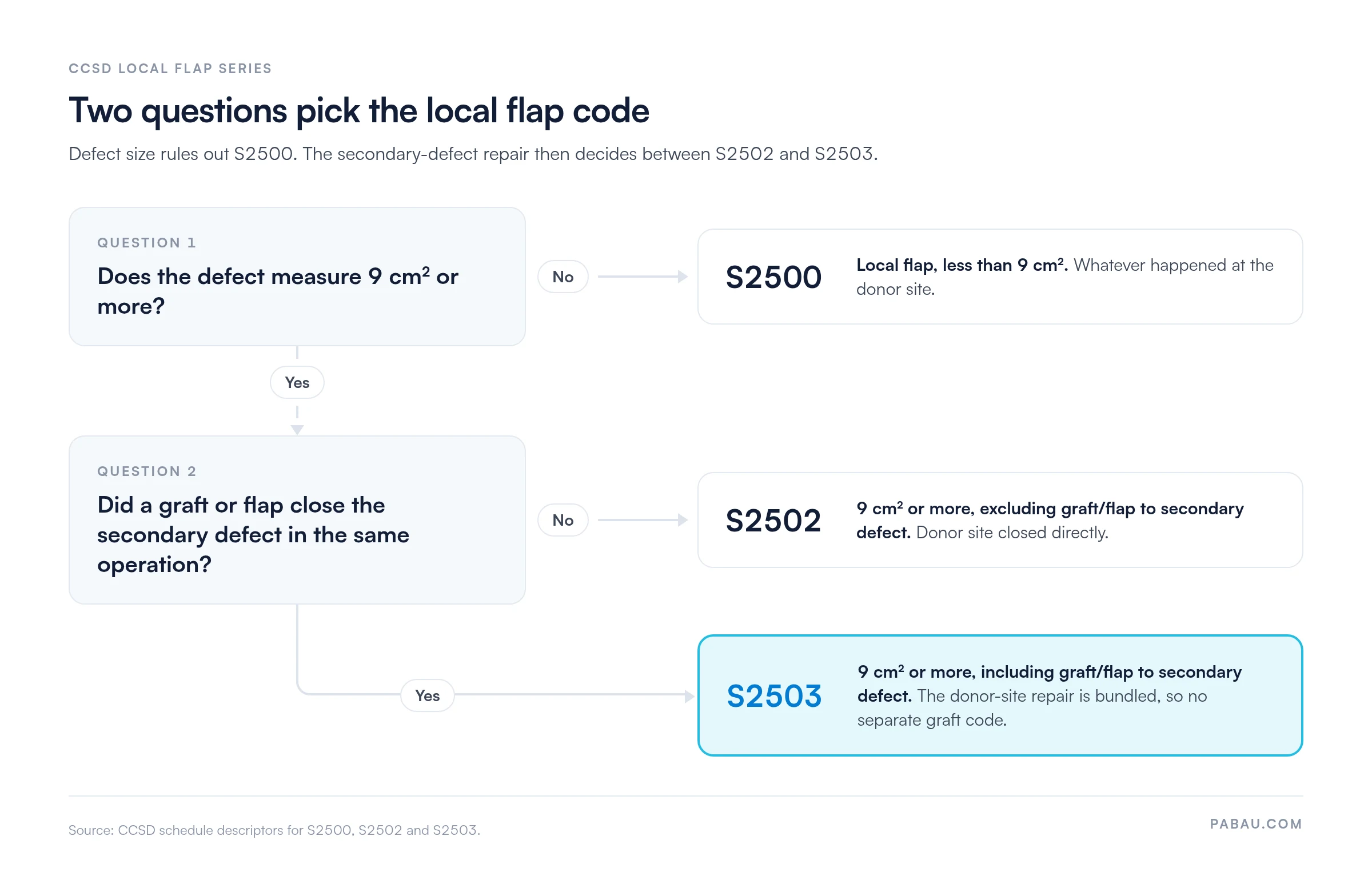
Important: S2503 is not a bigger flap than S2502. Both cover defects of 9 cm² or more, so a larger defect never moves a claim from S2502 to S2503. Confirm the current descriptors in the official CCSD schedule before billing.
Once the defect reaches 9 cm², the code choice turns on one fact in the operative note. Ask what happened to the donor site after the flap was raised.
Name the secondary-defect closure in the operative note, with the graft type or flap design. An insurer auditing S2503 looks for that sentence first, because it is the only thing S2503 adds to S2502.
Pedicled distant flaps and free flaps fall outside the local flap series. A distant flap moves tissue from a remote donor site on a vascular pedicle, and a free flap needs microvascular anastomosis. Both are coded elsewhere in the CCSD schedule, not under S2503. Find those codes in our CCSD code reference.
CCSD S2503 appears across several surgical specialties wherever a skin defect exceeds 9 cm² and primary closure is not possible. Plastic surgeons and dermatological surgeons bill it most often, and ENT and general surgeons use it too.
Every one of these scenarios shares two conditions. The defect is too large for direct suture or a simple graft alone. Adjacent tissue is also available for a local flap without harming function or appearance at the donor site.
Before selecting S2503, confirm the flap type and defect size match the operative note. Rotation flaps on the scalp frequently reach 9 cm² or more. Transposition flaps on the nose often do not. If the defect area sits at 8.8 cm² by planimetry, do not upcode to S2503. Bill S2500 and document the measurement method clearly.
A complete operative note is the foundation of an S2503 claim. UK private insurers audit this code regularly, and a vague or incomplete note is the most reliable predictor of denial. The claim needs each of the following elements.
Digital operative documentation that prompts for each field reduces the risk of missing entries that insurers flag at adjudication. Where a practice uses dictation or a templated note, build the measurement fields into the template so they cannot be skipped.
Pre-authorisation requirements for S2503 vary by insurer, plan type, and clinical urgency. The guidance below reflects general UK private-insurer practice. Check the insurer’s current clinical policy before the procedure.
Record the authorisation number against the patient before surgery, so it goes on the claim at submission. A claim without it risks an administrative denial.
CCSD S2503 claims are denied for a predictable set of reasons. Most are preventable at the documentation stage rather than at appeal, and the table below pairs each one with its fix.
Two billing errors in CCSD S2503 claims carry compliance risk beyond a simple denial. Unbundling and upcoding can both trigger audits by UK private insurers, particularly where a practice bills this code regularly.
Unbundling: Billing the graft or secondary flap that closed the donor site as a separate line item, even though the S2503 descriptor includes it. It often happens when billing staff miss the descriptor’s bundling language.
The claim then recovers a higher fee than the procedure warrants, and it leaves an audit trail. Insurers’ claim systems may flag a graft code billed alongside S2503 on the same claim.
Upcoding: Selecting S2503 when the documented defect fell below 9 cm² because the surgeon considered it “close enough.” Close is not billable. A defect of 8.8 cm² is S2500, with the actual measurement documented.
Upcoding also happens at 9 cm² and above, when S2503 is billed but no graft or flap closed the donor site. That procedure is S2502. Insurers cross-reference the operative note against the code during clinical audits, and repeated upcoding is a recoverable overpayment pattern.
Co-billing an excision code: Where the defect follows a skin lesion excision, some practices bill an excision code and S2503 on the same claim. Whether this is permitted depends on the specific payer’s bundling rules and whether the excision was a staged or separate procedure. Confirm the payer’s clinical policy before billing both codes together.
The ICD-10 diagnosis code paired with S2503 must reflect the clinical indication for the flap repair. A billing system that asks for an ICD-10 code when the claim is created reduces the risk of a mismatch. The table below shows the most frequently paired diagnoses.
Use the most specific ICD-10 sub-code available rather than a category-level code. For example, C44.4 (malignant neoplasm of skin of scalp and neck) is preferable to C44 alone. Insurers that apply medical necessity checks match the site in the ICD-10 code against the site stated in the operative note.
Vitality, AXA Health, and similar UK insurers use real-time code-matching tools to check ICD-10 pairings at adjudication. Use the site-specific sub-code rather than the parent category. Then confirm the operative note describes the anatomical site in the same body-region terms as the ICD-10 code. Mismatches at the site level are a common secondary denial reason when the procedure code itself is correct.
Most S2503 denials start in the operative note, long before the claim reaches the insurer. A missing cm² figure or an unrecorded donor-site graft turns a valid claim into a query. Pabau keeps the operative note, the pre-authorisation reference and the claim on one patient record.
Pabau’s digital forms can carry fields for the defect area, the measurement method and the secondary-defect closure. Your team then sends the claim through Healthcode with Pabau’s claims software for surgeons. Any insurer query is tracked against the same record, instead of in paper notes.

Pabau keeps the operative note, the pre-authorisation reference and the CCSD claim on one patient record. Your team submits through Healthcode with the facts an insurer checks already recorded.

S2503 is a two-question code. The defect has to measure 9 cm² or more, which rules out S2500. A graft or flap has to close the secondary defect in the same operation, which rules out S2502. Answer both in the operative note, and the code choice defends itself at audit.
Bill the donor-site repair inside S2503, never beside it, and the most common unbundling query disappears. Book a demo to see how Pabau keeps the note, the pre-authorisation and the claim together.

Need a broader CCSD billing reference for Bupa procedures? Pabau’s Bupa CCSD codes guide covers the structure of the CCSD tariff and how UK private insurers apply it across surgical specialties.
Repairing a wound by direct closure instead of a flap? CCSD code S4213 covers debridement and primary suture of a skin wound on the trunk and limbs.
Excising a benign lesion below the skin? CCSD code S0653 covers removal of a benign lesion in muscle or deeper tissue, excluding lipoma.
CCSD Code S2503 is the tariff item for a local flap of 9 cm² or more. It includes the graft or further flap that closes the donor-site secondary defect. That bundled secondary-defect repair is what separates it from S2502. Plastic surgeons, dermatologists, and ENT surgeons use it when billing UK private insurers.
The defect area is calculated as length multiplied by width at the greatest perpendicular points, measured post-excision before flap inset. For irregular wounds, planimetry (tracing the defect outline and calculating the enclosed area) is the preferred method. The exact figure in cm², the measurement method used, and the timing must all appear in the operative note.
Yes. The descriptor explicitly states “including graft/flap to secondary defect,” which bundles the donor-site closure within the S2503 tariff item. Billing a separate graft code for the secondary defect management during the same operative episode constitutes unbundling and is a common denial trigger. A graft to a separate anatomical site, unrelated to the primary flap, may be an exception. Confirm it against the insurer’s clinical policy.
This depends on the specific payer’s bundling rules and the operative context. Where the excision happens in the same operative episode, some payers bundle it within the flap code. Others permit separate billing when the two procedures are clearly distinct. Check the scheme’s current clinical policy before billing both codes on the same claim, as unbundling a bundled excision is an audit risk.