HCPCS Code Q4185: Cellesta flowable amnion billing guide
HCPCS Code Q4185: definition and official descriptor HCPCS Code Q4185 is the Lev...

Last Updated: Nov 20, 2026
P0320 is the CCSD code for marsupialisation of Bartholin cyst. The surgeon opens and drains the cyst, then sutures its wall to the surrounding skin, so it keeps draining instead of sealing over. UK private medical insurers such as Bupa, AXA Health, Aviva and Vitality use the code to identify the procedure on a claim.
Bupa bands P0320 at complexity INTER 2 with a fee of £286, the same as P0310, excision of Bartholin gland. The operative note decides between them, so bill P0320 only when it records the cyst wall sutured open.
Let Pabau's smart automation suggest the right codes, reduce claim denials, and keep your practice compliant—effortlessly.
Automate repetitive tasks and focus on what matters most—your patients.
Reduce coding errors and ensure compliance with the latest regulations.
Clean claims, fewer denials, and faster reimbursements.
Powerful insights and reporting to help your practice thrive.
HIPAA compliant SOC 2 certified GDPR-compliant Trusted by 4,000+ clinics worldwide

CCSD code P0320 is marsupialisation of Bartholin cyst, a UK private-sector code in the Vulva / Labia section of the CCSD schedule.
Bupa lists P0320 at complexity INTER 2 with a fee of £286, the same banding as P0310, excision of Bartholin gland.
Bill P0320 only when the operative note describes the cyst wall sutured open. Simple drainage or a balloon catheter is a different procedure.
Pair P0320 with ICD-10 N75.0 for a Bartholin cyst or N75.1 for a Bartholin abscess, matched to the operative findings.
Most denials trace back to a missing pre-authorisation, the wrong Bartholin code or an operative note that does not confirm the technique.
CCSD code P0320 is the UK private-sector code for marsupialisation of Bartholin cyst. It comes from the CCSD schedule, the standard set of procedure codes for UK private healthcare. The schedule places it in Chapter 14, Female reproductive organs, within the Vulva / Labia section.
The Clinical Coding and Schedule Development (CCSD) Group maintains the schedule. UK private medical insurers, including Bupa, AXA Health, Aviva and Vitality, use it to identify the procedure on a claim.
Each insurer sets its own fees. Bupa bands P0320 at complexity INTER 2 and lists a fee of £286 in its February 2026 CCSD schedule. Check the figure in Bupa’s code search before you quote it, because insurers update their schedules.
Neighbouring Chapter 14 codes, from vulval biopsy to vulvectomy, are listed in our full CCSD code library.
The surgeon opens the cyst and stitches its lining to the surrounding skin. That leaves a permanent pouch that keeps draining instead of sealing over.
Billing staff should read the operative note against these steps before a P0320 claim goes out. Each one should appear in the note.
Step four is the billing test. If the cyst wall was not sutured open, the operation was a drainage procedure rather than marsupialisation, and P0320 is the wrong code.
Many Bartholin cysts settle without surgery. The NHS guidance on Bartholin’s cyst says surgery to drain the cyst may be needed when antibiotics fail or the cyst keeps coming back.
Insurers review the clinical reasons on the pre-authorisation request. These are the indications they typically expect the notes to show, not a fixed list any insurer publishes:
Policy terms decide cover, so check them with the insurer before booking. A small, first-presentation cyst with thin notes is the case most likely to draw a query.
UK insurers expect an ICD-10 diagnosis code alongside the CCSD procedure code. The most common error is coding a cyst as an abscess, or the reverse.
N75.0 fits most P0320 claims. Use N75.1 only when the operative note confirms infection or pus. Where the note supports neither, N75.9 is the fallback, and it draws more queries. A diagnosis code that contradicts the operative findings is one of the first details an adjudicator flags.
Two CCSD codes cover surgery on the Bartholin gland, and they describe different operations. Bupa bands both at INTER 2 with the same £286 fee, so the code must follow the note, not the fee.
Simple incision and drainage of a Bartholin cyst is a different treatment, and so is Word catheter insertion. Do not bill P0320 for either one. Bupa lists only the generic code 25000, incision and drainage (not elsewhere covered), and no Bartholin-specific or Word catheter code. Confirm with the insurer.
Agree the code before the claim goes out whenever a consultant performs one of them in your practice. Never assign P0320 on clinical intent alone. The decision below runs from the operative note to the code.
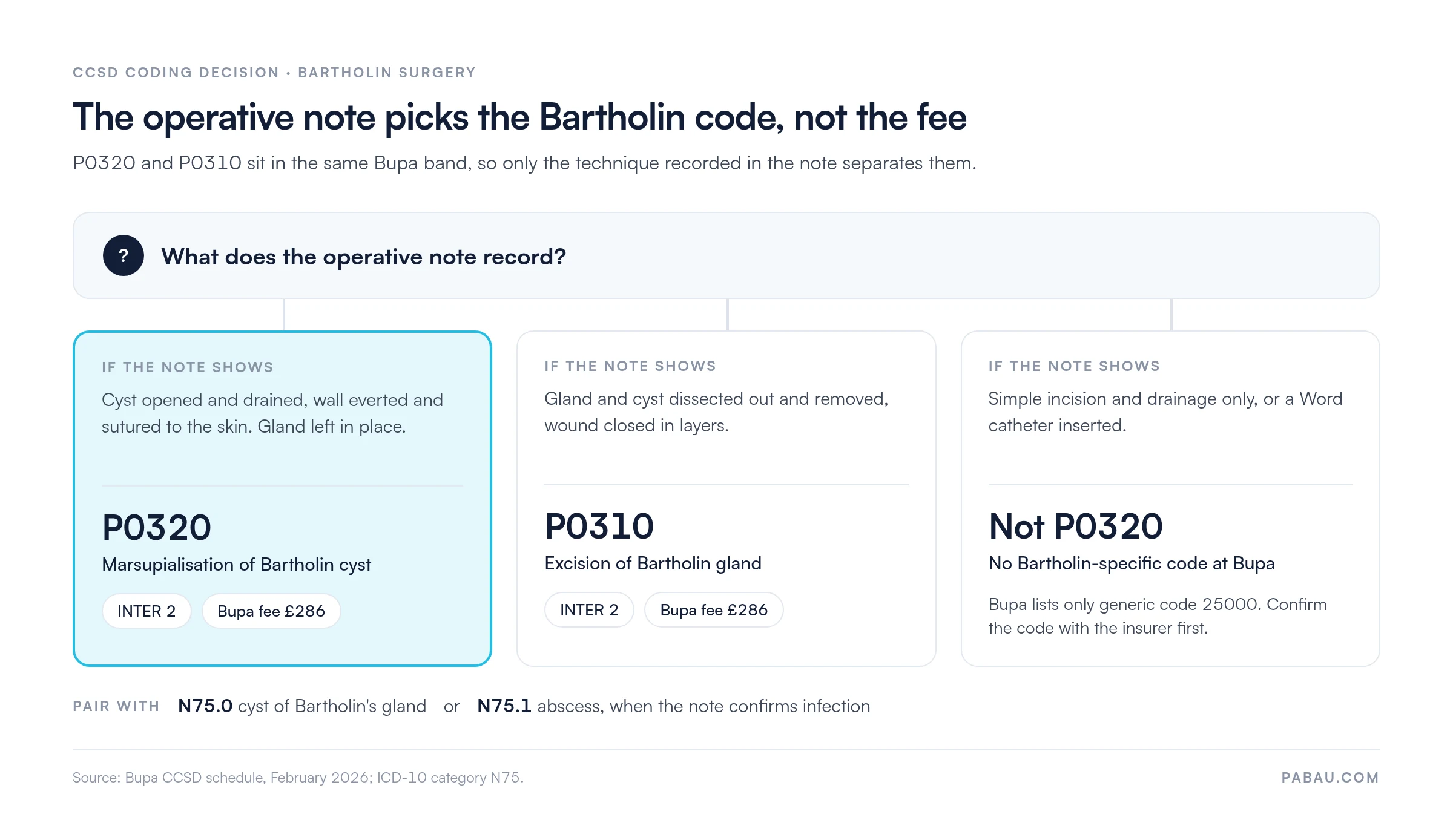
Before a Bartholin claim leaves the practice, ask one question of the operative note: was the cyst wall sutured open, or was the gland removed? Sutured open is P0320. Removed is P0310. Anything else needs a check with the insurer before you choose a code.
The major UK private medical insurers work from the CCSD schedule. Whether they pay P0320 for a given patient depends on the member’s policy, its exclusions and any benefit limits.
Use the payer’s own lookup before you book the theatre date. For Bupa members, our Bupa CCSD codes guide covers its accepted codes and submission requirements.
Pre-authorisation is a conditional approval, not a promise of payment. An insurer can authorise P0320 and still decline the claim if the notes do not match what it approved.
When you request it, the insurer will typically ask for these details:
If the date moves, or the plan changes to excision, update the authorisation before surgery. Retrospective approval depends entirely on each insurer’s rules, so do not plan around one.
Most UK private practitioners submit CCSD-coded claims electronically through Healthcode, the clearing service the major insurers use. A clean P0320 claim takes this route:
Confirm every item below before a P0320 claim leaves the practice. CQC-registered providers must also keep accurate, complete records for each patient, which this checklist supports.
Pabau, a practice management platform, captures consent and clinical history at the point of care through its digital forms. The billing team then works from a complete record instead of chasing paper files.
P0320 denials repeat the same few patterns. Match the rejection to a reason below to see what to fix before you resubmit.
Review open P0320 claims once a week. Chase any claim older than 14 days that has neither payment nor a query. Early follow-up recovers revenue that would otherwise drift towards write-off.
A P0320 claim depends on the operative note, the consent form and the authorisation reference agreeing with each other. Pabau keeps all three on one patient record.
Pabau’s claims management software submits CCSD-coded claims through Healthcode and to Bupa. It then tracks each claim from submission to payment, so stalled claims surface early.
In Pabau, each detail of a gynaecology procedure gets its own structured field in the patient record. An insurer audit then becomes a quick retrieval rather than a search through scanned notes.
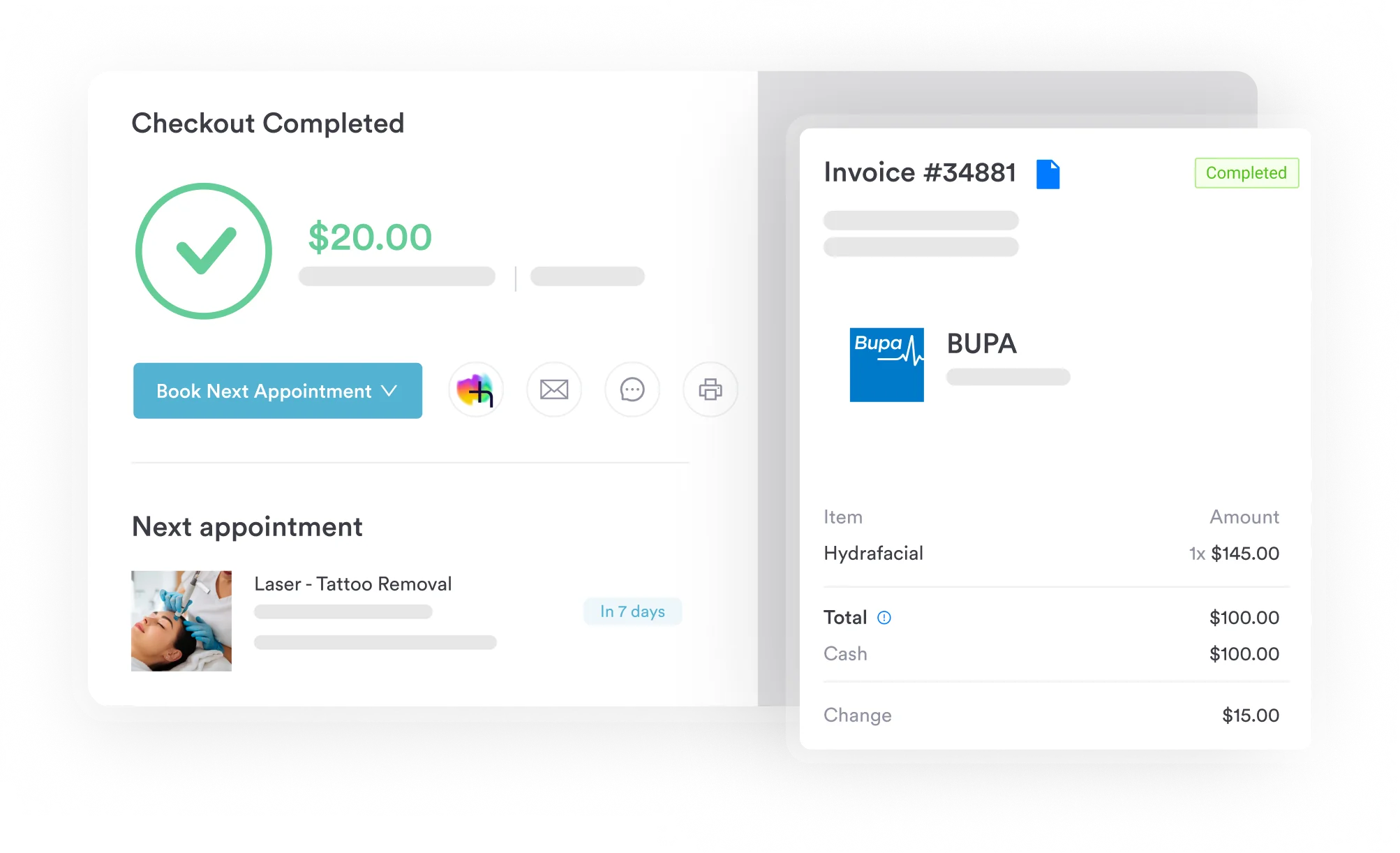

Pabau keeps the operative note, consent and pre-authorisation reference on one record, submits CCSD-coded claims through Healthcode and tracks each one to payment.

P0320 is simple to assign once the operative note is clear. Claims go wrong at the neighbouring code. P0310 carries the same Bupa banding and fee, so only the note separates them.
Get the authorisation, the diagnosis code and the description of the sutured cyst wall to agree, and the claim has little left to query. Book a demo to see how Pabau keeps P0320 claims complete from consultation to payment.

Looking for insurer-specific CCSD fee guidance? Bupa CCSD codes and procedure billing explains how Bupa applies CCSD codes, complexity bands and submission rules across specialties.
Coding a Bartholin case the notes leave unclear? ICD-10 code N75.9 covers the unspecified Bartholin gland code and why insurers query it.
Billing another Chapter 14 procedure? CCSD code P1400 walks through incision of the introitus of the vagina, from coding to claim.
Choosing software for UK insurer billing? Best medical billing software in the UK compares the platforms UK private practices use to submit and track insurer claims.
CCSD Code P0320 covers marsupialisation of a Bartholin cyst. The surgeon opens the cyst and sutures its wall to the surrounding skin so it keeps draining. It does not cover excision of the Bartholin gland, which is P0310, or simple drainage.
Submit N75.0, cyst of Bartholin’s gland, for a non-infected cyst. Submit N75.1, abscess of Bartholin’s gland, when the operative note confirms infection. The diagnosis code must match the operative findings, because a mismatch is a common reason for an insurer query.
P0320 is marsupialisation, where the cyst is opened and sutured open while the gland stays in place. P0310 is excision of the Bartholin gland, where the gland is removed. Bupa bands both at INTER 2 with a £286 fee, so the operative note decides the code.
Usually, yes. UK private medical insurers such as Bupa, AXA Health, Aviva and Vitality generally expect pre-authorisation before planned surgery. Rules vary by insurer and policy, so confirm with the insurer and record the authorisation reference before the procedure date.
Bupa lists P0320 at complexity INTER 2 with a fee of £286 in its CCSD schedule, February 2026 edition. Other insurers set their own fees, so check each one before quoting a patient. An anaesthetist, where involved, bills separately.