Pabau Engage inbox

Pabau Engage is here: every patient conversation in one inbox.

Learn more
Book a demo Book a demo
☰
CCSD Code

CCSD code Q0800 – Non-laparoscopic vaginal hysterectomy


Code Definition

Q0800 is the CCSD code for vaginal hysterectomy without laparoscopic assistance. It covers total removal of the uterus and cervix through the vaginal canal, with no abdominal incision and no laparoscope at any stage. Practices bill it to UK private insurers, usually through Healthcode.

Any laparoscopic step moves the case to a laparoscopic-assisted code, and a retained cervix moves it to a sub-total code. A salpingo-oophorectomy at the same sitting is coded as Q0890 instead.

Group
14 Female reproductive organs
Category
Uterus / Adnexa
Subcategory
Q08 Vaginal excision of uterus
Billable
No
Code also known as
vaginal uterine removal, VH, vaginal womb removal
Save time. Improve accuracy. Get paid faster.
Automate coding with Pabau

Let Pabau's smart automation suggest the right codes, reduce claim denials, and keep your practice compliant—effortlessly.

  • AI-powered code suggestions
  • Real-time compliance checks
  • Faster claims, fewer denials
Why practices choose Pabau
Save hours every week

Automate repetitive tasks and focus on what matters most—your patients.

Improve accuracy

Reduce coding errors and ensure compliance with the latest regulations.

Get paid faster

Clean claims, fewer denials, and faster reimbursements.

Grow with confidence

Powerful insights and reporting to help your practice thrive.

HIPAA compliant SOC 2 certified GDPR-compliant Trusted by 4,000+ clinics worldwide

Key takeaways

Key takeaways

CCSD code Q0800 covers vaginal hysterectomy with no laparoscopic assistance at any stage, which separates it from laparoscopic-assisted (LAVH) codes.

The operative note must state the vaginal approach and confirm that no laparoscopic ports were used.

A salpingo-oophorectomy at the same sitting moves the case to Q0890 instead of adding a second line to Q0800.

Most UK private insurers require pre-authorisation for elective vaginal hysterectomy. A claim without the reference number is declined.

Practice software such as Pabau tracks the pre-auth code and dates on the patient’s case and warns when one is missing. It also submits UK claims through Healthcode.

CCSD code Q0800: Definition and clinical scope

CCSD code Q0800 is the procedure code for vaginal hysterectomy performed without laparoscopic assistance. Surgeons remove the uterus entirely through the vaginal canal, with no abdominal incision and no laparoscopic ports. The code sits in the gynaecological Q-series of private practice CCSD codes, the schedule that the Clinical Coding and Schedule Development Group maintains.

The “without laparoscopic assistance” qualifier defines the code. As a result, any use of a laparoscope during the procedure, even for initial inspection or adhesiolysis, moves the case to a laparoscopic-assisted vaginal hysterectomy (LAVH) code. Therefore, coders confirm this from the operative note, not from the procedure request.

Code elementDetail
CodeQ0800
Official descriptorVaginal hysterectomy without laparoscopic assistance
Code seriesCCSD Q-series (gynaecological procedures)
SettingUK private healthcare (independent hospitals, day-case units)
Surgical approachVaginal only; no abdominal incisions, no laparoscopic ports
What is typically includedAnaesthesia, routine vaginal closure, standard post-operative care

Clinical overview: Vaginal hysterectomy without laparoscopic assistance

Surgeons perform vaginal hysterectomy without laparoscopic assistance for benign gynaecological conditions where the uterine size and pelvic anatomy allow a purely vaginal approach. Common indications include uterine prolapse, symptomatic fibroids, dysfunctional uterine bleeding unresponsive to medical management, and endometriosis where laparoscopic staging is not required.

The Royal College of Obstetricians and Gynaecologists (RCOG) regards the vaginal approach as the preferred route for hysterectomy when it is practical. It also cites lower morbidity and faster recovery than abdominal surgery. For that reason, coders should understand what the approach involves clinically, so they can interpret operative notes accurately.

  • Cervix: Removed with the uterine body in a total vaginal hysterectomy. Where the surgeon retains the cervix, a different code applies.
  • Laparoscopy: Not performed at any stage. No ports, no CO2 insufflation, no camera use. If a diagnostic laparoscopy preceded the vaginal procedure, that is a separate billable event.
  • Concurrent procedures: Surgeons may perform salpingectomy and prolapse repair at the same sitting. Before adding a line, check each one against the CCSD combination rules. A salpingo-oophorectomy changes the code to Q0890.
  • Uterine size: However, a significantly enlarged uterus may require laparoscopic assistance, which shifts the code category. The operative note is final.

What Q0800 includes and excludes

Understanding what Q0800 bundles, and what it does not, prevents both undercoding and overbundling errors.

Included in Q0800Must be billed separately
Anaesthesia management (surgeon element)Anaesthetist’s fee (the anaesthetist bills it separately)
Vaginal vault closureSalpingo-oophorectomy is not a second line. Code the whole case as Q0890 in place of Q0800.
Standard post-operative reviewAnterior or posterior colporrhaphy (prolapse repair)
Routine haemostasisDiagnostic laparoscopy if performed at the same sitting
Histopathology specimen preparationHistopathology reporting fee

Also check bundling rules against the current CCSD technical guide, because insurer-specific schedule variations may apply. Fees that each insurer agrees can alter what counts as included.

How CCSD code Q0800 differs from neighbouring hysterectomy codes

The surgical approach and the extent of uterine removal decide which hysterectomy code applies. A case that looks routine on the booking form can land on a different code once you read the operative note.

CCSD codeProcedureKey differentiator from Q0800
Q0800Vaginal hysterectomy without laparoscopic assistanceReference code: Vaginal approach, no laparoscopy at any stage
LAVH codeLaparoscopic-assisted vaginal hysterectomy (LAVH)Laparoscope used at any stage of the procedure
TAH codeTotal abdominal hysterectomy (TAH)Abdominal incision used; uterus removed through the abdomen
Sub-total codeSub-total (cervix-sparing) hysterectomyCervix retained; uterine body only removed
TLH codeTotal laparoscopic hysterectomy (TLH)Entire procedure completed laparoscopically including vault closure

Two neighbours have their own pages. For example, bill a cervix-sparing operation through an abdominal incision under Q0750 instead. Likewise, a hysterectomy for ovarian malignancy, with removal of the omentum and adnexa, has its own code, Q0880. Removal of the omentum alone, with no hysterectomy, is coded CCSD T3600.

The LAVH versus Q0800 distinction is where most disputes arise. If the surgeon begins laparoscopically to lyse adhesions and then completes the case vaginally, the procedure is an LAVH, not a Q0800. Three questions on the operative note settle the code, in the order the flow below sets out.
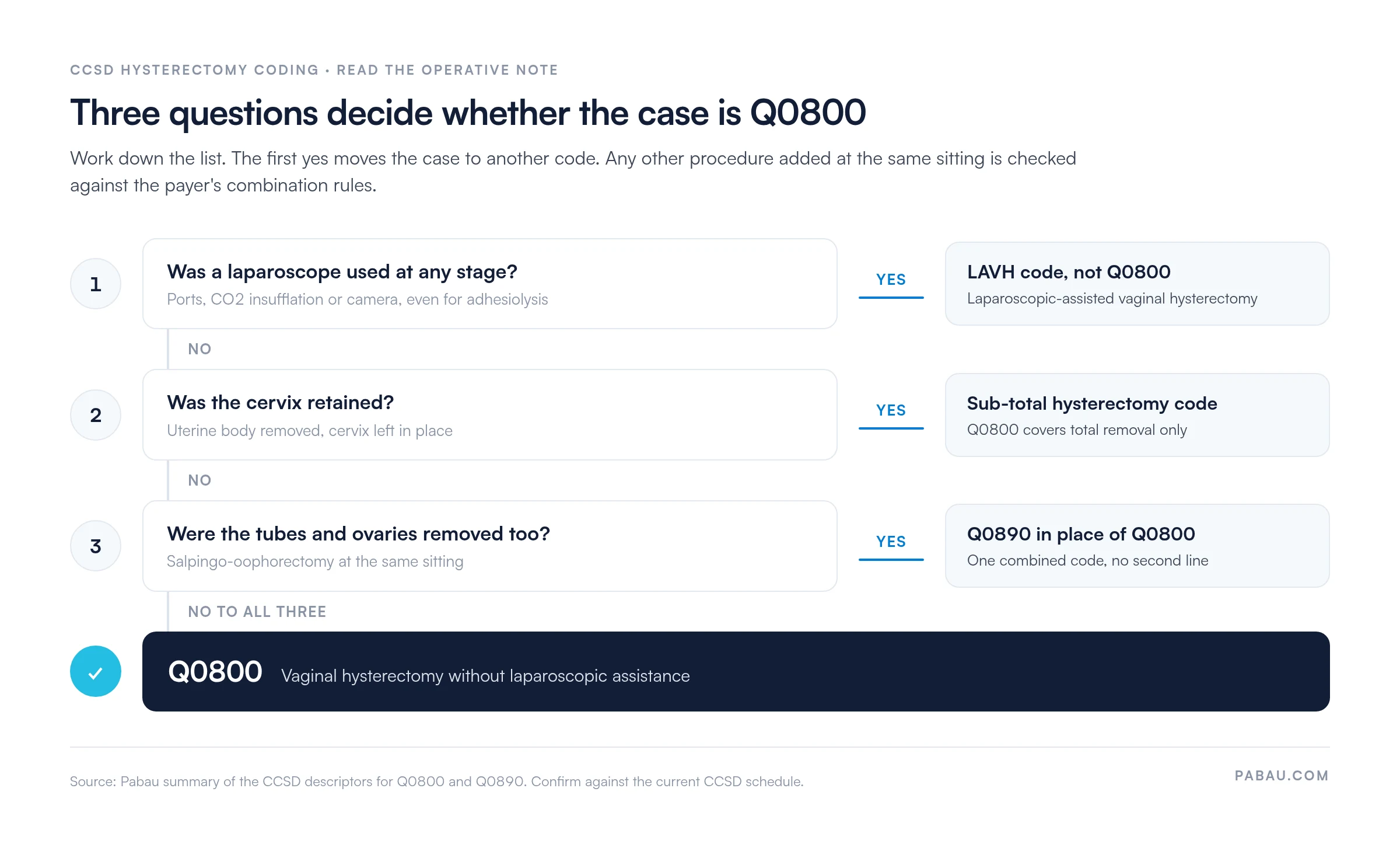
Decision flow for CCSD code Q0800
The first yes on the operative note moves the case off Q0800, so check for a laparoscope first. The flow summarises the CCSD descriptors for Q0800 and Q0890.

Confirm with the operating surgeon before coding an ambiguous case.

Pro Tip

Check the operative note for the phrase ‘without laparoscopic assistance’ or its equivalent before assigning Q0800. If the note references any trocar insertion, CO2 insufflation, or laparoscopic visualisation, the case is an LAVH regardless of how the procedure was planned preoperatively.

Coding CCSD code Q0800 when additional procedures are performed

Bill most procedures added at the same sitting as Q0800 on their own CCSD code line. One clear exception is a salpingo-oophorectomy, which CCSD codes together with the hysterectomy as Q0890.

The list below sets out the most common concurrent procedures and their billing implications. Check each code against the current CCSD schedule and your insurer’s specific fee schedule, because payment rates and secondary-procedure reductions may vary.

  • Salpingo-oophorectomy: Do not add a second line to Q0800. CCSD has a combined code, Q0890, for vaginal hysterectomy with salpingo-oophorectomy, so the whole case is billed as Q0890.
  • Anterior or posterior colporrhaphy (prolapse repair): Bill separately on its own CCSD code. Pelvic floor repair is a distinct procedure, and Q0800 never includes it. Many insurers apply a secondary procedure reduction to the second code.
  • Unilateral salpingectomy: Separate code required. Where the surgeon removes only one fallopian tube, use the unilateral code rather than the bilateral descriptor.
  • Cystoscopy: When a surgeon performs it to confirm ureteric integrity, it is a separate billable procedure with its own code line.
  • Diagnostic laparoscopy preceding vaginal hysterectomy: A surgeon may use a laparoscope to look first and then withdraw it before the vaginal phase begins. In that case, ask the surgeon whether the case is an LAVH or two separate procedures.

Documentation requirements for a Q0800 claim

After the wrong code, incomplete documentation is the usual reason a Q0800 claim comes back. Each of the following must be in place before you submit the claim.

  • Operative note confirming vaginal approach: The note must explicitly state that the hysterectomy was performed vaginally and that no laparoscopic assistance was used. A generic note stating “hysterectomy performed” without approach detail is not enough.
  • Indication documented: The clinical indication, such as prolapse, fibroids or dysfunctional uterine bleeding, must appear in the referral letter or consultation note. The operative note alone is not enough.
  • Surgeon’s GMC number: Required on all CCSD claim forms, because missing or incorrect GMC numbers cause validation failures at the insurer or on the Healthcode platform.
  • Correct Q0800 code: Write it exactly as Q0800 on the claim, with the full CCSD code format. Do not abbreviate or substitute a free-text descriptor.
  • Supported diagnostic code: Attach a compatible ICD-10 diagnostic code. CCSD is a procedure schedule, so the diagnosis is coded in ICD-10 and should match the documented indication.
  • Pre-authorisation reference number: Where the insurer required pre-auth, the reference number must appear on the claim. Insurers decline claims without a valid pre-auth reference, regardless of clinical need.

A structured operative note template, with its own fields for the approach, the indication and the surgeon, makes these details hard to leave out. Then the claim draws on fields that staff have already filled in.
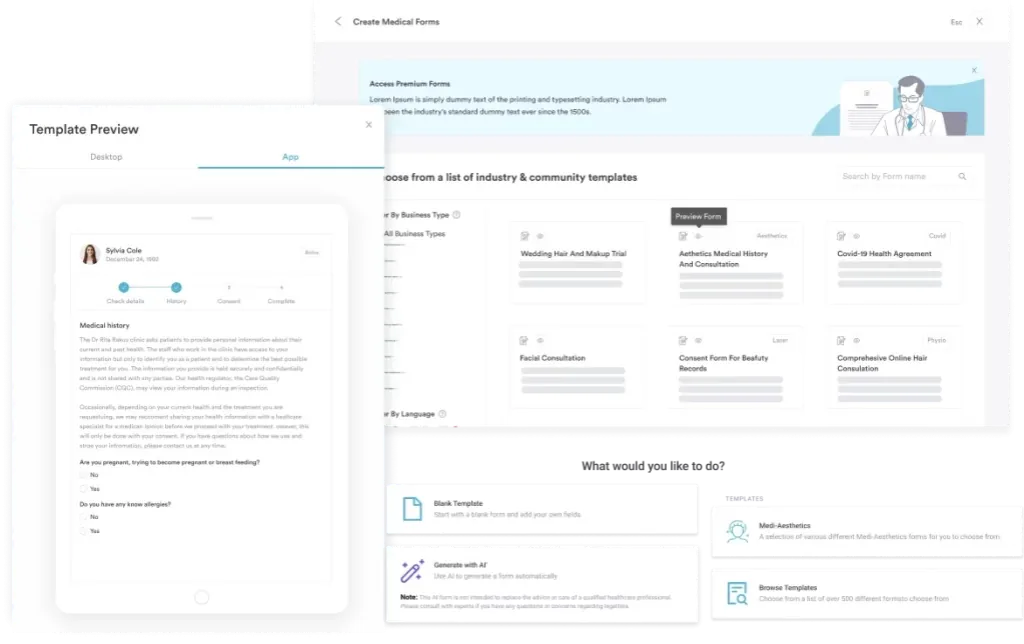
Pabau form builder showing a template library and a mobile preview of a medical history form
Pabau’s form builder turns a practice’s operative note into a template, with a set field for the surgical approach that Q0800 depends on.

Pre-authorisation requirements for vaginal hysterectomy

UK private insurers usually require pre-authorisation for elective vaginal hysterectomy before they will pay for Q0800. Requirements vary by insurer and change over time, so check with the payer before you schedule the procedure.

InsurerTypical pre-auth requirementReference
BupaBupa requires pre-authorisation for elective surgical procedures and usually asks for a referral letter and diagnosis confirmationBupa code search
AXA HealthAXA requires prior approval and may request clinical evidence of conservative treatment failureAXA procedure codes
Aviva HealthPre-authorisation required; procedure must align with Aviva’s CCSD-based fee scheduleAviva fee schedule
Vitality HealthPre-authorisation required; Vitality verifies the procedure fee against its CCSD fee finderVitality fee finder

For Bupa patients, the Bupa CCSD billing guide covers Bupa-specific coding and pre-authorisation across gynaecological procedures. Record each authorisation against the booked procedure, so an outstanding approval surfaces before theatre is scheduled rather than on the day of billing.

Common reasons Q0800 claims are denied

CCSD code Q0800 claims fail for a consistent set of reasons, but the right documentation and pre-submission checks prevent most of them.

Denial reasonRoot causePrevention
Wrong code submittedQ0800 used when laparoscopy was performed; should be LAVH codeReview operative note before coding; confirm no laparoscopic port use
Missing pre-authorisationNo pre-auth reference on the claim, or the practice did not obtain pre-auth before surgeryObtain and record insurer pre-auth reference before scheduling theatre
Incomplete operative noteNote does not confirm vaginal approach or absence of laparoscopyUse a structured operative note template that includes approach field
Mismatched ICD-10 diagnostic codeICD-10 diagnostic code does not align with the documented clinical indicationConfirm that the ICD-10 code matches the referral indication exactly
Concurrent procedure coded wronglyAn oophorectomy line added where Q0890 applies, or another procedure coded against the combination rulesUse Q0890 when the tubes and ovaries are removed, and check every added code against the insurer’s list
Late submissionClaim submitted outside the insurer’s timely-filing window (usually 90 days)Submit claims within 30 days of the procedure date as standard practice

How to submit a Q0800 claim via Healthcode

Healthcode is the main electronic data interchange (EDI) platform for UK private healthcare billing. Most independent hospitals and specialist practices therefore use it to submit CCSD claims. The steps below cover the standard Q0800 workflow; insurer or facility set-ups may differ slightly.

  1. Select the correct code: Navigate to the procedure code field and enter Q0800. Confirm the descriptor reads “Vaginal hysterectomy without laparoscopic assistance” before proceeding. Do not select a neighbouring code with a similar label.
  2. Attach the insurer reference: Enter the pre-authorisation reference number that the insurer provides. Without this, the claim will fail Healthcode’s pre-submission validation for most major insurers.
  3. Add concurrent procedure lines: If the surgeon performed another separately coded procedure, check the insurer’s combination rules before adding a line for it. If the tubes and ovaries were removed, replace Q0800 with Q0890 rather than adding a line. Apply the insurer’s secondary-procedure reduction where applicable.
  4. Attach the ICD-10 diagnostic code: Link the ICD-10 code for the documented indication to the Q0800 procedure line. Confirm the diagnostic and procedure codes are clinically consistent.
  5. Enter the surgeon’s GMC number: This is a mandatory field. Healthcode will therefore reject the submission if the GMC number is absent or does not match the insurer’s registered practitioner list.
  6. Run the pre-submission validation: Healthcode performs automatic validation checks before transmission. Review all flagged errors, and do not override validation warnings until you understand the reason.
  7. Transmit and retain the acknowledgement: Save the Healthcode submission acknowledgement reference. If the insurer later queries or denies the claim, you need this reference for the appeal or resubmission.

How Pabau keeps pre-authorisation and Q0800 claims together

Many Q0800 rejections come from two records that never meet. For example, the insurer’s pre-authorisation reference sits in an email or on a paper form, while staff build the claim days later in a separate billing tool.

Pabau, a practice management platform with UK insurance billing, tracks the pre-auth code, its dates and the authorised sessions on the patient’s case. Pabau warns the team when a case has no authorisation, so the team chases the reference before the patient reaches theatre.

After the operation, Pabau’s private practice claims software submits the claim through Healthcode from the same case that holds the authorisation. Your billing team stops re-keying references between systems, and a missing approval shows up as a warning before submission.
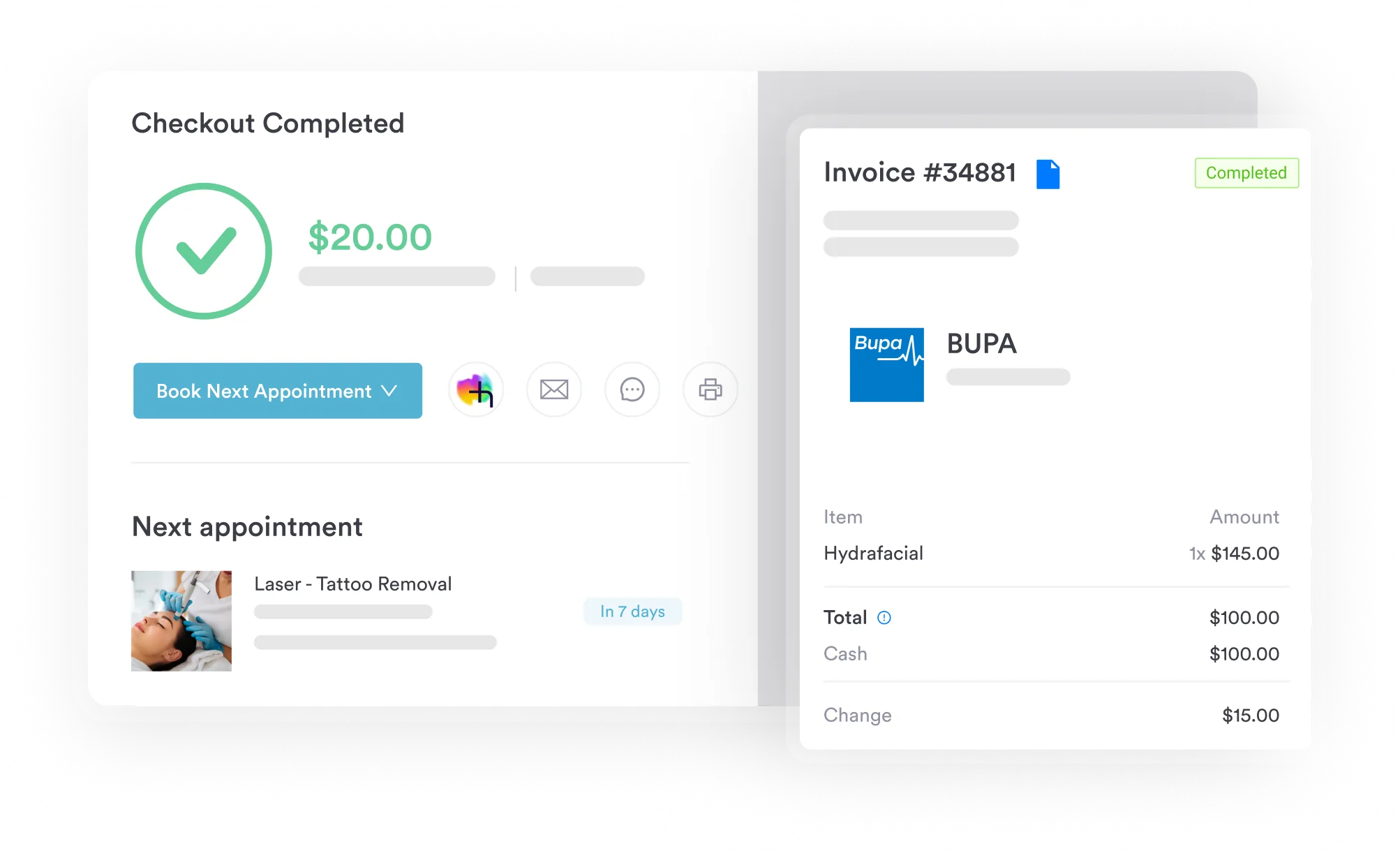
Pabau checkout screen with a completed invoice
Pabau’s checkout shows the insurer and the patient share on one invoice, so the Bupa balance on a Q0800 case stays traceable after submission.

Reduce Q0800 claim rejections with Pabau

Pabau tracks each pre-authorisation on the patient’s case, warns when one is missing, and submits UK claims through Healthcode. Book a demo to see it on a Q0800 case.

Pabau practice management software for gynaecology billing

Conclusion

Q0800 rewards the coder who reads the operative note before the booking form. The planned approach and the performed approach can differ, and only the operative note records what happened in theatre.

Settle three points before a claim leaves the practice. Confirm that no laparoscope was used, and check whether the tubes and ovaries came out, which makes the case Q0890. Then make sure a valid pre-auth reference sits on the claim, because each fix costs less in the theatre record than in an insurer query.

Book a demo to see how Pabau keeps the authorisation and the Healthcode claim on one patient case for every gynaecology procedure you bill.

Continue your research

Continue your research

Need a full Bupa CCSD code reference? Bupa CCSD codes covers how Bupa procedure codes map to the CCSD schedule across surgical specialties.

Billing a cervix-sparing abdominal operation? CCSD code Q0750 explains the subtotal abdominal hysterectomy code and how it differs from Q0800.

Hysterectomy for an ovarian malignancy? CCSD code Q0880 covers the hysterectomy code that includes removal of the omentum and adnexa.

Removing the tubes and ovaries laparoscopically on their own? CCSD code Q2230 walks through billing a laparoscopic bilateral oophorectomy and salpingectomy.

Frequently asked questions

What does CCSD code Q0800 cover?

CCSD code Q0800 covers vaginal hysterectomy without laparoscopic assistance. Surgeons remove the uterus entirely through the vagina, with no laparoscopic ports, CO2 insufflation or camera at any stage. Prolapse repair is not part of Q0800. A salpingo-oophorectomy at the same sitting moves the case to Q0890.

What is the difference between Q0800 and laparoscopic hysterectomy codes?

Q0800 applies when no laparoscopic assistance is used at any point during the hysterectomy. Laparoscopic-assisted vaginal hysterectomy (LAVH) codes apply whenever a laparoscope is introduced, even briefly for adhesiolysis before the vaginal phase begins. If the operative note references any trocar insertion or laparoscopic visualisation, the correct code is the LAVH code, not Q0800.

Which CCSD code should I use for a vaginal hysterectomy with oophorectomy?

Use Q0890, the CCSD code for vaginal hysterectomy with salpingo-oophorectomy, rather than Q0800. Q0890 already covers both procedures, so billing Q0800 with a separate oophorectomy line duplicates the hysterectomy. Confirm the code and its fee with the insurer before submission.

Can Q0800 be billed alongside prolapse repair codes?

Yes. Bill anterior or posterior colporrhaphy performed at the same operative sitting as Q0800 on a separate CCSD code line. Prolapse repair is not included within the Q0800 descriptor. The secondary-procedure reduction on the second code depends on each insurer’s fee schedule and contract terms.
Avatar photo
Despina Petrushevska
Content Writer

Despina Petrushevska is a content writer covering aesthetics, dermatology, and clinic operations, known for making detailed clinical concepts clear and engaging. Outside of work, she enjoys photography, weekend getaways, and finding inspiration in everyday experiences.
×