

CPT Code 48152: Whipple procedure without pancreatojejunostomy
CPT code 48152: Official description and procedure overview CPT code 48152 descr...

Last Updated: Nov 13, 2026
P1300 is the CCSD code for operations on the female perineum, the tissue between the vaginal opening and the anus. UK private insurers use it for the surgeon's fee when a consultant repairs or reconstructs the perineal body. That covers episiotomy and obstetric tear repair, perineorrhaphy and perineoplasty.
The code sits in Chapter 14 of the CCSD schedule, under sub-chapter 14.4 Vagina/perineum. Bupa rates it MINOR 4, and AXA Health lists it as a minor procedure. Work on the vaginal wall, the vulva or the anal sphincter takes a separate code.
Let Pabau's smart automation suggest the right codes, reduce claim denials, and keep your practice compliant—effortlessly.
Automate repetitive tasks and focus on what matters most—your patients.
Reduce coding errors and ensure compliance with the latest regulations.
Clean claims, fewer denials, and faster reimbursements.
Powerful insights and reporting to help your practice thrive.
HIPAA compliant SOC 2 certified GDPR-compliant Trusted by 4,000+ clinics worldwide

CCSD code P1300 covers surgery on the female perineal body, while vaginal wall, vulval and anal sphincter work each take their own code.
Bupa rates P1300 as MINOR 4, and AXA Health lists it as a minor procedure in sub-chapter 14.4 Vagina/perineum.
Third- and fourth-degree tears add a sphincter repair code, such as H5020, alongside P1300.
AXA Health lists P2310, P2930, P0910, P2932 and S5210 as unacceptable combinations with P1300.
Pabau, the practice software we build, sends UK claims through Healthcode and Bupa and warns you when a case has no pre-authorisation code.
CCSD Code P1300 is the Clinical Coding and Schedule Development code for operations on the female perineum, used to bill UK private health insurers. AXA Health’s chapter 14 specialist schedule lists it under 14.4 Vagina/perineum as a minor procedure. It carries a £150 surgeon fee and £142 for general anaesthesia.
Bupa’s February 2026 schedule rates the same code MINOR 4, with a £166 fee. The CCSD Group maintains the code, and practices usually submit the claim through Healthcode.
The code serves both obstetric and elective work. An obstetrician repairing a tear after a private delivery uses P1300. So does a gynaecologist performing elective perineorrhaphy for prolapse-related symptoms. The documentation and pre-authorisation rules differ between the two, as the sections below show.
The official descriptor, “Operations on female perineum”, covers surgery whose main anatomical site is the perineal body. That includes emergency obstetric repairs and planned reconstructive or functional gynaecological surgery.
The following procedures fall within P1300’s scope:
The table below maps each procedure to its primary clinical indication, helping coders and billers confirm whether P1300 applies before submission.
P1300 applies only when the operative site is the perineal body itself. Procedures on anatomically adjacent structures use separate CCSD codes, and conflating these is a frequent source of incorrect submissions.
The following are not coded under P1300:
When a procedure involves both the perineum and an adjacent structure, review whether both codes can be billed simultaneously or whether bundling rules apply. See the section on billing P1300 alongside other CCSD codes below.
A fistula between the bladder and the vagina is not a perineal operation, and it is coded P2510. Repair of a urethrovaginal fistula is coded CCSD P2520 instead. Reconstruction of the vagina itself has its own code, P2100. Repair of the vaginal vault falls in the P24 range, which includes CCSD P2420.
Obstetric perineal trauma is graded by degree, and that grading directly affects how the operative note must be written to support a P1300 claim. The table below summarises the degree classification and the corresponding documentation requirements.
P1300 applies to the perineal repair in all four degrees. For third- and fourth-degree tears, the sphincter repair is billed separately, and the schedule lists repair of anal sphincter as H5020. Insurers may audit a claim whose operative note describes sphincter involvement but which carries P1300 alone.
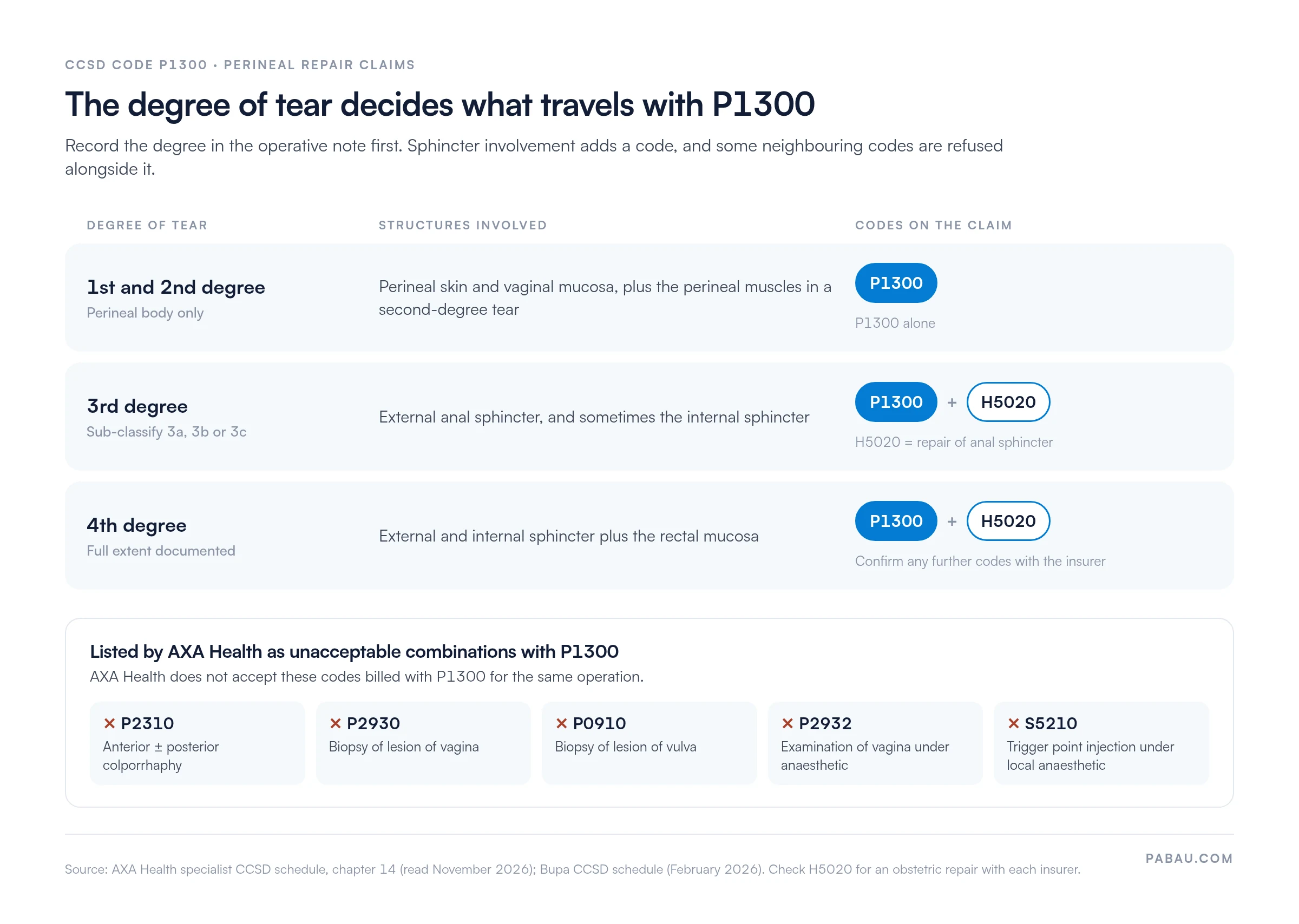
Always record the degree of perineal tear in the operative note, using the standard first- to fourth-degree classification. A note that says only ‘perineal repair’ gives the insurer grounds to downcode or query the claim. That risk is highest for third- and fourth-degree injuries, where a second CCSD code is expected.
Elective perineal procedures present a different documentation challenge. An obstetric repair is an emergency with a clear clinical indication. Elective perineorrhaphy and perineoplasty need an operative note that establishes medical necessity beyond cosmetic intent.
Key distinctions to capture in the clinical record for elective P1300 procedures:
Perineoplasty performed mainly for cosmetic reasons is frequently excluded from private health insurance cover. Where there is any cosmetic component, get written pre-authorisation that confirms cover before the procedure. A standard approval for P1300 as a category does not settle it.
A complete operative note is the foundation of a successful P1300 claim. Missing or vague documentation is a common cause of insurer queries and payment delays. A structured operative note template captures every required field before the case closes.
The operative note for a P1300 claim must include all of the following:
For Healthcode submissions, enter the CCSD code accurately in the procedure field, with the correct consultant code and insurer membership number. One common rejection has nothing to do with clinical coding. The consultant code on the Healthcode submission does not match the insurer’s recognition records.
Pre-authorisation requirements for perineal procedures vary by insurer and by whether the procedure is obstetric or elective. The table below summarises the general position of the main UK private health insurers. Policies change, so verify current requirements with each payer before treating.
An elective P1300 pre-authorisation request should include:
Insurers may also request a brief letter of medical necessity for perineoplasty or perineorrhaphy where the indication is not straightforwardly reconstructive.
Claim denials for P1300 follow predictable patterns. Most can be prevented with the right documentation habits and a pre-submission checklist. The table below lists the most frequent denial reasons and the specific fix for each.
Several CCSD codes cover neighbouring anatomy and get submitted in error when P1300 is correct, or the reverse. Confirm current descriptors with the insurer’s schedule before submission. The CCSD technical guide (October 2025) explains how the schedule is structured. Our CCSD codes reference covers more of the neighbouring codes.
Yes, P1300 can go on the same claim as another CCSD code when each code reflects a distinct procedure. Bundling all perineal and pelvic work under P1300 is wrong. So is itemising every step of a single repair as its own code.
Codes that may legitimately be billed alongside P1300:
Codes that are likely to conflict with P1300:
The P2310 conflict matters most in prolapse surgery. A combined anterior and posterior repair that also repairs the perineal body goes to AXA Health without a separate P1300 line.
When in doubt, check the insurer’s fee schedule and unbundling rules. The Healix fee schedule includes specific guidance on unbundling and multiple procedure billing that reflects common practice across UK private health insurers.
The denial reasons above trace back to three manual steps: choosing the code, writing the operative note and recording the pre-authorisation reference. In a paper workflow, each step happens in a different place, so a mismatch surfaces only when the insurer queries the claim.
Pabau, the practice management platform we build, keeps the operative note and the claim on one patient record. Its claims management software sends UK claims through Healthcode and Bupa. Nobody re-keys the procedure from the note into a separate billing system.
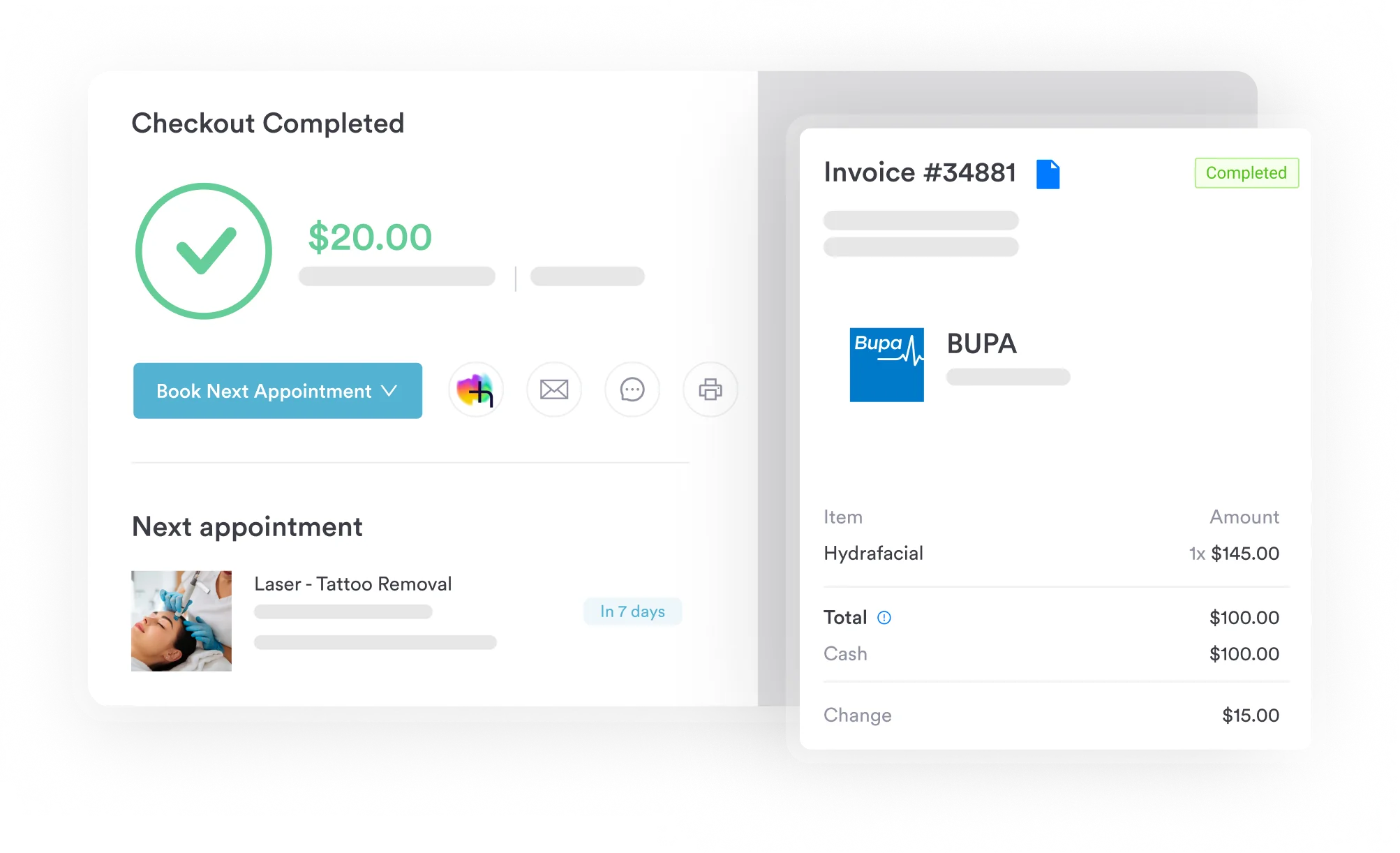
Pre-authorisation is tracked on the case, with the authorisation code, dates and sessions recorded. Pabau warns you when a case has no authorisation code, which heads off the first denial in the table above. For practices billing mainly to Bupa, our Bupa CCSD procedure codes guide covers the wider schedule.
Run a quarterly audit of your P1300 submissions, comparing the degree of tear in each operative note against the CCSD codes submitted. Third- or fourth-degree cases submitted with P1300 alone are likely under-coded. They don’t reflect the sphincter repair the surgeon performed.

Pabau sends UK claims through Healthcode and Bupa from the patient record, and warns you when a case has no pre-authorisation code. See how it fits a gynaecology practice.

Treat the operative note as the claim. Record the degree of tear, the exact operative site and any sphincter work on the day, and the code choice follows from it.
Check the insurer’s combination rules before you add a second code. AXA Health does not accept P1300 next to P2310 and four other codes, while a sphincter repair is billed separately. Elective cases need their pre-authorisation reference on file before the procedure. Book a demo to see how Pabau keeps the operative note, pre-authorisation and Healthcode claim on one record.

Repairing a rectal prolapse through the perineum? CCSD code H4200 covers perineal repair of prolapse of rectum.
CCSD code P1300 covers operations on the female perineum. That includes episiotomy repair, perineal laceration repair of any degree, perineorrhaphy, perineoplasty, and repair of perineal wound dehiscence. Procedures on the vaginal wall, vulva, urethra or anal sphincter use separate CCSD codes. The anal sphincter repair code is added alongside P1300 when a third- or fourth-degree tear involves the sphincter.
P1300 is specific to the perineal body. Colporrhaphy codes such as P2230 and P2310 cover vaginal wall repair, and vulval codes cover the labia and vestibule. Anal sphincter repair (H5020) covers the sphincter complex in third- and fourth-degree tears. The operative note’s description of the site decides which code or combination applies. A vague note makes P1300 impossible to tell apart from these codes.
Insurers typically require a full operative note. It should state the procedure, anatomical site, clinical indication, degree of tear or repair, suture technique and material, anaesthetic type, and the surgeon’s GMC number. For elective procedures, the Healthcode submission must also carry the pre-authorisation reference. A missing element commonly triggers an insurer query or a refused claim.
Sometimes, depending on the code and the insurer. AXA Health does not accept P2310, anterior ± posterior colporrhaphy, billed with P1300. A posterior colporrhaphy (P2230) documented as a distinct procedure, with its own technique, may be billed alongside it. Check the insurer’s unacceptable combinations before submitting both codes from one operation.
P1300 covers both episiotomy repair and elective perineal procedures. Episiotomy is a surgical cut to the perineum during delivery, and its suture repair is an operation on the female perineum. Elective perineorrhaphy and perineoplasty also use P1300, though their documentation and pre-authorisation rules differ from obstetric repairs.
Code P1300 for the perineal repair in every degree of obstetric tear. First- and second-degree tears usually need P1300 alone. For a third-degree tear, record the sub-degree (3a, 3b or 3c) and add the sphincter repair code, such as H5020. A fourth-degree tear also involves the rectal mucosa, so confirm any further codes with the insurer before submission.



