HCPCS code J7190: Factor VIII billing, units and reimbursement
HCPCS code J7190 bills human Factor VIII by the unit HCPCS code J7190 describes ...

Last Updated: Nov 10, 2026
CCSD code M3602 is the UK private insurance code for enterocystoplasty (including cystoscopy). Surgeons bill it when they enlarge the bladder with a segment of bowel, usually ileum, to raise capacity and lower filling pressure. Cystoscopy in the same session is part of the code.
Claims usually turn on two details. The bowel segment separates M3602 from M3600, the general bladder enlargement code, and robotic assistance moves the claim to M3603. M3602 sits in the urinary chapter of the CCSD Schedule, under Bladder. The operative note needs to name the segment and the approach.
Let Pabau's smart automation suggest the right codes, reduce claim denials, and keep your practice compliant—effortlessly.
Automate repetitive tasks and focus on what matters most—your patients.
Reduce coding errors and ensure compliance with the latest regulations.
Clean claims, fewer denials, and faster reimbursements.
Powerful insights and reporting to help your practice thrive.
HIPAA compliant SOC 2 certified GDPR-compliant Trusted by 4,000+ clinics worldwide

CCSD code M3602 covers enterocystoplasty, which enlarges the bladder with a segment of bowel, plus the cystoscopy done in the same session.
A bowel segment is what moves the claim from M3600, the general bladder enlargement code, to M3602.
Robotic-assisted enterocystoplasty has its own code, M3603, so the operative note must record the surgical approach.
Insurers expect a documented indication, usually urodynamic evidence that less invasive treatment has failed.
Pre-authorization rules, expiry dates and appeal windows vary by insurer, so check them against each patient’s policy.
CCSD code M3602 is the UK private healthcare code for enterocystoplasty (including cystoscopy). The surgeon opens the bladder and stitches in a patch of bowel, usually ileum, to make it larger and softer. The cystoscopy that checks the bladder lining in the same session is part of the code, so it never gets its own invoice line.
The code belongs to the CCSD Schedule, which the Clinical Coding & Schedule Development Group maintains for UK private medical insurers. M3602 sits in the schedule’s urinary chapter, under Bladder. NHS hospitals code the same family of operations under OPCS-4 category M36, enlargement of bladder.
The descriptor above comes from the schedule’s public code index. The full schedule sits behind a CCSD login, so confirm the wording there before you invoice. Our CCSD procedure codes library covers the neighboring urology codes, and the Bupa CCSD codes guide shows how one insurer applies them.
Three CCSD codes cover bladder enlargement, and two facts about the operation decide between them. Was a segment of bowel used? And was the operation robotic assisted?
The diagram runs both questions in order, and the table below it gives each code’s descriptor.
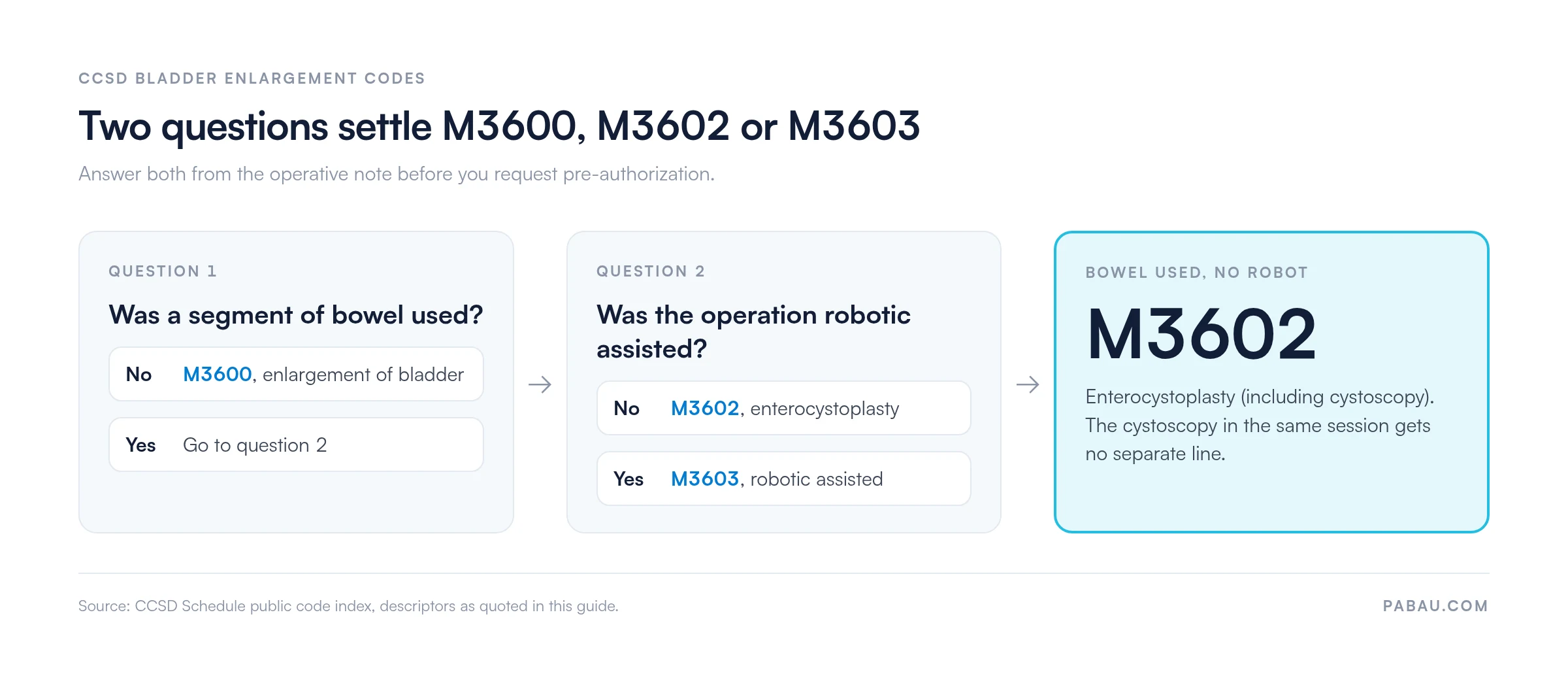
Billing M3600 for an ileocystoplasty undercodes the operation. Billing M3602 for a robotic case misstates the approach, which invites a query. Our guide to CCSD code M3600 covers the general code in more depth.
Enterocystoplasty is reconstructive surgery for a bladder that holds too little or fills at dangerously high pressure. The surgeon isolates a length of bowel, opens it flat and sews it onto the opened bladder. The aim is to protect the kidneys and improve continence.
Many patients can’t empty the enlarged bladder fully afterwards. They often need clean intermittent self-catheterization, sometimes for life, so it belongs in the consent discussion.
Usually part of the M3602 episode:
Billed separately, or checked with the insurer first:
Each insurer sets its own rules for combining procedure codes. Ask at pre-authorization before you add any second code alongside M3602.
Insurers want to know why the bladder needed bowel. Most claims rest on one of the indications below, documented after other treatment has failed.
UK private insurers use the WHO version of ICD-10, not the US ICD-10-CM. The diagnosis on the invoice should match the pre-operative assessment and the operative note.
NICE guidance on laparoscopic augmentation cystoplasty frames the operation as an option once other treatment has failed. Listing each earlier treatment and its outcome answers the insurer’s first question before they ask it.
The operative note carries most of the claim’s weight. A note that only says “bladder augmented” leaves the insurer choosing between three codes, so spell out the details below.
A paper consent form is easy to misfile, and an insurer may ask for it months later. In Pabau, the practice management platform we build, digital consent forms save straight to the patient’s record once signed.
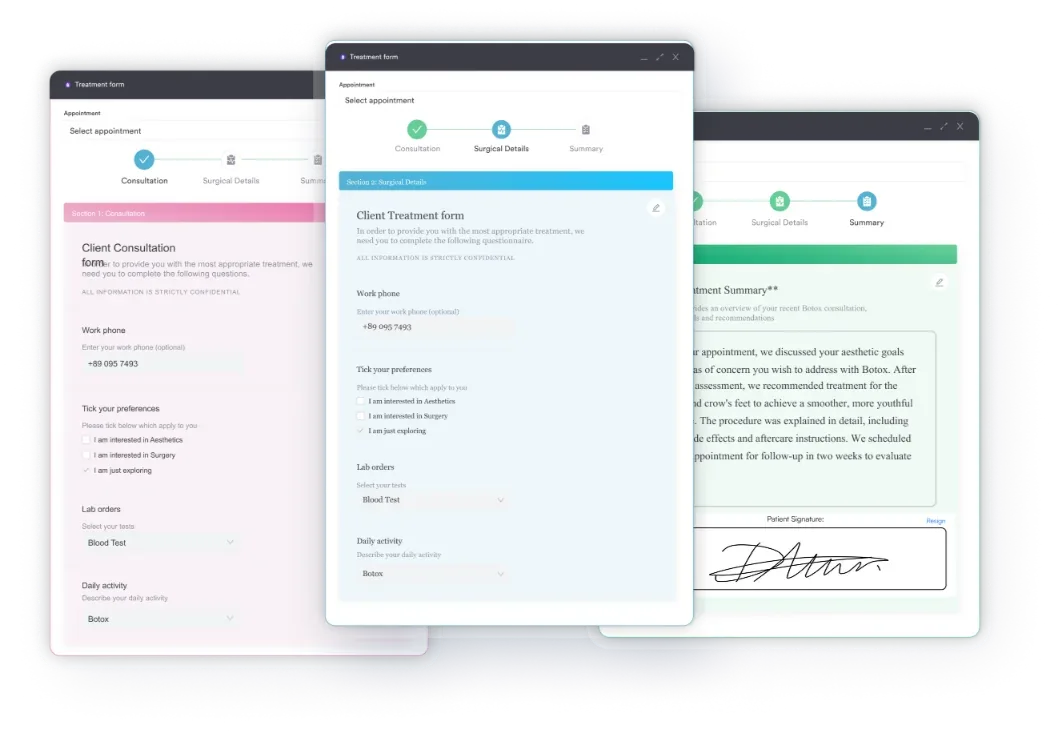
Most M3602 claims follow the same seven steps. The walkthrough below shows who does what, and where a mismatch tends to creep in.
Take an illustrative case. A patient with spina bifida has a small, high-pressure bladder despite botulinum toxin injections and self-catheterization. Urodynamics confirm poor compliance, and the consultant plans an open ileocystoplasty.
The booking team requests authorization for M3600, the general enlargement code. The operative note then describes an ileal patch sewn onto the opened bladder.
Billed as authorized, the claim undercodes the operation. Billed as M3602, it no longer matches the approval. The fix is to call the insurer, explain the bowel segment and ask for the authorization to be amended before the invoice goes out.
Laparoscopic, but not robotic? The schedule’s only approach split for enterocystoplasty is robotic assistance. A conventional laparoscopic case would normally sit under M3602, but confirm it with the insurer at pre-authorization.
Bladder enlarged without bowel? Then M3602 doesn’t fit, because the bowel segment is what defines it. Look at M3600 and confirm the code with the insurer.
Urine diverted rather than stored? A different code applies. Urinary diversion through an ileal conduit is billed under CCSD code M1910, not M3602.
On paper, the authorization, the operative note and the invoice often live in three different places. That’s how an M3600 approval ends up attached to an M3602 operation.
Pabau’s claims management software pre-fills the invoice from the patient record. It also checks that required fields, such as the membership number and authorization code, are complete before the claim can be sent.
Claims go to Healthcode from the same system, where you can follow their status and reconcile each payment. With consent, notes and the claim on one record, answering an insurer’s records request is far quicker.
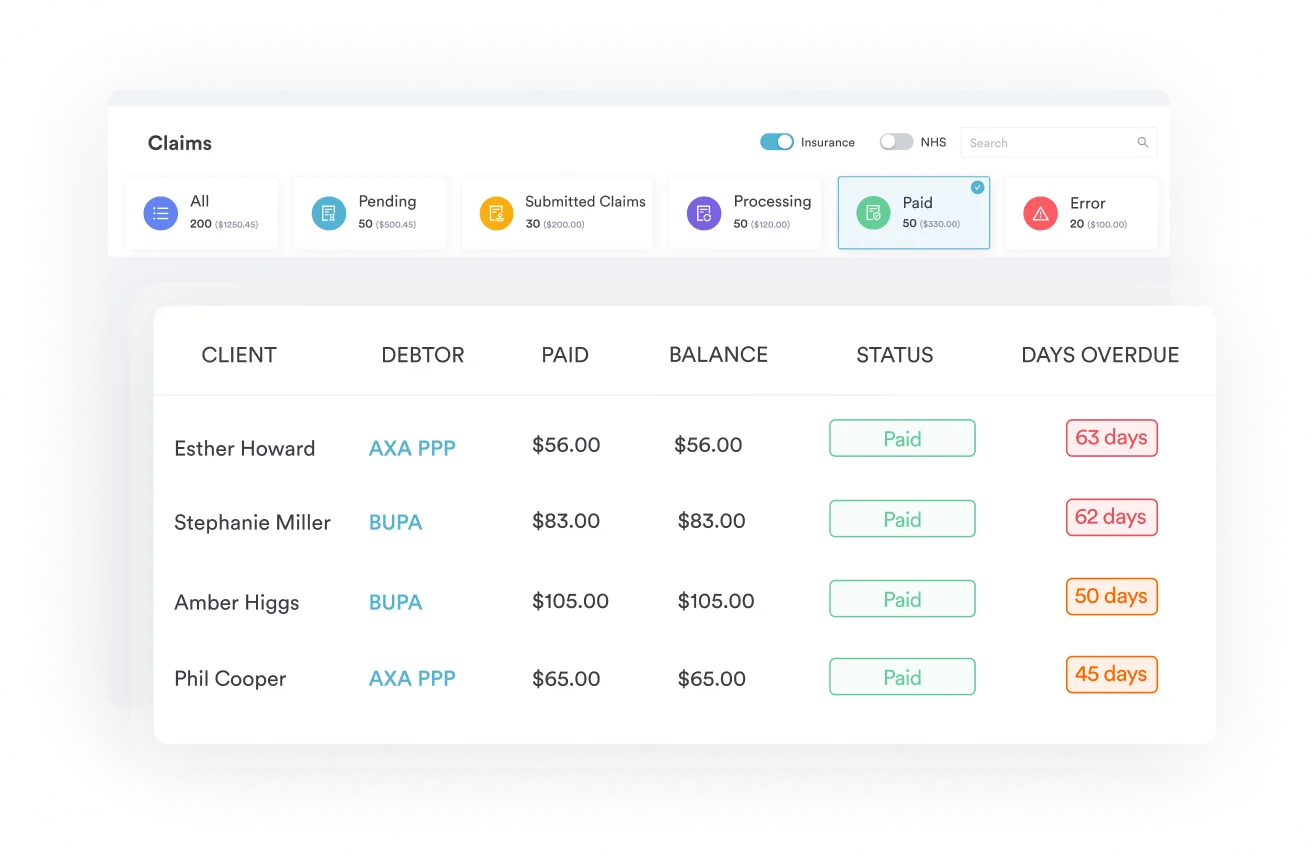

Pabau keeps the consent form, the operative note and the CCSD-coded invoice on one patient record. Claims go to Healthcode with required fields checked, and payments reconcile in the same place.

M3602 turns on one detail, the bowel segment. Put it in the authorization request, the operative note and the invoice, and the code choice explains itself to the insurer.
The cost is a few minutes before surgery, checking the authorized code and the patient’s policy terms. That is far cheaper than chasing an amended approval after the event.
Book a demo to see how Pabau keeps CCSD authorizations, operative notes and Healthcode claims on one patient record.

Billing other CCSD codes for Bupa? Bupa CCSD codes explains how Bupa structures its CCSD-coded fee schedule and invoicing rules.
Enlarging the bladder without bowel? CCSD code M3600 covers the general bladder enlargement code and where it stops.
Billing the urodynamics before surgery? CCSD code M4780 covers invasive urodynamic assessment and how it is invoiced.
Billing a cystoscopy on its own? CCSD code M4510 covers flexible cystoscopy as a standalone procedure.
Diverting urine instead of storing it? CCSD code M1910 covers construction of an ileal conduit.
No. CCSD codes are for billing UK private medical insurers. NHS hospitals record the same operation with OPCS-4 codes from category M36, enlargement of bladder.
Enterocystoplasty is the umbrella term for enlarging the bladder with any bowel segment. Ileocystoplasty uses small bowel, while colocystoplasty uses large bowel. Without robotic assistance, both point to M3602.
The bowel lining keeps producing mucus, so bladder stones and urinary infections are common. Other risks include metabolic changes, bladder perforation and a small rise in cancer risk. Patients need lifelong urology follow-up.
No. Authorization confirms cover for the planned procedure at that point. The insurer can still query the claim if the note, the code or the policy terms don’t line up.
Anesthetists send their own invoice for the same episode, usually referencing the procedure performed. Check each insurer’s anesthetist fee rules before invoicing.