CCSD code Q1802: Hysteroscopic fibroid resection billing guide
What CCSD code Q1802 covers CCSD code Q1802 is the UK private-practice code for ...

Last Updated: Nov 13, 2026
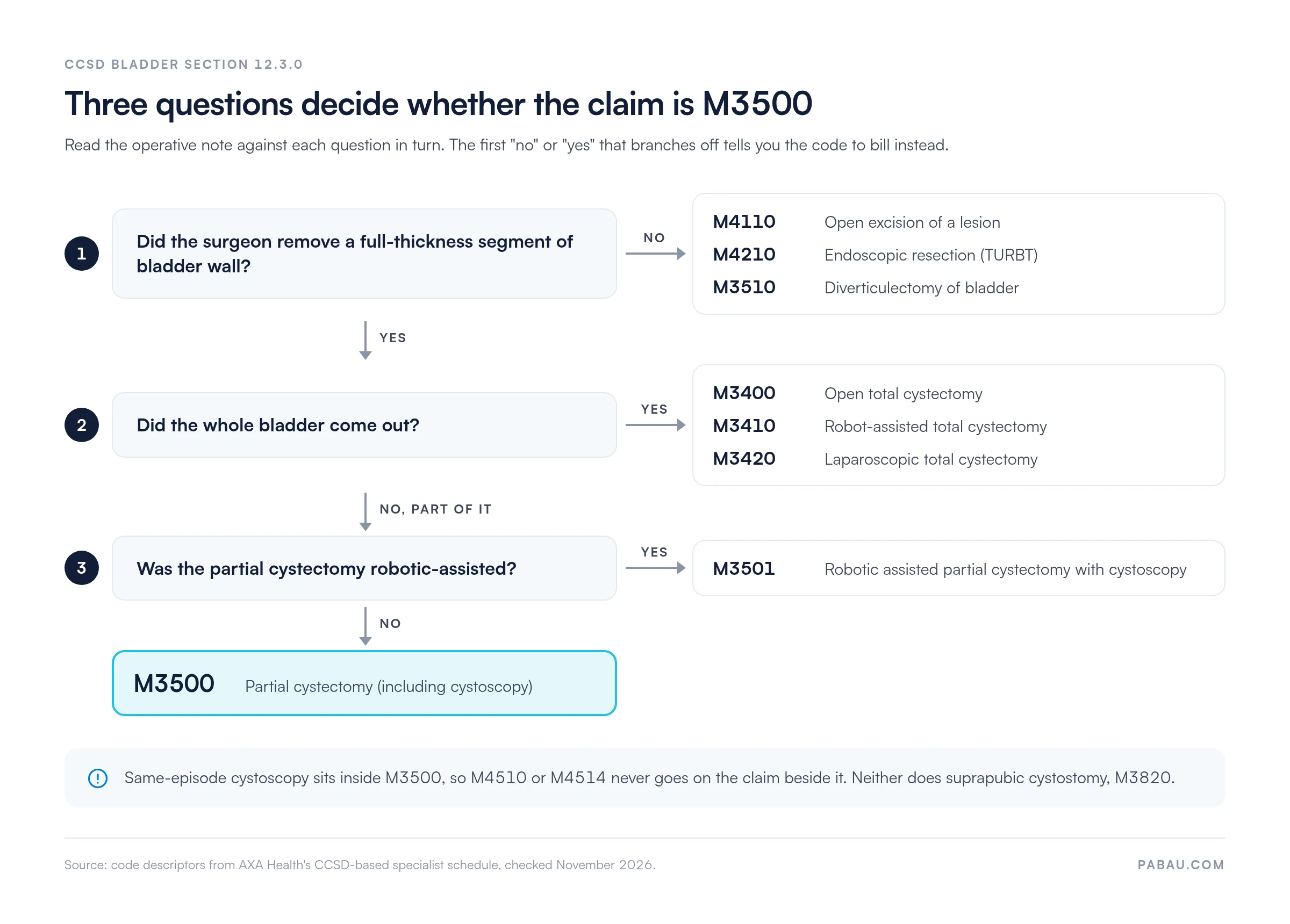
M3500 is the CCSD code for partial cystectomy (including cystoscopy), the non-robotic removal of a full-thickness segment of bladder wall. It sits in the CCSD bladder section (12.3.0) and is billed as one inpatient procedure, with any same-episode cystoscopy already included.
Robotic-assisted partial cystectomy has its own code, M3501. The approach recorded in the operative note decides which of the two you bill.
Let Pabau's smart automation suggest the right codes, reduce claim denials, and keep your practice compliant—effortlessly.
Automate repetitive tasks and focus on what matters most—your patients.
Reduce coding errors and ensure compliance with the latest regulations.
Clean claims, fewer denials, and faster reimbursements.
Powerful insights and reporting to help your practice thrive.
HIPAA compliant SOC 2 certified GDPR-compliant Trusted by 4,000+ clinics worldwide

CCSD code M3500 is partial cystectomy (including cystoscopy), an inpatient bladder operation in CCSD section 12.3.0, never a minor procedure code.
The cystoscopy done in the same episode is part of M3500, so M4510 or M4514 never goes on the claim beside it.
Robotic-assisted partial cystectomy has its own code, M3501, so the approach in the operative note decides which code you bill.
Total cystectomy codes, suprapubic cystostomy (M3820) and anterior pelvic exenteration (X1420) are unacceptable combinations with M3500.
Get pre-authorisation for the exact code before surgery, and keep the histology report with the operative note.
CCSD code M3500 is the UK private-practice code for partial cystectomy (including cystoscopy). The surgeon removes a full-thickness segment of the bladder wall and closes the bladder, leaving the rest in place. It is an inpatient operation, done in the operating room under general anaesthesia.
The code sits in Chapter 12 of the CCSD schedule, in the bladder section, 12.3.0. CCSD introduced it on 11 March 2011. A robotic-assisted version followed on 15 April 2024 as its own code, M3501. You can find neighbouring CCSD codes for the rest of the bladder section in our code library.
Treat the descriptor as the test. If the operation did not remove part of the bladder wall, M3500 is the wrong code, however small the procedure looked on the list. An endoscopic cut of the urethral sphincter, for example, is billed as M4400 urethral sphincterotomy. A reconstruction of the bladder neck and urethra is a different operation again, and our M3710 billing guide covers it. Enlarging the bladder with a segment of bowel is an enterocystoplasty, billed under CCSD M3602. Stretching the bladder with fluid under pressure at cystoscopy, with no tissue removed, is hydrodistension, billed as M4320.
Surgeons also call the operation a segmental cystectomy. It suits a lesion that can be cleared with a margin while enough healthy bladder remains to hold urine. Typical reasons include a solitary tumour at the bladder dome, a urachal tumour or bladder endometriosis.
M3500 includes:
M3500 does not cover:
The descriptor names no approach for the open or laparoscopic route. If your surgeon used a conventional laparoscopic technique, confirm the code with the insurer when you request authorisation.
The usual M3500 error is picking a code one row up or down the bladder section. The descriptors below are from AXA Health’s published CCSD-based specialist schedule, checked in November 2026.
Two of these have their own billing guides on our site, M4110 and M4510. Read the M4110 guide if your surgeon describes a wide local excision.
CCSD lists unacceptable combinations for M3500. Billing one of these beside it on the same episode will be rejected or cut back to the higher-value code.
AXA Health’s own list for M3500 goes further. It also blocks M3412 (laparoscopic cystoprostatectomy), M3420 (laparoscopic cystectomy) and T4300 (laparoscopic adhesiolysis). Each insurer decides which combinations it adopts, so check the payer’s list before you add a second code.
Pelvic lymph node dissection often comes up with partial cystectomy for cancer. T8580 is worded “as sole procedure”, so ask the insurer before adding it to an M3500 claim.
Insurers read the operative note against the descriptor. A note that says “bladder lesion removed” reads like M4110, so the claim gets queried. A structured operative-note template keeps the same fields filled in on every case.
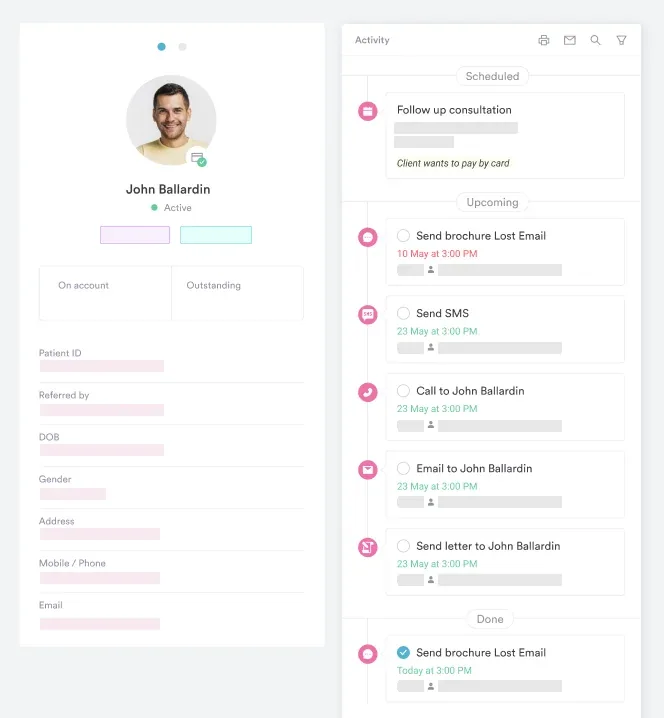
For M3500, the operative note should record:
Keep the histopathology report on the same record. It confirms what was removed and whether the margins were clear. Insurers that query the code often ask for it, and the pathology lab bills its own fee separately.
Partial cystectomy is planned inpatient surgery, so the patient’s insurer must authorise it before admission. Bupa applies pre-authorisation to M3500, and UK insurers generally expect members to call before any planned surgery. Our guide to Bupa CCSD codes covers how Bupa handles recognition and fees.
Here is what the authorisation request should carry:
If the plan changes from robotic to open in the operating room, call the insurer afterwards and have the authorisation amended. A claim billed under a different code from the one authorised is a common reason for payment to stall.
A partial cystectomy produces several invoices from one admission. Each party bills its own part against the same procedure code.
Specialist invoices usually go electronically through Healthcode or the insurer’s own portal. Fees depend on the insurer and your recognition status. AXA Health’s contracted schedule lists M3500 at £650 for the procedure and £285 for general anaesthesia, checked in November 2026.
For a self-pay patient, your own fee schedule applies, and M3500 is just the reference on the invoice. For an insured patient, check the insurer’s shortfall rules before billing the patient for any difference.
Take an illustrative case. A patient has a single tumour at the bladder dome, confirmed on biopsy. The consultant plans an open partial cystectomy and obtains pre-authorisation for M3500.
In the operating room, a rigid cystoscopy maps the tumour before the incision. The surgeon removes a full-thickness segment of the dome with a margin, closes the bladder and leaves a urethral catheter. The operative note records all three steps, and histology later confirms clear margins.
The surgeon bills M3500 alone. The rigid cystoscopy stays off the claim because M4514 is an unacceptable combination. Had the surgeon used the robot, the authorisation and the invoice would both have needed M3501.
The same three questions settle any bladder case, and the decision path below takes them in order.
When an M3500 claim fails, the reason is usually one of these.
You can usually appeal these with the operative note and histology report. Write a short cover letter that ties the evidence to the descriptor.
When a partial cystectomy claim stalls, the cause is usually paperwork. The authorisation sits in an email, the operative note sits in the hospital system, and the invoice gets typed up days later.
Pabau keeps those pieces on one patient record. The authorisation number, consent, operative note and histology report sit together. Your invoice to the insurer is raised from that record, and claims management sends it through Healthcode.
The result is fewer queries about missing numbers and quicker payment for your surgical work.

Pabau keeps authorisation numbers, consent, operative notes and histology on one record, then sends the insurer invoice through Healthcode.

M3500 is a bladder operation code with a narrow descriptor. Bill it only when a segment of bladder wall came out, by a route that wasn’t robotic. Leave the cystoscopy off the claim and keep M3820 away from it.
Get the authorisation for the same code you will invoice, and file the histology with the operative note. Do both, and the insurer has no paperwork reason left to query the claim.
Book a demo to see how Pabau keeps each surgical claim and its evidence on one patient record.

Need the full Bupa coding picture? Bupa CCSD codes explains how the CCSD schedule works with Bupa claims, recognition and fees.
Was the lesion excised rather than a segment of wall? CCSD code M4110 covers open excision of a bladder lesion and its documentation.
Was it a diagnostic cystoscopy only? CCSD code M4510 covers flexible cystoscopy and when a biopsy stays inside the code.
Usually, yes, when the policy covers the underlying condition and the insurer approves it first. Cancer cover and policy exclusions decide the outcome, so check the member’s benefits before booking surgery.
Transurethral resection of a bladder tumour is M4210, endoscopic resection of lesion of bladder (including cystoscopy). Use M3500 only when a segment of bladder wall is removed through an incision.
The Clinical Coding and Schedule Development Group, a body run by UK private insurers and hospital groups. Its full schedule sits behind a login at ccsd.org.uk.
Yes. The anaesthetist bills an anaesthetic fee against the same procedure code. AXA Health, for example, lists a separate general anaesthesia fee for M3500.
The diagnosis decides it. UK insurers use WHO ICD-10, where a cancer at the bladder dome is C67.1, a urachal cancer is C67.7 and bladder endometriosis is N80.8. Quote the same code on the authorisation request and the invoice.