CPT code 95808: Attended polysomnography billing guide
CPT code 95808 covers attended PSG with 1 to 3 extra channels CPT code 95808 is ...

Last Updated: Nov 11, 2026
M4320 is the CCSD code for endoscopic hydrostatic distension of bladder (including cystoscopy). It covers stretching the bladder with fluid under cystoscopic view, a procedure urologists offer for bladder pain and overactive bladder symptoms.
The cystoscopy is part of the code, so it is never billed as a separate line. CCSD lists M4510, diagnostic flexible cystoscopy, as an unacceptable combination with M4320. UK insurers such as Bupa and AXA Health use M4320 for private claims, usually after pre-authorization.
Let Pabau's smart automation suggest the right codes, reduce claim denials, and keep your practice compliant—effortlessly.
Automate repetitive tasks and focus on what matters most—your patients.
Reduce coding errors and ensure compliance with the latest regulations.
Clean claims, fewer denials, and faster reimbursements.
Powerful insights and reporting to help your practice thrive.
HIPAA compliant SOC 2 certified GDPR-compliant Trusted by 4,000+ clinics worldwide

CCSD code M4320 covers endoscopic hydrostatic distension of the bladder, and the cystoscopy is included in the code.
It is a UK private-insurance code, used by insurers that work from the CCSD Schedule, such as Bupa, AXA Health, Aviva and VitalityHealth.
CCSD’s coding principles flag M4510, diagnostic flexible cystoscopy, as an unacceptable combination with M4320.
A biopsy taken during hydrodistension doesn’t justify adding M4510, even though that code’s descriptor includes any biopsy.
Relief is often temporary, so repeat procedures are common, and each one needs its own pre-authorization.
CCSD code M4320 is the UK private-insurance code for endoscopic hydrostatic distension of bladder (including cystoscopy). The urologist passes a cystoscope through the urethra and fills the bladder with fluid until it is very full. They then empty it and fill it again.
The aim is to stretch the bladder beyond its normal capacity. According to the BAUS patient leaflet on hydrodistension, it is offered for bladder pain and overactive bladder symptoms. The second fill also lets the surgeon look for bleeding or splitting of the bladder wall, which can help explain the symptoms.
M4320 sits in the CCSD Schedule, the procedure code list maintained by the Clinical Coding & Schedule Development group. Its members are Aviva, AXA Health, Bupa and VitalityHealth, and other UK insurers use the schedule too. Our guide to Bupa CCSD codes explains how the wider schedule works.
Neighboring bladder codes sit together in our library of CCSD procedure codes. Check what each one includes before you build a claim.
The cystoscopy is written into the descriptor, so it is never billed as a line of its own. That one rule sits behind most of the M4320 errors covered below. Urethral sphincterotomy, code M4400, carries cystoscopy in its descriptor the same way.
CCSD’s coding principles name procedures that shouldn’t be billed with M4320 on the same occasion. M4510, diagnostic flexible cystoscopy including any biopsy, is one of them. Its own CCSD entry lists M4320 in return, so the rule runs both ways.
The logic sits in the descriptor. M4320 already reads “including cystoscopy”, so a separate cystoscopy line charges twice for the same look inside the bladder. If the cystoscope did the looking, M4320 has already paid for it.
CCSD calls these principles non-exhaustive guidelines, and each insurer decides whether to apply them. If the surgeon did anything else through the scope, such as treating a lesion, ask the insurer how to bill it before you invoice.
BAUS estimates that between 1 in 2 and 1 in 10 patients need a small biopsy of the bladder lining during the procedure. That’s common enough to plan for at booking.
The temptation is to add M4510, since its descriptor includes any biopsy. CCSD lists it as an unacceptable combination with M4320. Record the biopsy in the operative note and bill M4320 on its own. If you believe the biopsy should be billed separately, ask the insurer before you invoice, not after a rejection.
Hydrodistension is planned surgery, so the claim starts long before the patient reaches the operating room. Each stage of a consultant-led private case has one check that keeps the claim moving.
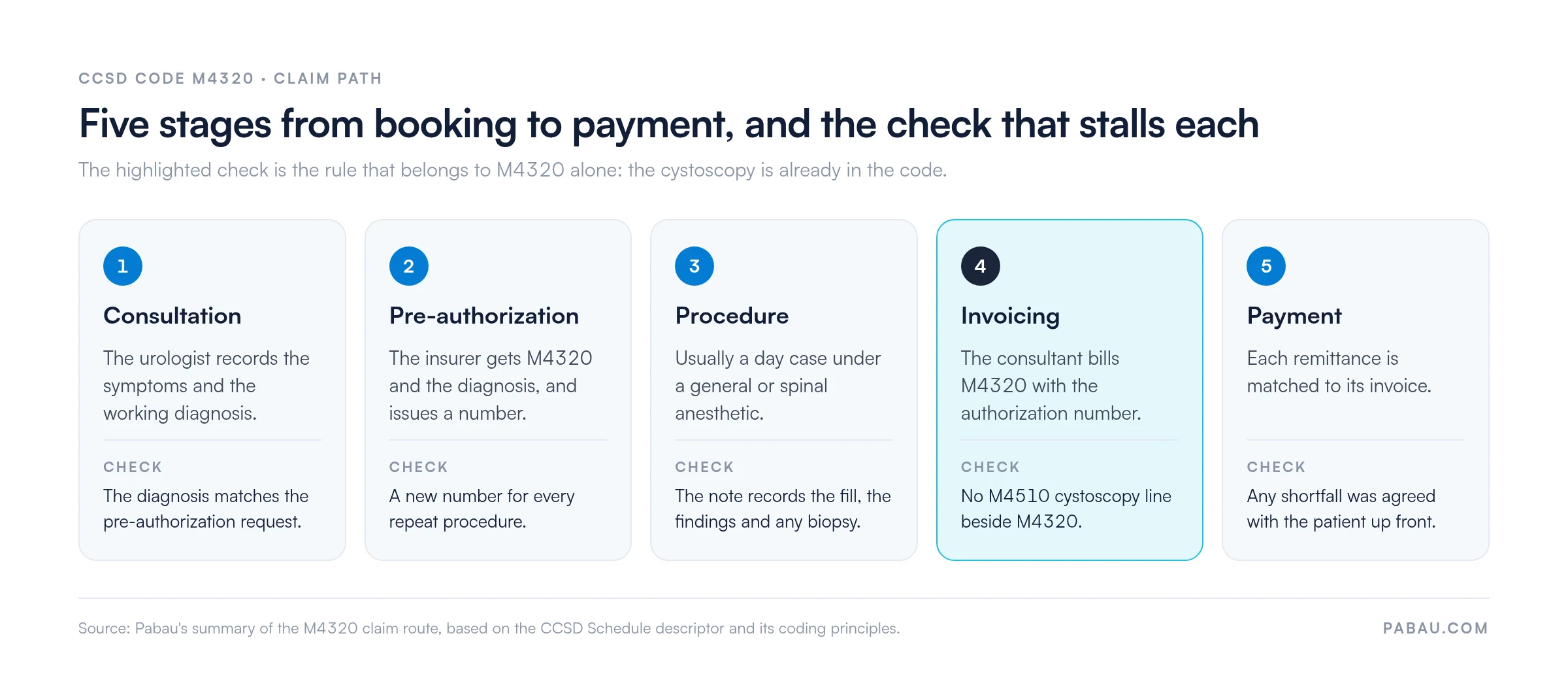
Here’s how a typical claim might run for an illustrative patient. A 52-year-old woman with bladder pain syndrome had hydrodistension 14 months ago. Her symptoms eased, then came back, which BAUS says happens to almost all patients at some point.
Her consultant books a repeat procedure. The practice calls her insurer with M4320 and the diagnosis, and receives a new authorization number. The one from last year doesn’t carry over.
During the procedure, the surgeon takes a biopsy from one area of the bladder lining. The medical secretary is about to add M4510 for it. Instead, the claim goes out as M4320 alone, with the new authorization number and an operative note that records the biopsy.
Most M4320 problems start at the front desk, not in the operating room. The authorization number sits in an email, the operative note lives somewhere else, and the invoice gets keyed in by hand.
Pabau, the practice management and billing platform we build, keeps those pieces on one patient record. The authorization code, its dates and its sessions sit on the patient’s case, and Pabau warns you when one is missing.
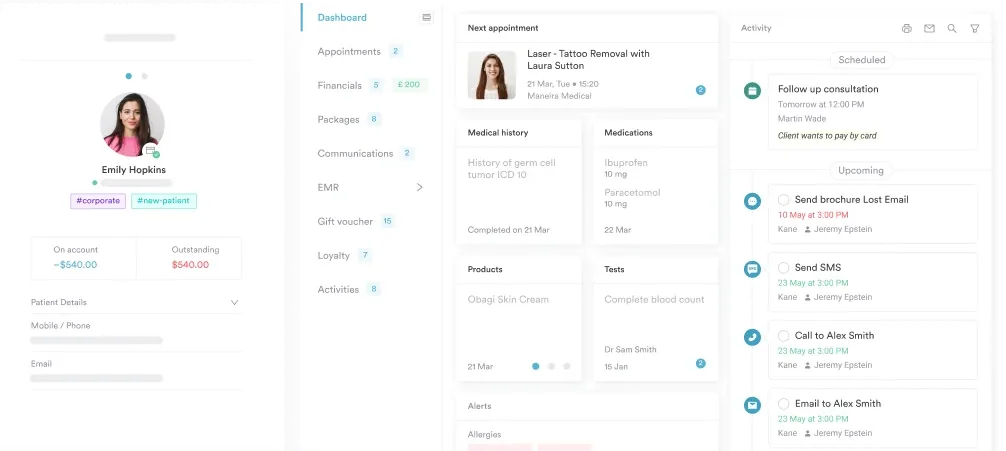
UK claims go through Pabau’s claims management software to Healthcode and Bupa. Pabau checks that the claim’s required fields are complete before it sends, then tracks the claim through to payment. Choosing M4320 alone, with no cystoscopy line, stays your coder’s call.
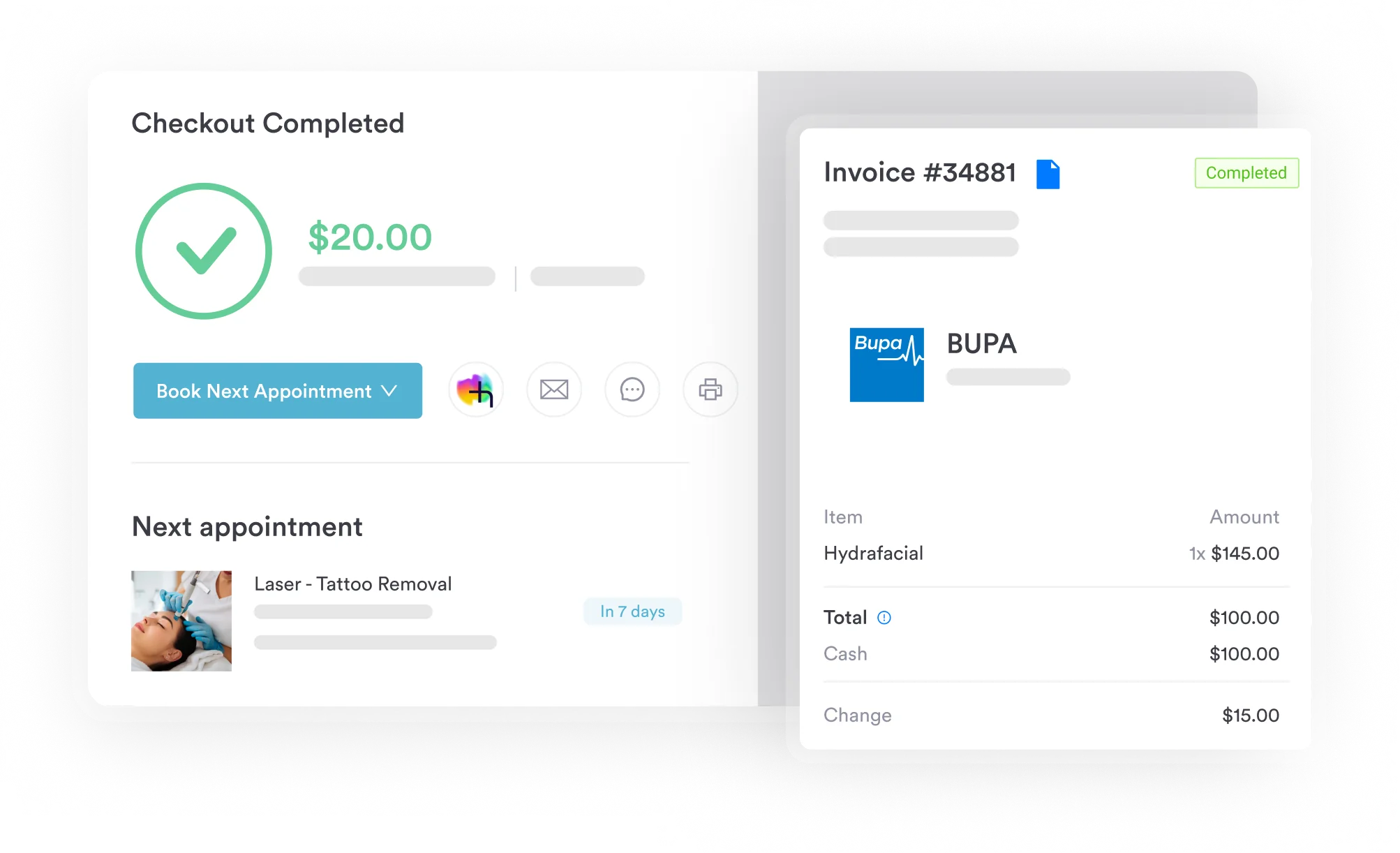

Pabau keeps the authorization, the operative note and the invoice on one patient record, then sends UK claims through Healthcode. Your team spends less time chasing rejections.

M4320 is an easy code to get right once you accept one rule. The cystoscopy belongs to it, so any other procedure done through the same scope needs the insurer’s agreement before it goes on the claim.
The harder part is the paperwork around it. Repeat procedures, biopsies and fresh authorizations are where these claims stall, so build them into your booking routine rather than your rejection queue.
Book a demo to see how Pabau tracks authorizations and sends CCSD claims through Healthcode from the patient record.

Billing a diagnostic look without treatment? CCSD code M4510 covers flexible cystoscopy, with or without biopsy.
Billing a bladder repair instead? CCSD code M3700 walks through the bladder repair code and how its claim runs.
Is the plan surgical enlargement instead of stretching? CCSD code M3600 covers bladder enlargement and its bowel-segment variants.
New to the CCSD Schedule? Bupa CCSD codes explains how the schedule is structured and used by insurers.
Usually, but not always. BAUS says it is done under either a general anesthetic or a spinal anesthetic, which numbs the body from the waist down.
Yes, most are discharged the same day. A temporary catheter is sometimes placed, especially after a biopsy, and is usually removed within a few days.
It varies. BAUS notes the relief may be temporary, and symptoms return at some point in almost all patients. Some get no relief at all.
Burning on passing urine and a short flare of symptoms affect almost all patients. Urine infection affects between 1 in 10 and 1 in 50. Bladder perforation is rarer, usually after a biopsy.
Each insurer does. CCSD sets the codes and their descriptions, not the fees, so check the patient’s insurer before you quote a price.