

HCPCS Code E0272: Foam rubber mattress billing guide
HCPCS Code E0272: official descriptor and code overview HCPCS Code E0272 is the ...

Last Updated: Nov 6, 2026
CCSD code L9180 is the UK private billing code for inserting an implantable central venous port, or portacath, under image guidance. Consultants use it when a patient needs months of reliable venous access, most often for chemotherapy. The port sits under the skin, usually on the chest.
The trouble is that L9180 has close neighbors. Removal has its own code, L9181, and CCSD lists two other access codes, L9115 and XR915, as unacceptable alongside it. Getting those boundaries and the paperwork right before submission keeps an L9180 claim out of the query pile.
Let Pabau's smart automation suggest the right codes, reduce claim denials, and keep your practice compliant—effortlessly.
Automate repetitive tasks and focus on what matters most—your patients.
Reduce coding errors and ensure compliance with the latest regulations.
Clean claims, fewer denials, and faster reimbursements.
Powerful insights and reporting to help your practice thrive.
HIPAA compliant SOC 2 certified GDPR-compliant Trusted by 4,000+ clinics worldwide

CCSD code L9180 covers inserting an implantable central venous port, or portacath, under image guidance.
Taking the port out later is a separate episode, billed under its own removal code, L9181.
CCSD lists L9115 and XR915 as unacceptable combinations with L9180, so never put them on the same invoice.
A clean claim needs the insurer’s authorization number, the underlying diagnosis and an operation note that names the imaging used.
Each insurer decides which CCSD principles it adopts, so confirm anything unusual with the insurer before you bill.
CCSD code L9180 is the UK private billing code for inserting an implantable central venous port under image guidance. The official descriptor reads “Insertion of implantable central venous port (portacath) e.g Port-a-Cath under image guidance.”
A portacath is a small chamber placed under the skin, usually on the chest, with a catheter running into a central vein. It gives reliable venous access for months of treatment, most often chemotherapy. Consultants who place ports, such as interventional radiologists and surgeons, bill it to private medical insurers.
The code includes:
It does not cover taking the port out, placing a line with no port, or a PICC. Those have their own codes, set out below. The CCSD group, which sets the codes on behalf of the major UK insurers, publishes the full schedule behind a login. Our CCSD codes library covers other codes from the same schedule.
Most port claims follow the same five steps. Knowing where each one can stall saves weeks of chasing.
For insurer-specific routes, our guide to Bupa CCSD codes walks through how Bupa handles coded invoices.
Four codes sit close enough to L9180 to cause trouble. Two of them, L9115 and XR915, appear on CCSD’s list of unacceptable combinations with L9180.
CCSD describes these combination rules as guidance, and each insurer chooses whether to adopt them. So when an episode really involves two devices, call the insurer before you bill both.
The device named in the operation note settles which code goes on the invoice, as the chart below shows.
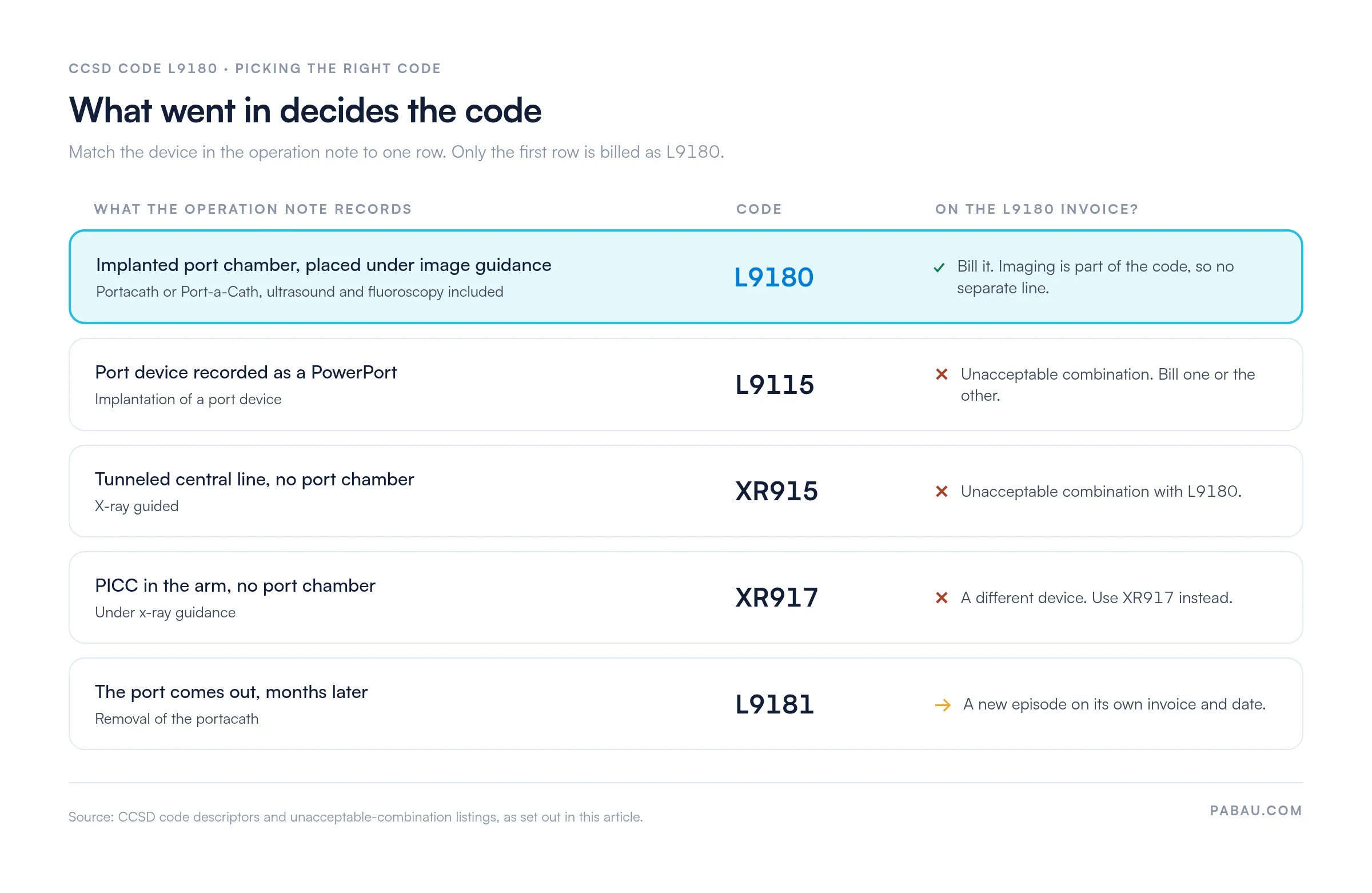
Picture a privately insured patient about to start several months of chemotherapy. Her oncologist refers her for a port, and the insurer issues an authorization number.
A consultant interventional radiologist finds the vein with ultrasound and checks the catheter tip on fluoroscopy. His invoice carries L9180, the cancer diagnosis, the authorization number and the date. He doesn’t add a separate imaging line, because the descriptor already includes image guidance.
Eight months later, treatment ends and the port comes out. That is a new episode under L9181, with its own date and, depending on the insurer, its own authorization. Putting the removal on the original L9180 invoice, or billing it as a second L9180, is how this claim gets rejected.
Rejections on port claims tend to come from the same handful of mistakes:
If an old port is swapped for a new one in a single session, ask the insurer how it wants that episode coded. Don’t guess.
Image guidance bundled into a port insertion doesn’t take its own invoice line, but a venogram with its own request and report does. CCSD code L9510 covers that contrast study on one line, whether one side or both.
Run through these points on every port invoice. Each one takes seconds and closes off a common query.
Port claims usually stall on admin. A missing authorization number or a mistyped membership number is enough to bounce an invoice.
Pabau, the practice management platform we build, connects to Healthcode, so a CCSD-coded invoice goes from the patient record to the insurer without retyping. It also helps you catch missing claim details, such as the membership and authorization numbers, before you send.
You can then follow each claim’s status in one place, so a query reaches you while the episode is still fresh. See how our claims management software handles the rest of the pipeline.

Pabau sends CCSD-coded invoices to insurers through Healthcode and helps you catch missing claim details first. Fewer port claims come back with queries.

L9180 is a narrow code, and that works in your favor. If a port chamber went in under image guidance, the code fits. If it didn’t, a neighboring code does.
Rejected port claims usually trace back to code boundaries and paperwork. So settle the device, the authorization and the operation note before the invoice leaves. Then bill the removal as its own episode when the time comes.
Book a demo to see how Pabau sends CCSD-coded port claims to insurers through Healthcode, straight from the patient record.

Billing port and line codes to Bupa? Bupa CCSD codes explains how Bupa uses the CCSD schedule and what it expects on a coded invoice.
Wondering what a port insertion pays? Bupa procedure codes fee schedule shows how Bupa sets its fees by procedure code.
Coding other image-guided vascular work? CCSD code XR935 covers vena cava filter insertion and removal.
Billing the same procedure in the US? CPT code 36561 covers a tunneled central venous catheter with a subcutaneous port.
L9180 is the CCSD code for inserting an implantable central venous port, or portacath, under image guidance. UK consultants use it to bill private medical insurers, most often when a patient needs long-term access for chemotherapy.
No. Removal has its own code, L9181, “Removal of Portacath/Port-a-Cath/Vasoport Unit.” Bill it as a separate episode when the port comes out.
CCSD lists both XR915 and L9115 as unacceptable combinations with L9180. Each insurer decides whether to adopt CCSD’s combination rules, so confirm with the insurer before billing two access devices together.
No. A PICC has no implanted port chamber. PICCs placed under x-ray guidance are listed under XR917.
The consultant who places the port bills it, usually an interventional radiologist or a surgeon. If an anesthetist provides sedation, they normally invoice the insurer separately.
Most UK private medical insurers expect the patient to get authorization before treatment. Put the authorization number on the invoice, because a missing number is a common reason for a query.




