

HCPCS Code Q4185: Cellesta flowable amnion billing guide
HCPCS Code Q4185: definition and official descriptor HCPCS Code Q4185 is the Lev...

Last Updated: Nov 20, 2026
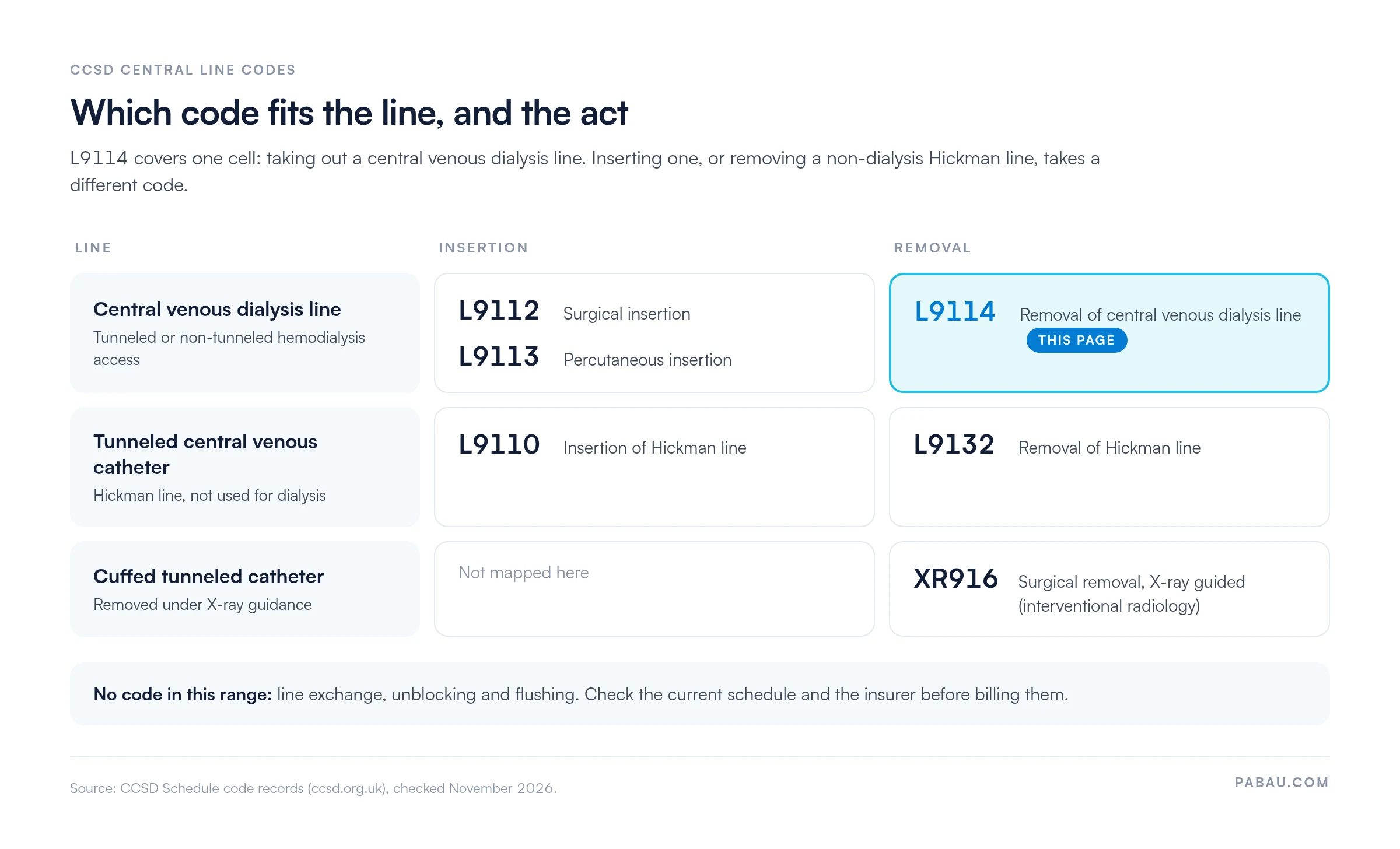
L9114 is the CCSD code for removal of a central venous dialysis line, the catheter that gives hemodialysis access through a central vein. UK private practices use it to bill private medical insurers for taking that line out.
It covers removal only. Inserting a dialysis line takes L9112 (surgical) or L9113 (percutaneous), and removing a non-dialysis Hickman line takes L9132.
Let Pabau's smart automation suggest the right codes, reduce claim denials, and keep your practice compliant—effortlessly.
Automate repetitive tasks and focus on what matters most—your patients.
Reduce coding errors and ensure compliance with the latest regulations.
Clean claims, fewer denials, and faster reimbursements.
Powerful insights and reporting to help your practice thrive.
HIPAA compliant SOC 2 certified GDPR-compliant Trusted by 4,000+ clinics worldwide

CCSD code L9114 covers removal of a central venous dialysis line. Inserting one takes L9112 (surgical) or L9113 (percutaneous).
A tunneled Hickman line that isn’t used for dialysis has its own pair of codes, L9110 for insertion and L9132 for removal.
The CCSD schedule shows no separate code in this range for exchanging, unblocking or flushing a dialysis line, so ask the insurer before billing one.
State in the procedure note whether the catheter was tunneled or non-tunneled, because insurers query claims that leave it out.
Preauthorization rules differ between Bupa, AXA Health, Aviva, Vitality and Healix, so confirm them before the procedure date.
CCSD code L9114 is the procedure code for removal of a central venous dialysis line, used by UK private practices to bill private medical insurers. The CCSD Schedule holds the standard codes for procedures and diagnostic tests in the UK private healthcare sector. L9114 sits in its vascular system chapter and covers only the act of taking the catheter out.
Insertion has separate codes, L9112 for surgical insertion and L9113 for percutaneous insertion. A tunneled Hickman line that isn’t used for dialysis is removed under L9132 instead. The CCSD record lists no exchange, unblocking or flushing code alongside them.
The official descriptor is Removal of central venous dialysis line. Put the code and that descriptor on the invoice exactly as the current schedule lists them. Any variation in wording can trigger a query from the insurer’s coding team. Bupa builds its own procedure list on the same schedule, and our guide to Bupa CCSD codes covers how those claims are submitted.
Removal of a central venous dialysis line is the controlled extraction of a catheter that has provided temporary or longer-term hemodialysis access. The catheter usually sits in the internal jugular, subclavian or femoral vein. The procedure differs depending on whether the catheter is tunneled or non-tunneled, and that changes what the note has to record.
Non-tunneled (temporary) lines are removed at the bedside or in a procedure room. The sutures are cut, the catheter is withdrawn under steady pressure, and manual pressure is held on the exit site until hemostasis is confirmed. A tunneled line has a Dacron cuff embedded in the subcutaneous tissue. That cuff must be dissected free before the catheter comes out, which adds a minor surgical step to the note.
Standard steps for removing a tunneled central venous dialysis line:
Record the indication for removal in the clinical note. Typical reasons are a move to an arteriovenous fistula or graft, the end of dialysis, or a catheter-related bloodstream infection (CRBSI). A malfunctioning catheter that won’t be replaced is another.
The tunneled and non-tunneled distinction matters to coders because it changes documentation depth and operator expectations. It can also change how an insurer reads the claim.
The L9114 descriptor doesn’t separate tunneled from non-tunneled dialysis lines. What changes the code is the line’s purpose. A tunneled Hickman line placed for long-term IV access isn’t a dialysis line, so its removal is L9132.
CCSD also holds XR916, “Surgical removal of cuffed central venous catheter – tunnelled (X-ray guided)”, in its radiology codes. When a radiologist removes a cuffed line under X-ray guidance, ask the insurer which code it expects before you submit.
Five neighboring CCSD codes describe other acts on a central line, and picking the wrong one is a frequent reason L9114 claims get queried. The map below shows which code fits each line and each act.
When a catheter is exchanged in one session, the clinical record must state that two procedural acts took place. Billing L9114 alone for a same-session exchange is likely to draw a query, because the notes describe more than the invoice does.
The CCSD technical guide says no common intervention should routinely need more than one code. It also tells you to contact the insurer before using two procedure codes for one attendance. So ask how the insurer wants an exchange billed before the claim goes in.
Before you submit an L9114 claim, check the clinical note against the CCSD descriptor for every code on the invoice. If the note describes an exchange and the invoice shows only a removal, correct the invoice first. A mismatch you knew about and submitted anyway is a harder audit problem than a query before submission.
Private medical insurers check L9114 claims against the clinical documentation submitted with the claim or held on record for the episode. The procedure note should record each of these elements:
A note built around these elements also supports the record-keeping a Care Quality Commission (CQC) inspection looks for. One structured record can serve the insurer and the inspector.
UK private medical insurers process L9114 claims through Healthcode, the main UK private healthcare billing portal. Preauthorization requirements differ by insurer and change over time. The table below shows general patterns rather than guaranteed rules, so verify with the insurer’s provider line or portal before the procedure.
A preauthorization request should include the CCSD code (L9114), the clinical indication and the catheter type. Add the treating consultant’s GMC number and the proposed procedure date. Retrospective authorization for a dialysis line removal is harder to obtain, and refusals tend to rest on procedural grounds rather than clinical ones.
L9114 claims tend to fail for predictable reasons, and each one can be fixed before submission.
Not every central venous dialysis line removal goes as planned. When a complication arises, the clinical record and the invoice must both reflect it. Under-coding a complicated removal loses revenue, and over-coding without documentary support creates audit risk.
The most common complications and their coding implications are:
Across all four scenarios, a complication justifies additional billing only when detailed, contemporaneous documentation supports it. A note that says “difficult removal” without describing the difficulty won’t support an extra code at audit.
Knowing which codes can accompany L9114 on the same claim, and which are bundled within it, prevents both underclaiming and unbundling queries.
With single-record claims management, the billing team can check these code combinations against the note before the claim reaches Healthcode. When you code neighboring procedures, Pabau’s code library helps you find the right CCSD codes.
Run a quarterly audit of the L9 central line claims submitted in the last three months. Compare what the clinical note describes (tunneled or non-tunneled, dialysis or Hickman line, complication or none) with the code billed. Any mismatch is a denial risk on resubmission or a future audit. Flag repeated mismatches for a documentation training session with the clinical team.
In many practices the removal is written up in one system and billed from another. Someone at the billing desk reads the note, picks a code and keys the claim into Healthcode. A missing catheter type, or a Hickman line logged as a dialysis line, only surfaces when the insurer queries it.
Pabau keeps the note and the claim in the same patient record. Its digital forms let you build the catheter type, line purpose, operator and indication into the procedure note. Client records hold that note against the patient’s history, and the claim goes to Healthcode or Bupa from the same record.
So the coder reads the same note the insurer will see, and fewer L9114 claims come back asking for details the clinician already recorded.
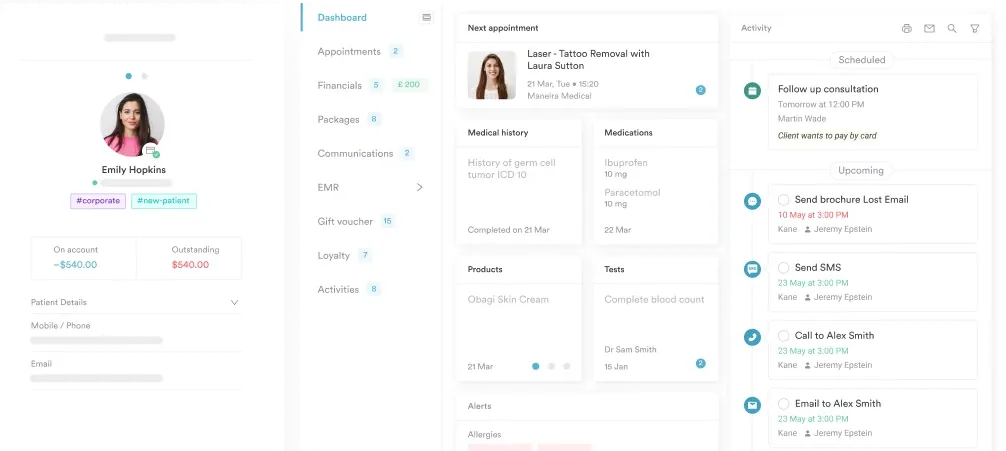

Pabau connects your procedure documentation, billing codes and Healthcode submission. See how UK private practices handle L9114 and other CCSD codes without switching between systems.

L9114 is easy to code once two questions are settled. Was a line taken out rather than put in, and was it a dialysis line rather than a Hickman line? Answer both in the procedure note, and the code follows from the note instead of from memory.
The work that pays off happens before the claim. Record the catheter type and line purpose, confirm preauthorization before the procedure date, and ask the insurer how it wants an exchange billed. A claim built that way is far less likely to come back with a query.
If your team still re-keys procedure notes into Healthcode, book a demo to see Pabau carry the note straight into the claim.

Need a broader CCSD billing reference for Bupa procedures? Bupa CCSD codes guide covers the Bupa procedure code schedule and how to submit claims via Healthcode.
Billing the insertion instead? CCSD code L9112 covers surgical insertion of a central venous dialysis line.
Was the line placed through the skin? CCSD code L9113 covers percutaneous insertion of a central venous dialysis line.
CCSD code L9114 covers removal of a central venous dialysis line, the catheter that gives hemodialysis access through a central vein. It does not cover insertion, which is L9112 (surgical) or L9113 (percutaneous). Removal of a non-dialysis Hickman line is L9132.
L9114 is the removal code for a dialysis line. The adjacent codes cover insertion, with L9112 for surgical and L9113 for percutaneous placement. L9110 and L9132 cover inserting and removing a tunneled Hickman line. The CCSD record shows no separate exchange, unblocking or maintenance code in this range.
Preauthorization rules vary by insurer and change over time. Bupa and AXA Health may require prior authorization for a planned dialysis catheter removal. Confirm with the insurer’s provider helpline or portal before the procedure date, because retrospective authorization is much harder to obtain.
Insurers expect the clinical indication, the catheter type (tunneled or non-tunneled), and the anatomical site and side. Add the operator’s name and registration number, and any anesthesia or sedation used. Confirm the catheter and any cuff came out intact, record how hemostasis was achieved, and state whether complications occurred.
Complications such as bleeding that needs surgical hemostasis, a retained cuff, or a fractured catheter may justify codes beyond L9114. That holds only when the note describes the complication, the intervention and the clinical reasoning. Extra codes without that documentation risk being read as upcoding at audit.
Yes, with the right structure. A separate anesthetist bills sedation or general anesthesia under their own recognized provider number, and that doesn’t affect the operating clinician’s L9114 claim. Local anesthetic given by the operating clinician is part of L9114 and isn’t billed separately.





