CCSD code XR940: Foreign body retrieval billing guide
CCSD code XR940 is the UK private healthcare code for retrieval of a foreign bod...

Last Updated: Nov 26, 2026
CCSD code XR916 is the UK private billing code for removing a tunnelled central venous catheter (CVC) under X-ray guidance. It sits in chapter 9.6.0 (Non-Specific) of the CCSD Schedule, which holds the standard procedure codes for UK private healthcare.
Think of it as a line removal that happens to use imaging. The “XR” prefix tempts coders to bill it as plain-film radiography, and insurers refuse those claims.
Getting it right keeps payment moving for a quick procedure with heavy paperwork. Below, you’ll find how the removal runs, how the claim moves, a before-you-submit checklist and the mistakes to avoid.

CCSD code XR916 covers removal of a tunnelled central venous catheter under X-ray guidance, in chapter 9.6.0 (Non-Specific).
XR-prefix codes cover imaging and image-guided procedures, so XR916 bills a line removal rather than a plain-film study.
XR915 and XR917 both list XR916 as an unacceptable combination, so check the rules before billing a line exchange.
The CCSD schedule is login-gated, so confirm the exact XR916 descriptor in your CCSD login before coding.
Many UK insurers use CCSD coding, but each sets its own fees and authorization rules for XR916.
XR916 describes one service, taking out a tunnelled central venous catheter with X-ray imaging to guide the procedure. A tunnelled line runs under the skin from an exit site on the chest wall to the vein it enters. Most carry a cuff that the tissue grows around, which anchors the catheter in place.
The CCSD Group (Clinical Coding and Schedule Development) maintains the schedule. Its full code list sits behind a login, so the wording below is our summary rather than a quote. Check the exact XR916 descriptor in your CCSD login, or your insurer’s code search, before you code the claim.
Neighboring procedures have their own pages in our CCSD codes library, each with the same claim checks.
Many tunnelled lines come out at the bedside without imaging. XR916 applies when X-ray guidance forms part of the removal, typically in an interventional radiology suite. Here’s the general outline, though the operating clinician’s own record is what the claim rests on.
The record should say why imaging was used. That note is what separates XR916 from a removal that didn’t need X-ray guidance.
Insurers want to see why the line came out. The usual indications for removing a tunnelled CVC are:
The XR codes around XR916 cover other image-guided line work. Picking the right one comes down to two questions. Is the line going in or coming out? And what type of line is it? The panel below maps each answer to a code.
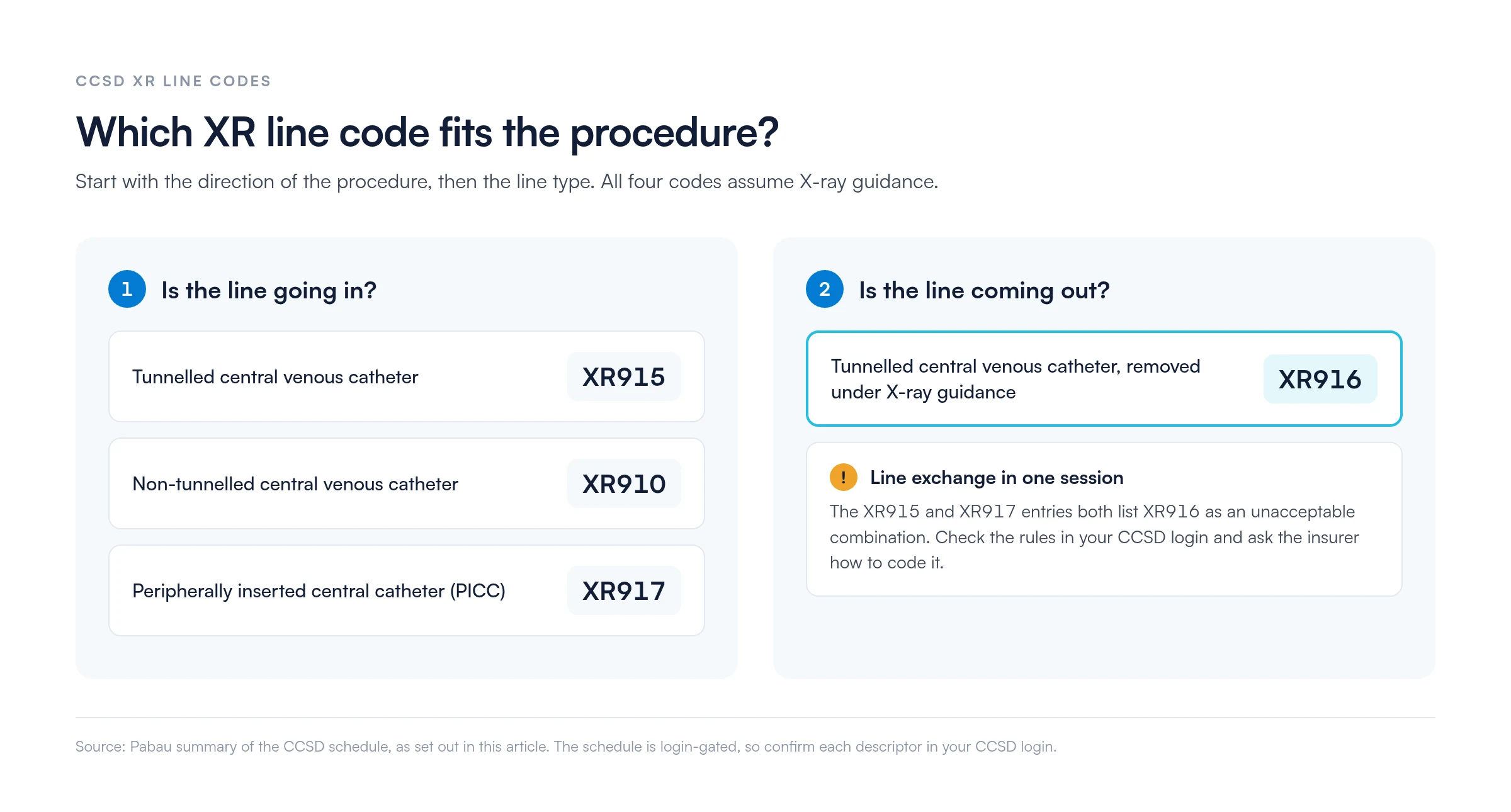
A PICC placed under X-ray guidance is billed with XR917, so match the line type before you pick a code.
The prefix alone can’t guide code selection either. XR920 shares the XR letters but sits in another chapter. XR codes span several CCSD chapters, so always code from the descriptor.
The combination that catches practices out is a line exchange. One line comes out and another goes in during the same visit. Three quick questions cover the rules.
Can you bill XR915 and XR916 together? Not as a standard pair. The XR915 entry lists XR916 as an unacceptable combination, alongside L9110, XR910, XR917 and L9180.
Does a PICC change the answer? No. The XR917 entry also lists XR916 as an unacceptable combination.
So how do you code an exchange? Check the current rules in your CCSD login, then ask the insurer how it wants the exchange coded. Rules can change between schedule updates.
Before you add a second line code to an XR916 claim, open the combination rules for both codes in your CCSD login. An unacceptable pairing is usually rejected outright, and the resubmission delays payment for the whole episode.
Each stage hands something to the next, and a missing piece stalls the claim. This is the usual path:
Record the authorization number in the patient’s file as soon as it’s issued. Most insurers won’t pay a claim that’s missing it, and few accept retrospective requests.
Here’s how that looks for an illustrative patient. Her chemotherapy course has ended, and her tunnelled line won’t slide free at the cuff. The consultant requests removal under X-ray guidance, and the team secures authorization for XR916. The note explains why imaging was needed and confirms the line came out whole. The invoice then carries XR916, the authorization number and the consultant’s recognition number.
XR916 is a procedure, so the claim rests on the procedure note rather than a radiology report. Tick off each item before the invoice goes out:
Each refusal below traces back to coding or paperwork, and each one has a simple fix.
Fees for XR916 differ by insurer and change with each schedule update. We don’t quote a figure here because none is published openly for this code. Confirm each insurer’s schedule before the appointment:
Multiple-procedure rules matter too, where a pairing is allowed. Aviva’s procedure guidelines pay 100% of the first procedure, 50% of the second and 25% of the third.
Checking the fee early means the invoice matches what the insurer expects. It also spares the patient a shortfall conversation after the procedure. The Bupa CCSD codes guide explains how Bupa’s code search works.
Line removals are quick, but the paperwork around them isn’t. The procedure note, consent record and authorization number often sit in different places. The claim then waits until someone pulls them together.
Pabau, a practice management platform with built-in claims tools, brings those pieces together. You can keep the procedure note on the patient’s episode and track authorization status. Coded claims then go to insurers through Healthcode, and our claims management software follows each one to payment.
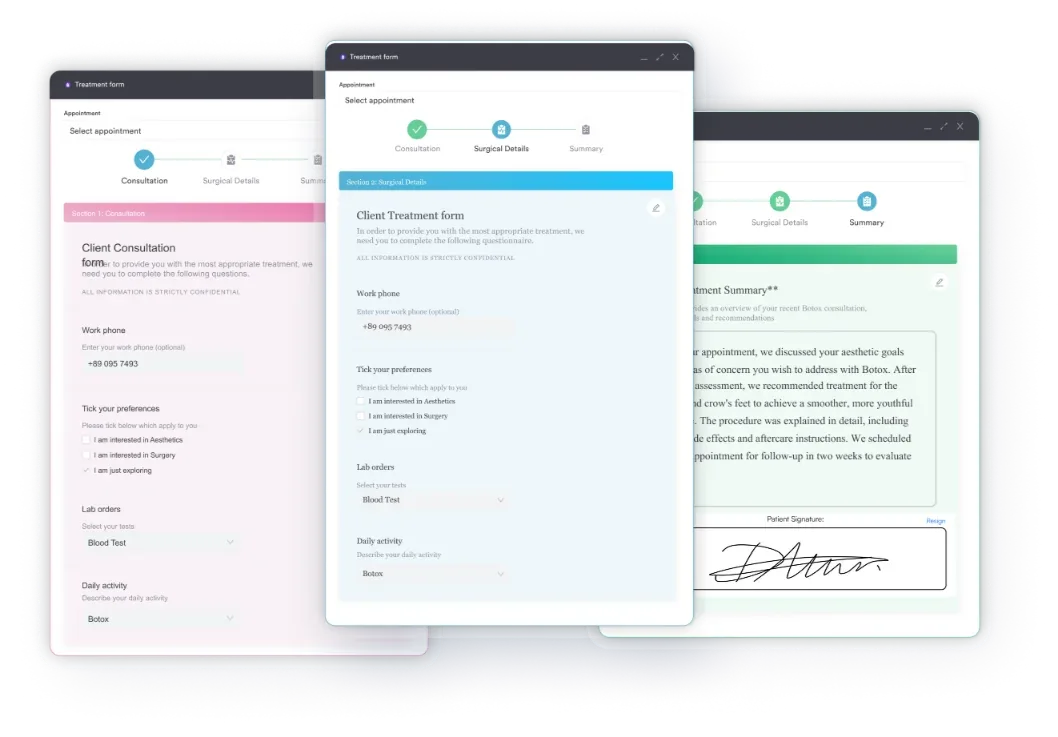
Digital consent forms help as well. Patients sign before the appointment, and the signed record lands in the same file as the procedure note.
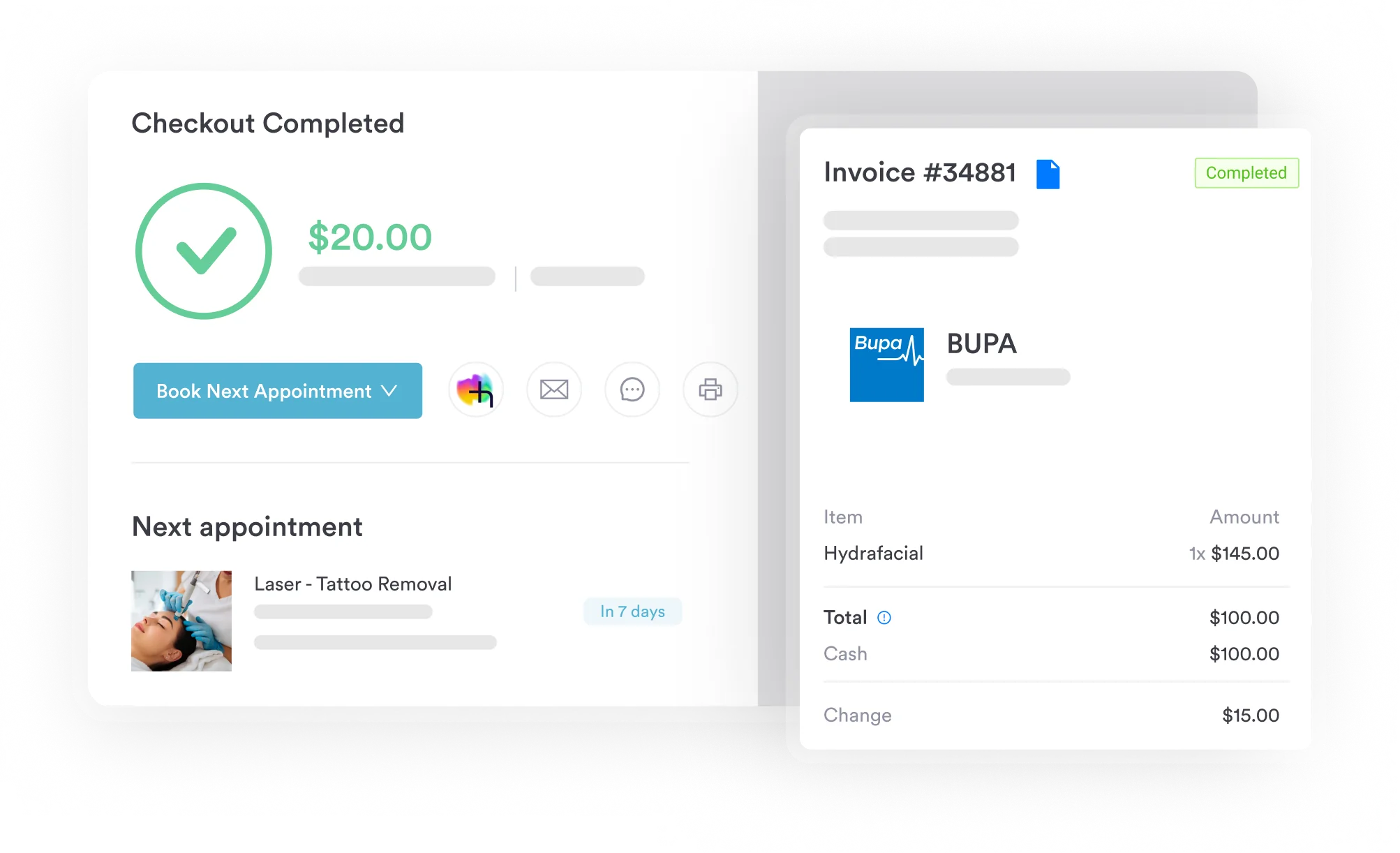

Pabau tracks authorization status, keeps the procedure note and consent on the patient’s episode, and sends coded claims through Healthcode.

XR916 looks like an X-ray code but bills as a procedure. Code it as the X-ray guided removal of a tunnelled central line. Back it with a note that explains the imaging, and keep it apart from XR915 and XR917 on an exchange.
The schedule is login-gated and changes on a set cycle, so make one habit stick. Confirm the descriptor and combination rules in your CCSD login after each update. Book a demo to see how Pabau keeps consent, notes and authorization together before an XR916 claim goes out.

Coding a PICC placed under X-ray guidance? CCSD code XR917 covers the PICC insertion code that sits next to XR916 in the schedule.
Billing a vena cava filter instead of a line? CCSD code XR935 explains the image-guided filter insertion and removal code.
Need a full reference for Bupa procedure codes? Bupa CCSD codes covers the complete Bupa procedure code schedule with fee and submission guidance.
Looking for tools to handle multi-insurer private billing? Claims management software outlines how Pabau tracks claim status, documents and payment across UK private insurers.
Often, yes. A Hickman line is a common type of cuffed, tunnelled central venous catheter. If it comes out under X-ray guidance, XR916 is the likely fit, but confirm the descriptor in your CCSD login first.
Don’t assume it does. A port sits fully under the skin, with no external line or exit site. That makes it a different device, so search your CCSD login for the port removal code.
CCSD publishes changes within 10 working days of each Working Group meeting. Each change carries a recommended adoption date, about two months after publication. Recheck XR916 after each cycle.
No. The CCSD Board describes the schedule as non-binding, so applying a code is each insurer’s commercial decision. Check XR916 against each insurer’s own schedule before the procedure.
Yes, many are removed at the bedside with no imaging. XR916 fits only when X-ray guidance is part of the removal, so the procedure note needs to say why it was used.