

HCPCS Code E0272: Foam rubber mattress billing guide
HCPCS Code E0272: official descriptor and code overview HCPCS Code E0272 is the ...

Last Updated: Nov 6, 2026
L3710 is the CCSD code for bypass of subclavian artery from the arch. In this open operation, a surgeon runs a graft from the aortic arch to the subclavian artery. The graft carries blood past a narrowed or blocked segment.
CCSD files L3710 in Chapter 9, Head & Neck, under sub-chapter 9.1.0. It lists L3711, the extra-thoracic subclavian bypass, as an unacceptable combination, along with L3730, L6710 and L7010. Fees are agreed between each insurer and provider, so check the patient's policy before admission. The operative note should name the arch as the graft's origin.
Let Pabau's smart automation suggest the right codes, reduce claim denials, and keep your practice compliant—effortlessly.
Automate repetitive tasks and focus on what matters most—your patients.
Reduce coding errors and ensure compliance with the latest regulations.
Clean claims, fewer denials, and faster reimbursements.
Powerful insights and reporting to help your practice thrive.
HIPAA compliant SOC 2 certified GDPR-compliant Trusted by 4,000+ clinics worldwide

CCSD code L3710 covers bypass of the subclavian artery from the aortic arch, an open vascular operation inside the chest.
CCSD files L3710 in Chapter 9, Head & Neck, under sub-chapter 9.1.0 of the CCSD schedule.
CCSD lists L3711, L3730, L6710 and L7010 as unacceptable combinations with L3710, so none of them belongs on the same claim.
The operative note should name the arch as the graft’s origin, because that detail separates L3710 from L3711.
CCSD does not set fees, so confirm cover, pre-authorization and fees with the patient’s insurer before admission.
CCSD code L3710 is the UK private-sector code for bypass of subclavian artery from the arch. In plain terms, a surgeon connects a graft to the aortic arch and joins it to the subclavian artery. Blood then flows around a narrowed or blocked segment near the artery’s origin.
The code sits in Chapter 9, Head & Neck, under sub-chapter 9.1.0 of the CCSD schedule. Its closest relative is L3711, the extra-thoracic subclavian bypass, which CCSD bars from the same claim. Our CCSD code guides cover the neighboring vascular entries in the same format.
One warning before you go further. HCPCS, the US Level II code set, also has an L3710. There, it describes a prefabricated elastic elbow orthosis with metal joints. Your UK claim needs the CCSD meaning, so check which code set a source uses before you trust it.
The subclavian artery carries blood to the arm and feeds the vertebral artery. When its first part narrows, the arm or the back of the brain can run short of blood.
A bypass from the arch reaches that first part from inside the chest. The surgeon usually opens the chest through the breastbone. A graft then runs from the arch to the subclavian artery beyond the disease. That intrathoracic route is what sets L3710 apart.
Extra-thoracic options stay outside the chest, for example a bypass from the carotid artery in the neck. Those fall under L3711, not L3710. Stenting through a catheter is a third route, billed under its own code.
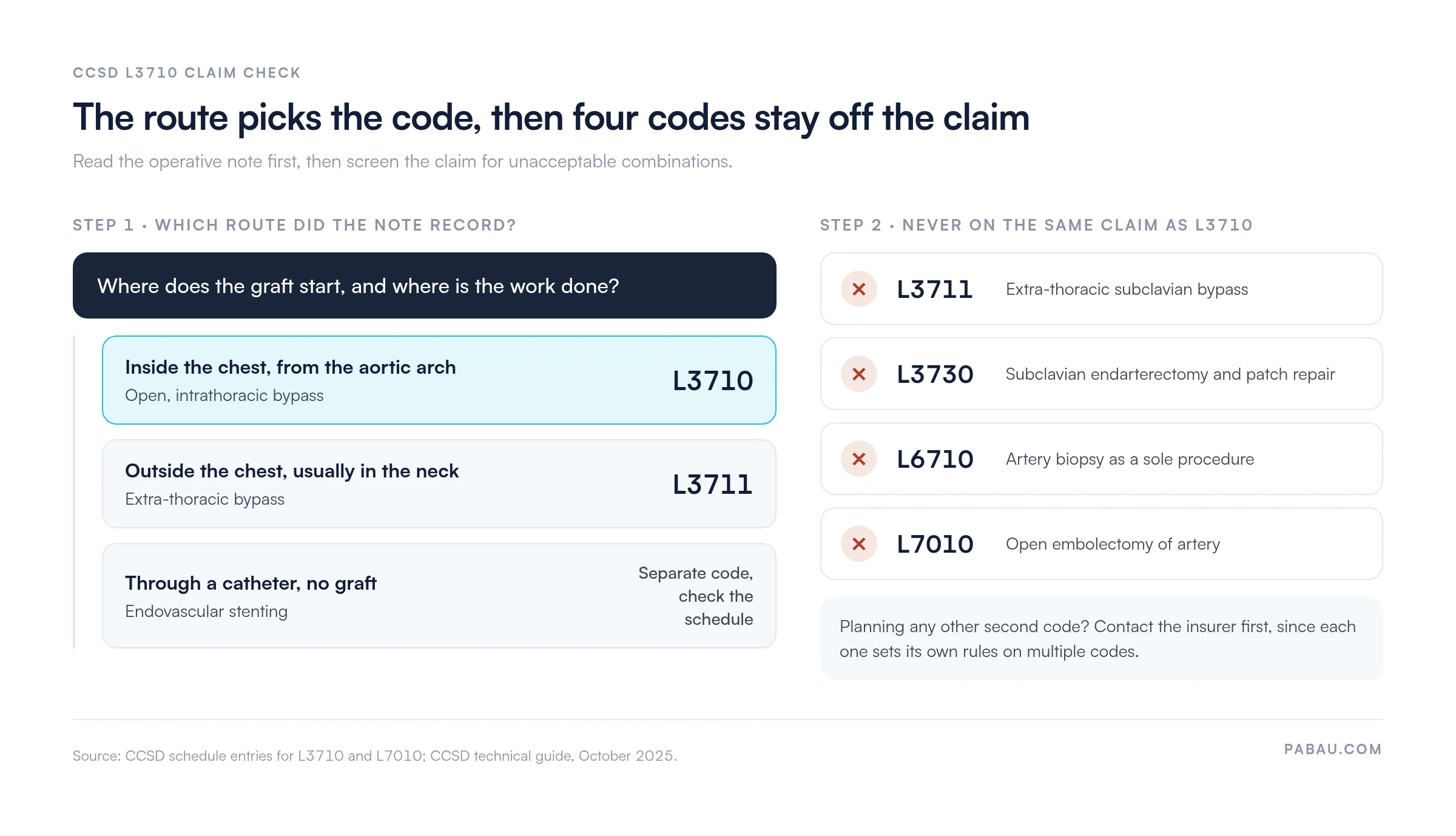
The route decides the code, so keep the three apart. This table sets them side by side.
Only the first row belongs on an L3710 claim. If the note describes a neck incision and no chest opening, recheck the code.
CCSD lists L3711 as an unacceptable combination with L3710. That means the two codes should not appear on the same claim. CCSD also lists L3730, L6710 and L7010 as unacceptable combinations with L3710. Those cover subclavian endarterectomy and patch repair, artery biopsy as a sole procedure, and open embolectomy of artery.
The chart below puts the route check and all four bans in one view.
Two of those bans apply to another bypass code as well. CCSD lists L6710 and L7010 as unacceptable combinations with L1620, the axillo-unifemoral bypass from the axillary artery to one groin.
The CCSD technical guide adds three rules worth knowing:
That last rule matters here. An open bypass and a stent on the same artery, in one sitting, need a careful check with the insurer.
Each insurer has its own contract rules for using two procedure codes at one attendance. If you plan to bill a second code beside L3710, contact the insurer first.
UK insurers expect the diagnosis on the claim to explain the surgery. These ICD-10 codes often fit the conditions that lead to a bypass from the arch. Always confirm the final code against the ICD-10 index and the clinical record.
The surgeon’s own words decide the code. If the note says “subclavian steal”, code that. If it only says “stenosis”, do not code steal.
Steal carries a second meaning in vascular coding. Dialysis access steal syndrome arises when an arteriovenous fistula diverts blood from the limb, and ligating that fistula takes L7423.
The operative note is your main evidence. Because L3710 and L3711 differ only by route, a vague note invites a query. Make sure it records these points:
Store the note and imaging reports in one patient record where the billing team can find them. Insurers may ask for both when they review a claim.
Run through this checklist before the claim leaves the practice. Each item answers a question an insurer may otherwise ask.
On fees, the CCSD technical guide is clear. CCSD develops the codes, but fees are a matter for each funder and provider to decide through contract. So the insurer, not CCSD, tells you what L3710 pays. For insurer-specific code lists, see our guide to CCSD codes accepted by Bupa.
Each of these errors is easy to catch before submission.
In many practices, vascular billing runs on three systems. The operative note sits in one, the imaging report in another, and the claim in a third. When an insurer queries the claim, someone has to rebuild the file by hand.
Pabau, the practice management platform we build, keeps those pieces on one patient record. Its claims management software sends UK claims through Healthcode. It also checks that fields such as the membership number and authorization code are complete before a claim goes out. Practices in the US and Australia submit through Claim.MD and Tyro Health instead.
The coder still chooses the code. Pabau simply puts the note, the scans and the claim in one place, so a query takes minutes to answer.

Pabau keeps operative notes, imaging reports and Healthcode claims on one patient record. See how it works for your practice.

CCSD code L3710 is a route code at heart. The claim succeeds when the record proves the graft started on the aortic arch. It struggles when the note leaves the route open to question.
So build the proof in on the day of surgery. Ask the surgeon to name the arch, the graft and the imaging in the note. Then screen the claim for L3711 and the other banned codes, and confirm the fee with the insurer before you submit.
That small habit saves your team from long query letters later. Book a demo to see how Pabau keeps vascular claims and their evidence on one record.

Billing other great-vessel surgery? CCSD code L2350: Aortic revision surgery covers revision operations on the ascending and proximal descending aorta.
Need a reference for Bupa CCSD codes? CCSD codes accepted by Bupa explains how Bupa uses the CCSD schedule.
Coding cerebral vessel surgery too? CCSD code L3380 explains reinforcement of a cerebral artery aneurysm.
Yes, but you need an account. The CCSD website asks you to log in before you can search the schedule for codes. Registration is through the CCSD site, and the code page shows L3710’s descriptor and its unacceptable combinations.
CCSD does not set it. Its technical guide says the fee for each clinical event is a matter for each funder and provider to decide through contract. Check the insurer’s fee schedule before you quote the patient.
Yes. CCSD accepts requests to add or remove unacceptable combinations. Its technical guide says those rules should be reciprocal, so a request should cover both codes in the pair.
CCSD lists L3711, L3730, L6710 and L7010 as unacceptable combinations with L3710. They are the extra-thoracic bypass, subclavian endarterectomy with patch repair, artery biopsy as a sole procedure, and open embolectomy of artery.




