HCPCS Code V2629: Ocular prosthesis billing guide
HCPCS Code V2629: Definition, descriptor, and code attributes HCPCS Code V2629 i...

Last Updated: Nov 6, 2026
L2350 is the CCSD code for revision operation on ascending aorta and proximal descending aorta. It covers reoperation on an earlier repair or prosthetic graft in one or both of these thoracic aortic segments.
The code sits in CCSD Chapter 8, Thorax and intra-thoracic organs, under sub-chapter 8.10.0 Great vessels. CCSD lists L2200, L2290, L2302 and L2303 as incompatible with L2350, so they should not be billed alongside it.
Let Pabau's smart automation suggest the right codes, reduce claim denials, and keep your practice compliant—effortlessly.
Automate repetitive tasks and focus on what matters most—your patients.
Reduce coding errors and ensure compliance with the latest regulations.
Clean claims, fewer denials, and faster reimbursements.
Powerful insights and reporting to help your practice thrive.
HIPAA compliant SOC 2 certified GDPR-compliant Trusted by 4,000+ clinics worldwide

CCSD Code L2350 covers a revision operation on the ascending aorta and proximal descending aorta, such as reoperation on an earlier repair or graft.
CCSD lists L2200, L2290, L2302 and L2303 as incompatible with L2350, so none of them belongs on the same claim.
The operative note should name the earlier operation, the segment revised, and the repair or graft that was revised or replaced.
Check pre-authorisation, co-procedure coding and fees with the CCSD technical guide and the patient’s insurer before admission.
CCSD Code L2350 is the Clinical Coding and Schedule Development (CCSD) code for a revision operation on the ascending aorta and proximal descending aorta. Its official descriptor reads “Revision operation on ascending aorta and proximal descending aorta”. The code sits in Chapter 8 of the CCSD schedule, Thorax and intra-thoracic organs, under sub-chapter 8.10.0 Great vessels.
Revision means the surgeon is returning to work done in an earlier operation. In practice, L2350 describes reoperation on a previous repair or prosthetic graft in one or both of these thoracic aortic segments. The full CCSD narrative and business rules sit behind a login on the CCSD website. Check the CCSD technical guide and the insurer before you rely on detail beyond the descriptor.
The code sits within the CCSD schedule, the procedure coding system used across UK private healthcare. Private hospitals and private medical insurers (PMIs) such as Bupa, AXA Health, Aviva and Vitality all use it. CCSD codes are specific to UK private healthcare. They do not map to CPT or HCPCS codes used in the United States.
A revision operation reopens earlier aortic surgery. The surgeon reaches the ascending aorta, the proximal descending aorta, or both, and revises or replaces the previous repair or graft. The exact steps depend on the original operation, the reason for revision, and the surgeon’s technique.
Operative notes for this kind of surgery commonly describe these stages:
The operative note should cover each of these stages in the surgeon’s own words. Coders rely on it to confirm that the operation revised earlier work, and to see which segment was revised.
L2350 is used when a patient who has already had surgery on the ascending or proximal descending aorta needs that earlier work revised. Typical reasons for revising a thoracic aortic repair include:
Infection of an aortic graft raises a separate coding question. CCSD lists L2290, excision of infected aortic graft with bypass, as incompatible with L2350. Where infection is the reason for surgery, check the CCSD technical guide and the insurer before you choose a code.
The clinical record should support the indication with imaging, the history of the earlier operation, and the consultant’s reasons for reoperating.
The L2350 descriptor names two segments, the ascending aorta and the proximal descending aorta. It does not say how CCSD treats surgery that also involves the aortic arch or the descending aorta further down. Check the CCSD technical guide and the insurer before you code those cases. The diagram sets the segments out in order from the heart.
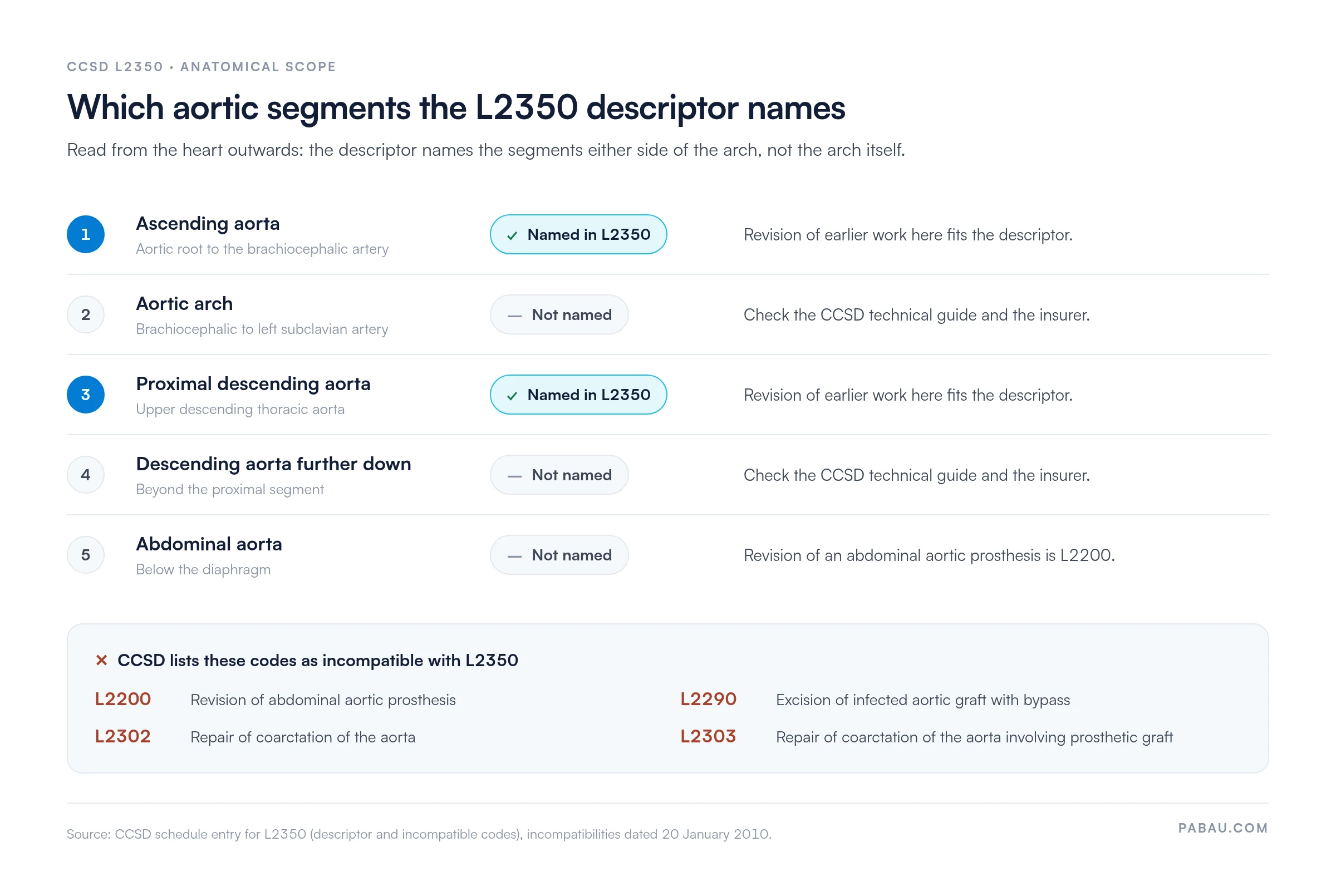
CCSD lists four codes as incompatible with L2350, so they should not be billed alongside it. Each of these entries dates from 20 January 2010.
Other work in the same operation, such as valve or coronary surgery, perfusion or anaesthesia, follows the CCSD technical guide and each insurer’s rules. Check both before you submit a claim with more than one code. Our CCSD codes library covers other procedures in the schedule. The Bupa CCSD procedure codes resource explains how the schedule is structured.
Searches for “L2350” often return HCPCS code L2350, a US code from the L2000 orthotics series. HCPCS L2350 is an addition to a lower-extremity orthosis. It describes a prosthetic-type below-knee (BK) socket, moulded to a model of the patient, for a PTB ankle-foot orthosis. It shares a number with the CCSD code but has no clinical or billing link to it.
Before you submit an L2350 claim, confirm from the operative note that the operation revised earlier work on the ascending or proximal descending aorta. Where surgery also involved the arch or other aortic segments, check the CCSD technical guide and the insurer before submission.
Diagnosis codes on UK private claims use WHO ICD-10, not the US ICD-10-CM edition. The diagnosis comes from the clinical record, not from the procedure code. Codes that often describe the reason for thoracic aortic revision include:
Confirm the diagnosis code against the clinical record and the insurer’s requirements before submission.
An insurer reviewing an L2350 claim needs to see that the operation revised earlier aortic work, and where. The operative note should include:
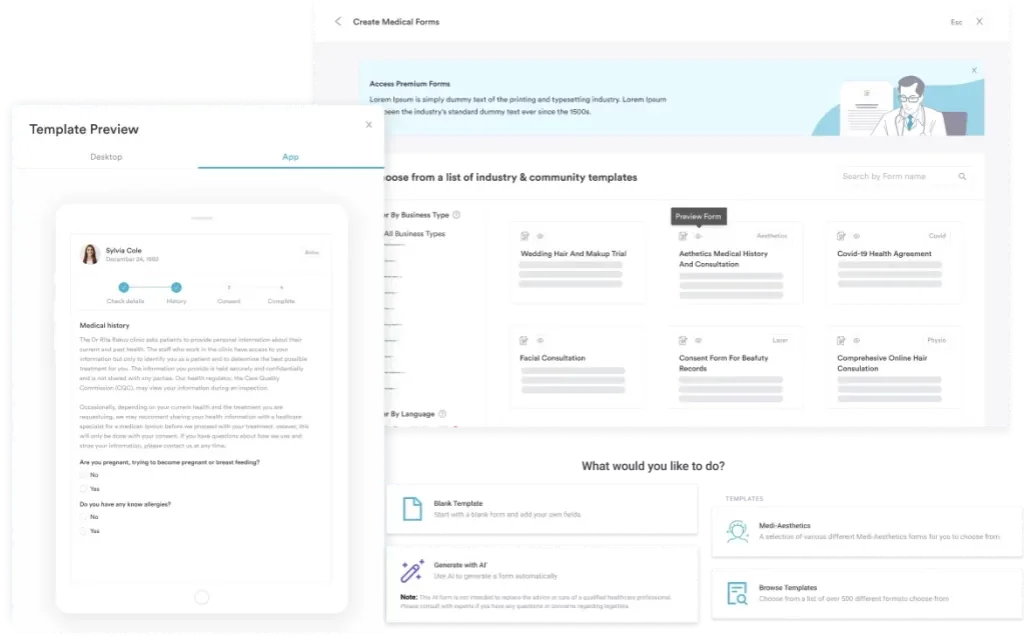
Digital forms in Pabau, the practice management platform we build for private practices, let cardiothoracic teams build structured operative note templates around these headings. Each note then records the same details, so a reviewer’s query can be answered from the record.
UK private medical insurers usually expect pre-authorisation before admission for major cardiothoracic surgery. Requirements vary by insurer and policy, so confirm them for each L2350 case.
Pre-authorisation for L2350 usually follows these steps:
Insurer requirements vary and change. The Aviva provider fee schedule and the Bupa code search portal give current guidance for those insurers. Confirm the requirements with the patient’s own insurer before admission.
Well-run UK private practice billing teams keep a log of each insurer’s pre-authorisation rules and review it at least once a year. That reduces the risk of submitting claims under an outdated process.
Most rejected L2350 claims trace back to the operative note, the code combination, or the authorisation. The common causes are:
A few habits keep L2350 claims moving and cut the back-and-forth with insurers.
Most UK private medical insurers receive electronic bills through Healthcode, the UK clearing house for private healthcare billing. An L2350 bill should carry the CCSD code, the authorisation number and the patient’s policy details. Check each insurer’s billing rules before submission, because they differ.
Pabau keeps the operative note, the authorisation and the claim on one patient record. Its claims management software sends private medical insurance claims through Healthcode to insurers such as Bupa, AXA Health and Vitality.
Each pre-authorisation is stored as a case on the patient record, and a claim missing its authorisation is flagged before it goes out. If an insurer rejects a claim, Pabau shows the reason so your team can correct it and resubmit. That gives a cardiothoracic team a clearer billing workflow, with fewer claims chased by email.
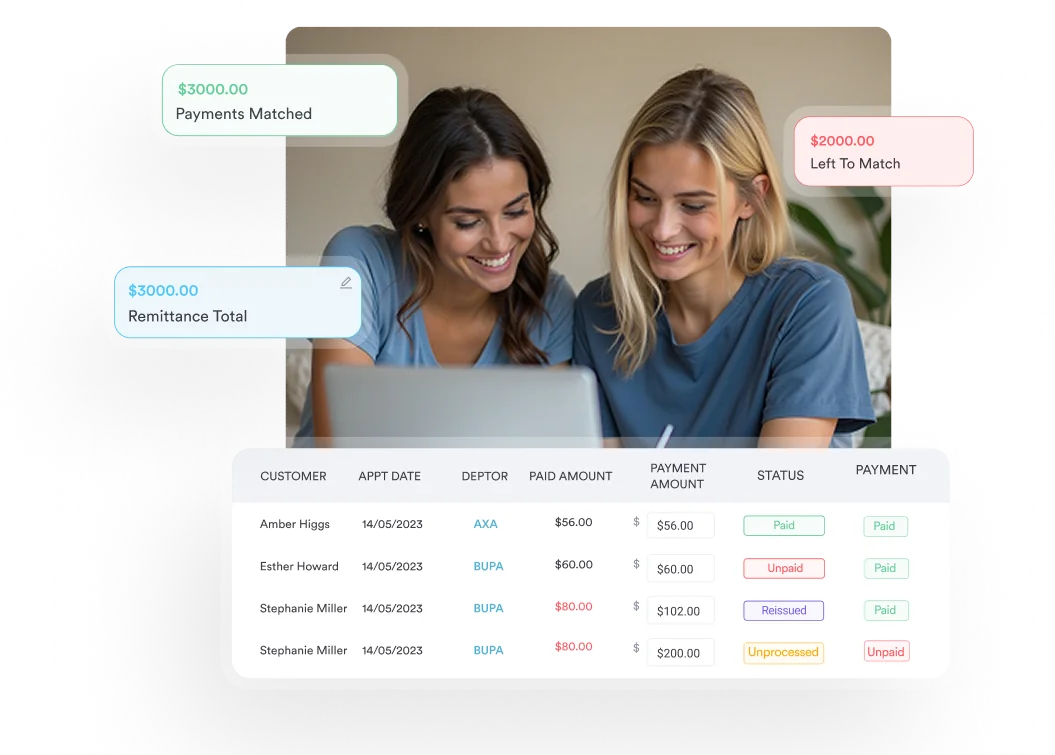

Pabau keeps operative notes, pre-authorisation cases and Healthcode claims on one patient record. See how it works for your practice.

CCSD Code L2350 is a revision code, so an L2350 claim stands or falls on proof that the operation revised earlier aortic work. Build that proof into the operative note on the day of surgery, not after a rejection arrives. A note that names the earlier operation, the segment revised and the graft leaves the insurer little to query.
The trade-off is time at the point of dictation against weeks of back-and-forth later. Keep L2200, L2290, L2302 and L2303 off the same claim, and check any other codes against the CCSD technical guide and the insurer first.
To see how Pabau keeps operative notes, authorisations and Healthcode claims in one place, book a demo.

Need a broader guide to CCSD procedure codes? Bupa CCSD procedure codes covers the full Bupa schedule structure, fee chapters, and how CCSD codes are organised for UK private practice billing.
Coding surgery on the aortic arch? CCSD code L1880 covers repair of a leaking aneurysm of the arch of the aorta.
Looking up another CCSD procedure? CCSD codes is our library of CCSD procedure code guides for UK private practice billing.
Want to understand how claims management software works? Claims management software outlines the core features UK private practices use to track submissions, manage denials, and reconcile payments.
CCSD Code L2350 covers a revision operation on the ascending aorta and proximal descending aorta. It applies when a surgeon revises earlier aortic work, such as a previous repair or graft, in either or both segments. It sits in CCSD Chapter 8, sub-chapter 8.10.0 Great vessels.
CCSD lists L2200, L2290, L2302 and L2303 as incompatible with L2350. L2200 is revision of abdominal aortic prosthesis, and L2290 is excision of infected aortic graft with bypass. L2302 and L2303 are coarctation repair codes. These entries date from 20 January 2010.
Most UK private medical insurers expect pre-authorisation before admission for major cardiothoracic surgery such as L2350. The request usually includes the consultant’s letter, imaging, the earlier surgical history and the proposed CCSD code. Confirm the requirements with the patient’s insurer before admission.
That depends on the procedures performed and the CCSD business rules. Valve or coronary work, perfusion and anaesthesia each follow their own coding rules. Check the CCSD technical guide and the insurer before submitting a claim with more than one code.
The usual cause is a note that never states the operation revised earlier work. An unclear segment, an incompatible code on the same claim or a missing authorisation number also cause rejections. A pre-submission checklist covering each point catches these problems before the claim goes out.
No. HCPCS L2350 is a US orthotics code. It describes an addition to a lower-extremity orthosis, a prosthetic-type below-knee socket moulded to a model of the patient. It has no link to the UK CCSD code for aortic revision.