CCSD Code C7920: Pars plana vitrectomy with tamponade, buckling and retinopexy
CCSD Code C7920: Definition and official descriptor CCSD Code C7920 is the CCSD ...

Last Updated: Nov 11, 2026
L3711 is the CCSD code for bypass of subclavian artery - extra-thoracic. UK private medical insurers use it for surgery that restores flow past a blocked subclavian artery through the neck, without opening the chest. A carotid-subclavian bypass is the usual operation.
The code sits in chapter 9.1.0 Head & Neck of the CCSD Schedule, under 9.0.0 Vascular System. When the graft takes inflow from the aortic arch through the chest, the correct code is L3710 instead. The operative note needs to name the inflow vessel and confirm the approach.
Let Pabau's smart automation suggest the right codes, reduce claim denials, and keep your practice compliant—effortlessly.
Automate repetitive tasks and focus on what matters most—your patients.
Reduce coding errors and ensure compliance with the latest regulations.
Clean claims, fewer denials, and faster reimbursements.
Powerful insights and reporting to help your practice thrive.
HIPAA compliant SOC 2 certified GDPR-compliant Trusted by 4,000+ clinics worldwide

CCSD code L3711 covers bypass of the subclavian artery through an extra-thoracic approach, most often a carotid-subclavian bypass made through a neck incision.
When the graft takes inflow from the aortic arch through the chest, the correct code is L3710, not L3711.
L3711 sits in chapter 9.1.0 Head & Neck of the CCSD Schedule, beside L2930, L2950, L3710 and L3730. There is no L3712.
CCSD lists L3710, L3730, L6710 and L7010 as unacceptable combinations with L3711, so none of them belongs on the same claim.
UK private medical insurers such as Bupa, AXA Health, Aviva and Vitality generally expect pre-authorization before planned vascular surgery.
Pabau, our practice management software, submits CCSD claims to UK insurers through Healthcode from the record that holds the operative note.
CCSD code L3711 is the Clinical Coding and Schedule Development (CCSD) procedure code for bypass of subclavian artery – extra-thoracic. The surgeon reroutes blood around a blocked or narrowed proximal subclavian artery through an incision in the neck, without opening the chest.
UK private medical insurers and Healthcode use the CCSD Schedule to identify procedures on a claim. It lists L3711 under reference FI.004, in chapter 9.1.0 Head & Neck within 9.0.0 Vascular System. Our CCSD procedure code library covers the other codes in the schedule.
The key billing facts at a glance:
The operation restores flow to the arm and the vertebral artery when the first part of the subclavian artery is blocked. Every step happens outside the chest, which is what “extra-thoracic” in the descriptor means for coding.
Coders should be able to find these elements in the operative note:
No sternotomy or thoracotomy appears in an L3711 note. If either word does appear, read the inflow vessel again before choosing the code.
Surgeons choose an extra-thoracic subclavian bypass when proximal subclavian disease causes symptoms and an open repair suits the patient better than a stent. The common indications are:
L3711 describes an open bypass. If the surgeon treats the lesion with angioplasty or a stent instead, L3711 does not apply. Look up the code that matches the endovascular work in the CCSD Schedule before submitting.
Chapter 9.1.0 Head & Neck lists five open arterial procedures beside one catheter venography code, and the five are easy to confuse on a claim. Three questions settle the code, in the order the diagram below follows. Which artery is treated, was a graft placed, and where does the graft take its inflow?
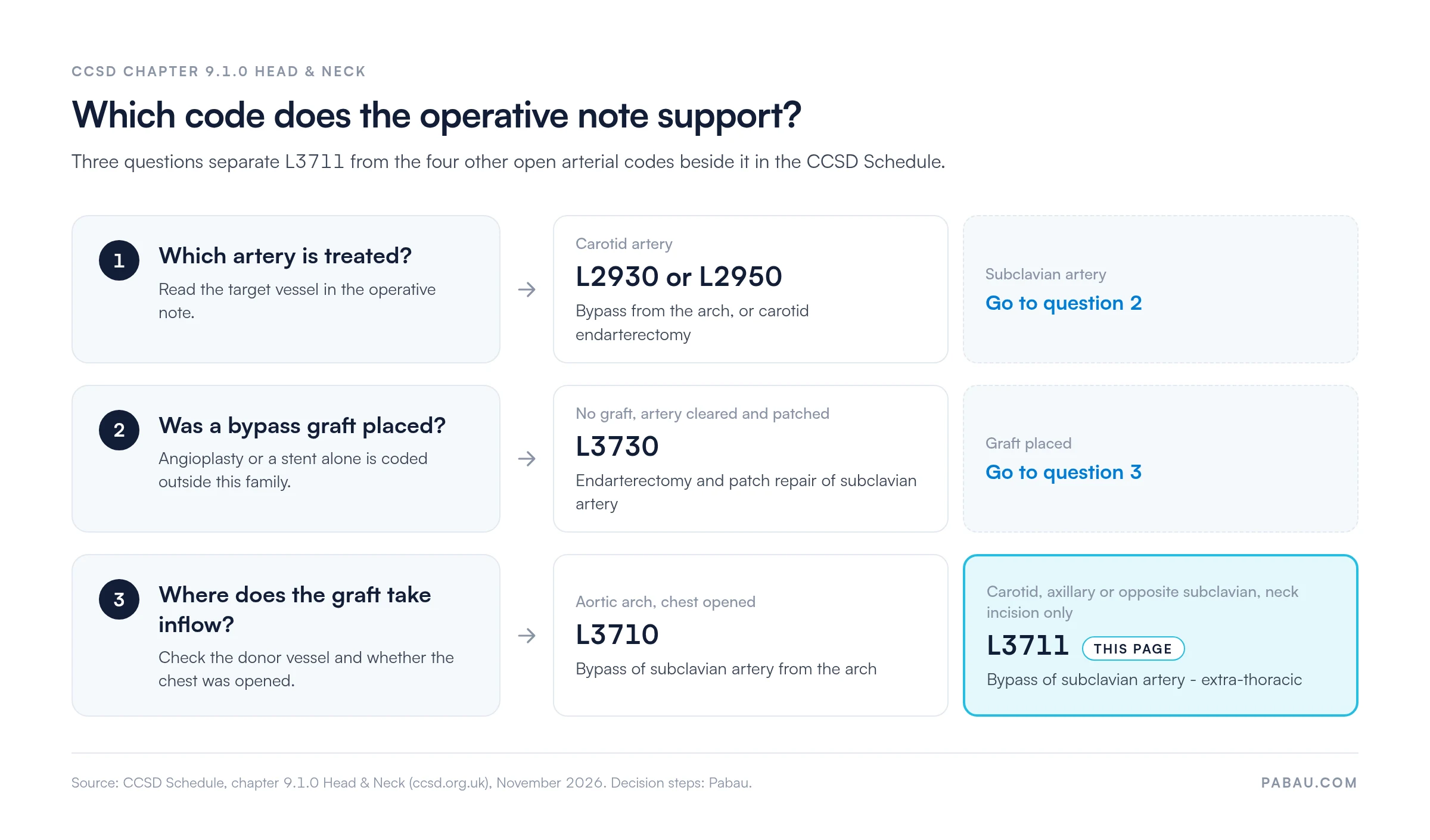
The most common swap is between L3711 and CCSD code L3710. Both bypass the subclavian artery, but L3710 takes inflow from the aortic arch through the chest. If the note describes a neck incision and carotid inflow, L3711 is the code.
The CCSD Schedule has no L3712, so a claim carrying that number cannot be matched to a schedule entry. A subclavian bypass through the chest is already covered by L3710.
Before coding a subclavian bypass, find the inflow vessel in the operative note. Carotid, axillary or opposite-side subclavian inflow points to L3711. Inflow from the aortic arch points to L3710. An endarterectomy closed with a patch, with no graft, is L3730.
A CCSD procedure code pays for the principal operation. Knowing what sits inside L3711 prevents both unbundling queries and missed charges.
Included within L3711:
Billed separately (verify per insurer contract):
The CCSD Schedule also lists four unacceptable combinations with L3711. They are L3710, L3730, L6710 (biopsy of artery) and L7010 (open embolectomy of artery), and none of them belongs on the same claim as L3711.
A carotid endarterectomy in the same operation is a separate CCSD code, L2950, and it is not on that list. Confirm with the insurer how it pays two procedures in one operation before submitting both.
UK private insurers decide L3711 claims on the operative note. A note that leaves out the approach or the inflow vessel invites an information request, or a query about whether L3710 applies instead.
The operative note should confirm all of the following:
Insurers may also ask for the discharge summary and the imaging report behind the decision to operate. Keeping them in the patient record beside the operative note lets the billing team answer a query the same day. Pabau’s claims management software ties each claim to that record.
UK private medical insurers generally require pre-authorization before planned surgery, and an arterial bypass falls in that group. Insurers such as Bupa, AXA Health, Aviva and Vitality ask for the CCSD code at the authorization stage. The code on the claim should match the code that was authorized.
A pre-authorization request for L3711 usually includes:
Check each insurer’s requirements on its own provider portal. Our guide to Bupa CCSD codes explains how to look a code up against Bupa’s schedule. Emergency surgery may go ahead before authorization, but the insurer still expects prompt notification.
Healthcode is the main electronic billing route for UK private healthcare. A typical L3711 claim follows these steps:
The same documentation logic applies to other open bypass codes. CCSD code L1680, axillo-bifemoral bypass, also turns on which inflow and outflow vessels the note names.
UK insurers expect an ICD-10 diagnosis that explains why the bypass was needed. The WHO ICD-10 browser confirms each descriptor. The pairings below are illustrative, and the surgeon’s documented diagnosis decides the code.
Atherosclerosis is the most common cause in older patients, which makes I70.8 a frequent pairing. In a younger patient with large-vessel vasculitis, M31.4 usually carries the indication instead.
Most L3711 denials trace back to the authorization, the code choice or the operative note. The table pairs each trigger with its fix.
Send any appeal inside the deadline the insurer sets, with the corrected note or authorization attached.
In many practices the authorization, the operative note and the claim live in three places. The secretary logs the authorization number in one system, and the surgeon dictates the note into another. The billing team rebuilds the claim days later, which is when L3710 and L3711 get swapped.
Pabau holds those steps in one patient record. The insurer, membership number and pre-authorization number sit on the patient’s file, beside the operative note and imaging. Claims go to UK insurers through Healthcode or straight to Bupa, so billing works from the code the insurer authorized.
The outcome is fewer information requests to chase and a shorter wait between surgery and payment. Core features come with every plan, so billing and patient records sit together from day one.

Pabau sends CCSD claims through Healthcode from the same record that holds the pre-authorization number and operative note. Your vascular team spends less time answering insurer queries.

For L3711, the inflow vessel decides the claim. A note that names carotid or other neck inflow and rules out a chest incision supports L3711. Arch inflow belongs to L3710, and there is no L3712 to fall back on.
The fix sits before billing starts. Agree a note template with your vascular surgeons that records the side, approach, inflow and conduit every time. Then confirm the authorized code matches the planned operation before the theater list is final.
Book a demo to see how Pabau keeps authorizations, operative notes and Healthcode claims for CCSD vascular codes in one record.

Coding an extra-anatomic bypass to the legs? CCSD code L1680 covers axillo-bifemoral bypass and the outflow detail insurers check.
Repairing a limb artery with a vein graft? CCSD code L6840 explains the documentation and billing for that repair.
Billing an endarterectomy elsewhere in the vascular chapter? CCSD code L4530 covers endarterectomy and patch repair of a visceral branch of the abdominal aorta.
Working on open aortic surgery? CCSD code L1810 covers ascending aortic aneurysm repair for UK private billing.
CCSD code L3711 covers bypass of the subclavian artery through an extra-thoracic approach. The surgeon restores flow past a proximal subclavian blockage through the neck, usually with a carotid-subclavian bypass. No chest incision is made.
The inflow vessel separates them. L3710 covers a subclavian bypass that takes inflow from the aortic arch, which requires opening the chest. L3711 covers a bypass made outside the chest, usually from the carotid artery.
No. The CCSD Schedule has no L3712, and its subclavian codes are L3710, L3711 and L3730. A claim carrying L3712 cannot be matched to a schedule entry.
UK private medical insurers, Healthcode and private specialists use CCSD codes to identify procedures on claims. The CCSD Group maintains the schedule and publishes it at ccsd.org.uk.
I77.1 (stricture of artery) and I70.8 (atherosclerosis of other arteries) are common pairings for subclavian stenosis. I74.2 fits embolic or thrombotic occlusion, M31.4 fits Takayasu arteritis, and G45.0 fits subclavian steal. The surgeon’s documented diagnosis decides the code.
Usually, yes. UK private medical insurers generally require pre-authorization before planned surgery, including subclavian bypass. Authorization confirms cover, but the claim is still checked against the operative note.
Both can appear on a claim when a carotid endarterectomy is performed in the same operation, because they are separate CCSD codes. Check how the insurer pays a second procedure before submitting, and document both in the operative note.
CCSD lists L3710, L3730, L6710 and L7010 as unacceptable combinations with L3711. None of them belongs on the same claim. A carotid endarterectomy, L2950, is not on that list, so check how the insurer pays a second procedure.