CCSD code D2040: Diagnostic tympanotomy billing guide
CCSD code D2040 covers a middle ear exploration on its own CCSD code D2040 is th...

Last Updated: Oct 28, 2026
L1620 is the CCSD code for axillo-unifemoral bypass. The graft carries blood from the axillary artery below the collarbone to one femoral artery in the groin. Surgeons choose this extra-anatomic route when direct surgery on the aorta is too risky, such as in frail patients or after an infected aortic graft.
The code sits in CCSD Chapter 9 Vascular system, sub-chapter 9.4.0 Abdominal vessels, under reference FI.022. It covers a graft to one groin only. A graft to both groins takes L1680, and CCSD bars the two from the same claim.
Let Pabau's smart automation suggest the right codes, reduce claim denials, and keep your practice compliant—effortlessly.
Automate repetitive tasks and focus on what matters most—your patients.
Reduce coding errors and ensure compliance with the latest regulations.
Clean claims, fewer denials, and faster reimbursements.
Powerful insights and reporting to help your practice thrive.
HIPAA compliant SOC 2 certified GDPR-compliant Trusted by 4,000+ clinics worldwide

CCSD code L1620 describes an axillo-unifemoral bypass, a graft from the axillary artery to one femoral artery.
The code sits in CCSD Chapter 9 Vascular system, sub-chapter 9.4.0 Abdominal vessels, under schedule reference FI.022.
CCSD lists L1680, L6710 and L7010 as unacceptable combinations with L1620 on the same claim.
Older references may still show the previous description, “Axillo-femoral bypass”, for the same code.
The operation note should name the side, the axillary inflow and the femoral target, so the insurer can see one groin was grafted.
CCSD code L1620 is the UK insurer billing code for an axillo-unifemoral bypass. The surgeon joins a graft to the axillary artery below the collarbone. The graft then runs under the skin of the chest and flank to the femoral artery in one groin.
Surgeons call this route extra-anatomic because it avoids the abdomen. It restores blood flow to a leg when direct surgery on the aorta carries too much risk. Typical cases include frail patients and patients with an infected aortic graft.
In the CCSD schedule, L1620 is a procedural code with reference FI.022. CCSD stands for Clinical Coding & Schedule Development, the group that maintains the codes UK private insurers accept. For background on that process, see our guide to how insurers apply CCSD codes.
The public CCSD record carries two dates that don’t agree. It lists a date inactive of 1 January 2006 and a date created of 20 January 2010. Check L1620 in the CCSD schedule members’ area before you bill it.
CCSD groups most open vascular operations under Chapter 9, Vascular system. That chapter splits into eight sub-chapters by body region and procedure type.
Sub-chapter 9.4.0 holds aortic and visceral artery work. Alongside L1620, it lists open aortic aneurysm repairs such as L1960. Bypasses that start at the aorta or iliac arteries mostly live in 9.5.0 instead.
That split matters when you search the schedule. A coder who looks only under ileo-femoral codes won’t find the axillary-inflow bypasses at all. For codes in other sub-chapters, browse our CCSD billing guides by code number.
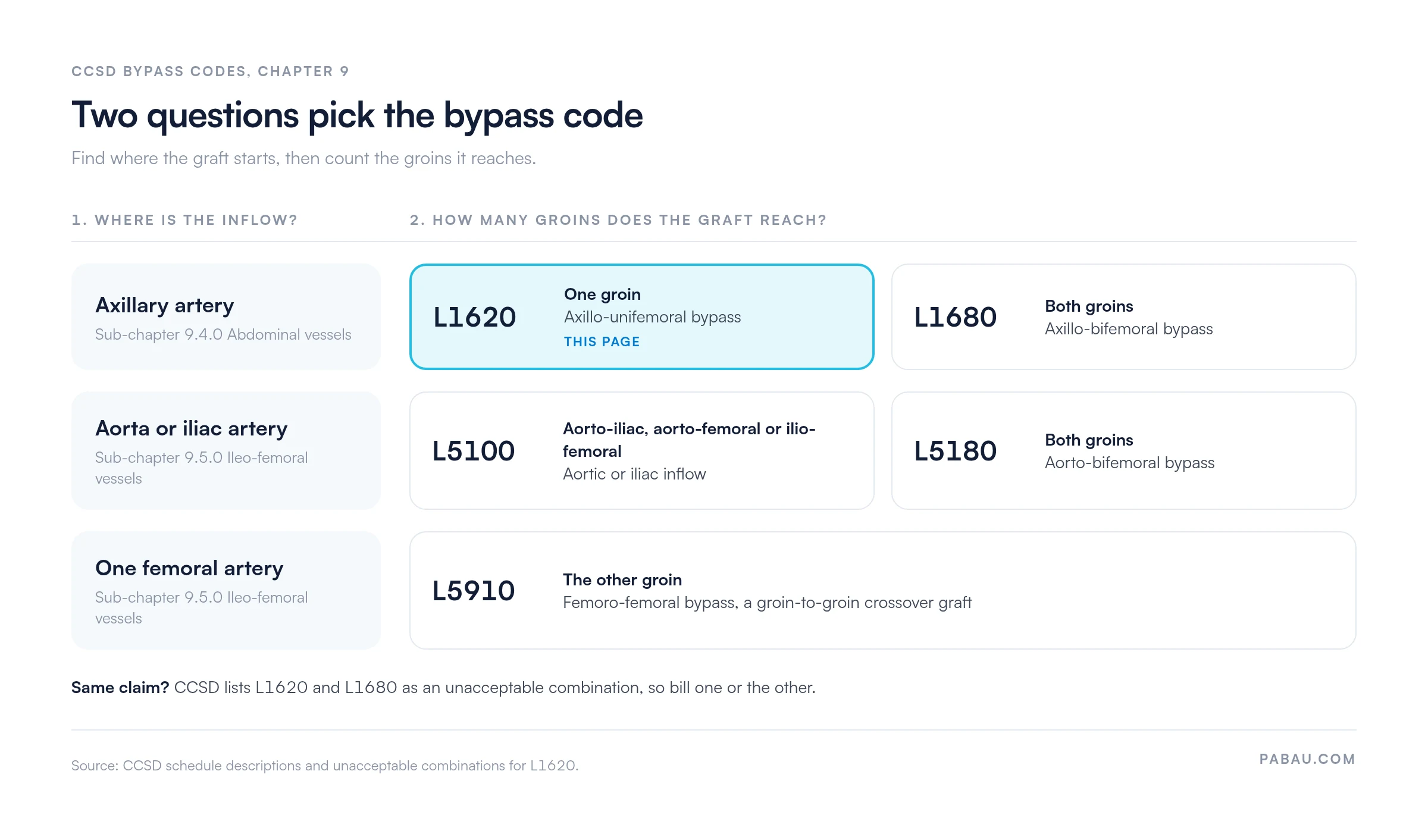
In the public CCSD data for 9.4.0, L1620 and L1680 are the only codes in the L16 run. The other close matches sit in 9.5.0. Each one differs by where the graft starts or how many groins it reaches.
Read the operation note for two facts before you choose. Where does the inflow come from, and how many groins does the graft reach? Those two answers separate every code in this table.
CCSD lists three unacceptable combinations for L1620. A claim that carries L1620 with any of them is likely to come back from the insurer.
When the note describes grafts to both groins, L1680 replaces L1620. Never bill both. If the surgeon also removed clot during the bypass, record it in the note rather than as a separate L7010 line.
An artery biopsy taken during the same operation stays off the bill too. L6710 applies only when the biopsy is the sole procedure.
Insurers query bypass claims when the note leaves the route unclear. Use this checklist before the bill goes out.

UK insurers expect a WHO ICD-10 diagnosis alongside the CCSD code. For limb ischemia from narrowed arteries, that is often I70.2, atherosclerosis of arteries of extremities. For an infected aortic graft, T82.7 covers infection due to vascular grafts.
The hospital codes the same operation in OPCS-4, the NHS procedure classification. Its category L16 covers extra-anatomic bypass of the aorta. L16.1 covers an emergency axillary-to-femoral bypass and L16.2 the other cases. L16.3 is the bilateral version. Match your CCSD code to the hospital’s OPCS-4 record before you submit.
These six slips come straight from the code’s scope and its CCSD clash list. Each one has a quick fix.
Many private surgical practices still key insurer bills by hand. A secretary copies codes, membership numbers and dates from the notes into a portal. One missed field can send the bill back weeks later.
Pabau pulls those details from the patient record instead, for faster claims management. The software pre-fills each claim and checks required fields, such as membership numbers, before you send it. UK claims then go to the insurer through Pabau’s Healthcode integration.
Fewer claims stall over a missing membership number. Your secretary stops re-keying the same details into a portal, and remittances stop waiting on queries.

Pabau pre-fills insurer claims from the patient record and checks required fields before sending. UK claims go straight through Healthcode.

L1620 is easy to bill correctly once the operation note does its job. One groin means L1620, two groins mean L1680, and the two never share a claim.
The open question is the code’s status. Its public dates conflict, so a quick check in the CCSD members’ area costs less than a returned claim weeks later.
Put the side, inflow and graft into every note, and most insurer queries never start. Book a demo to see how Pabau turns your patient records into complete insurer claims.

Billing aortic aneurysm repairs? CCSD code L1960: Infrarenal AAA bifurcation graft covers the open bifurcation graft in the same sub-chapter.
Coding a revision of an aortic graft? CCSD code L2200: Revision of prosthesis of abdominal aorta explains when a revision code applies.
Working on femoral artery procedures? CCSD code L6000: Endarterectomy of femoral artery covers femoral endarterectomy billing.
New to CCSD billing? CCSD billing reference for insurers shows how UK private insurers apply CCSD codes.
Want fewer returned claims? Claims management software shows how Pabau prepares and sends insurer claims.
CCSD code L1620 is the UK insurer code for an axillo-unifemoral bypass. The graft carries blood from the axillary artery to one femoral artery, avoiding the abdomen.
No. CCSD lists L1680, axillo-bifemoral bypass, as an unacceptable combination with L1620. Bill L1680 alone when the graft reaches both groins.
CCSD lists three: L1680 axillo-bifemoral bypass, L6710 artery biopsy as a sole procedure, and L7010 open embolectomy of artery.
The code’s earlier description was “Axillo-femoral bypass”. CCSD changed it to “Axillo-unifemoral bypass”.
It sits in Chapter 9 Vascular system, sub-chapter 9.4.0 Abdominal vessels, with schedule reference FI.022.
The public CCSD record doesn’t settle it, because its inactive and created dates conflict. Check the code in the CCSD members’ area before you bill.