HCPCS code P9058: Red blood cells, leukocytes reduced, CMV-negative, irradiated
HCPCS code P9058: Official descriptor and key attributes HCPCS code P9058 report...

Last Updated: Oct 26, 2026
L7423 is the CCSD code for ligation of arteriovenous fistula for dialysis. It covers the operative closure of a fistula created for haemodialysis access, by tying off the arterial inflow, the venous outflow or both.
The code sits in chapter 9 (vascular system) of the UK CCSD schedule and is graded Intermediate. Creating, revising or repairing a fistula uses other codes in the L-series.
Let Pabau's smart automation suggest the right codes, reduce claim denials, and keep your practice compliant—effortlessly.
Automate repetitive tasks and focus on what matters most—your patients.
Reduce coding errors and ensure compliance with the latest regulations.
Clean claims, fewer denials, and faster reimbursements.
Powerful insights and reporting to help your practice thrive.
HIPAA compliant SOC 2 certified GDPR-compliant Trusted by 4,000+ clinics worldwide

CCSD code L7423 covers surgical ligation of an arteriovenous fistula created for haemodialysis access, in chapter 9 of the UK CCSD schedule.
Accepted indications include steal syndrome, high-output cardiac failure, a large aneurysm, irreversible thrombosis and dialysis independence after a kidney transplant.
Pair L7423 with ICD-10 code I77.0 (arteriovenous fistula, acquired) as the primary diagnosis, then add a secondary code for the indication.
L7423 is graded Intermediate. Freedom Health Insurance lists a £200.00 specialist fee and a £213.00 anaesthetist fee, and other insurers set their own.
UK private medical insurers expect treatment to be pre-authorised, so get the authorisation number before surgery and put it on every invoice.
CCSD Code L7423 is the Clinical Coding & Schedule Development code for Ligation of arteriovenous fistula for dialysis. It sits in the L-series of the CCSD schedule, which covers vascular surgery.
The schedule is maintained by the CCSD Group, whose members are four insurers: Bupa, AXA Health, Aviva and VitalityHealth. Together they set the standard procedure codes for UK private healthcare. Our CCSD code library lists the wider schedule.
The code applies to the deliberate, operative ligation of a fistula that was created for haemodialysis access. It does not cover creating or revising a fistula. Nor does it cover an arteriovenous fistula caused by trauma or a congenital anomaly. The procedure code and the ICD-10 diagnosis codes on the invoice must both reflect this.
The fees belong to each insurer, because CCSD maintains the codes rather than the prices. Bupa publishes its own surgeon and anaesthetist benefit limits in its Schedule of Procedures. Our Bupa fee schedule guide shows how one insurer prices each code.
Ligation of an arteriovenous fistula is a vascular procedure performed under local, regional or general anaesthesia. The surgeon exposes the fistula at the wrist, forearm or upper arm, depending on how it was built. Blood flow through the fistula is then interrupted by ligating the arterial inflow, the venous outflow or both.
For the invoice to be defensible, the operative note must record the site accessed and exactly how the ligation was done. It should also say whether the fistula was tied at one point or at several. A note that says only “AV fistula ligated” is a common trigger for an insurer query.
L7423 is billed by a consultant vascular surgeon, or another consultant surgeon whose practice includes dialysis access. In the UK the surgeon must be registered with the General Medical Council (GMC). Each insurer also has to recognise the consultant before it will settle their invoice.
Insurers expect a documented clinical indication before they authorise or pay an L7423 invoice. Each indication below is accepted in vascular surgery and nephrology practice. The pre-operative assessment must record it, and the operative note must refer to it.
Billing components that are part of L7423 cannot be invoiced separately. Procedures outside it need their own CCSD codes.
Creating a new fistula and ligating the old one in the same session is possible, for example when access moves to another site. Both codes may then be billed, but the insurer’s multiple-procedure rule applies. Pre-authorise both procedures and record why both were needed at once.
L7423 sits among the CCSD codes for arteriovenous fistula and shunt surgery. Choosing the wrong one is the most common error in vascular access billing. The decision path below sorts them by what the operation did to the fistula.
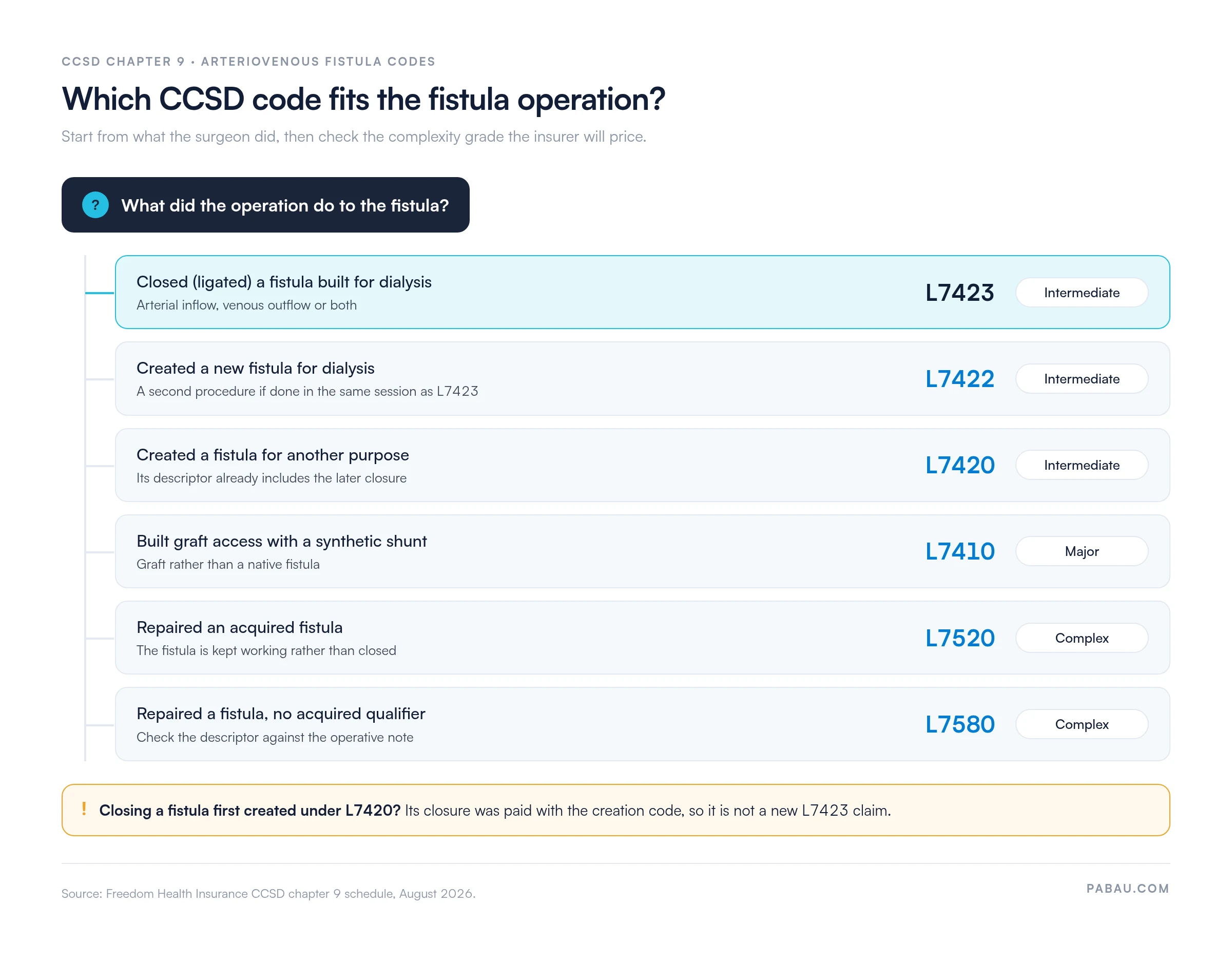
The descriptors and grades above come from the Freedom Health Insurance chapter 9 schedule, updated August 2026. Check the current CCSD schedule and the Bupa code search tool before you invoice.
Check how the fistula was created before you invoice its closure. L7420 includes subsequent closure in its descriptor, so a fistula created under that code has already been paid for its closure. L7423 is for a fistula created for dialysis.
UK insurers expect an ICD-10 diagnosis code alongside the CCSD procedure code. The codes below map to the clinical indications for L7423. Check each one against the WHO ICD-10 edition used in the UK, not the US ICD-10-CM.
Use I77.0 as the primary diagnosis on every L7423 claim. The secondary code should reflect the clinical indication that led to the decision to ligate. A secondary code that doesn’t match the documented indication is a common cause of an insurer query.
Record the clinical indication in the pre-operative assessment note, not only in the operative note. An insurer reviewing an L7423 invoice will look for the indication in the record before the procedure date.
CCSD codes carry no modifiers. The rules that change what an L7423 invoice pays come from the CCSD technical guide and from each insurer’s fee schedule.
UK private medical insurers expect treatment to be pre-authorised before it starts. The patient usually contacts their insurer with the code and its description. The insurer then issues an authorisation number, which goes on every invoice.
Private medical insurance generally covers acute conditions rather than the ongoing management of chronic ones. Kidney failure that needs dialysis is chronic, so confirm the policy covers the fistula complication before you book theatre. Where the insurer declines, the patient can still choose to fund the ligation themselves.
For elective ligation after a transplant, or for planned steal or aneurysm treatment, send the insurer:
Urgent ligation for acute limb-threatening steal, or for bleeding from a ruptured aneurysm, is harder to fund privately. Most UK insurers leave emergency treatment to the NHS. Where an urgent case is treated privately, contact the insurer before surgery if you can, and record the authorisation number.
Insurers that query L7423 invoices look for a clear chain of clinical evidence, from the decision to ligate to the operative report. Use this checklist before you invoice.
Audit your last 10 L7423 operative notes before you invoice. Check that each one names the anatomical site, laterality, technique and pre-operative indication. Clarify any note missing one of these with the surgeon before the invoice goes to the insurer.
L7423 denials cluster around a small set of correctable errors. Catching them while the invoice is prepared keeps rejections down.
Our Bupa CCSD codes guide explains how Bupa handles CCSD claim submissions in more detail.
Vascular billing teams often track a fistula ligation across clinic letters, theatre notes and insurer portals. The authorisation number and the indication easily end up separated from the invoice that needs them.
Pabau, the practice management software we build for private practices, keeps the CCSD code, the ICD-10 diagnosis and the authorisation number on one claim record. You submit the claim through Healthcode and track its status in the same place.
Our claims management software also lets you attach insurer billing notes to the record, such as a multiple-procedure rule. Pabau doesn’t choose the code for you, so the checks above still apply.

Pabau keeps the CCSD code, ICD-10 diagnosis and authorisation number on one claim record, then submits it through Healthcode. See how it fits your vascular billing workflow.

L7423 fits one operation: deliberately closing a fistula that was built for dialysis. A fistula created under L7420 already includes its closure, and a repair that keeps the fistula working belongs to L7520 or L7580.
For UK private billing, cover is the harder question. Kidney failure is a chronic condition, and urgent fistula complications often fall to the NHS. A funded L7423 claim rests on authorisation before surgery and a pre-operative note that names the indication.
Settle the code, the diagnosis and the authorisation number before the invoice leaves the practice. To see how Pabau keeps the whole claim in one place, book a demo.

Is the fistula being repaired rather than closed? CCSD code L7520 covers repair of an acquired arteriovenous fistula and the documentation insurers expect for it.
Coding open aortic surgery as well as access work? CCSD code L1960 covers an infrarenal aortic aneurysm repair with a bifurcation graft.
Coding a leaking aneurysm higher up the aorta? CCSD code L1880 sets out the arch repair code, its ICD-10 pairing and its pre-authorisation rules.
CCSD Code L7423 is the UK private healthcare procedure code for surgical ligation of an arteriovenous fistula created for haemodialysis access. It covers closing the fistula at the arterial inflow, the venous outflow or both, including wound closure. Anaesthesia, thrombectomy and excision of an aneurysm sac are billed separately.
Accepted indications include steal syndrome causing limb ischaemia, high-output cardiac failure caused by the fistula, and a large aneurysm at risk of rupture. Irreversible thrombosis, dialysis independence after a kidney transplant and withdrawal from dialysis also qualify. Each indication must be documented in the pre-operative clinical record to support the L7423 invoice.
Use I77.0 (arteriovenous fistula, acquired) as the primary diagnosis on every L7423 claim, then add a secondary code for the indication. That is Z99.2 for active dialysis patients and I50.9 for high-output cardiac failure. Use T82.8 for steal syndrome or aneurysm, and Z94.0 after a kidney transplant.
Yes. UK private medical insurers expect treatment to be pre-authorised, and the authorisation number goes on the invoice. Send a clinical summary, the Doppler or imaging findings, and the CCSD and ICD-10 codes. Most insurers leave emergency treatment to the NHS, so an urgent case needs the insurer’s agreement before surgery.
The most common reasons are a missing authorisation number and a secondary ICD-10 code that doesn’t match the indication. Others include a same-session fistula creation the insurer didn’t agree, a thin operative note and a late invoice. Each one can be fixed before the invoice leaves the practice.
The anaesthetist sends a separate invoice under the same CCSD code, L7423, at the insurer’s anaesthetist fee. Freedom Health Insurance lists that fee at £213.00, against a £200.00 specialist fee. Other insurers publish their own figures, so check the patient’s policy.
L7423 is graded Intermediate. It sits in chapter 9 (vascular system), section 9.6 Non-specific, of the CCSD schedule. It shares that grade with L7422, the code for creating a fistula for dialysis.