CCSD Code B2710: Radical mastectomy including block dissection
CCSD Code B2710: Definition and clinical scope CCSD Code B2710 is the UK private...

Last Updated: Nov 13, 2026
L5950 is the CCSD code for femoro-distal calf bypass using a prosthesis, with or without a vein cuff or patch. It applies when a synthetic graft runs from the femoral artery to a calf vessel, such as the posterior tibial, anterior tibial or peroneal artery.
The code sits in chapter 9.5.0 Ileo-femoral Vessels of the CCSD schedule, which UK private insurers use for billing. A bypass using vein instead is coded L5960, and one ending at the popliteal artery takes a femoro-popliteal code.
Let Pabau's smart automation suggest the right codes, reduce claim denials, and keep your practice compliant—effortlessly.
Automate repetitive tasks and focus on what matters most—your patients.
Reduce coding errors and ensure compliance with the latest regulations.
Clean claims, fewer denials, and faster reimbursements.
Powerful insights and reporting to help your practice thrive.
HIPAA compliant SOC 2 certified GDPR-compliant Trusted by 4,000+ clinics worldwide

CCSD code L5950 covers femorodistal calf bypass using a prosthetic graft to a tibial or peroneal artery, with or without a vein cuff or patch.
L5950 includes the vein cuff or patch whether or not the surgeon uses one, so a Miller cuff or Taylor patch takes no separate code.
The conduit and the outflow vessel decide the code. A vein conduit moves the claim to L5960, and a popliteal outflow moves it to L5922, L5923 or L5924.
Major UK private insurers usually require pre-authorization for this procedure, so obtain the reference number before surgery and put it on the Healthcode invoice.
Common denial triggers are a missing pre-authorization, an operative note without named inflow and outflow vessels, and a femoropopliteal code on a calf bypass.
CCSD code L5950 is the UK private-sector code for femorodistal calf bypass using a prosthesis, with or without a vein cuff or patch. The CCSD schedule holds the standard procedure codes for UK private healthcare. The Clinical Coding and Schedule Development (CCSD) Group maintains it, and its members represent four major private health insurers. L5950 sits within the Vascular System chapter (9.0.0), under 9.5.0 Ileo-femoral Vessels, with the schedule reference FI.039.
Several neighboring codes in this chapter have their own pages in our CCSD code library. Each insurer applies the schedule through its own lookup tools, and our Bupa CCSD codes guide shows how Bupa processes CCSD-coded invoices.
Three clinical elements define L5950, and all three must be present in the operative note to support the code:
The code has a short history. The CCSD record notes that L5950 and L5960 came from splitting one older code, L5980, which covered calf bypass using prosthesis and/or vein. Since that split, the conduit decides which of the two codes goes on the claim.
CCSD codes are specific to the private sector. NHS trusts use OPCS-4 procedure codes instead, so a coder who works across NHS and private lists has to switch code sets with the setting.
Femorodistal calf bypass is performed when inflow from the femoral artery is adequate but disease extends too far down for a femoropopliteal bypass to work. Disease higher up, in the iliac artery itself, takes a different code. Open iliac surgery that no named code describes falls under code L5300. The target is a patent calf vessel, most commonly the posterior tibial, anterior tibial, or peroneal artery.
The operative sequence typically runs as follows:
The clinical indication is almost always chronic limb-threatening ischemia (CLTI) with rest pain, tissue loss, or gangrene. The operative goal is limb salvage.
UK private payers expect the claim to carry a primary diagnosis code that supports medical necessity for a procedure of this complexity. NICE guideline CG147 on peripheral arterial disease identifies CLTI as the principal indication for distal bypass surgery.
| Clinical indication | ICD-10 code | Notes |
|---|---|---|
| Peripheral arterial disease with critical limb ischemia | I70.2 | Atherosclerosis of arteries of extremities. UK ICD-10 (5th edition) stops at this level, so it is the usual primary code on a UK claim. |
| Rest pain due to atherosclerosis of native arteries | I70.22- (ICD-10-CM) | US ICD-10-CM only. Rutherford category 4. The 6th character sets the leg (I70.221 right, I70.222 left). |
| Non-healing ischemic ulcer of the leg | I70.23- / I70.24- (ICD-10-CM) | US ICD-10-CM only. I70.23- is the right leg and I70.24- the left, and the 6th character names the ulcer site. |
| Ischemic gangrene | I70.26- (ICD-10-CM) | US ICD-10-CM only. Strongest medical necessity signal, Rutherford categories 5-6. The 6th character sets the leg. |
| Failed or occluded previous bypass graft | T82.3 | Mechanical complication of other vascular grafts. Use it when L5950 is a redo procedure after a prior graft occluded. |
UK private claims use ICD-10, the WHO-based classification. The sub-codes marked ICD-10-CM belong to the US modification, which adds the symptom and the side. Confirm with your coding team which codes each insurer accepts before you submit.
Include ankle-brachial pressure index (ABPI) values, toe pressures, or duplex findings in the clinical record. Payers increasingly request hemodynamic evidence alongside the diagnosis code to support surgery at calf level over a less complex intervention.
The +/- notation in the L5950 descriptor means the claim is identical with or without a vein cuff or patch at the distal anastomosis. One code covers both versions of the operation, so coders add nothing for the cuff or patch.
The schedule handles this differently one level up. A femoropopliteal bypass using a vein cuff or patch has its own code, L5924. At calf level, the cuff or patch is part of L5950.
Two techniques are in common use:
The decision to use or omit a vein cuff rests with the operating surgeon. It depends on vein availability, vessel caliber, and the surgeon’s reading of outcomes data. Comparative studies in the British Journal of Surgery report better primary patency with a cuff in below-knee prosthetic bypass. The size of that benefit varies by outflow vessel.
For CCSD coding, the operative note must state whether a vein cuff or patch was used. If one was, the note names the technique and the vein harvest site. The code stays L5950 either way, but that record answers a payer audit query.
Several codes in the same 9.5.0 Ileo-femoral Vessels chapter describe peripheral bypass procedures that look similar to L5950. Selecting the wrong one is the most common coding error for vascular bypass. Two facts in the operative note decide the code: The outflow vessel and the conduit, laid out in the matrix below.
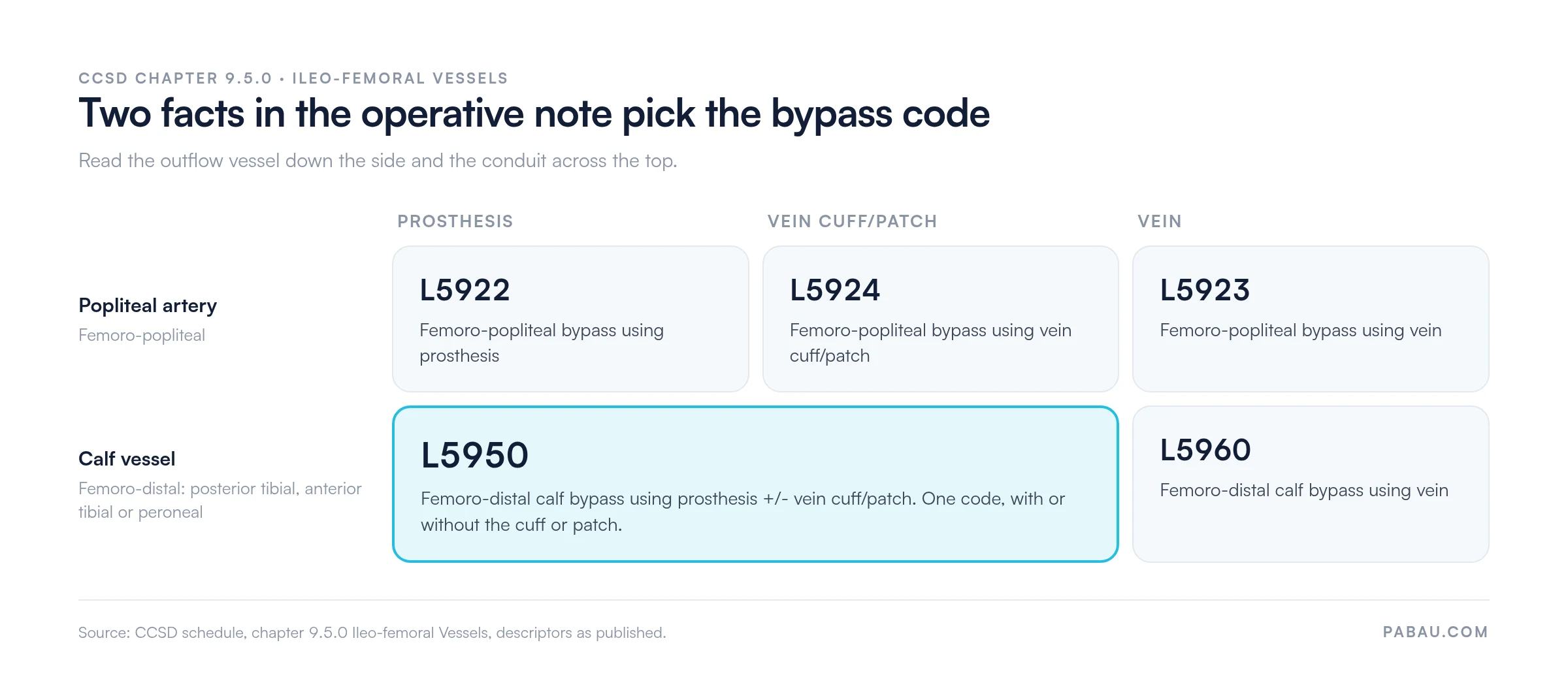
| CCSD code | CCSD descriptor | Key differentiator from L5950 |
|---|---|---|
| L5922 | Femoro-popliteal bypass using prosthesis | The outflow vessel is the popliteal artery, not a calf vessel. Use L5950 when the distal anastomosis is to the posterior tibial, anterior tibial, or peroneal artery. |
| L5923 | Femoro-popliteal bypass using vein | Popliteal outflow and an autologous vein conduit (reversed or in-situ saphenous). Both facts differ from L5950. |
| L5924 | Femoro-popliteal bypass using vein cuff/patch | At popliteal level the vein cuff or patch has its own code. At calf level it is part of L5950. |
| L5950 | Femoro-distal calf bypass using prosthesis +/- vein cuff/patch | Reference code: Synthetic graft to a calf-level outflow vessel, with or without a cuff or patch. |
| L5960 | Femoro-distal calf bypass using vein | Same calf-level target as L5950, but the conduit is autologous vein. This is the code most often confused with L5950, so check the graft material. |
| L6000 | Endarterectomy of femoral artery | No bypass graft is created. Plaque is removed from inside the native femoral artery, a structurally different procedure. |
The two variables that decide whether L5950 applies are the outflow target level (calf, not popliteal) and the conduit type (prosthesis, not autologous vein). Confirm both in the operative note before you assign the code. A vein conduit to the same calf vessel is L5960, and clearing femoral plaque without a graft is L6000.
An operative note that leaves the conduit or the outflow target unclear will not survive a payer audit. For L5950, the surgical record must state each of the following elements:
Payers may also request the pre-operative imaging report (MR angiography or CT angiography) to confirm the outflow target was chosen appropriately. Storing it digitally alongside the operative note speeds up any post-payment audit response.
Before the case, confirm that the pre-operative imaging report names the calf outflow vessel being targeted. Payers increasingly cross-reference the imaging report against the operative note when they review CCSD L5950 claims. A report that says ‘calf vessels patent’ without naming the vessel used for the distal anastomosis leaves the reviewer guessing, and that can slow payment.
Femorodistal calf bypass is a major elective surgical procedure. UK private payers commonly require pre-authorization before the operation, and proceeding without it is one of the fastest routes to a denied claim.
| Payer | Pre-auth typically required? | Reference / portal |
|---|---|---|
| Bupa | Yes, for all major vascular procedures | Bupa code search portal; see also the Bupa fee schedule guide |
| AXA Health | Yes, surgical procedures typically require prior approval | AXA Health procedure codes portal |
| Aviva Health | Yes, for inpatient surgical procedures | Aviva fee schedule details |
| Vitality Health | Yes, pre-auth required for surgical admissions | Contact the Vitality provider line and check the Vitality fee finder for the current schedule |
| Healix | Yes, governed by CCSD unbundling guidelines | Healix fee schedule |
Authorization criteria change without notice, so contact each insurer’s provider line to confirm current requirements before scheduling elective cases. When you submit the pre-authorization request, quote CCSD code L5950 and include:
Insurers use this information to confirm that bypass surgery is appropriate rather than a less invasive option such as angioplasty.
Healthcode is the main electronic billing clearinghouse for UK private healthcare, and most major insurers receive CCSD-coded invoices through it. Healthcode-connected claims management software cuts the data-entry errors that delay payment on high-value vascular procedures.
The claim submission sequence for L5950 follows these steps:
Denial patterns for CCSD L5950 are consistent across payers. Knowing each root cause lets the billing team fix the issue before submission rather than after rejection.
| Denial reason | Root cause | Corrective action |
|---|---|---|
| Missing pre-authorization | No pre-auth number on the invoice, or the pre-auth was obtained after the procedure date | Obtain and record the pre-auth number before the operative date. Include it on every invoice line for L5950. |
| Wrong code: Femoropopliteal used for calf-level bypass | Coder applied a femoropopliteal code (e.g. L5922 or L5923) when the distal anastomosis was to a tibial or peroneal calf vessel | Confirm the outflow vessel from the operative note. Use L5950 when the named outflow is the posterior tibial, anterior tibial, or peroneal artery. |
| Inadequate operative note | The operative note does not name both the inflow and outflow vessels, or does not specify the graft material | Use a structured operative note template that prompts for inflow vessel, outflow vessel, graft type, cuff/patch decision, and completion duplex result. |
| Unbundling error | A separate code was submitted for the vein cuff or patch, treating it as an additional procedure rather than part of L5950 | The +/- notation means the cuff or patch is included in L5950. Do not code it separately. |
| Medical necessity not established | The diagnosis code or clinical documentation does not support bypass surgery over a less invasive alternative | Include ABPI or toe-pressure values and the imaging report reference. Make sure the diagnosis code reflects CLTI severity (rest pain, tissue loss, or gangrene). |
Several CCSD codes are legitimately billed alongside L5950 when the documented procedure supports them, and each needs its own operative justification. On a complex vascular list, software that tracks several codes per episode reduces transcription errors.
What must NOT be coded separately: The vein cuff or patch, the graft tunneling, and the routine completion duplex the operating surgeon performs. These are components of L5950, and billing them again is unbundling.
Graft patency surveillance after femorodistal bypass is a clinical standard. Duplex ultrasound is performed at regular intervals to detect early graft stenosis before thrombosis occurs. Each scan is a separate billing episode from the original surgical procedure.
Key follow-up coding considerations for L5950 episodes:
In a typical vascular practice, the facts that decide L5950 live in different places. The conduit and the outflow vessel sit in the operative note, the pre-authorization number in an email, and the invoice in Healthcode. Someone in billing pieces them together days after the case.
Pabau holds them on one patient record. The operative note and the imaging report sit beside the insurer’s authorization reference and the CCSD-coded invoice, which goes to Healthcode from the same screen. When an insurer queries the conduit or the calf vessel, the answer is already on file.
A rejected claim then needs a correction, not a search through three systems.

Pabau helps UK private vascular practices track pre-authorization numbers, send CCSD-coded invoices through Healthcode, and monitor claim status. Your billing team spends less time chasing payments and more time supporting patients.

Code L5950 from the operative note, never from the theater booking. The note has to name a calf vessel as the outflow and a prosthesis as the conduit before the claim goes out. If either is missing, query the surgeon first, because a vein conduit makes it L5960 and a popliteal outflow makes it a femoropopliteal code.
The trade-off is a few minutes before submission against a rebuilt claim afterward. Checking the note and the pre-authorization number takes minutes. Reworking a rejected vascular claim means chasing the surgeon, the insurer and Healthcode all over again.
Book a demo to see how Pabau keeps the operative note, the pre-authorization and the CCSD invoice on one patient record.

Coding the vein version of this bypass? CCSD code L5960 covers femoro-distal calf bypass using vein, the code most often confused with L5950.
Clearing femoral plaque without a graft? CCSD code L6000 explains how endarterectomy of the femoral artery is coded and billed.
Billing a bypass from one groin to the other? CCSD code L5910 is the billing guide for femoro-femoral bypass in the same chapter.
Need a full reference for Bupa CCSD codes and fees? Bupa CCSD codes guide covers the schedule structure, chapter navigation, and how Bupa processes CCSD-coded invoices.
Looking for the Bupa fee schedule for vascular procedures? Bupa procedure codes and fee schedule provides current fee guidance for UK private practice billing teams.
CCSD code L5950 describes femorodistal calf bypass using a prosthetic graft, with or without a vein cuff or patch at the distal anastomosis. It applies when the bypass runs from the femoral artery to a calf vessel, such as the posterior tibial, anterior tibial, or peroneal artery. The conduit must be synthetic rather than autologous vein.
The vein cuff or patch is included within L5950. The +/- notation in the official descriptor means the claim is identical whether or not a Miller cuff or Taylor patch is used. Adding a separate code for the cuff or patch is an unbundling error and will typically trigger a denial.
The difference is the outflow target. Femoropopliteal bypass ends at the popliteal artery, above or below the knee. Femorodistal calf bypass ends at a named tibial or peroneal artery at calf level. Use L5950 when the operative note names the posterior tibial, anterior tibial, or peroneal artery as the distal anastomotic vessel. Use a femoropopliteal CCSD code such as L5922 (prosthesis) or L5923 (vein) when the popliteal artery is the target.
Major UK private payers, including Bupa, AXA Health, Aviva, Vitality, and Healix, typically require pre-authorization before major vascular surgery. Criteria can change, so contact each insurer’s provider line before scheduling the case. Proceeding without a pre-auth number is the most common single cause of denial for L5950 claims.
The most common reasons are a missing pre-authorization number and a femoropopliteal code used for a calf-vessel bypass. Claims also fail when the operative note does not name the inflow vessel, the outflow vessel and the graft material. Billing the vein cuff or patch as a separate code is an unbundling denial. Thin hemodynamic evidence can also leave medical necessity unproven.
Yes. The anesthetist submits separate CCSD codes for their services on their own invoice, and these do not conflict with L5950. If a qualified assistant surgeon took part, an assistant-surgeon code or modifier may apply. Confirm with each insurer which one it uses, as practice varies across payers.