

CPT Code 30801: Superficial turbinate ablation billing guide
CPT Code 30801: Official descriptor and procedure overview The American Medical ...

Last Updated: Nov 27, 2026
K4600 is the CCSD code for off-pump coronary artery bypass (OPCAB), including harvesting of grafts. It covers bypass surgery performed on the beating heart, without cardiopulmonary bypass.
Graft harvesting is part of the code, so it is never billed as a separate line. If the operation converts to on-pump bypass, K4100 applies instead, and the two codes are never billed together.
Let Pabau's smart automation suggest the right codes, reduce claim denials, and keep your practice compliant—effortlessly.
Automate repetitive tasks and focus on what matters most—your patients.
Reduce coding errors and ensure compliance with the latest regulations.
Clean claims, fewer denials, and faster reimbursements.
Powerful insights and reporting to help your practice thrive.
HIPAA compliant SOC 2 certified GDPR-compliant Trusted by 4,000+ clinics worldwide

CCSD Code K4600 covers OPCAB, and graft harvesting is part of the code descriptor. Graft procurement cannot be billed separately.
The defining difference from K4100, conventional CABG, is the absence of cardiopulmonary bypass. The operative note must state the off-pump technique explicitly.
UK private payers including Bupa, AXA Health, and Aviva require pre-authorization before they accept a K4600 claim.
Pabau, a practice management platform, sends UK claims through Healthcode and keeps operative notes beside the claim for cardiothoracic teams.
CCSD Code K4600 is the procedure code for off-pump coronary artery bypass (OPCAB), including harvesting of grafts.
The Clinical Coding and Schedule Development Group maintains the CCSD schedules, the standard procedure codes for the UK private healthcare sector. K4600 sits within the cardiac surgery section of the CCSD schedule.
The code applies only to bypass surgery performed on the beating heart, without a heart-lung machine. Graft harvesting is bundled into the code descriptor itself, a billing distinction covered in full below. The table summarizes the key billing facts for K4600 at a glance.
CCSD codes are submitted through Healthcode, a widely used electronic data interchange platform for UK private practice billing. Each insurer maintains its own fee schedule based on the CCSD structure, so the reimbursement rate for K4600 varies by payer and is updated annually. For neighboring cardiac procedures, look up each code in our index of CCSD codes for surgeons. Never state a fixed pound figure for K4600 reimbursement without consulting the current insurer-specific fee schedule.
K4600 covers the complete OPCAB procedure performed on the beating heart, without cardiopulmonary bypass. The official descriptor text, “including harvesting of grafts,” means every step from conduit procurement through to coronary anastomosis is captured by a single code. Non-surgical septal reduction for obstructive hypertrophic cardiomyopathy, such as alcohol septal ablation, is a catheter procedure billed under K1690 instead.
The following elements are included within CCSD Code K4600:
The left internal mammary artery (LIMA) is the most commonly harvested conduit for OPCAB due to its superior long-term patency. Where multiple vessels require revascularization, the right internal mammary artery (RIMA), radial artery, or long saphenous vein may be harvested in addition. Each of these conduit harvesting steps is covered by K4600 regardless of the number of vessels bypassed. In peripheral bypass surgery, the conduit changes the code instead. A prosthetic femoro-popliteal graft is coded L5922.
Billing errors on this code usually come from one of two mistakes. Either a procedure that needs its own code is left off, or an element already captured within K4600 is unbundled.
The most common coding error on OPCAB cases is mixing up K4600 and K4100. Both codes describe coronary artery bypass with graft harvesting, but they differ on one clinically decisive point: The use of cardiopulmonary bypass.
K4100 is the code for conventional coronary artery bypass, including graft harvesting and endarterectomy. K4600 and K4100 are an unacceptable combination, so only one of them can appear on the claim. A third neighbor, K4610, is minimally invasive direct coronary artery bypass (MIDCAB), including harvesting of graft. MIDCAB is also an off-pump technique, performed through a small incision rather than a full sternotomy. The decision path below shows which of the three codes an operative note supports.
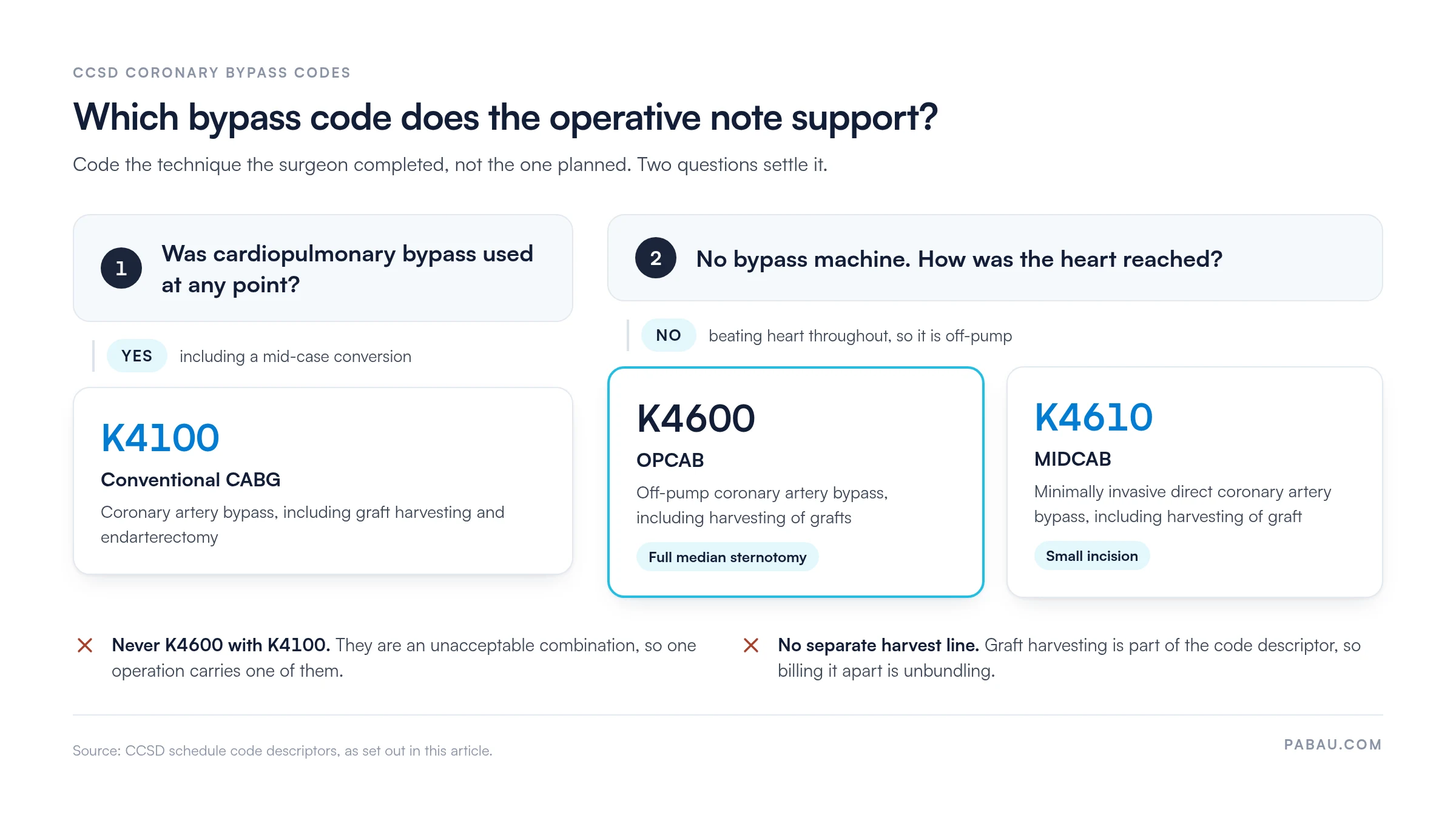
The table sets K4600 and K4100 side by side, feature by feature.
If a case planned as OPCAB converts to on-pump bypass intraoperatively, K4600 no longer applies and K4100 is coded instead. Never submit both codes for one operation. The operative note must reflect the technique actually completed, and the billing code must match. Submitting K4600 when CPB was ultimately used is a factual inaccuracy that payers will identify on audit.
Always confirm the final operative technique before coding. An OPCAB planned at the start may convert to on-pump bypass if hemodynamic instability arises mid-procedure. Code the technique documented in the operative note, not the pre-operative plan.
OPCAB is selected when the surgeon judges that avoiding cardiopulmonary bypass reduces operative risk for a specific patient. Coders do not need to make this clinical judgment. Knowing the indications still helps confirm that K4600 fits and that the operative note carries the expected reasoning.
Common indications for OPCAB include:
The operative note should include a brief statement of clinical rationale for the off-pump approach. This is not a CCSD coding requirement per se, but it strengthens the claim documentation and supports pre-authorization justification for payers who request clinical detail. Where the workup included a standalone pressure wire study, that test carries its own code, K6512, on a separate claim.
The operative note is the primary document that supports a K4600 claim. Payers audit cardiac surgery records with particular care, and an incomplete operative note is the leading cause of denial or recovery request for this code.
A K4600-supporting operative note must contain all of the following:
Where digital consent forms or structured pre-operative assessments were completed, these should be accessible alongside the operative note to support pre-authorization queries.
Submitting CCSD Code K4600 follows the standard Healthcode EDI workflow used across UK private healthcare. The steps below reflect common practice for major UK private payers. Insurer rules vary, so confirm them against each payer’s current billing manual before submission.
Pabau’s claims software for surgeons handles CCSD code submission and claim status tracking for UK cardiothoracic practices. Compliant patient records sit in the same workflow.
Pre-authorization is required by all major UK private health insurers before OPCAB (K4600) is performed as an elective or semi-elective procedure. Without a valid pre-authorization reference, the claim will be rejected at the point of submission, regardless of clinical appropriateness.
Key pre-authorization steps:
Bupa, AXA Health, Aviva, and other major UK insurers each publish specific guidance on their pre-authorization processes. Check the Bupa procedure code lookup and the Aviva fee schedule for current procedure-specific requirements. Pabau’s compliance workflows track pre-authorization status and flag cases where authorization is still pending before the procedure date.
No. Graft harvesting is not separately billable when K4600 is used. The official CCSD descriptor for K4600 reads “including harvesting of grafts.” This is explicit bundling language: The code covers both the bypass procedure and all associated graft procurement steps as a single billable unit.
This applies to all conduit types. Harvesting the LIMA, the long saphenous vein, or the radial artery does not attract a separate CCSD code alongside K4600. Submitting a standalone graft harvesting code in addition to K4600 is an unbundling error. UK private health payers, including those following the Healix fee schedule guidelines, treat unbundling as a billing inaccuracy and will recover the overpayment on audit.
OPCAB is a complex procedure that routinely involves a surgical assistant and a consultant anesthetist. Their billing operates separately from the operating surgeon’s K4600 claim.
Because assistant surgeon allowances are payer-dependent, verify the current rules with each insurer’s billing manual before submitting co-claims. Some policies require the assistant’s details to be included on the primary surgeon’s claim; others require a separate submission through Healthcode.
UK private payers scrutinize high-value claims such as cardiac surgery closely. These are the common denial triggers for CCSD Code K4600 claims, and a wider denial management process catches the same patterns across your other claims.
A denied K4600 claim is recoverable in most cases when the denial arises from documentation deficiency or coding error rather than policy exclusion.
Consult the Healix CCSD fee schedule for a worked example of unbundling rules and fee recovery. Other major UK insurers apply similar procedures. How Bupa applies the schedule in private hospital billing is covered in our guide to Bupa CCSD codes.
Most cardiothoracic billing teams chase three documents before a K4600 claim can go out. They need the signed operative note, the insurer’s pre-authorization reference and the Healthcode submission. When those live in separate inboxes and spreadsheets, a missing reference or an ambiguous note surfaces only after the denial arrives.
Pabau keeps the operative note, consent forms and pre-authorization reference on the patient record, then sends the CCSD claim through Healthcode from the same file. Pending authorizations are flagged before the procedure date, so a case does not reach theatre without one. If you are still comparing systems, our roundup of the best UK billing software sets the options side by side.
The outcome is a claim that leaves with its evidence attached. An audit query on an off-pump case is then answered from one record instead of a search through three systems.

Pabau helps UK private healthcare practices submit CCSD claims, track pre-authorization status, and keep compliant operative records for cardiothoracic procedures including OPCAB.

Code K4600 from the finished operative note, never from the theatre list. If the note does not say the heart was beating throughout, ask the surgeon for an addendum before the claim goes out. A conversion to bypass makes it a K4100 case.
The trade-off is time up front. Checking the note, the pre-authorization reference and the single bundled code before submission costs minutes, while a recovery on audit costs the whole fee. Book a demo to see how Pabau keeps operative notes, authorizations and Healthcode claims together for cardiothoracic billing.

Need a wider view of Bupa CCSD coding? Bupa CCSD procedure codes covers how Bupa applies the CCSD schedule across its private healthcare network.
Looking up another cardiac procedure? CCSD codes lists every procedure code guide in the schedule, in one index.
Coding the diagnostic workup too? CCSD Code K6512 explains how a standalone pressure wire measurement study is coded.
Want fewer cardiac claims bounced back? Denial management in healthcare sets out a process for catching and appealing denied claims.
Choosing a billing system for UK private practice? Best medical billing software in the UK compares the platforms that handle Healthcode and insurer claims.
CCSD Code K4600 is the procedure code for off-pump coronary artery bypass (OPCAB) including harvesting of grafts, as defined in the CCSD schedule. It covers the complete beating-heart revascularization procedure performed without cardiopulmonary bypass, from conduit harvesting through to coronary anastomosis using mechanical stabilization. All graft types (IMA, saphenous vein, radial artery) are bundled into this single code.
Graft harvesting is included within K4600. The official CCSD descriptor reads “including harvesting of grafts,” which is explicit bundling language. Submitting a separate graft harvesting code alongside K4600 is an unbundling error. UK private health insurers deny the claim or recover the payment on audit.
K4600 applies to off-pump bypass where cardiopulmonary bypass is not used. K4100 is conventional coronary artery bypass, including graft harvesting and endarterectomy, usually performed on-pump. If an OPCAB case converts to on-pump intraoperatively, K4100 applies instead of K4600, and the two are never billed together. K4610 is a different code, for minimally invasive direct coronary artery bypass (MIDCAB).
Yes. All major UK private health insurers, including Bupa, AXA Health, and Aviva, require pre-authorization before K4600 is performed as an elective procedure. Claims submitted without a valid pre-authorization reference are automatically rejected. The pre-authorization request should explicitly name K4600 and include the clinical justification for the off-pump approach.
The most common trigger is a missing pre-authorization reference. Others are an operative note that never states no cardiopulmonary bypass was used, and K4100 applied where K4600 is correct (or the reverse). Unbundled graft harvesting and thin documentation of target vessels and anastomoses complete the list. Addressing these in the operative note and claim submission prevents the majority of K4600 denials.
Possibly, but the allowance is payer-dependent. Some UK private health insurers permit a separate assistant surgeon fee for complex cardiac procedures; others have specific eligibility criteria regarding the assistant’s grade. Rules differ between Bupa, AXA Health, Aviva, and other payers. Confirm the current assistant surgeon policy in each insurer’s billing manual before submitting a co-claim.




