Pabau Engage inbox

Pabau Engage is here: every patient conversation in one inbox.

Learn more
Book a demo Book a demo
☰
CCSD Code

CCSD code K1690 – Non-surgical myocardial septum reduction


Code Definition

K1690 is the CCSD code for non-surgical reduction of myocardial septum (e.g. alcohol septal ablation). It covers catheter-based septal reduction in hypertrophic obstructive cardiomyopathy, most often alcohol septal ablation through a septal perforator artery.

The code sits in chapter 8 of the CCSD schedule, sub-chapter 8.9 Heart - Cardiology. UK private medical insurers such as Bupa, AXA Health, Aviva and Vitality use CCSD codes, and surgical septal myectomy takes a separate code.

Group
8 Thorax and intra-thoracic organs
Category
Heart - Cardiology
Sub-chapter
8.9 Heart - Cardiology
Billable
No
Code also known as
alcohol septal ablation, ASA, percutaneous septal reduction, HOCM treatment, non-surgical septal reduction therapy
Save time. Improve accuracy. Get paid faster.
Automate coding with Pabau

Let Pabau's smart automation suggest the right codes, reduce claim denials, and keep your practice compliant—effortlessly.

  • AI-powered code suggestions
  • Real-time compliance checks
  • Faster claims, fewer denials
Why practices choose Pabau
Save hours every week

Automate repetitive tasks and focus on what matters most—your patients.

Improve accuracy

Reduce coding errors and ensure compliance with the latest regulations.

Get paid faster

Clean claims, fewer denials, and faster reimbursements.

Grow with confidence

Powerful insights and reporting to help your practice thrive.

HIPAA compliant SOC 2 certified GDPR-compliant Trusted by 4,000+ clinics worldwide

Key takeaways

Key takeaways

CCSD code K1690 covers non-surgical septal reduction only. Surgical myectomy (the Morrow procedure) is billed under a separate CCSD code.

ICD-10 code I42.1 (obstructive hypertrophic cardiomyopathy) is the primary diagnosis to pair with K1690.

UK private medical insurers such as Bupa, AXA Health, Aviva and Vitality generally expect pre-authorization before K1690, and each sets its own rules.

In Pabau, practice software that sends UK insurer claims through Healthcode, digital forms capture the LVOT gradient, echo reports and operator notes insurers ask for.

CCSD code K1690: Definition and what the code covers

CCSD code K1690 is the code for non-surgical reduction of myocardial septum (e.g. alcohol septal ablation).

It belongs to the CCSD Schedules, the standard procedure codes for the UK private healthcare sector. CCSD stands for Clinical Coding and Schedule Development, and its group is made up of four insurers: Aviva, AXA Health, Bupa and VitalityHealth.

K1690 sits in chapter 8, Thorax and intra-thoracic organs, under sub-chapter 8.9 Heart – Cardiology. Codes from the other chapters are in our CCSD code library. AV junction ablation, billed under code K5710, sits in the same sub-chapter. So does a standalone coronary pressure wire study, billed under code K6512.

The descriptor has two important implications for billing. First, the qualifier “non-surgical” draws a clear line. K1690 covers only percutaneous, catheter-based septal reduction. Any open-chest approach involving cardiopulmonary bypass falls under a different CCSD code. Second, the parenthetical “(e.g. alcohol septal ablation)” signals that alcohol septal ablation is the principal example, not the only possible technique covered by the code.

ElementDetail
CodeK1690
Code systemCCSD (Clinical Coding and Schedule Development) – UK private healthcare
CCSD chapter8 Thorax and intra-thoracic organs
Sub-chapter8.9 Heart – Cardiology
Official descriptorNon-surgical reduction of myocardial septum (e.g. alcohol septal ablation)
Procedure typePercutaneous (catheter-based); non-surgical
Principal clinical indicationHypertrophic obstructive cardiomyopathy (HOCM) with significant LVOT obstruction
Primary ICD-10 codeI42.1 (Obstructive hypertrophic cardiomyopathy)
Surgical equivalentSeptal myectomy (Morrow procedure) – billed under a separate CCSD code

The alcohol septal ablation procedure: Step by step

Alcohol septal ablation is performed through standard cardiac catheterization access, typically through the femoral artery. Coders need to know each stage, because some same-day steps can be claimed separately and others cannot.

  1. Cardiac catheterization and coronary angiography: The cardiologist gains arterial access. Coronary angiography then maps the septal perforator branches of the left anterior descending (LAD) artery. The CCSD schedule lists coronary angiography as an unacceptable combination with K1690, so this step is usually not claimed separately.
  2. Identification of the target septal branch: A guidewire and over-the-wire balloon catheter are advanced into the first (or occasionally second) septal perforator branch. That branch supplies the hypertrophied basal septum.
  3. Contrast echocardiographic confirmation: Contrast echocardiography, performed transthoracically or transesophageally, confirms that the target septal territory matches the area of outflow tract obstruction. Some insurers pay for this intraprocedural echo guidance separately.
  4. Balloon occlusion and alcohol injection: The balloon is inflated to occlude the septal branch. Typically 1-3 ml of absolute ethanol is then injected, causing a controlled, localized infarction of the hypertrophied myocardium.
  5. Pacing and monitoring: A temporary pacemaker is inserted as a precaution before or during the procedure. Complete heart block is a well-documented complication of alcohol injection near the conduction system. Check with the insurer whether the pacing wire insertion can be claimed separately.
  6. Post-procedure assessment: A repeat echocardiogram documents the reduction in LVOT gradient, confirming procedural success. This post-procedure echo supports both clinical documentation and claim justification.

Pro Tip

Always record the pre-procedure and post-procedure LVOT gradient (in mmHg) in the operator report. The reduction in gradient is the main clinical evidence that the procedure was both necessary and completed. Insurers that query a K1690 claim usually ask for this figure first.

Clinical indications: When is K1690 appropriate?

K1690 is indicated for patients with symptomatic hypertrophic obstructive cardiomyopathy who have failed an adequate trial of guideline-directed medical therapy. The ESC Guidelines on Hypertrophic Cardiomyopathy and the ACC/AHA HCM Clinical Practice Guidelines both set the criteria for septal reduction therapy. The claim file needs to document each one.

  • Confirmed HOCM diagnosis: Echocardiographic evidence of septal hypertrophy (typically wall thickness more than 15 mm in adults) with dynamic LVOT obstruction.
  • Significant resting or provoked LVOT gradient: Both ESC and ACC/AHA guidelines set the threshold at a peak gradient of 50 mmHg or more. It may be measured at rest or on provocation. Document the specific gradient value measured, not just “significant obstruction.”
  • Drug-refractory symptoms: NYHA functional class III or IV symptoms despite maximum tolerated doses of beta-blockers, disopyramide, or verapamil. Document each drug tried, the dose, the duration, and the reason for discontinuation or failure.
  • Patient suitability for the percutaneous approach: Appropriate septal branch anatomy on coronary angiography (confirmed at the time of catheterization). Patients with unfavorable anatomy or concurrent structural disease requiring surgery may be better candidates for surgical myectomy.
  • Absence of other indications requiring open surgery: Severe mitral valve disease, significant coronary artery disease, or other pathology needing surgical correction favors myectomy over K1690.

When documenting indications, include the specific gradient measurement, the drug regimen tried, and why the percutaneous approach was chosen over surgical myectomy. Insurers’ clinical reviewers may check that the patient met these criteria before they approve payment.

What K1690 covers and what it excludes

K1690 covers the septal ablation itself: the injection of ethanol into the septal perforator branch and the balloon catheter work around it. Several components performed on the same day fall outside the code, and CCSD rules out some same-day combinations entirely.

ServiceIncluded in K1690?Coding note
Ethanol injection into septal branchYesCore procedure covered by K1690
Cardiac catheterization / coronary angiographyNoCCSD lists coronary angiography as an unacceptable combination with K1690. The insurer decides how strictly to apply it.
Intraprocedural contrast echocardiographyNoMay be claimable separately, depending on the insurer
Temporary pacemaker insertionNoCoded separately if performed. Check with the insurer first.
Surgical septal myectomy (Morrow procedure)NoA different CCSD code. Never substitute K1690.

The most consequential exclusion is surgical myectomy. The two are distinct procedures and are never coded interchangeably. Insurers treat K1690 on an open-chest myectomy, or the reverse, as a coding error and may reject or query the claim. For how one insurer publishes its CCSD codes, see our guide to Bupa CCSD codes.

Required ICD-10 diagnosis codes to pair with K1690

Every K1690 claim needs a valid ICD-10 diagnosis code that justifies the procedure. UK private insurers expect the diagnosis in ICD-10, the classification published by the World Health Organization. The NHS uses the same classification, in its 5th edition. A missing or non-specific diagnosis code is a leading reason K1690 claims are rejected.

ICD-10 CodeDescriptionUse
I42.1Obstructive hypertrophic cardiomyopathyPrimary diagnosis; required on every K1690 claim
I42.2Other hypertrophic cardiomyopathySecondary code where non-obstructive HCM coexists; not to be used as primary for K1690
I50.xHeart failure (various subcategories)Secondary code if heart failure is a comorbidity
Z95.0Presence of cardiac pacemakerSecondary code if pacemaker is subsequently implanted

Critical point: I42.1 must be coded as the principal diagnosis, not I42.2. The word “obstructive” in I42.1 ties the diagnosis to the LVOT obstruction that justifies K1690. Submitting I42.2 as the primary code is a common error. It prompts insurer clinical reviewers to ask why a septal reduction procedure was performed for non-obstructive disease.

AAPC’s coding database offers ICD-10 code lookup and verification, though it follows the US ICD-10-CM version of the classification.

Documentation requirements for K1690 claims

Insurers reviewing K1690 claims look for clinical evidence across six documentation categories. A missing item from any category can leave the claim on hold pending more information, or get it rejected outright. Recording each item in a structured form at the time of the procedure saves rebuilding the file at billing time.
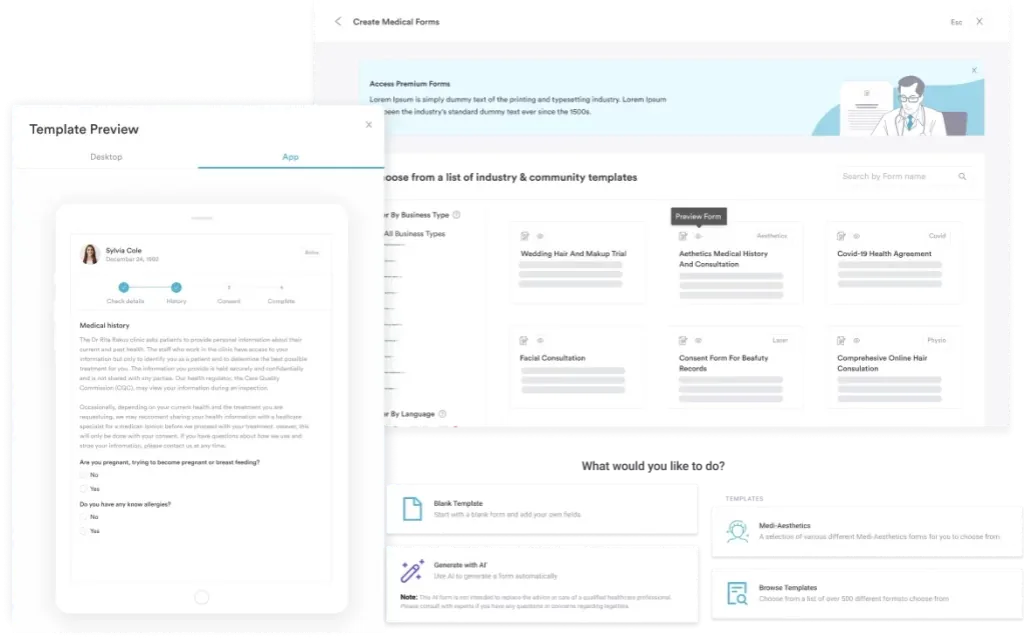
Digital forms
Pabau’s digital forms capture the LVOT gradient, drug history and operator details during the procedure, so the K1690 claim file is complete before billing starts.
  • Pre-procedure echocardiographic report: Must record the peak resting LVOT gradient in mmHg and the septal wall thickness. Note any systolic anterior motion (SAM) of the mitral valve.
  • Drug-refractory status documentation: A dated record of each medication tried (name, dose, duration). Add the clinician’s note on why medical therapy was inadequate or not tolerated.
  • Operator procedure report: A written report, not just catheterization laboratory data output. It names K1690, the target septal branch, the volume of ethanol injected, the balloon occlusion time, and any complications.
  • Intraprocedural echo report: Documents the contrast injection confirming the correct septal territory and the initial response in the LVOT gradient if measurable at the time.
  • Post-procedure echocardiogram: Performed within 24-48 hours or at discharge, documenting the new LVOT gradient and confirming procedural outcome. Some insurers ask for this as evidence that the procedure was completed as described.
  • Pre-authorization reference number: If pre-authorization was obtained (see the section below), the reference number must appear on the claim. Insurers routinely hold claims submitted without it.

The checklist below groups these records by when they are created, from the pre-authorization request to the claim itself.
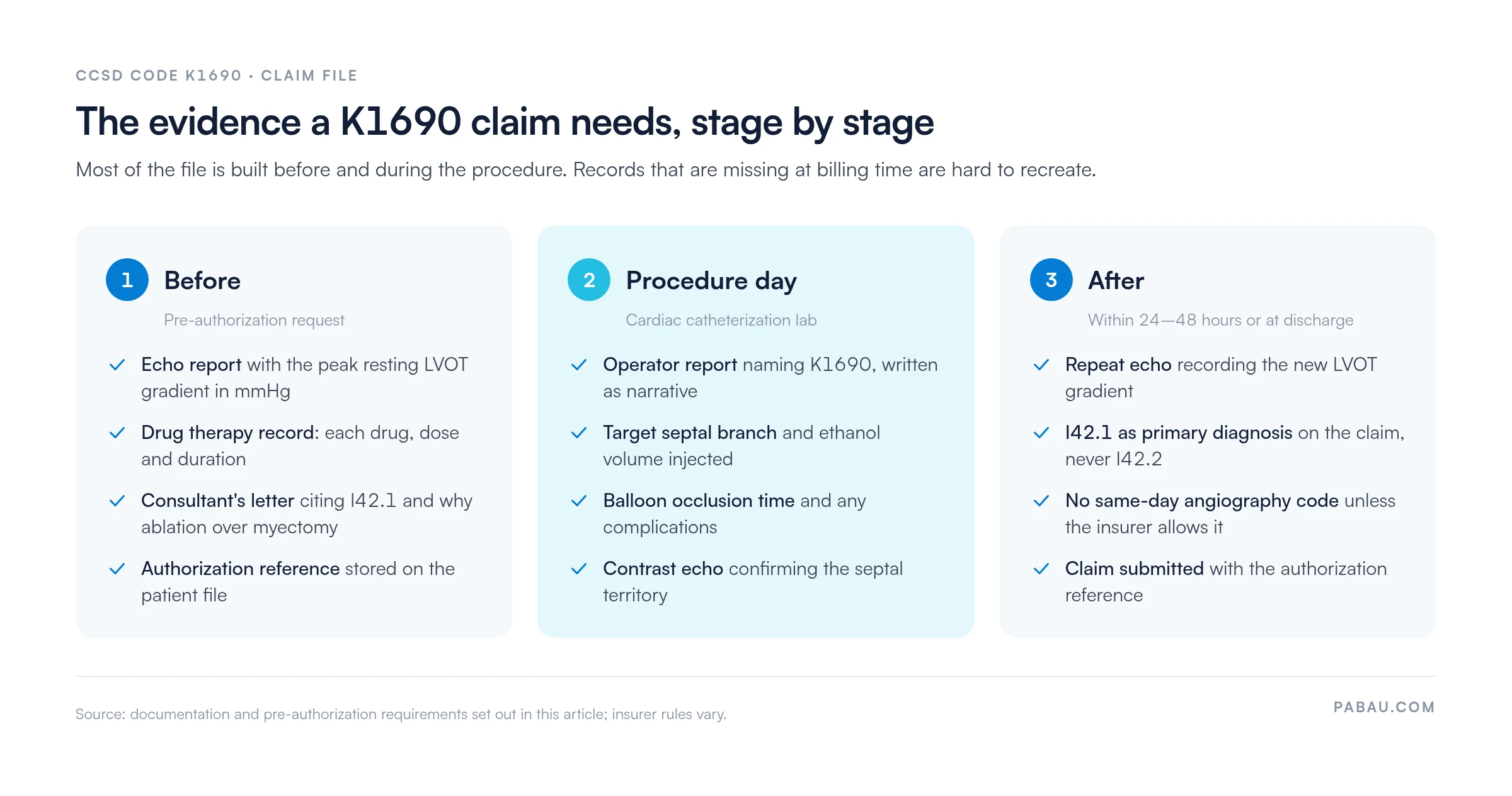
Three-stage checklist for a CCSD K1690 claim. Before: echo report with peak resting LVOT gradient in mmHg, drug therapy record, consultant's letter citing I42.1, authorization reference. Procedure day: operator report naming K1690, target septal branch and ethanol volume, balloon occlusion time and complications, contrast echo. After, within 24 to 48 hours or at discharge: repeat echo with new LVOT gradient, I42.1 as primary diagnosis, no same-day angiography code unless the insurer allows it, claim with the authorization reference.
Most of the K1690 claim file is created before and during the procedure, which is why missing records are hard to recreate at billing time. Compiled from the requirements in this article.

K1690 pre-authorization: What UK insurers require

UK private medical insurers such as Bupa, AXA Health, Aviva and Vitality generally expect pre-authorization before a planned procedure like K1690. Requirements vary by insurer and by the patient’s policy, so check with the insurer before scheduling. Authorization confirms cover in principle. The insurer can still query or reject the claim if the documentation does not support the authorized procedure.

A standard pre-authorization request for K1690 typically includes:

  1. Consultant’s letter of support: Signed by the treating cardiologist, citing the diagnosis (ICD-10 I42.1), the LVOT gradient and the drug-refractory status. It also explains why the percutaneous approach was chosen over myectomy.
  2. Current echocardiographic report: A recent report confirming HOCM with significant LVOT obstruction. Check how recent the insurer needs it to be.
  3. Drug therapy summary: A medication list showing the drugs tried, doses, and duration, confirming guideline-directed medical therapy was exhausted.
  4. Planned procedure code and treating hospital: State K1690 explicitly in the request, along with the treating hospital and the planned date.

Once pre-authorization is granted, store the reference number in the patient’s file straight away. An authorization can lapse if the procedure is not performed within the approved window, so confirm its validity dates.

Pro Tip

Submit the pre-authorization request as soon as the procedure is booked. A request sent the day before the procedure risks a delayed or conditional authorization, which creates billing problems after the fact.

Common reasons K1690 claims are denied

K1690 carries a low claim volume compared with routine cardiology codes. Insurer clinical reviewers often look at it more closely than a standard catheterization claim. The most common denial triggers are systematic, and software that checks claims can catch them before submission.
Automate claims through Healthcode
Pabau sends insurer claims through Healthcode, so a K1690 claim goes out from the same record that holds the echo reports and operator note.
Denial reasonWhat goes wrongPrevention
Incorrect or missing ICD-10 codeI42.2 submitted instead of I42.1; or no diagnosis code at allVerify I42.1 is coded as principal diagnosis before submission
No pre-authorizationProcedure performed without the insurer’s prior approvalObtain pre-authorization and record the reference number before the procedure date
Same-day combination errorK1690 billed alongside a coronary angiography code that CCSD lists as an unacceptable combinationCheck the insurer’s combination rules before billing angiography on the same date
Missing procedure reportNo operator report attached; catheterization lab printout submitted insteadAttach a signed, narrative procedure report naming K1690 and describing the ethanol injection
Wrong provider typeK1690 billed under a provider number not recognized for interventional cardiologyConfirm the treating cardiologist’s insurer-recognized consultant/provider number matches the procedure type
Diagnostic cath only performedK1690 billed when only coronary angiography was performed and the ablation was deferredBill K1690 only on the date the ablation itself was performed

How to appeal a denied K1690 claim

A rejected K1690 claim is not necessarily final. Insurers review queried claims, and a denial caused by missing documentation can often be reversed once that documentation is supplied.

  1. Identify the denial reason: Read the insurer’s remittance or rejection letter carefully. The stated reason tells you what the reviewer found insufficient. An appeal that addresses a different issue rarely succeeds.
  2. Compile the supporting documentation: Assemble the pre-procedure echo report, the drug therapy record, the operator report, the post-procedure echo, and the pre-authorization reference (if applicable). If the denial cites a missing document, that document must be in the appeal.
  3. Write a consultant’s letter of support: The treating cardiologist signs a letter citing the LVOT gradient, the drug-refractory status and the guideline basis for K1690. Name the ESC Guidelines on Hypertrophic Cardiomyopathy or the ACC/AHA HCM Clinical Practice Guidelines explicitly. A guideline-cited letter gives the clinical reviewer a standard to check the case against.
  4. Use the insurer’s own appeal or complaints process: Each insurer sets its own route and time limits for disputing a claim decision. Check them before you submit.
  5. Ask for clinical review if the first appeal fails: Request a review by a clinician on the insurer’s panel. Attach the full documentation and the guideline citations.

If the insurer’s complaints process ends without a resolution, the patient, as policyholder, can take the complaint to the Financial Ombudsman Service. The ombudsman expects the complaint to go to the insurer first. It must then be referred within six months of the insurer’s final response.

How Pabau supports accurate K1690 claims

Many cardiology practices still build a K1690 claim by hand. The echo reports sit in one system, the operator note in the catheterization lab software, and the claim gets keyed into an insurer portal.

Pabau keeps the patient record, clinical forms, notes and invoice together. It sends private medical insurance claims through Healthcode to UK insurers such as Bupa, AXA Health and Vitality.

Structured forms prompt the cardiologist to record the gradient before and after ablation, the ethanol volume and the target branch. The coder then has the evidence to support K1690 on the first submission, which means fewer insurer queries.

Prepare complete K1690 claims for UK insurers

Pabau’s digital forms and clinical notes capture LVOT gradient data, echo reports and procedure notes in one structured record. Claims then go to UK insurers through Healthcode, with fewer queries and less rework.

Pabau clinical documentation for cardiology billing

Conclusion

K1690 claims fail on detail rather than on clinical merit. The wrong primary diagnosis, a same-day angiography code or a missing gradient figure can each stop payment for a procedure the patient clearly needed.

The fix sits upstream of billing. Record the gradient, the drug history and the ablation details while the patient is in the lab, and secure pre-authorization before the date is fixed. The coder then builds the claim from records that already exist.

Book a demo to see how Pabau keeps cardiology documentation and Healthcode claims in one record for UK practices.

Continue your research

Continue your research

Need a broader CCSD billing reference? Bupa CCSD codes explains how Bupa lists CCSD procedure codes for private healthcare claims.

Looking to reduce claim denials across your practice? Claims management software from Pabau helps practices track submissions, flag incomplete documentation, and manage resubmissions in one workflow.

Looking up another CCSD code? CCSD code library collects Pabau’s guides to CCSD procedure codes across the schedule’s chapters.

Billing an electrophysiology study? CCSD code K5810 covers intracardiac electrophysiological study, another sub-chapter 8.9 cardiology code.

Frequently asked questions

What procedure does CCSD Code K1690 cover?

CCSD Code K1690 covers non-surgical reduction of the myocardial septum, most commonly performed as alcohol septal ablation in patients with hypertrophic obstructive cardiomyopathy (HOCM). The code is specific to the percutaneous, catheter-based approach only. Surgical septal myectomy (the Morrow procedure) is billed under a separate CCSD code and must never be substituted with K1690.

Which ICD-10 codes must be paired with K1690?

ICD-10 code I42.1 (Obstructive hypertrophic cardiomyopathy) is the required primary diagnosis for K1690 claims. I42.2 (Other hypertrophic cardiomyopathy) may be added as a secondary code where non-obstructive disease coexists, but it cannot serve as the primary code. Submitting I42.2 as primary is a common denial trigger.

Does K1690 require pre-authorization from insurers?

UK private medical insurers such as Bupa, AXA Health, Aviva and Vitality generally expect pre-authorization for K1690 before the procedure. Requirements vary by insurer and policy. Send the consultant’s letter of support, a current echocardiographic report, and the drug-refractory medication history with the request. Going ahead without authorization raises the risk that the insurer rejects the claim.

Can echocardiography be billed separately on the same day as K1690?

Intraprocedural contrast echocardiography used to identify the target septal branch may be claimable under a separate CCSD echocardiography code, but this depends on the insurer. Check each insurer’s rules before submitting both codes for the same date. Some insurers reduce or deny the echo code when it is billed alongside K1690.

What is the difference between K1690 and surgical septal myectomy for billing purposes?

K1690 covers the percutaneous, catheter-based alcohol injection approach performed in a cardiac catheterization laboratory under local anesthesia. Surgical myectomy (the Morrow procedure) is an open-heart operation requiring cardiopulmonary bypass, performed under general anesthesia in a cardiothoracic surgical suite. It is billed under a separate CCSD cardiothoracic surgery code. The two codes cover different procedural approaches to the same clinical problem and cannot be used interchangeably.
Tanja Lepcheska
Content Writer

Tanja Lepcheska is a Senior Content Writer at Pabau, where she turns complex med spa and aesthetics topics into clear, practical guides. Since 2023, she has written 500+ articles on launching, running, and growing a practice, from regulation across the UK, US, Canada, and UAE to day-to-day operations. Her goal is simple: help practice owners feel confident about their next business decision. Her featured work covers practice launches, compliance, business models, and med spa operations. Browse it below. Away from the keyboard, you'll find her watching movies, working on a new crochet project, or rearranging her home decor "just one more time."
×