

CPT Code 30801: Superficial turbinate ablation billing guide
CPT Code 30801: Official descriptor and procedure overview The American Medical ...

Last Updated: Nov 27, 2026
L5922 is the CCSD code for femoropopliteal bypass using prosthesis. It covers open surgery that uses a synthetic graft, such as PTFE or Dacron, to bypass a blocked segment of the thigh artery.
The code sits in chapter 9 of the CCSD schedule, under 9.5.0 Ileo-femoral Vessels. UK private insurers, including Bupa, AXA Health, Aviva and Vitality, use it for pre-authorization and billing. A bypass using the patient's own vein is coded L5923 instead.
Let Pabau's smart automation suggest the right codes, reduce claim denials, and keep your practice compliant—effortlessly.
Automate repetitive tasks and focus on what matters most—your patients.
Reduce coding errors and ensure compliance with the latest regulations.
Clean claims, fewer denials, and faster reimbursements.
Powerful insights and reporting to help your practice thrive.
HIPAA compliant SOC 2 certified GDPR-compliant Trusted by 4,000+ clinics worldwide

CCSD Code L5922 covers femoropopliteal bypass with a synthetic graft, such as PTFE or Dacron. A bypass using the patient’s own vein is L5923.
The operative note decides the code: it must name the graft material, its diameter and both anastomosis sites to support L5922.
UK private insurers such as Bupa, AXA Health, Aviva and Vitality expect an authorization number before elective bypass surgery.
Pair L5922 with a WHO ICD-10 diagnosis, usually I70.2 or I74.3. Codes such as I70.22 belong to the US ICD-10-CM and don’t apply.
CCSD Code L5922 is the Clinical Coding and Schedule Development code for “femoro-popliteal bypass using prosthesis.”
It belongs to the CCSD Group’s schedule, the standard set of procedure codes for UK private healthcare. In this operation, the surgeon sews a synthetic graft from the femoral artery to the popliteal artery, bypassing a blocked or narrowed segment.
The CCSD Group brings together representatives of four major private insurers: Bupa, AXA Health, Aviva and Vitality. Like all CCSD codes, L5922 sits in a numbered chapter, here chapter 9, the vascular system, under group 9.5.0, Ileo-femoral Vessels. Specialists and hospitals quote it on pre-authorization requests and invoices, alongside an ICD-10 diagnosis code.
The patient lies flat, and the surgeon prepares the leg for incisions at the groin and the knee. The surgeon exposes the common femoral artery at the groin, then the popliteal artery above or below the knee. The level depends on how far the disease extends.
A synthetic conduit, most often expanded polytetrafluoroethylene (ePTFE) or Dacron (polyester), is tunneled under the skin or along the natural route of the artery. The surgeon joins the upper end to the femoral artery and the lower end to the popliteal artery. Completion imaging, such as angiography or duplex scanning, confirms the graft is open before the wounds are closed.
PTFE is the usual choice for an above-knee bypass when no suitable vein is available. Dacron is more common in aortoiliac surgery, but surgeons also use it in the femoropopliteal position. To support L5922, the operative note must name the material, the graft diameter and both anastomosis sites.
Surgeons perform the bypass coded L5922 for peripheral arterial disease (PAD) when ischemia justifies open surgery and no suitable vein is available. The main indications, in line with TASC II and European Society for Vascular Surgery guidance, are:
Surgeons choose a prosthetic conduit when the great saphenous vein is missing, varicose or too narrow, or was used in earlier surgery. A redo bypass after a failed vein graft is another common reason. An ankle-brachial pressure index (ABPI) below 0.5 at rest gives objective evidence of significant ischemia, and insurers often ask for it.
The CCSD schedule codes femoropopliteal bypass by conduit. L5922 is for a synthetic graft, and L5923 is for a bypass using the patient’s own vein. Billing L5922 when a reversed saphenous vein was used is miscoding, and it can prompt an insurer query or a recovery request after audit. The conduit named in the operative note settles it:
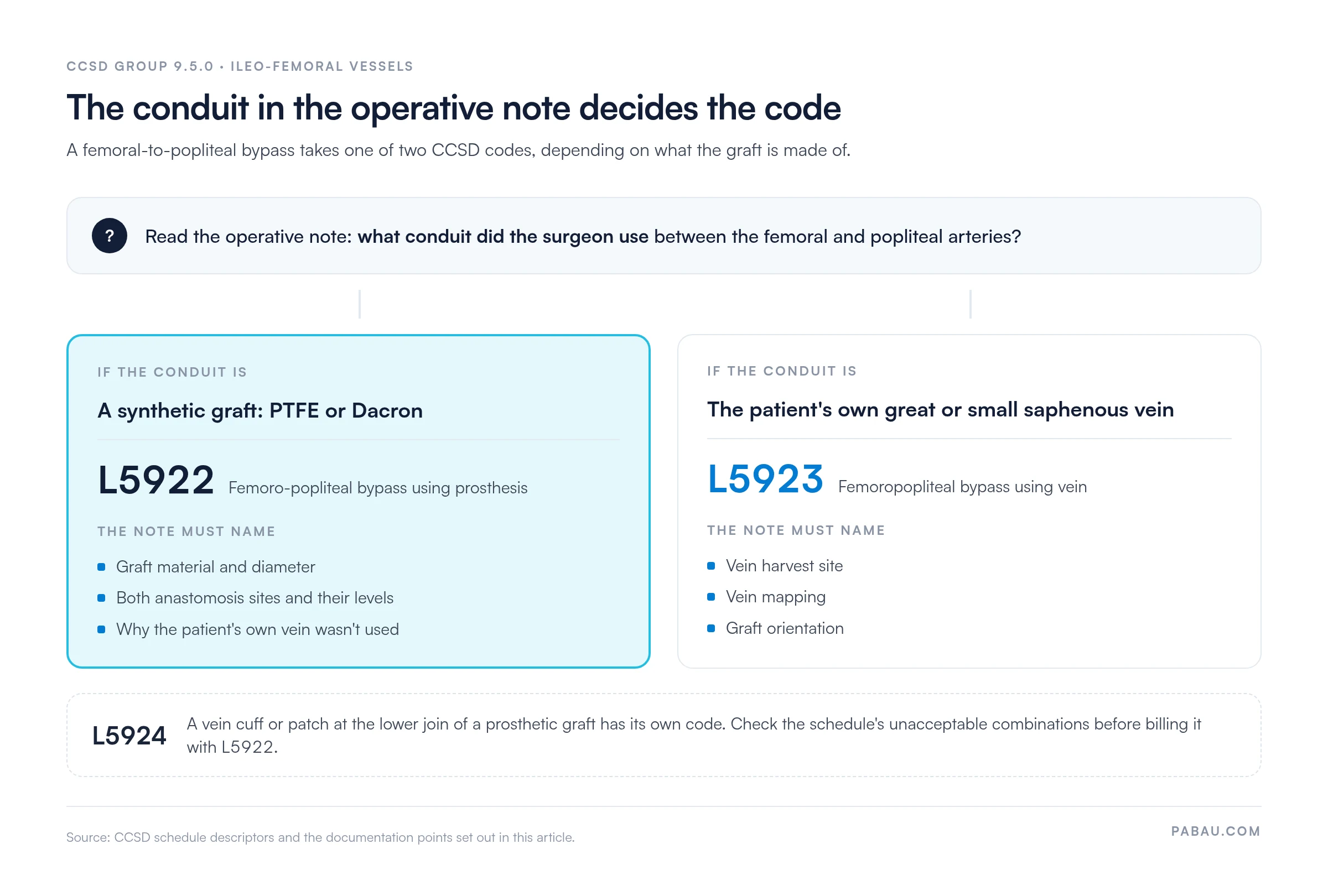
Insurers check the same points on both codes, so the table compares them side by side:
The descriptor for CCSD Code L5922 doesn’t split the code by where the lower join lands. Whether the distal anastomosis is above the knee or below it is a documentation detail, not a separate CCSD code. When the lower join lands on a calf artery instead, the operation is a femorodistal bypass, coded L5950 when a prosthesis is used.
The operative report must still state the exact level of the distal anastomosis. Insurers may ask for it during pre-authorization or a later claim review to check the treatment was appropriate.
L5922 sits in CCSD group 9.5.0, Ileo-femoral Vessels, next to codes for the same artery segment. Picking a neighbor by mistake is a common coding error, so check the descriptor before you submit:
A vein cuff or patch (L5924) is sometimes added at the lower join of a prosthetic graft. Check the CCSD schedule’s unacceptable combinations for L5922 before billing a second code for the same operation. Bupa applies its own fee and combination rules on top of the schedule, set out in the guide to Bupa CCSD codes.
A complete operative file is the biggest factor in getting L5922 paid without a query. Insurer claim reviewers check these elements against the invoice:
In Pabau, a practice management platform, the surgeon records the operative note and diagnosis on the patient record during the episode. The billing team then works from one complete file instead of chasing missing details after the surgery.
Before you submit L5922, check the operative report for the graft material, its diameter, both anastomosis levels and the reason vein wasn’t used. Add the ABPI values and the imaging result too, because each missing item invites a query.
Most UK insurers expect an ICD-10 diagnosis code alongside the CCSD procedure code. UK claims use the WHO ICD-10, not the US ICD-10-CM, so stick to these codes:
NHS England publishes the WHO ICD-10 5th Edition as the UK standard for diagnosis coding. Use the WHO ICD-10 browser to check codes and descriptions. Avoid extended codes such as I70.21, I70.22 or I70.24, because they exist only in the US ICD-10-CM.
UK private insurers expect pre-authorization before elective femoropopliteal bypass surgery. The patient usually calls the insurer with the CCSD code the surgeon supplies. The insurer may also ask the surgeon’s practice for supporting detail, such as:
Bupa, AXA Health, Aviva and Vitality each set their own policy rules and authorization steps. Without authorization, the insurer may refuse the claim, leaving the patient to pay. Confirm each insurer’s requirements and the patient’s cover before the surgery date.
Pabau’s claims management software keeps the authorization code, its dates and the diagnosis on the patient’s case. It also warns the team when an authorization is missing, before the claim goes out.
These are the patterns that most often hold up an L5922 claim with a UK private insurer:
In UK private practice, the anesthetist usually bills the same CCSD code as the surgeon. Each clinician sends their own invoice, and the insurer pays them against its own fee schedule. Some insurers also pay a fee for a surgical assistant, so check each policy before the assistant bills.
Extra procedures in the same operation, such as a profundaplasty, may or may not be billable alongside L5922. Check the CCSD schedule for a separate code and for any unacceptable combinations first. Billing a step the schedule treats as part of the bypass is an audit risk.
When an assistant surgeon scrubs in for L5922, confirm the insurer pays assistant fees for this procedure first. A rejected assistant fee doesn’t affect the surgeon’s own L5922 payment, but it does cut what the team recovers.
Prosthetic femoropopliteal grafts need regular surveillance, and some need further treatment. Each follow-on procedure carries its own coding rule, and L5922 is rarely the right code for it.
Graft surveillance duplex scans are billed separately from L5922, under the relevant imaging code rather than a surgical one. If a scan finds a narrowing and it’s treated with angioplasty or a stent, the code for that intervention applies. Don’t bill L5922 again. Renal angioplasty, with or without a stent, likewise takes its own code, CCSD code XR430.
When a prosthetic graft blocks suddenly, removing the clot from the graft is a separate procedure with its own CCSD code. A graft revision, such as a jump graft or an extension, also has its own code. L5922 applies again only when the surgeon builds a complete new prosthetic bypass. When the clot is dissolved or suctioned out through a catheter under imaging, that procedure is coded XR410.
The operative report must make clear which of the three took place, because each one needs its own authorization.
Most UK private practices send insurer claims electronically through Healthcode. It works as the medical claims clearinghouse for UK private insurers. A typical L5922 claim follows these steps:
Many vascular practices still keep the operative note in one system and the insurer invoice in another. The authorization number then sits in an email or on paper. Each handover is a chance for an L5922 claim to go out incomplete.
Pabau keeps the clinical record and the billing in one place. The team records the authorization code on the patient’s case, adds L5922 and the diagnosis, and sends the claim through Healthcode or to Bupa. Pabau flags a missing authorization before the claim leaves.
The result is fewer insurer queries and faster payment for every bypass the practice performs.

Pabau keeps the CCSD code, ICD-10 diagnosis, authorization number and operative notes on one patient record, then sends the claim through Healthcode.

L5922 is a high-value code, and an insurer will query it when the operative file can’t prove a prosthetic graft was used. The conduit decides the code, so the operative note must name the material, the graft size and both anastomosis sites.
Get authorization from the insurer first, use a WHO ICD-10 diagnosis, and keep the report ready for any query. When the clinical record and the billing live in one system, those steps happen as part of the episode. Book a demo to see how Pabau handles CCSD claims through Healthcode.

Need the wider CCSD picture? CCSD codes explains how the schedule is structured and how UK insurers use it.
Billing Bupa patients? Bupa CCSD codes covers how Bupa applies the schedule to its fee rules.
Coding a vein bypass to the calf? CCSD code L5960 covers femoro-distal bypass using the patient’s own vein.
Want fewer insurer queries? Claims management software from Pabau tracks authorization numbers, diagnosis codes and claim status in one place.
CCSD Code L5922 covers femoropopliteal bypass using a prosthetic conduit, such as PTFE or Dacron. It restores blood flow past a blocked femoral or popliteal segment when no suitable vein is available. A bypass using the patient’s own vein is coded L5923.
Use L5922 when the operative note confirms a synthetic graft. If the surgeon harvested the great or small saphenous vein as the conduit, L5923 applies. The operative note is the deciding document, so it must name the conduit clearly.
Yes, Bupa, AXA Health, Aviva and Vitality expect an authorization number before elective treatment. The patient usually calls the insurer with the CCSD code the surgeon supplies. Each insurer sets its own rules, so check the policy before the surgery date.
The L5922 descriptor doesn’t split the code by the level of the lower join. Above-knee and below-knee popliteal targets both fall under the same femoropopliteal descriptor. The operative report should still state the exact level of the distal anastomosis.
UK claims use the WHO ICD-10. The usual pairings are I70.2 (atherosclerosis of arteries of extremities) and I74.3 (embolism and thrombosis of lower limb arteries). Codes such as I70.21 or I70.22 come from the US ICD-10-CM and don’t apply to UK claims.
Both codes describe a femoropopliteal bypass in CCSD group 9.5.0, Ileo-femoral Vessels. L5922 uses a prosthetic graft, while L5923 uses the patient’s own vein. The conduit named in the operative note decides which one applies.




