

CPT Code 30801: Superficial turbinate ablation billing guide
CPT Code 30801: Official descriptor and procedure overview The American Medical ...

Last Updated: Nov 27, 2026
K4100 is the CCSD code for bypass for coronary artery(ies) including harvesting of grafts and endarterectomy. It covers a first coronary bypass performed on cardiopulmonary bypass, billed to UK private medical insurers.
Graft harvesting and endarterectomy are part of the code, so neither is billed as a separate line. Off-pump bypass takes K4600 instead. If an off-pump operation converts to on-pump, K4100 applies, and the two codes are never billed together.
Let Pabau's smart automation suggest the right codes, reduce claim denials, and keep your practice compliant—effortlessly.
Automate repetitive tasks and focus on what matters most—your patients.
Reduce coding errors and ensure compliance with the latest regulations.
Clean claims, fewer denials, and faster reimbursements.
Powerful insights and reporting to help your practice thrive.
HIPAA compliant SOC 2 certified GDPR-compliant Trusted by 4,000+ clinics worldwide

CCSD Code K4100 covers a first coronary artery bypass performed on-pump, with graft harvesting and endarterectomy bundled into the one code.
Billing the saphenous vein or radial artery harvest as a separate line is a common cause of K4100 claim rejection by UK private insurers.
Off-pump bypass bills under K4600 and a redo bypass under K4410. A conversion from off-pump to on-pump bills K4100 alone, never both.
Most UK private insurers, including Bupa, AXA Health, Aviva and Vitality, require pre-authorization before a planned K4100 operation.
Pabau’s claims management software keeps authorizations and operative notes on the patient record and sends CCSD claims through Healthcode.
CCSD Code K4100 describes bypass for coronary artery(ies) including harvesting of grafts and endarterectomy.
Cardiac surgeons bill it to UK private medical insurers under the shared CCSD schedule for a first coronary artery bypass graft (CABG) performed on-pump. The descriptor sets no minimum or maximum number of vessels, so one graft or several bill as one K4100 line.
CCSD stands for Clinical Coding and Schedule Development. The CCSD Group brings together Aviva, AXA Health, Bupa and Vitality, and maintains one shared schedule of CCSD codes. Other insurers and administrators also use CCSD codes. K4100 sits in the Heart – Cardiac Surgery section of the schedule, group 8.8.0.
Clinically, CABG reroutes blood flow around partially or fully blocked coronary arteries. The surgeon harvests a conduit, typically the great saphenous vein, the radial artery or an internal mammary artery (LIMA or RIMA). The conduit is then joined to the coronary artery beyond the blockage. Where plaque fills the vessel lumen, the surgeon may perform a coronary endarterectomy to remove it before completing the anastomosis.
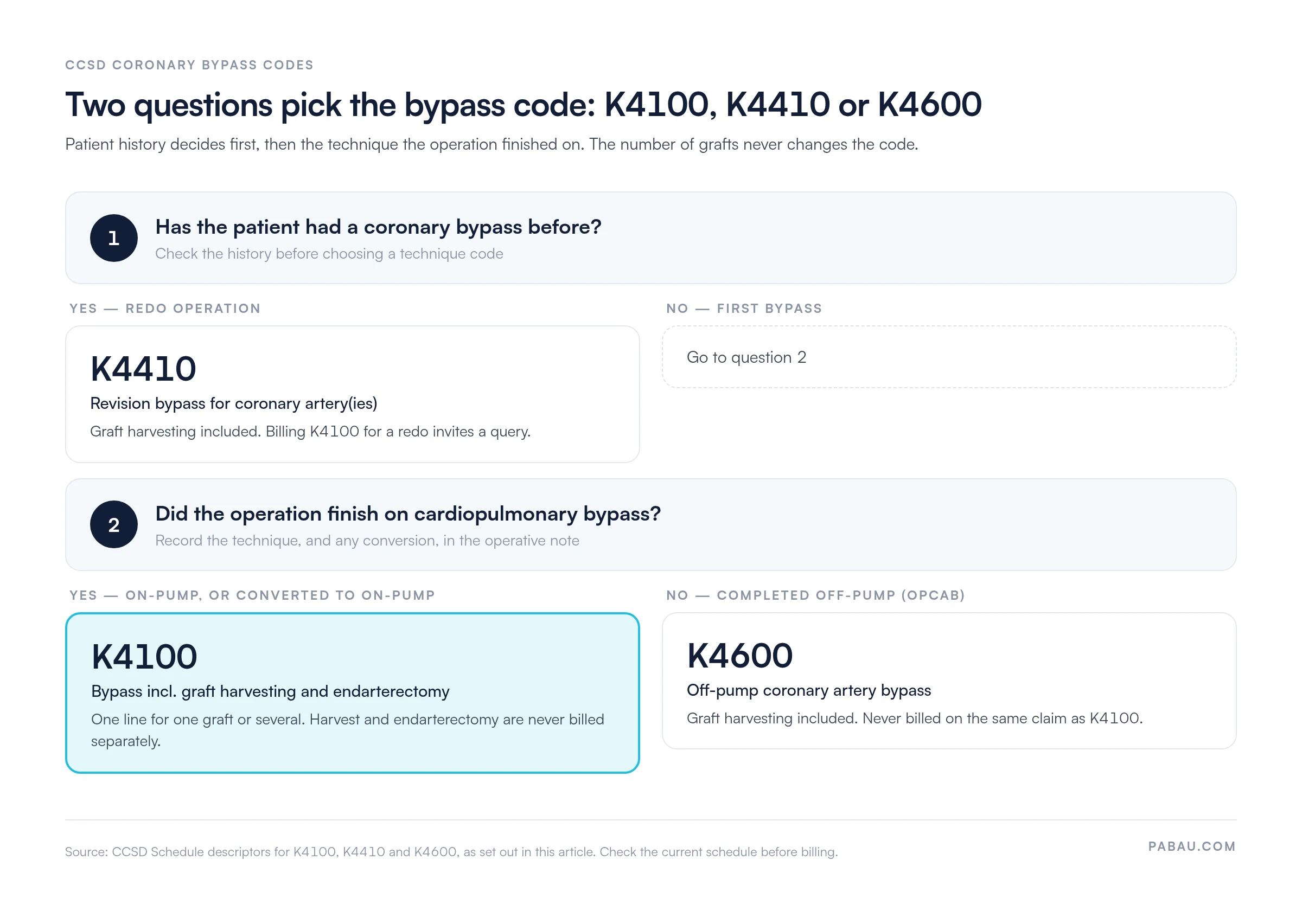
Technique decides the code. K4100 covers bypass performed on cardiopulmonary bypass (CPB), commonly called on-pump CABG. Bypass on the beating heart without CPB, known as off-pump CABG (OPCAB), bills under K4600. If an off-pump operation converts to on-pump, the claim takes K4100, and the two codes are never billed together. Patient history comes before technique, as the decision path below shows.
Four service components are bundled into K4100 by its descriptor. Billing any of them as a separate line alongside K4100 is unbundling, and UK private insurers reject the extra line.
Graft harvesting is a bundling rule coders can misapply. Harvesting the saphenous vein or radial artery happens at a separate site, the leg or forearm. That leads some coders to assume it warrants its own code. The CCSD descriptor makes no such allowance, because the harvest is part of K4100. Check the current CCSD schedule before billing, as the group updates codes and descriptors over time.
Several services delivered around a K4100 operation are billed on separate lines or by other clinicians. Each needs the insurer’s authorization and clear documentation.
Split the operative report clearly when a valve procedure or aortic root repair accompanies the CABG. A single narrative that merges both procedures makes it hard for the insurer’s reviewer to confirm two distinct procedures. The second code is then often queried or rejected.
The cardiac surgery section of the Bupa CCSD procedure codes schedule holds three bypass codes. Choosing between them depends on the patient’s history and the surgical technique, not on the number of grafts.
Check every code descriptor against the current CCSD schedule before you submit. The CCSD Group maintains the codes but does not set fees, so each insurer publishes its own fee for K4100. That applies across the Thorax chapter, including chest wall codes such as CCSD code T0212 for a posterior costoplasty.
Narrowed arteries outside the heart take their own codes. Renal angioplasty, with or without a stent, for example, is billed under code XR430.
Every K4100 claim must carry at least one ICD-10 diagnosis code that documents the clinical indication for surgery. UK private insurers work from the WHO edition of ICD-10, so the codes and titles below follow it rather than the US ICD-10-CM. The coder must confirm the patient’s clinical documentation supports the selected code before submitting.
An incorrect ICD-10 pairing is an audit flag for insurer clinical reviewers. A typical example is an MI code on a claim whose notes describe chronic stable disease. Select the code that matches the documented indication, not the most severe code available.
An operative report that is vague, incomplete or inconsistent with the code submitted is a frequent, preventable cause of K4100 claim rejection. The operative note captured at the time of surgery must support every element billed.
The operative report for K4100 should contain these elements to withstand an insurer audit:
Most UK private medical insurance policies require pre-authorization before planned inpatient surgery such as K4100. The patient usually contacts the insurer, but the surgeon’s team supplies the clinical detail. Bupa, AXA Health, Aviva, Vitality and WPA each run their own authorization process, so check the patient’s insurer before booking theater time.
Emergency bypass performed before authorization is handled under the insurer’s own rules. Contact the insurer as soon as possible after the operation, and keep the clinical record ready to support the claim.
A complete pre-authorization request for K4100 usually carries:
Record the authorization number on the patient’s file as soon as it arrives. If the plan changes in the operating room, such as a conversion from off-pump to on-pump, tell the insurer promptly. An authorization for K4600 does not cover a K4100 claim.
CCSD Code K4100 claims fail for a predictable set of reasons. Most are preventable with structured checks before the invoice goes out.
When an insurer rejects or queries a K4100 claim, get the written reason before resubmitting. Resubmitting without it usually brings the same rejection. Where the dispute is clinical, involve the operating surgeon in the reply. Claims management software that tracks rejection reasons per claim helps practices spot repeat billing errors early.
Reconcile every submitted K4100 claim against insurer remittance advice each month. Follow up any claim still outstanding after 30 days. Early follow-up stops unpaid claims from turning into write-offs and surfaces documentation problems before an audit.
Several circumstances change which code goes on the claim or who else invoices for the operation. Check the billing rules of the insurer or its administrator, such as the Healix fee schedule guidelines, before submitting.
A K4100 claim draws on paperwork from several places. The authorization letter sits in one inbox, the angiogram report in another system, and the operative note with the hospital. When an insurer query arrives weeks later, someone has to find all of it again.
Pabau, a practice management platform for private consultants, keeps those documents on the patient record. Its claims management tools send CCSD-coded invoices to insurers such as Bupa through Healthcode. Your team can track each claim’s status and reconcile payments without leaving Pabau.

Pabau keeps authorizations, operative notes and invoices on one patient record. It then sends CCSD-coded claims to UK insurers through its Healthcode integration.

K4100 is the right code for a first coronary bypass performed on-pump. It bundles the bypass, graft harvesting and coronary endarterectomy into one claim line. A redo operation belongs under K4410, and a beating-heart operation under K4600.
The code choice is rarely what holds up payment. Claims stall when a harvest line stays on the invoice, the authorization is missing, or the note never names the technique. Fix those before submission, and the insurer has little left to query.
Book a demo to see how Pabau keeps the authorization, the operative note and the K4100 invoice on one patient record.

Was the bypass done on the beating heart? CCSD code K4600 covers off-pump coronary artery bypass and when a conversion moves the claim to K4100.
Has the patient had a bypass before? CCSD code K4410 explains how to bill a revision coronary artery bypass.
New to the CCSD schedule? CCSD codes explains how the shared schedule works across UK private insurers.
Billing Bupa patients for cardiac surgery? Bupa CCSD codes walks through how Bupa applies the CCSD schedule.
Want CCSD claims sent from the patient record? Pabau’s claims management software sends claims to insurers through Healthcode.
CCSD Code K4100 is the UK private insurance procedure code for bypass for coronary artery(ies) including harvesting of grafts and endarterectomy. Cardiac surgeons use it to bill a first on-pump coronary bypass to insurers such as Bupa, AXA Health, Aviva and Vitality.
No. Coronary endarterectomy is named in the K4100 descriptor as a bundled component. A separate endarterectomy code on the same claim is unbundling, and the insurer will typically reject that line.
Yes. Harvesting of grafts, including the great saphenous vein, radial artery and internal mammary artery, is bundled into K4100. No separate harvesting code is billed alongside it.
Yes, for planned surgery. Most UK private medical insurers, including Bupa, AXA Health, Aviva and Vitality, require pre-authorization before a planned coronary bypass. Emergency surgery follows the insurer’s own rules, so contact the insurer as soon as possible afterward.
K4100 claims are typically denied for missing pre-authorization, unbundled harvest or endarterectomy lines, or vague operative notes. Incorrect ICD-10 pairing is another. So is K4100 on a claim that needed K4410 for a redo bypass or K4600 for an off-pump bypass.
Off-pump bypass is billed under K4600, not K4100. If an off-pump operation converts to on-pump, the claim takes K4100 alone, and the two codes are never billed together. Record the technique, and any conversion, in the operative note.




