HCPCS Code E0272: Foam rubber mattress billing guide
HCPCS Code E0272: official descriptor and code overview HCPCS Code E0272 is the ...

Last Updated: Nov 6, 2026
J0740 is the CCSD code for open hepatectomy and ablation. UK private medical insurers use it when a surgeon resects part of the liver and ablates further lesions in the same open operation.
The code sits in CCSD sub-section 11.7.0, Other Organs (Mainly Digestive). Both the resection and the ablation must take place for J0740 to apply, and they are billed as one code rather than two.
Let Pabau's smart automation suggest the right codes, reduce claim denials, and keep your practice compliant—effortlessly.
Automate repetitive tasks and focus on what matters most—your patients.
Reduce coding errors and ensure compliance with the latest regulations.
Clean claims, fewer denials, and faster reimbursements.
Powerful insights and reporting to help your practice thrive.
HIPAA compliant SOC 2 certified GDPR-compliant Trusted by 4,000+ clinics worldwide

CCSD code J0740 covers an open hepatectomy and an ablation of liver lesions that a surgeon performs in the same operation, and you bill it as one code.
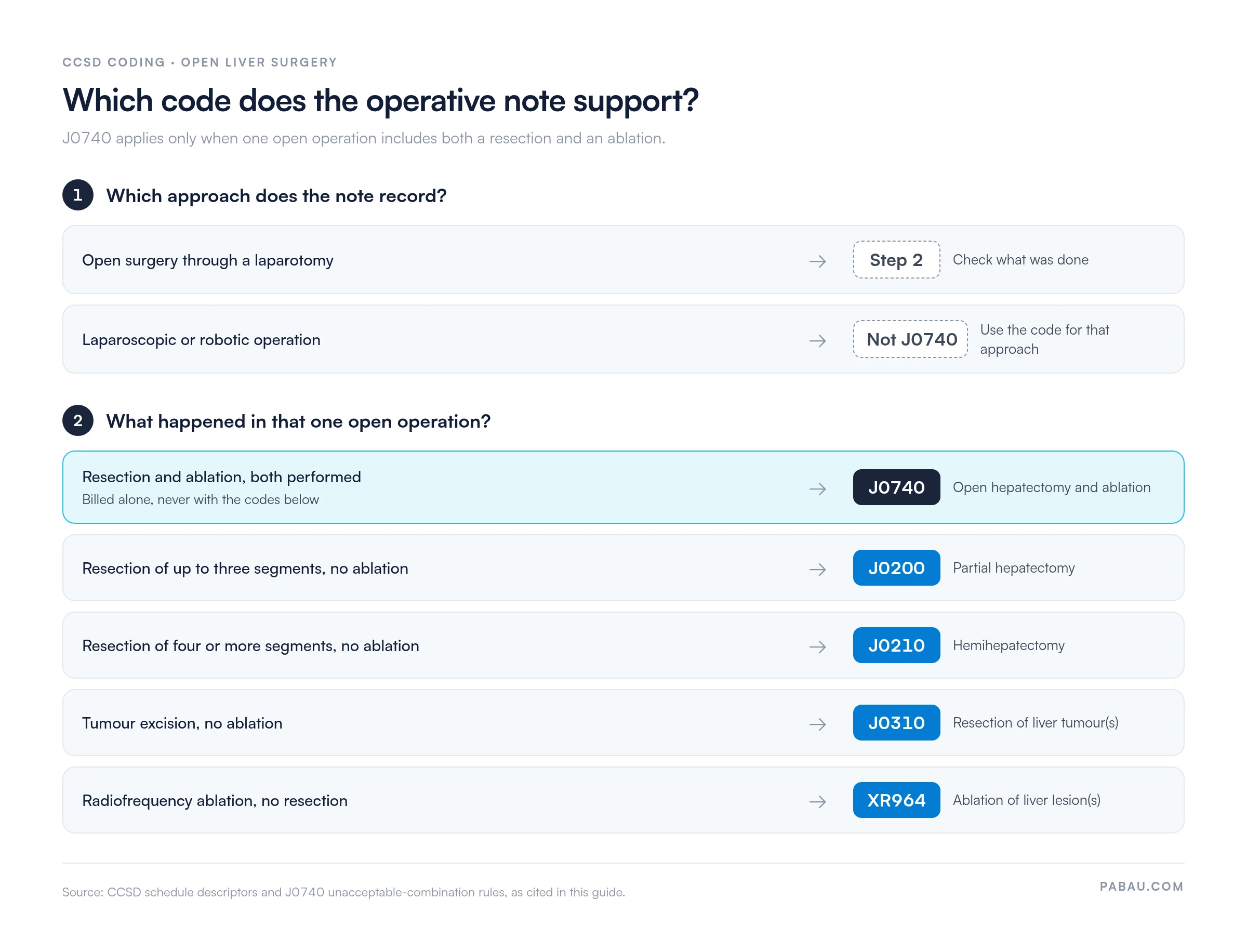
CCSD lists J0200, J0210, J0310, J0510 and J1300 as unacceptable combinations with J0740, and J0740 is also incompatible with XR964.
C22.0, C22.1, C22.2, C22.9 and C78.7 are the WHO ICD-10 codes that usually pair with J0740.
The CCSD Group does not set fees, so each UK private medical insurer applies its own benefit rules and pre-authorisation process.
Pabau, the practice management platform we build, carries the authorisation case and CCSD code from the appointment to the claim sent through Healthcode.
CCSD code J0740 is the UK private-sector procedure code for open hepatectomy and ablation. It is a single coded procedure. In other words, the surgeon resects part of the liver and ablates one or more further lesions during the same open operation.
The CCSD Group (Clinical Coding & Schedule Development) publishes the code. Its members are UK private medical insurers such as Bupa, AXA Health, Aviva and Vitality. Also, our CCSD codes index collects guides to other codes in the schedule.
J0740 sits in chapter 11, Abdomen (Excl. Urinary & Reproductive Organs), under sub-section 11.7.0, Other Organs (Mainly Digestive). It is a stand-alone code, so you do not claim the resection and the ablation as two separate procedures.
J0740 fits a patient whose liver disease needs resection for some lesions and ablation for others. Surgeons usually choose the combined approach when the following situations arise:
However, J0740 does not fit an ablation without resection, or a resection without ablation. Instead, those operations take other codes from the CCSD schedule.
In an open hepatectomy, the surgeon opens the abdomen through a laparotomy incision. Then the surgeon mobilises the liver, transects the parenchyma and removes the target segments or lobe.
Next, the surgeon ablates the lesions that are unsuitable for resection. However, the descriptor does not name an ablation modality, so the operative note should record which one was used, such as radiofrequency or microwave ablation.
The combined approach aims to clear the tumour burden while preserving as much liver as possible. Resection deals with lesions where a clear margin is achievable. In contrast, ablation treats residual or satellite lesions, where removing them would cost too much functioning liver.
Because J0740 already includes both the resection and the ablation, CCSD lists several liver codes as unacceptable combinations with it. As a result, an insurer is likely to query or reject any of them billed alongside J0740 for the same operation. The diagram below shows which code each operative note supports.
The CCSD Group describes its coding principles as guidance, and each insurer decides how it applies them. Also, the CCSD technical guide explains how the schedule and its combination rules work.
CCSD lists each code below as an unacceptable combination with J0740. Use them for the operations they describe, but never on the same claim as J0740 for one operation.
When the operative note describes a tumour excision without ablation, our guide to J0310 explains how that resection is coded on its own. A biopsy taken with a needle passed through the skin into the lesion, with no resection, is coded J1300 rather than J0740.
UK private medical insurers expect each J0740 claim to carry a WHO ICD-10 diagnosis code for the condition behind the surgery. In addition, the WHO ICD-10 browser holds the full code definitions and inclusion notes.
Where a patient has a primary liver tumour and metastases from a separate primary, code the condition that drove the surgical decision first. After that, the other condition can follow as an additional diagnosis.
UK private medical insurers generally ask for pre-authorisation before major liver surgery such as J0740. Each insurer runs its own process, so confirm the requirements with the patient’s insurer before the operation is booked.
For example, Bupa publishes its accepted codes through its code search portal. Our guide to Bupa CCSD codes also covers Bupa-specific billing rules.
The CCSD Group maintains the codes but does not determine reimbursement or fees. Each insurer sets its own rules and benefit levels in pounds sterling (GBP) for J0740.
Most UK practices submit insurer claims online through Healthcode. Check the insurer’s schedule for the amount it will pay before you quote a self-funding top-up to the patient.
The operative note has to show that both components of J0740 took place in the same open operation. If a note describes only the resection, the insurer has no basis to accept the code.
The operative note should include each of the following points:
Ask the surgeon to dictate the operative note within 24 hours, while the details are fresh. Otherwise, a note the surgeon writes days later is more likely to miss segment numbers, ablation cycles or the modality used.
Rejected J0740 claims tend to follow a few patterns, but each one has a direct fix.
A J0740 claim depends on the insurer’s pre-authorisation, and the insurer is likely to reject a claim that reaches it without its reference. In Pabau’s claims software for practices, the authorisation case and the CCSD code stay attached to the appointment and follow it through to the claim.
Your billing team records J0740 and the authorisation details at booking, not after surgery. Once the operation has taken place, the claim already carries both and goes to the insurer through Healthcode.
A claim-status dashboard then flags every claim that needs action from your team. On a high-value code like J0740, that means your team picks up a stalled claim early instead of leaving it unpaid.

Pabau carries the authorisation case and CCSD code from the appointment to the claim. Claims go to UK insurers through Healthcode, and a dashboard flags any that need action.

Treat J0740 as one code for one operation. The operative note decides whether it applies, so it has to show an open approach, a resection and an ablation.
Most problems with this code start before billing. So agree with your surgeons on what every operative note records, secure the insurer’s authorisation first, and keep the unacceptable combinations off the claim.
Book a demo to see how Pabau carries the authorisation and code from booking to a Healthcode claim for every CCSD procedure.

Need a full reference for Bupa CCSD codes? Bupa CCSD codes guide covers the procedure codes Bupa accepts and how to submit them.
Billing a liver tumour excision without ablation? CCSD code J0310 explains when open tumour resection is coded on its own.
Looking up another code in the CCSD schedule? CCSD codes index collects our guides to individual CCSD procedure codes.
CCSD code J0740 covers an open hepatectomy and an ablation of liver lesions carried out in the same operation. It is a single code, so the resection and the ablation are not billed separately. An ablation alone or a resection alone takes a different CCSD code.
The usual pairings are C22.0 (liver cell carcinoma), C22.1 (intrahepatic bile duct carcinoma), C22.2 (hepatoblastoma) and C78.7 (secondary malignant neoplasm of liver). C22.9 applies when the histological type of the liver malignancy is not yet confirmed.
UK private medical insurers generally ask for pre-authorisation before major liver surgery such as J0740. Each insurer runs its own process, so confirm the requirements with the patient’s insurer before the operation is booked.
No. CCSD lists J0200, J0210, J0310, J0510 and J1300 as unacceptable combinations with J0740, and J0740 is also incompatible with XR964. J0740 already includes the resection and the ablation, so it is billed alone for that operation.
The J0740 descriptor does not name an ablation method. Radiofrequency and microwave ablation are the common choices, and the operative note should record which one was used, the lesions treated and the technique.
Each UK private medical insurer sets its own fee or benefit level for J0740 in pounds sterling. The CCSD Group maintains the code but does not determine reimbursement, so check the insurer’s own schedule.