

HCPCS Code Q4175: Billing, coverage, and documentation guide
HCPCS code Q4175: Code description and product identity HCPCS Code Q4175 is the ...

Last Updated: Nov 20, 2026
T3410 is the CCSD code for open drainage of subphrenic abscess. The surgeon opens the abdomen and drains pus that has collected beneath the diaphragm. It is used when image-guided drainage has failed or is not safe.
Drainage under CT or ultrasound guidance takes a different code. T3410 sits in Chapter 11 of the CCSD Schedule, under 11.10.0 Peritoneum, and is never reported with T3930 on the same claim.
Let Pabau's smart automation suggest the right codes, reduce claim denials, and keep your practice compliant—effortlessly.
Automate repetitive tasks and focus on what matters most—your patients.
Reduce coding errors and ensure compliance with the latest regulations.
Clean claims, fewer denials, and faster reimbursements.
Powerful insights and reporting to help your practice thrive.
HIPAA compliant SOC 2 certified GDPR-compliant Trusted by 4,000+ clinics worldwide

CCSD Code T3410 is the UK private healthcare code for open drainage of a subphrenic abscess. Image-guided percutaneous drainage takes a different code.
T3410 sits in Chapter 11 of the CCSD Schedule, under sub-chapter 11.10.0 Peritoneum.
In WHO ICD-10, a subphrenic abscess is coded K65.0. A postprocedural subphrenic abscess is coded T81.4 instead.
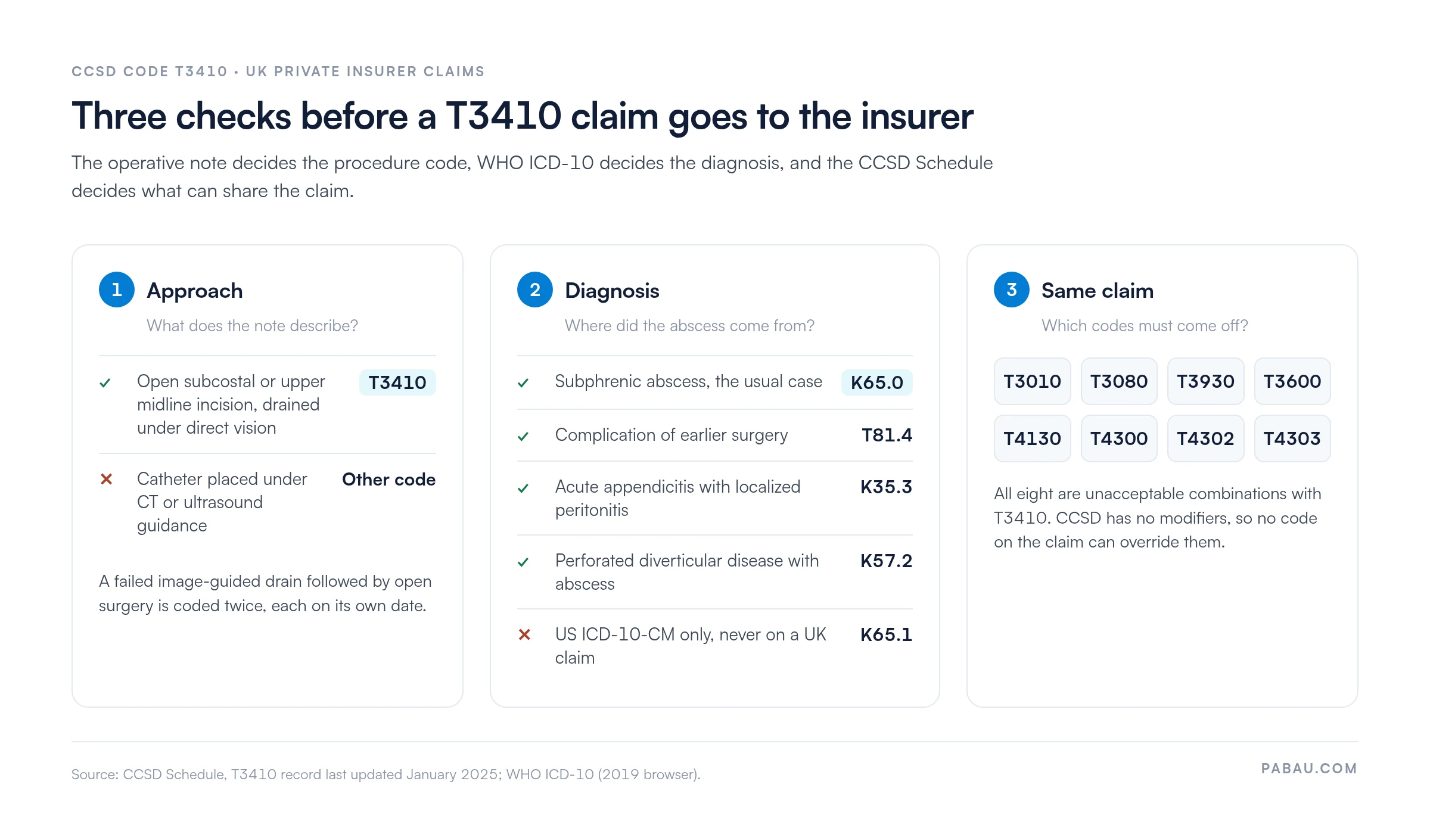
The CCSD Schedule lists T3010, T3080, T3930, T3600, T4130, T4300, T4302 and T4303 as unacceptable combinations with T3410. Never report them on the same claim.
Pabau, the practice management platform we build, sends UK insurance claims through Healthcode. The T3410 claim, operative note and pre-authorisation sit on one patient record.
CCSD Code T3410 is the UK private healthcare code for open drainage of subphrenic abscess. The surgeon opens the abdomen and drains pus collected beneath the diaphragm. The CCSD Schedules hold the standard procedure and diagnostic test codes for the UK private healthcare sector. T3410 sits in Chapter 11 (Abdomen, excluding urinary and reproductive organs), sub-chapter 11.10.0, Peritoneum.
The Clinical Coding and Schedule Development (CCSD) Group maintains the schedule. Its members include major UK private insurers such as Bupa, AXA Health, Aviva and Vitality. CCSD does not set fees. Each insurer sets its own fees and rules, and decides which CCSD coding principles it adopts.
Claims go to the insurer with a WHO ICD-10 diagnosis code, usually through Healthcode. The guide to CCSD codes for insurers explains how the schedule is applied in practice.
At the time of writing, the CCSD website lists T3410 as a published code, and its record was last updated in January 2025. CCSD can inactivate codes in any publication cycle, so check the current schedule before you bill.
A subphrenic abscess is a collection of pus between the diaphragm and the liver on the right, or the stomach and spleen on the left. It most often follows abdominal surgery, a perforated ulcer or appendix, or generalised peritonitis. Left undrained, it carries a significant mortality risk. Operations on the diaphragm muscle itself sit in the thorax chapter instead, such as plication of a paralysed diaphragm under T1620.
Critical distinction: T3410 describes an open operation. Drainage of the same collection by a radiologist under CT or ultrasound guidance is not open drainage, so it takes a different CCSD code. An abscess under the skin is not a T3410 case either. Drainage of a large subcutaneous abscess through a skin incision is billed under CCSD code S4740.
Image-guided percutaneous drainage is usually the first choice for a subphrenic abscess. Open drainage becomes the right answer when that route is unsafe or has already failed.
The approach recorded in the operative or radiology report decides the code. Billing T3410 for a catheter placed under imaging is upcoding, and an insurer reviewing the notes will spot it.
A patient may have a failed image-guided drain first and open drainage later. Each procedure is then coded separately on its own date. The open operation’s note should mention the failed attempt, so the insurer can see why surgery followed.
Read the operative note before you assign T3410. A subcostal or midline incision with drainage under direct vision supports the code. A note describing a catheter placed under CT guidance does not, however urgent the case was.
UK private insurers expect a WHO ICD-10 diagnosis code alongside every CCSD procedure code. That matters here, because the US version, ICD-10-CM, has a code WHO ICD-10 lacks. K65.1 (Peritoneal abscess) exists only in ICD-10-CM, so it does not belong on a UK claim.
Check each code in the WHO ICD-10 browser before submission. An abscess inside the liver itself is K75.0, not a subphrenic abscess, so confirm the imaging and operative findings match the code. WHO also allows an extra code from B95 to B98 to name the organism.
CCSD publishes coding principles that say which codes must not be reported together. For T3410, the schedule lists T3010, T3080, T3930, T3600, T4130, T4300, T4302 and T4303 as unacceptable combinations. CCSD has no modifiers, so these principles do the work US modifiers would. To check a neighbouring code’s descriptor, use our CCSD code-by-code guides.
Insurers decide which CCSD coding principles they adopt. Check the insurer’s own rules too, especially before adding any second procedure code to a T3410 claim.
An insurer may query a T3410 claim if the operative note cannot confirm an open drainage of a subphrenic collection. Operative note templates that prompt for each element below cut these omissions.
Keep the preoperative CT or ultrasound report, the anaesthetic record and the signed consent with the claim file. Add the radiology report for any earlier percutaneous drain.
UK private insurers usually expect the patient to obtain pre-authorisation before planned surgery. Approval does not guarantee payment. It confirms the insurer will assess the claim under the patient’s policy, subject to its review of the documents.
A subphrenic abscess is often an urgent presentation, and many policies do not cover emergency treatment, which the NHS usually provides. Where an insurer does accept an urgent case, notification rules vary by insurer. Confirm each insurer’s emergency pathway and deadline before the need arises.
Send the imaging report and the clinical rationale with the first pre-authorisation request. Saying why image-guided drainage is not an option answers the insurer’s most likely question before it is asked.
A complete T3410 claim carries the procedure code, the matching ICD-10 code and the supporting documents. Pabau sends the claim to the insurer through Healthcode from the patient record.
Those six steps come down to three checks: the approach in the note, the WHO diagnosis code and the codes that cannot share the claim.
General anaesthesia is needed for T3410. In UK private practice, the anaesthetist bills separately, usually against the same CCSD procedure code as the surgeon. CCSD has no assistant or bilateral modifiers. Whether an insurer pays a surgical assistant, and how much, is set by the insurer’s own rules.
Most T3410 queries trace back to a handful of avoidable errors in the note or the claim.
A subphrenic abscess often follows earlier abdominal surgery. In that case, WHO ICD-10 places it under T81.4, which names subphrenic abscess among its inclusion terms. You can add a code for the organism or for sepsis where the record supports it.
Whether an insurer pays to treat a complication of earlier surgery depends on the policy, and on whether that surgery was private or NHS. Check with the insurer before treatment, and record the original operation and its date in the referral.
Billing T3410 runs on pre-authorisation tracking, the right WHO diagnosis code, coordination with the anaesthetist and insurer deadlines. When those steps live in spreadsheets and email threads, an operative detail or an authorisation number goes missing before the claim leaves.
Pabau keeps those steps together on one patient record, from the referral to the paid claim. Its claims management for insurers sends private medical insurance claims through Healthcode to Bupa, AXA Health, Vitality and more. Pabau stores each pre-authorisation as a case against the patient, so its reference follows the operation onto the claim.
Pabau’s digital forms capture the operative detail insurers check, such as the incision, the side and the drains placed. Claim status stays visible to the team, so staff can pick up and correct a queried T3410 claim quickly.

Pabau sends private medical insurance claims through Healthcode to Bupa, AXA Health, Vitality and more. Your team keeps the CCSD code, the operative note and the claim status on one patient record.

T3410 is a narrow code. It covers an open operation on one space, and the insurer checks the note for exactly that. Two traps sit either side of it. One is an image-guided drain billed as open surgery. The other is a US diagnosis code on a UK claim.
So read the note for the incision before you choose the code, and pair it with K65.0 or T81.4. Then strip any unacceptable combination, such as T3930, before the claim leaves.
Book a demo to see how Pabau keeps the operative note, the pre-authorisation case and the Healthcode claim for T3410 on one patient record.

Need a broader CCSD billing reference? CCSD codes for private health insurers covers how the CCSD Schedule applies across UK private insurers.
Draining an empyema rather than an abdominal collection? CCSD code T0810 explains the open pleural drainage code and its own unacceptable combinations.
Looking up a neighbouring code? Our CCSD code-by-code guides list every CCSD procedure we cover, with its descriptor and billing notes.
Choosing software for UK insurer billing? Best medical billing software in the UK compares the options that submit claims through Healthcode.
CCSD Code T3410 covers open drainage of a subphrenic abscess, a collection of pus beneath the diaphragm. It is a UK CCSD Schedule code used to bill private insurers. It applies only to open surgery. Drainage under CT or ultrasound guidance takes a different CCSD code.
Use WHO ICD-10, which UK private insurers expect. K65.0 (Acute peritonitis) includes subphrenic abscess and is the usual code. Use T81.4 when the abscess follows earlier surgery. K65.1 exists only in the US ICD-10-CM, so it does not belong on a UK claim.
No. The CCSD Schedule lists T3410 and T3930 (Surgical drainage of retroperitoneal abscess) as an unacceptable combination. It also rules out T3010, T3080, T3600, T4130, T4300, T4302 and T4303 alongside T3410. Insurers decide which coding principles they adopt, so check the insurer’s rules too.
No. The CCSD Schedule has no modifiers, unlike US CPT coding. The anaesthetist bills separately, usually against the same CCSD procedure code. Whether an insurer pays a surgical assistant is set by that insurer’s own rules.
For planned surgery, UK private insurers usually expect pre-authorisation first. Send the imaging report, the clinical rationale and the ICD-10 code with the request. Many policies do not cover emergency treatment, so confirm each insurer’s urgent-case pathway.
At the time of writing, the CCSD website lists T3410 as a published code in sub-chapter 11.10.0 Peritoneum. Its record was last updated in January 2025. CCSD can inactivate codes in any publication cycle, so check the current schedule before billing.





