CCSD Code H0480: Abdominal revision of restorative proctocolectomy
What is CCSD Code H0480? CCSD Code H0480 is the procedure code for abdominal rev...

Last Updated: Oct 15, 2026
G5000 is the CCSD code for open excision of lesion of duodenum. It covers removing a duodenal lesion through a laparotomy and duodenotomy, then closing the duodenum, billed as one procedure.
G5000 sits in the CCSD duodenum category (11.3.0). Endoscopic removal is coded separately, with G5050 for endoscopic submucosal dissection of duodenal lesions. Most UK insurers require pre-authorization before elective open surgery, plus an operative note confirming the open approach.
Let Pabau's smart automation suggest the right codes, reduce claim denials, and keep your practice compliant—effortlessly.
Automate repetitive tasks and focus on what matters most—your patients.
Reduce coding errors and ensure compliance with the latest regulations.
Clean claims, fewer denials, and faster reimbursements.
Powerful insights and reporting to help your practice thrive.
HIPAA compliant SOC 2 certified GDPR-compliant Trusted by 4,000+ clinics worldwide

CCSD code G5000 covers open (laparotomy) excision of a duodenal lesion only. Endoscopic submucosal dissection of duodenal lesions uses G5050 instead.
The operative note decides the code, so it must record the laparotomy, the duodenotomy and the local excision.
Pre-authorization from the patient’s insurer is required before elective open duodenal surgery in almost all UK PMI policies.
Missing or mismatched ICD-10 diagnosis codes are among the leading causes of G5000 claim denial.
In Pabau’s billing software, you select G5000 at the point of invoicing and bill the claim to the patient’s insurer.
CCSD code G5000 is the Clinical Coding and Schedule Development code for open excision of a lesion of the duodenum. The word “open” is the defining characteristic: This code applies only to surgery through a laparotomy. The surgeon performs a duodenotomy and excises the lesion under direct vision.
Endoscopic removal of duodenal lesions is not covered by G5000. Endoscopic submucosal dissection of a duodenal lesion is coded as G5050 instead.
The CCSD schedule links each procedure code to an insurer remuneration rate. Without the correct CCSD code, the insurer has no fee schedule reference to process the invoice against. That is why UK private medical insurance (PMI) payers reject uncoded or mis-coded invoices at the point of submission.
Knowing the code’s scope prevents the most common billing errors. The table below sets out what falls inside G5000 and what needs a separate code.
Unbundling is a common denial trigger. It means billing the duodenotomy or wound closure as separate line items alongside G5000. The CCSD schedule treats both as components of the G5000 procedure. Billed separately, they count as fragmented billing, and the insurer’s clinical auditors will query or reject them.
Open duodenal lesion excision is indicated when endoscopic removal is not feasible, has failed, or carries unacceptable risk. Common clinical scenarios include:
The ICD-10 diagnosis code submitted alongside G5000 must match the pathology confirmed at or before surgery. A mismatch between G5000 and the diagnosis code is one of the most consistent denial triggers across UK PMI payers. Verify the diagnosis code before submission, not after a rejection.
An operative note that supports G5000 must confirm three things: The approach was open (laparotomy), the duodenum was entered (duodenotomy), and a lesion was excised. Insurers and clinical auditors look for specific language in the procedure note. Digital operative forms with structured fields reduce the risk of missing a required data point.
Key phrases that auditors expect to see in the operative note:
Absent any of these elements, the insurer has grounds to query whether the procedure performed matches G5000. The Royal College of Surgeons of England recommends that operative notes follow a standardized structure. That structure covers indication, findings, procedure steps, and complications.
Applying that structure to every G5000 case removes the ambiguity behind most documentation-related denials. Consistent use of standardized clinical forms helps embed this discipline across your billing team.
G5000 sits in the duodenum category (11.3.0) of the CCSD abdomen chapter, alongside G5010, G5050, G5100 and G5320. Selecting the wrong code in this group is a common error. The table below shows how each neighbor differs from G5000.
Always verify adjacent code descriptors against the current CCSD schedule before billing. The schedule is updated periodically, so descriptors and numbering in the duodenum category can change. For procedures outside this group, our CCSD code library covers other codes in the schedule.
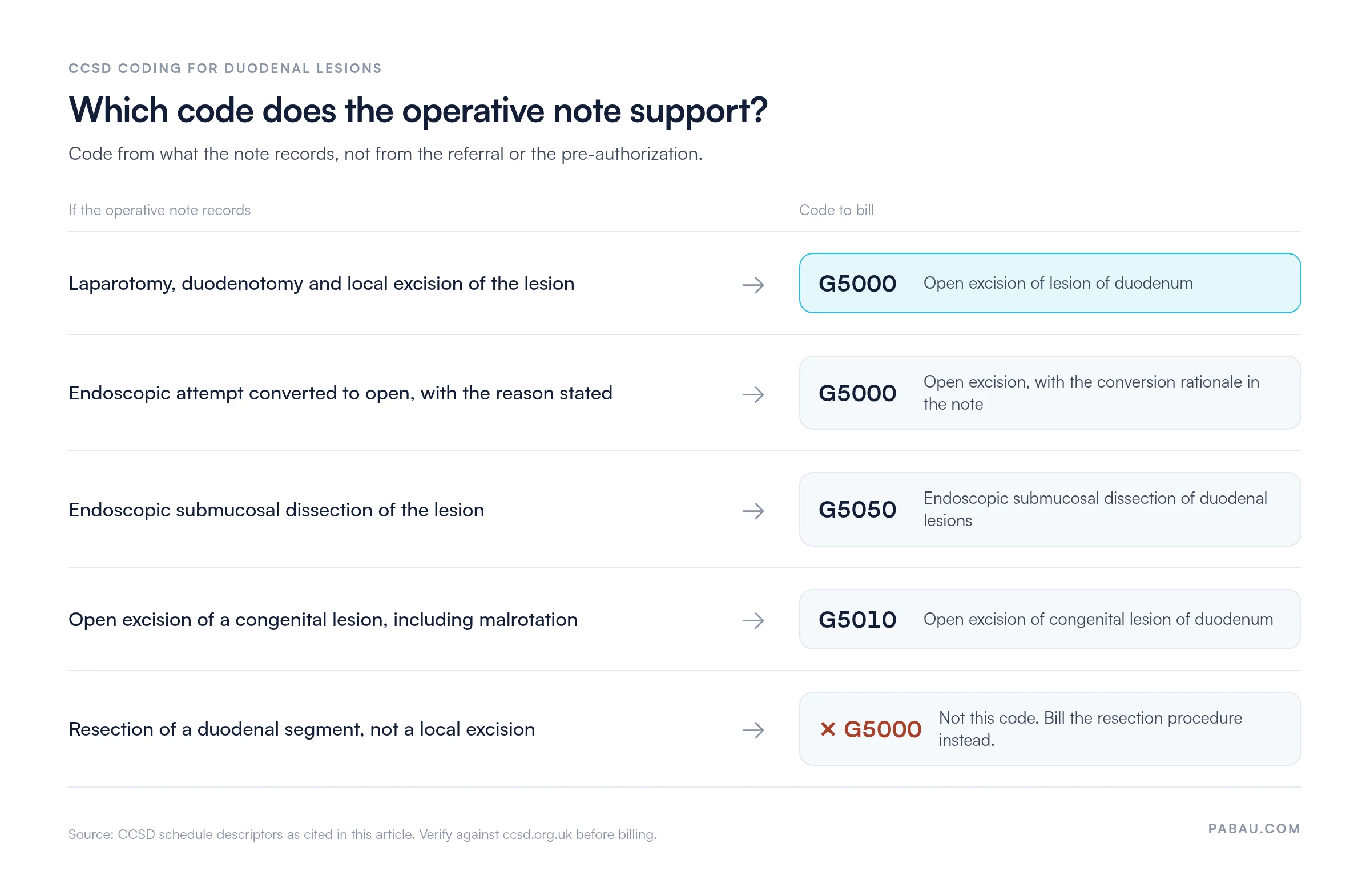
The approach documented in the operative note determines the code. If the note records laparotomy and direct duodenal access, G5000 applies. If it records a gastroscopy or duodenoscopy, an endoscopic code applies instead. For endoscopic submucosal dissection of a duodenal lesion, that code is G5050.
A note that records “attempted endoscopic removal, converted to open” should use G5000. Payers may query conversion cases, so the note must state the conversion and the reason for it. The decision table below maps each operative-note finding to its code.
Elective open abdominal surgery for a duodenal lesion almost always requires pre-authorization from the patient’s insurer before the procedure takes place. Without a valid pre-authorization number on the claim, payers will deny payment regardless of the clinical justification. Our guide to Bupa CCSD codes covers Bupa’s own pre-authorization and coding requirements.
The table below lists key payer requirements. Verify them against current payer guidelines before each case, as requirements change by policy year.
Always obtain the pre-authorization number in writing before the patient is admitted. Record it on the patient’s account, because it must appear on the invoice for the claim to be accepted.
A clean G5000 claim passes through six steps. Skipping any one of them creates a predictable denial.
G5000 covers the surgeon’s fee for the open excision procedure. The following codes can legitimately appear on the same invoice or episode, provided they reflect genuinely separate services:
What must NOT be billed separately alongside G5000: The duodenotomy itself, the wound closure, or intraoperative hemostasis. These are components of the open excision and are included in G5000’s fee. Separating them out is unbundling, a frequent audit finding on G5000 claims.
G5000 claim denials follow a predictable pattern. The table below lists the top denial reasons alongside the specific fix for each.
Beyond the denial reasons above, three coding errors recur specifically on G5000 cases and are rarely flagged in generic CCSD guides.
Run a pre-submission check on every G5000 claim: Confirm the pre-authorization number is recorded and the ICD-10 code matches the confirmed diagnosis. Then check that the operative note confirms the open approach and the lesion excision. A five-minute check at this stage can save weeks of appeals.
Manual CCSD billing invites three errors. A code gets applied from memory, a pre-authorization number never reaches the invoice, or an ICD-10 code is picked in haste. Purpose-built medical claims management within a practice management platform removes several of these failure points.
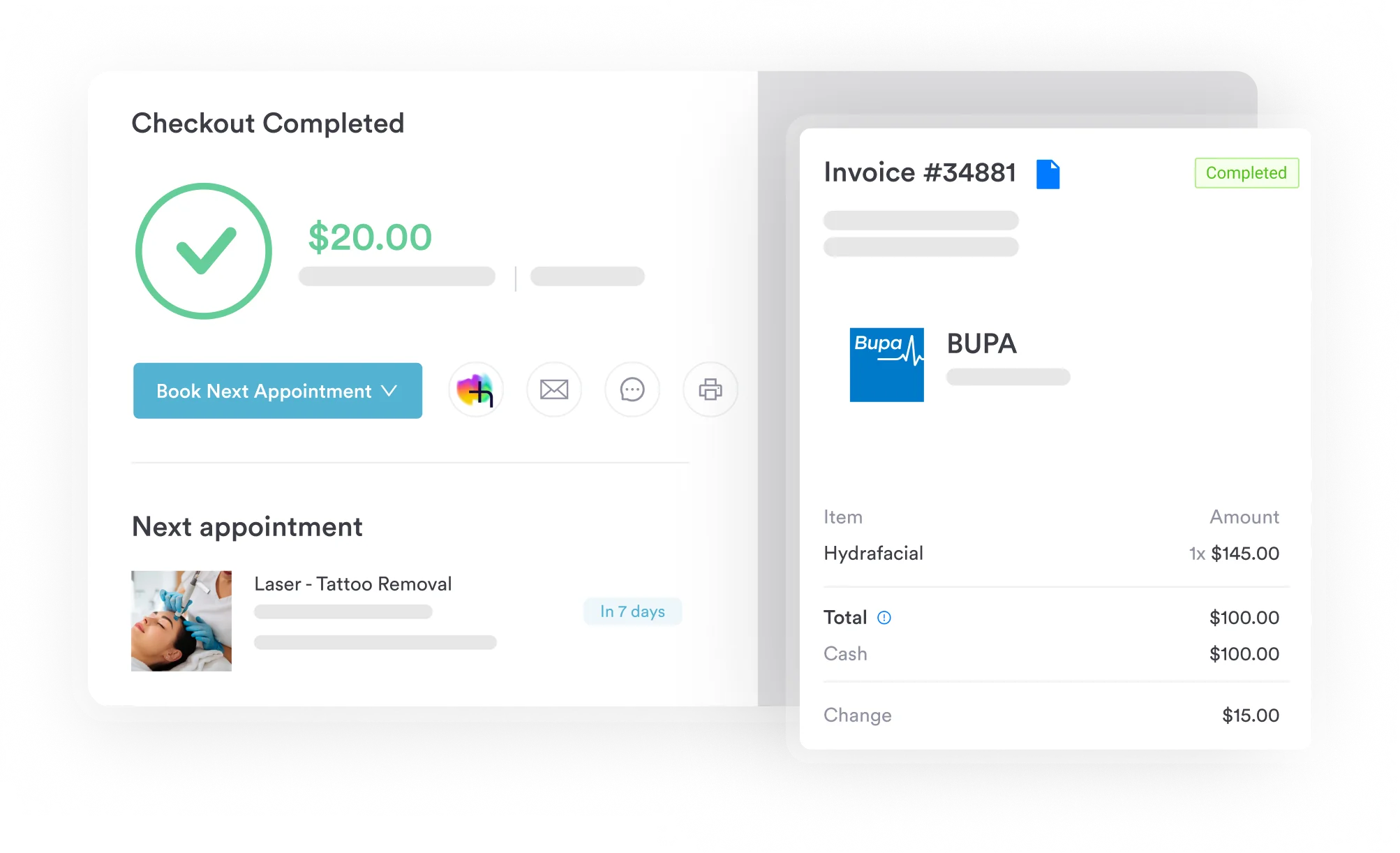
In Pabau, you select CCSD codes such as G5000 at the point of invoicing rather than typing them in from memory. The same invoice is billed to the patient’s insurer, so your team handles the insurer claim in the system it already codes in.
For practices with several upper GI consultants and high procedure volumes, that cuts the admin time spent preparing and re-submitting claims. If you are still comparing systems, our roundup of UK medical billing software weighs the options for private practices.

Select CCSD codes such as G5000 at the point of invoicing and bill the patient’s insurer from the same system. See how it fits your upper GI billing workflow.

CCSD code G5000 is a specific, approach-dependent code. Getting it right comes down to three things: Confirming the approach was open, pairing the correct ICD-10 diagnosis, and holding pre-authorization before surgery. Most G5000 denials are preventable at the preparation stage, not the appeals stage.
Build those checks into every invoice, and appeals stop being a routine cost of billing this code.
Pabau puts CCSD code selection and insurer billing in the same place your team already invoices from. Book a demo to see how it handles G5000 claims for upper GI surgical practices.

Need a broader guide to Bupa CCSD coding? Bupa CCSD codes reference covers payer-specific submission requirements and fee schedule context for private practice billing teams.
Coding open surgery further along the small bowel? CCSD code G6000: Open formation of jejunostomy explains documentation and billing for the open jejunostomy code.
Billing other open upper GI procedures? CCSD code G2330: Transabdominal repair of hiatus hernia walks through coding and claims for an open hiatus hernia repair.
Comparing billing systems for a UK private practice? Best medical billing software in the UK compares the options for practices that bill private medical insurers.
CCSD code G5000 is the Clinical Coding and Schedule Development code for open excision of a lesion of the duodenum. UK private medical insurers use it to link the procedure to a remuneration rate on the consultant’s invoice. It applies only when the approach is open (laparotomy) and the excision is local, not a segmental duodenal resection.
Open excision (laparotomy with duodenotomy) uses G5000. Endoscopic removal of a duodenal lesion uses a separate endoscopic CCSD code (G5050 for endoscopic submucosal dissection of duodenal lesions). The operative note determines which code applies. If the note records gastroscopy or duodenoscopy, G5000 is not correct, whatever code was pre-authorized.
All major UK PMI payers, including Bupa, AXA Health, Aviva, Vitality Health, and Cigna, require pre-authorization for elective open abdominal surgery. The pre-authorization number must appear on the invoice. Verify requirements with each insurer at the time of booking, as policies and thresholds are updated annually.
The most common denial reasons are missing pre-authorization and an ICD-10 code that does not match a duodenal lesion. An operative note that does not confirm the open approach, or unbundled component steps, also trigger denials. Late invoices are rejected too. Each insurer sets its own invoice time limit; check the insurer’s provider terms.
Yes. G5000 covers the operating surgeon’s fee only. Anesthetic fees and assistant surgeon fees use separate CCSD codes. They appear as distinct line items on the invoice, or as separate invoices from the relevant practitioners. The duodenotomy and wound closure are bundled within G5000 and must not be separately coded.
An insurer needs a structured operative note confirming laparotomy, duodenotomy, lesion excision with a description, and wound closure. A histopathology request reference is also expected. If the insurer requests clinical evidence during a query, the operative note is the primary document. A vague or incomplete note usually delays payment rather than causing an outright denial.