

CPT Code 98981: RTM Treatment Management Billing Guide
CPT code 98981: Definition and official descriptor CPT code 98981 is an add-on c...

Last Updated: Nov 9, 2026
G0920 is the CCSD code for oesophagocardiomyotomy (Heller's operation), a surgical myotomy that divides the muscle of the lower esophageal sphincter to relieve achalasia. It covers the standard laparoscopic or open operation. Robotic-assisted, thoracoscopic and endoscopic myotomies each take a code of their own.
UK private insurers list G0920 in Chapter 8 of the schedule, under the esophagus. Most require prior authorization, with manometry confirming achalasia, before the operation goes ahead.
Let Pabau's smart automation suggest the right codes, reduce claim denials, and keep your practice compliant—effortlessly.
Automate repetitive tasks and focus on what matters most—your patients.
Reduce coding errors and ensure compliance with the latest regulations.
Clean claims, fewer denials, and faster reimbursements.
Powerful insights and reporting to help your practice thrive.
HIPAA compliant SOC 2 certified GDPR-compliant Trusted by 4,000+ clinics worldwide

CCSD code G0920 covers oesophagocardiomyotomy (Heller’s operation), a surgical myotomy of the lower esophageal sphincter performed for achalasia.
The approach changes the code. Robotic-assisted Heller’s takes G0921, a thoracoscopic or VATS myotomy takes G0922 or G0980, and POEM takes E2810.
Pair G0920 with ICD-10 K22.0 (achalasia of cardia) as the primary diagnosis on every UK private claim.
Most major UK insurers require prior authorization, backed by manometry results and evidence that conservative treatment failed.
Whether a concurrent Dor or Toupet fundoplication is coded separately depends on current CCSD rules, so check the schedule and each insurer’s manual first.
CCSD code G0920 is the Clinical Coding and Schedule Development (CCSD) procedure code for oesophagocardiomyotomy (Heller’s operation).
The official descriptor in the CCSD schedule reads Oesophagocardiomyotomy (Heller’s operation). UK independent hospitals and private practices submit it when they bill insurers for a standard laparoscopic or open Heller’s myotomy.
G0920 sits in the G series, which includes esophageal procedures. Related operations, such as esophageal dilation, esophagectomy and anti-reflux surgery, carry codes of their own in the CCSD code library. Check the descriptor against the operative note before you submit, because a neighboring code can look similar when documentation is vague.
The code covers the surgical myotomy itself. Anesthetic fees are billed separately, and so is the pre-operative workup, such as manometry and a barium swallow.
Oesophagocardiomyotomy is a surgical myotomy of the lower esophageal sphincter (LES). The surgeon cuts the circular and longitudinal muscle fibers of the LES and distal esophagus without breaching the mucosa. This removes the functional obstruction that stops food from passing normally.
The key operative steps are similar across approaches:
A laparoscopic case typically takes 60–120 minutes. The operative note must state the myotomy length and the structures divided to support G0920 on audit.
Achalasia is a progressive esophageal motility disorder. The LES fails to relax and peristalsis is absent, which causes dysphagia and regurgitation. It is the main indication for Heller’s myotomy, and most UK private insurers want objective diagnostic evidence before they authorize G0920.
ICD-10 K22.0 (achalasia of cardia) is the primary diagnosis paired with G0920 on the claim. Secondary codes reflect comorbidities or complications documented at the time of surgery. The table below lists the codes most often submitted alongside it.
Insurers expect high-resolution esophageal manometry confirming type I or type II achalasia in the clinical record. Some payers also ask for a timed barium swallow or endoscopic findings. A claim without documented manometry is at high risk of denial for insufficient clinical justification. A clinical coder should review the full case notes before confirming secondary codes.
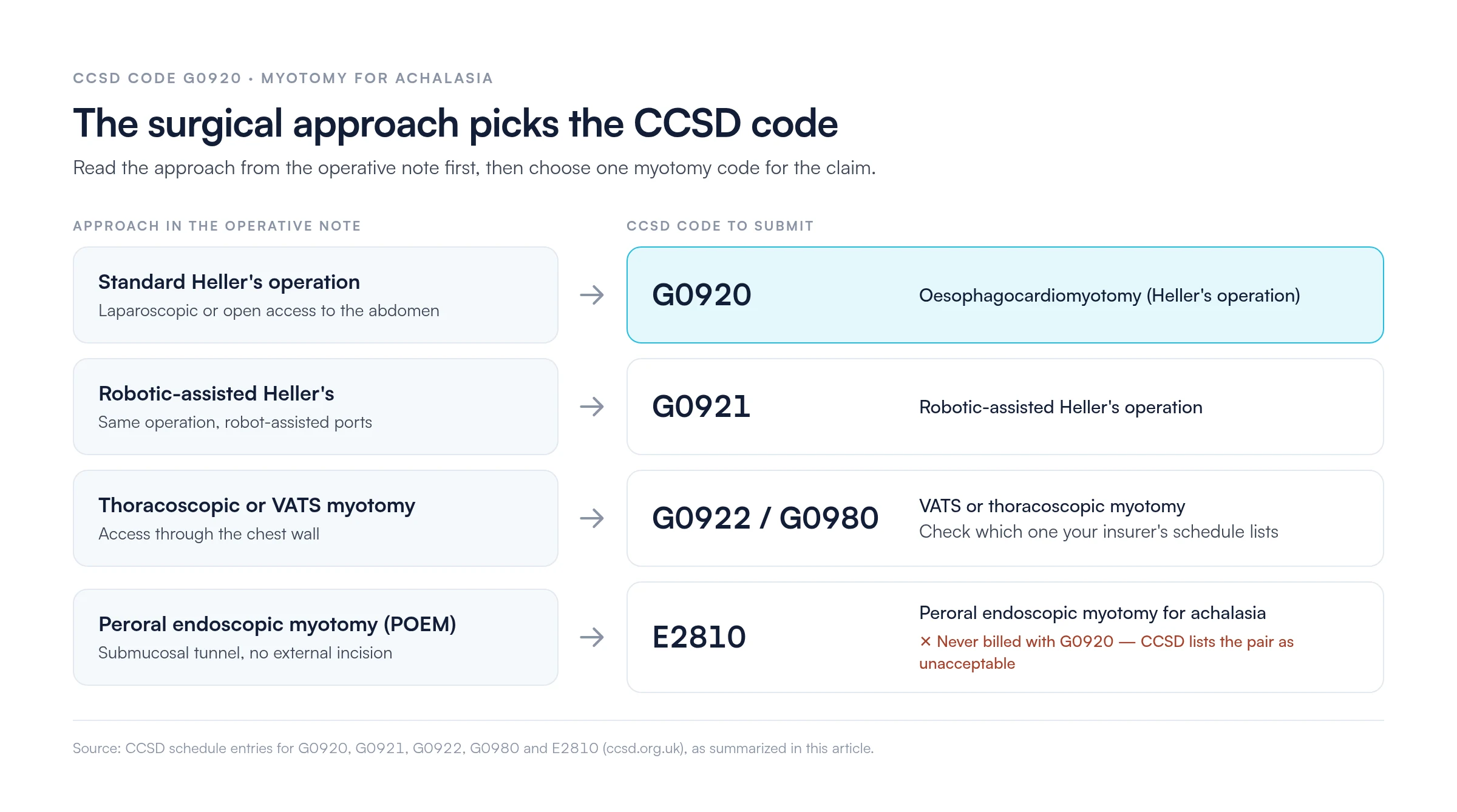
G0920 is the standard Heller’s operation, done laparoscopically or, rarely, through an open incision. The approach can change the code. Robotic-assisted Heller’s is G0921, and a thoracoscopic or VATS myotomy uses G0922 or G0980, depending on the schedule your insurer works from.
Whatever the code, the operative note must state which approach was used. Some insurers flag a claim for review when the approach is missing and treat it as a documentation problem. For a myotomy done through the chest, the G0922 guide covers the VATS code in detail.
The chart below adds POEM, the endoscopic alternative, so every myotomy code a coder might reach for sits in one place.
Most Heller’s myotomies include a partial fundoplication to prevent reflux after surgery. Whether it earns a separate CCSD code is one of the most common coding questions around G0920, and a frequent source of unbundling errors.
Under the general CCSD rule, a concurrent procedure may be coded separately when it is a substantive procedure in its own right. A step that only completes the primary operation does not qualify. Whether a Dor or Toupet fundoplication qualifies depends on the current CCSD technical guide and each insurer’s unbundling policy. Check both before you submit an additional code.
Resolve these questions before you submit a concurrent fundoplication code:
An unbundled code submitted without these answers is a common reason G0920 claims are rejected. When in doubt, get written pre-authorization for both procedures before the operation.
Peroral endoscopic myotomy (POEM) is an endoscopic alternative to Heller’s myotomy for achalasia. The surgeon creates a submucosal tunnel with an endoscope and divides the LES muscle fibers without any external incision. CCSD codes POEM as E2810 (Peroral endoscopic myotomy for achalasia), not G0920.
CCSD lists G0920 and E2810 as an unacceptable combination, so the two never appear on the same claim. Confirm the approach from the operative note before you choose the code. A note that describes a submucosal tunnel with no laparoscopic, robotic or thoracoscopic access calls for E2810.
Two other scenarios get confused with G0920. Esophageal balloon dilation is a non-surgical alternative with its own code. A Heller’s myotomy performed after an attempted POEM needs its operative documentation reviewed case by case.
Heller’s myotomy is an elective procedure, and major UK private medical insurers require prior authorization before it goes ahead. Without an authorization reference number, the claim is denied automatically, whatever the clinical justification or coding accuracy.
Pre-authorization requests to Bupa, AXA Health and Aviva typically include:
Bupa takes pre-authorization requests through its provider portal. Its code search tool confirms the current authorization requirement for G0920 and the diagnosis codes Bupa expects on the claim. Our guide to Bupa CCSD codes explains how the insurer’s schedule is organized.
Insurers update these rules periodically. Check each provider manual rather than relying on an earlier authorization for a similar case.
Get written authorization references for G0920 and any planned concurrent codes, such as a fundoplication, before the operation. Verbal confirmation is not enough for claim submission. Store the reference number in the patient’s billing record and quote it on the claim form.
An operative note that does not describe the myotomy explicitly is the most preventable cause of a G0920 denial. Insurers check the claim against the operative documentation. If the note does not describe what the code says was done, the claim is refused.
A complete operative note for G0920 includes:
The table below lists the most frequent G0920 denial reasons and how to prevent each one.
Billing G0920 means tracking a pre-authorization, keeping the operative evidence to hand, and following each claim across Bupa, AXA Health, Vitality and other insurers. Handled through spreadsheets and separate insurer portals, each handoff is another chance for a lost reference or a wrong code.
Pabau, the practice management platform we build, keeps those steps together. Its claims management software stores each insurer pre-authorization as a case and attaches it to the booking. The authorization code then carries through to the claim. Claims then go to Bupa, AXA Health and Vitality through Healthcode, at each insurer’s agreed rate.
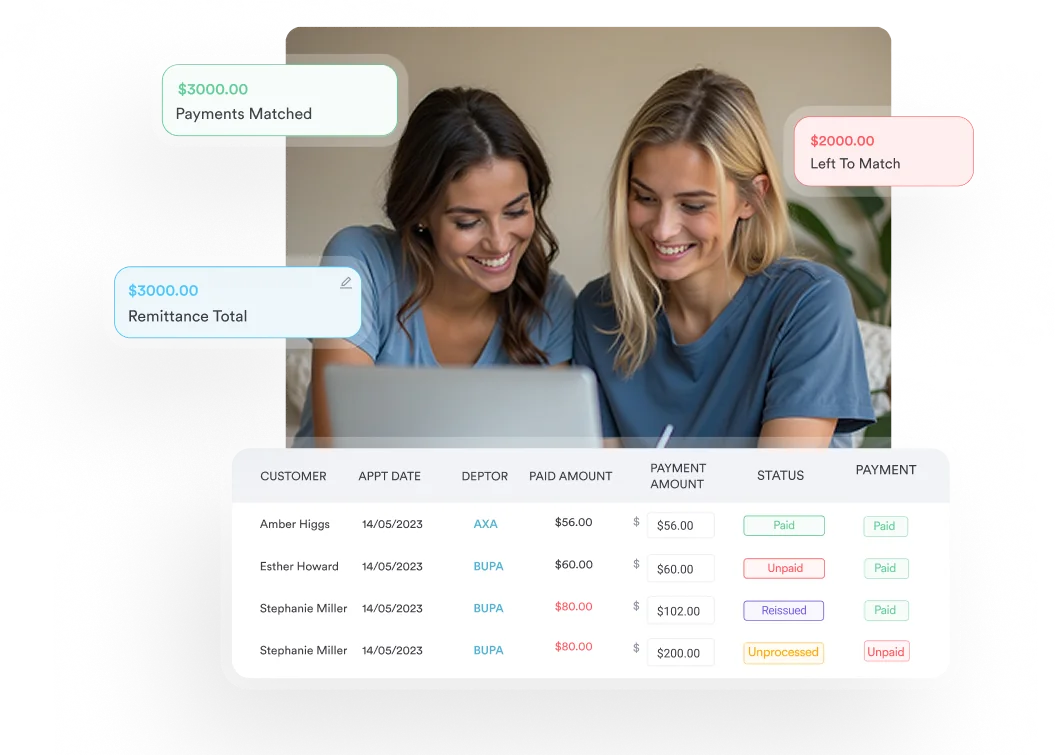
A claims dashboard follows each G0920 claim from Pending to Paid and flags any that need action. Your team can also check a patient’s Bupa cover before the operation, and pull in paid Bupa invoices without manual matching.
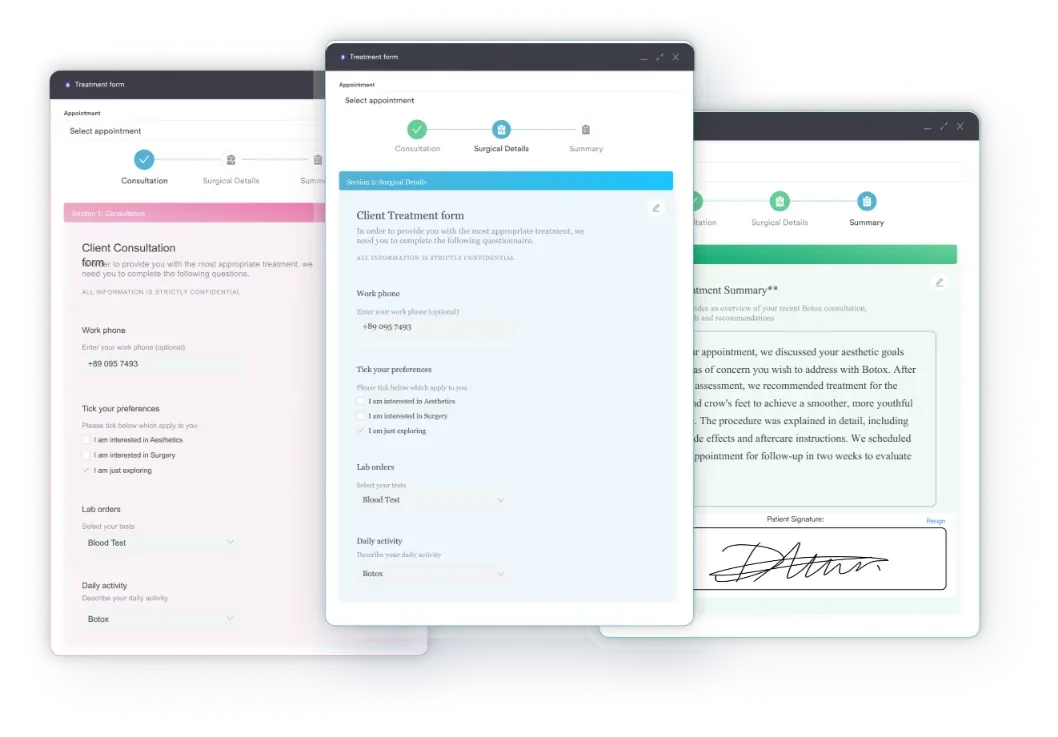
Signed consent, clinical notes and the claim all live in one patient record. When an insurer queries a G0920 claim, your billing team answers from that record instead of chasing paperwork across systems.

Pabau helps UK private practice teams track prior authorizations, follow every CCSD claim to payment, and keep consent and clinical records with the patient. See how it fits your surgical billing workflow.

For a Heller’s myotomy, the operative note settles the code before anything else. G0920 fits only the standard laparoscopic or open operation. Robotic, thoracoscopic and endoscopic myotomies each move the claim to a different code.
Settle the code, the K22.0 diagnosis and the fundoplication question before you request authorization, not after the operation. A pre-authorization that matches the operative note is what gets the claim paid the first time.
Pabau keeps the authorization, the patient record and the claim in one place for UK surgical teams. Book a demo to see how it tracks a G0920 case from pre-authorization to payment.

Coding a myotomy done through the chest? CCSD code G0922 covers the VATS esophageal myotomy code and how it differs from G0920.
Need a Bupa CCSD code reference? Bupa CCSD codes explains the Bupa procedure code set and fee schedule guidance for UK private billing.
Billing the diagnostic workup? CCSD code G1900 covers rigid oesophagoscopy, one of the esophageal procedures that sits near G0920 in the schedule.
Coding a more extensive esophageal operation? CCSD code G0260 covers endoscopically assisted oesophagectomy and its documentation needs.
CCSD code G0920 covers oesophagocardiomyotomy (Heller’s operation). The surgeon divides the muscle fibers of the lower esophageal sphincter to relieve the obstruction caused by achalasia. It applies to the standard laparoscopic or open operation. Robotic-assisted Heller’s is G0921, and a thoracoscopic or VATS myotomy uses G0922 or G0980.
ICD-10 K22.0 (achalasia of cardia) is the primary diagnosis code submitted with G0920 on UK private medical insurance claims. Secondary codes such as R13.1 (dysphagia) or K21.0 (GERD with esophagitis) may be added where the clinical record documents them.
Heller’s myotomy is a laparoscopic or open operation coded G0920. POEM reaches the same result endoscopically and is coded E2810. CCSD lists G0920 and E2810 as an unacceptable combination, so the operative note decides which single code goes on the claim.
It depends on current CCSD unbundling rules and the insurer’s provider manual. Check the current CCSD technical guide before you code a Dor or Toupet fundoplication separately. Incorrect unbundling is a common reason for denial.
Yes. Major UK private medical insurers, including Bupa, AXA Health and Aviva, require prior authorization before a Heller’s myotomy. A claim without a valid authorization reference number is denied automatically, whatever the clinical justification.
The most common reasons are a missing prior authorization and an operative note without the myotomy length, approach or mucosal check. Others include the wrong code, such as G0920 for a POEM, and a fundoplication code submitted without payer authorization. A structured pre-operative billing checklist prevents each of them.




