HCPCS Code E0272: Foam rubber mattress billing guide
HCPCS Code E0272: official descriptor and code overview HCPCS Code E0272 is the ...

Last Updated: Nov 6, 2026
G0260 is the CCSD code for endoscopically assisted oesophagectomy, the removal of all or part of the oesophagus through thoracoscopic and laparoscopic access. UK private medical insurers use it to pay for Ivor Lewis and McKeown resections performed endoscopically.
The code sits in CCSD chapter 8, Thorax and Intra-Thoracic Organs, under 8.1.0 Oesophagus. A claim holds up when the operative note names the endoscopic approach and the insurer has pre-authorized the procedure. It also needs the most specific diagnosis code available.
Let Pabau's smart automation suggest the right codes, reduce claim denials, and keep your practice compliant—effortlessly.
Automate repetitive tasks and focus on what matters most—your patients.
Reduce coding errors and ensure compliance with the latest regulations.
Clean claims, fewer denials, and faster reimbursements.
Powerful insights and reporting to help your practice thrive.
HIPAA compliant SOC 2 certified GDPR-compliant Trusted by 4,000+ clinics worldwide

CCSD code G0260 covers endoscopically assisted oesophagectomy only, and open resection is coded separately.
The operative note must state the endoscopic approach, the instruments and each operative phase to support the claim.
Most UK private insurers require pre-authorization before G0260 is performed, and a missing reference is the leading denial trigger.
Oesophageal malignancy (ICD-10 category C15) is the primary diagnosis pairing for G0260.
Barrett’s oesophagus (K22.7 in UK ICD-10) is also accepted when high-grade dysplasia is documented and endoscopic therapy has failed.
Pabau, the practice management platform we build, supports CCSD-coded claims with structured documentation and insurer submission tracking.
CCSD code G0260 is the procedure code for endoscopically assisted oesophagectomy, the minimally invasive removal of all or part of the oesophagus. UK private medical insurers use it to pay surgeons for Ivor Lewis and McKeown resections performed thoracoscopically and laparoscopically.
The Clinical Coding and Schedule Development (CCSD) Group maintains the schedule. All major UK private medical insurers, including Bupa, AXA Health, Aviva, Vitality and Cigna, use it as the standard framework for procedure billing. Surgeons billing privately submit G0260 when the operative record confirms an endoscopic approach throughout, or for the primary phase of the procedure.
G0260 sits in CCSD chapter 8, Thorax and Intra-Thoracic Organs (8.1.0 Oesophagus). It is distinct from the open oesophagectomy codes in the same chapter, which our full CCSD codes index lists side by side.
The code descriptor is specific to endoscopic assistance. A G0260 claim for a procedure performed entirely through open access will not survive audit or insurer review. According to the CCSD Technical Guide (October 2025), the code must reflect the surgical technique documented in the operative record, not the intended technique.
Endoscopically assisted oesophagectomy typically involves two coordinated phases performed under general anesthesia, most commonly in the context of oesophageal cancer resection.
The Ivor Lewis oesophagectomy pairs a thoracoscopic chest phase with a laparoscopic abdominal phase and an intrathoracic anastomosis. The McKeown oesophagectomy adds a cervical anastomosis phase. Both are eligible for G0260 when performed endoscopically. A transhiatal oesophagectomy performed without thoracoscopic access is not captured by G0260.
G0260 is appropriate when oesophagectomy is clinically justified and performed endoscopically. Insurers assess medical necessity against published guidelines, most notably NICE guideline NG83 on oesophago-gastric cancer. NG83 recommends surgery for resectable oesophageal and junctional tumors in patients fit for major surgery.
When achalasia is treated with a thoracoscopic myotomy instead, the oesophagus stays in place and the procedure is billed as G0922, not G0260.
Each insurer may apply its own criteria on top of these indications. Staging information, MDT minutes and the referring oncologist’s letter should accompany the pre-authorization request.
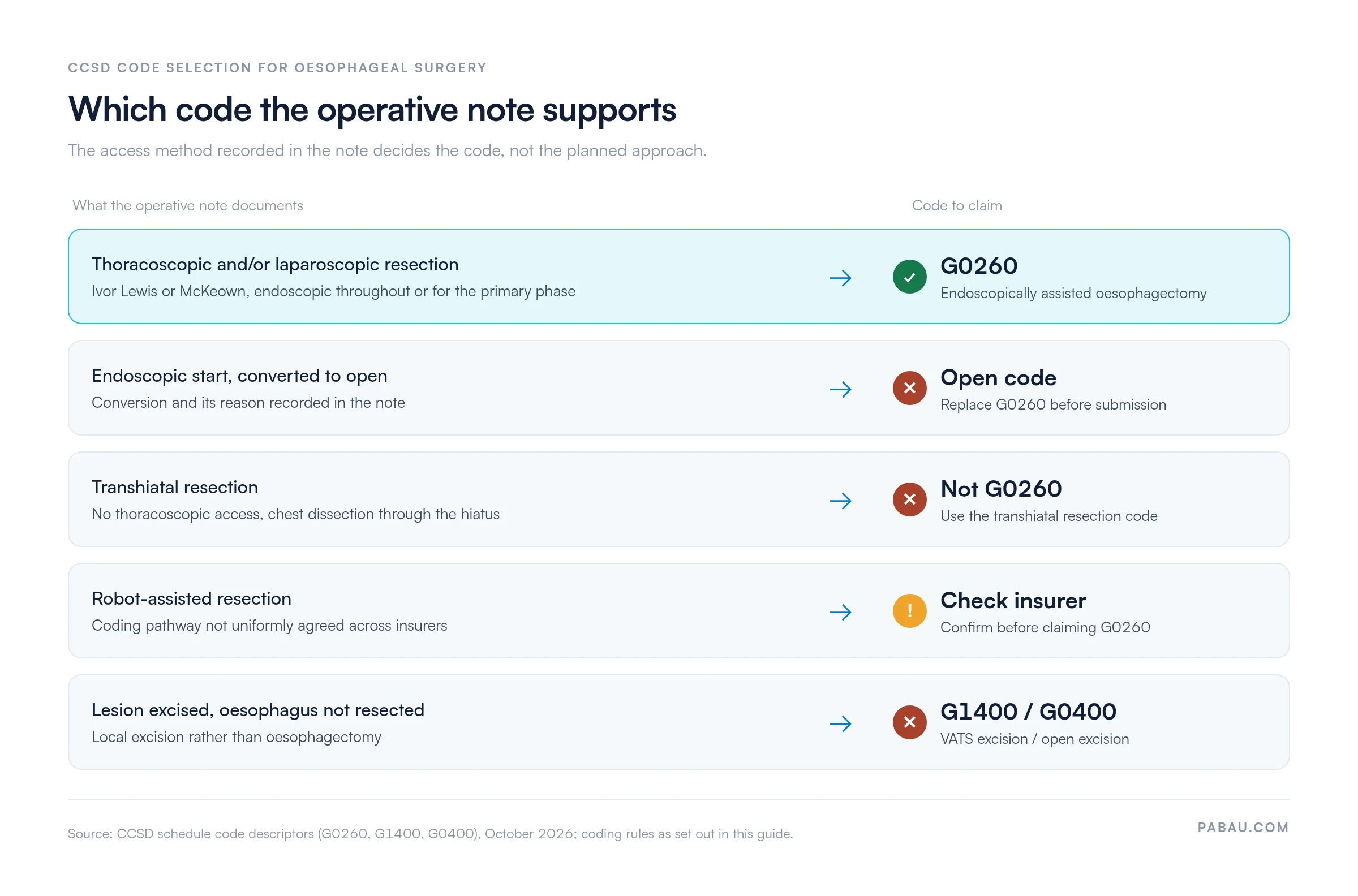
The most consequential coding decision for oesophagectomy is the approach, open or endoscopic. Selecting the wrong code is both a claim integrity issue and a potential audit trigger. The table below compares G0260 against the most commonly confused adjacent codes.
Both the Ivor Lewis (two-phase, intrathoracic anastomosis) and McKeown (three-phase, cervical anastomosis) oesophagectomies are eligible for G0260 when performed thoracoscopically and laparoscopically. The access method determines code eligibility, and the anastomosis level does not change it.
Robotic oesophagectomy coding is still evolving. Some insurers accept G0260 for robot-assisted cases on the basis that the robotic system is an endoscopic instrument platform. Others require a separate robotic supplement code or apply a different fee schedule.
Coders should confirm the individual insurer’s position before claiming G0260 for a robotic case. When the procedure converts from endoscopic to open intraoperatively, the operative note must document the conversion. The claim should then carry the open code rather than G0260.
Neighboring procedures carry their own codes. A total oesophagectomy with interposition of intestine, used when the stomach cannot form the conduit, is billed as G0220.
Excising an oesophageal lesion without resecting the oesophagus is not an oesophagectomy at all. It is billed as G1400 by VATS, or as G0400 through open access. The panel below maps each documented route to the code it supports.
Every G0260 claim requires an ICD-10 diagnosis code to establish the clinical reason for the procedure. The primary pairing codes come from category C15, Malignant neoplasm of oesophagus. Verify codes against current CCSD and insurer guidance for the submission year, as accepted pairings are reviewed annually.
Use the most specific code available. C15.9 should not be used when the operative report and staging document identify the tumor location. UK ICD-10 has no dysplasia split for Barrett’s oesophagus, so K22.7 is paired with a morphology code that records the dysplasia.
The NHS Classifications Browser provides current UK ICD-10 fifth edition code definitions for reference.
The operative note is the single most important document for a G0260 claim. Vague or incomplete documentation is the leading cause of denial and audit failure.
The Royal College of Surgeons’ Good Surgical Practice expects operation notes to be completed immediately after surgery. The GMC’s Good Medical Practice requires records made at the time, or as soon as possible afterwards. A delayed or retrospectively amended note weakens the claim, and a structured operative template helps the surgeon capture each element while it is fresh.
The operative note must explicitly address each of the following to support G0260:
All major UK private medical insurers require pre-authorization before oesophagectomy is performed. Submitting a G0260 claim without a valid authorization reference number is the single most common reason for initial denial. Each insurer maintains its own authorization portal and criteria. The documents below are standard across Bupa, AXA Health, Aviva and Vitality Health.
The Bupa CCSD codes guide covers the submission and authorization requirements for Bupa-insured patients in more detail. For procedure-specific criteria, check each insurer’s own tools, such as the Bupa code search or the Aviva provider fee schedule.
Oesophagectomy is a major surgical procedure requiring general anesthesia and, in most cases, a surgical assistant. The billing rules for these supplementary services vary by insurer. The table below summarizes what can typically be claimed alongside G0260 and what is considered bundled.
Several clinicians bill for a single G0260 procedure. Coordinated invoicing between the surgical team, the anesthetist and the hospital reduces the risk of duplicate or conflicting claims.
G0260 claim denials follow a predictable pattern, and most are preventable with pre-submission checks. Good claims management software flags a missing authorization reference or an incomplete operative note before the invoice reaches the insurer.
CCSD modifiers supplement the base code to communicate additional clinical or administrative information to the insurer. The modifiers most relevant to G0260 are as follows:
Modifier rules vary between insurers. The CCSD schedule provides the base framework. Individual insurer bulletins, available through the Bupa, AXA, Aviva and Vitality provider portals, specify how each modifier is applied and priced.
Oesophagectomy is one of the highest-banded surgical procedures in the CCSD schedule, reflecting its clinical complexity and operative duration. Reimbursement for G0260 depends on the insurer’s fee schedule and on whether the surgeon holds recognized consultant status with that insurer. Any rate negotiated at hospital or individual level also changes the figure.
Fee ranges in UK private practice are not publicly standardized, but consultants can benchmark against several sources. The Healix fee schedule publishes CCSD-based rates and is openly accessible. The Aviva fee schedule is available to recognized Aviva providers and covers the full CCSD surgical chapter. Cigna UK’s schedule is accessible via the Cigna provider portal for recognized consultants.
Key factors affecting G0260 reimbursement in practice:
Surgeons new to private practice should obtain recognized status with each insurer before performing insured procedures. Claims from unrecognized consultants are frequently reduced or redirected to the patient. Recognition typically requires a CV, a certificate of good standing and evidence of surgical activity in the relevant subspecialty.
Run a pre-submission audit on every G0260 claim before it leaves your billing team. Confirm the authorization reference matches the insurer and procedure. Check that the operative note names the endoscopic approach, and that the diagnosis code is the most specific one for the documented tumor site. These three checks resolve most preventable denials before the invoice is issued.
A G0260 claim draws on records that often live in different places. The operative note sits in one system, the authorization reference arrives by email, and the invoice is built somewhere else. Every handover is a chance for the approach, the code or the reference to drift apart.
Pabau holds those records on one patient file. Structured treatment notes and forms prompt the surgeon to record the access method and each operative phase. The invoice is then raised against that same record with the CCSD code attached, and sent to the insurer through Healthcode.
The result is a claim the insurer can match to the operative note line by line. Your billing team spends less time answering queries and resubmitting invoices.

Pabau keeps operative documentation, CCSD-coded invoicing and insurer submission tracking on one patient record, so surgical claims leave complete.

G0260 rewards the surgeon whose paperwork matches the operation. The access method written in the operative note decides the code, so the note deserves the same care as the resection itself.
The trade-off is a few extra minutes at the end of a long list. A complete note written straight after surgery costs little, while defending a vague one through an insurer query can hold up payment for much longer.
Book a demo to see how Pabau links operative notes, authorizations and CCSD invoices for private surgical practices.

Need a full guide to Bupa CCSD coding and submission? Bupa CCSD codes guide covers the full submission process, recognized procedure chapters and Bupa-specific billing rules for private consultants.
Reconstructing with intestine instead of stomach? CCSD code G0220 covers total oesophagectomy with interposition of intestine and how to bill it.
Excising an oesophageal lesion through open access? CCSD code G0400 explains how open excision of a lesion of the oesophagus is coded and claimed.
Treating achalasia without a resection? CCSD code G0922 covers billing for VATS oesophageal and oesophagogastric myotomy.
CCSD code G0260 covers endoscopically assisted oesophagectomy, the minimally invasive removal of the oesophagus using thoracoscopic and laparoscopic techniques. It applies to Ivor Lewis and McKeown procedures conducted endoscopically. It does not cover open oesophagectomy or transhiatal resection performed without thoracoscopic access.
Open oesophagectomy uses thoracotomy and laparotomy and is coded under a separate CCSD open-resection code. Endoscopically assisted oesophagectomy uses thoracoscopic and laparoscopic access and is coded as G0260. The approach must be documented in the operative note, because submitting G0260 for an open procedure is an audit risk.
Yes. All major UK private medical insurers require pre-authorization before oesophagectomy is performed, and the authorization reference number must appear on the claim. Claims submitted without a valid authorization are the most frequently denied G0260 claims across Bupa, AXA Health, Aviva and Vitality.
The operative note must state the endoscopic approach and name the instruments and port positions. It should describe each operative phase, from thoracoscopic mobilization to conduit formation and the anastomosis technique, and record specimen handling. Notes that omit the access method are the primary cause of documentation-related denials.
The coding pathway for robotic oesophagectomy is not uniformly agreed across UK private insurers. Some accept G0260 on the basis that the robotic system is an endoscopic platform. Others require a separate robotic supplement code, so confirm the position with each insurer before submitting G0260 for a robot-assisted case.
The primary pairing codes come from category C15, Malignant neoplasm of oesophagus, such as C15.4 middle-third, C15.5 lower-third and C15.9 unspecified. Barrett’s oesophagus (K22.7) is also accepted when high-grade dysplasia is documented and endoscopic therapy has failed. C15.9 should only be used when the tumor site is unspecified in the clinical record.