

HCPCS Code Q4185: Cellesta flowable amnion billing guide
HCPCS Code Q4185: definition and official descriptor HCPCS Code Q4185 is the Lev...

Last Updated: Nov 20, 2026
G4010 is the CCSD code for pyloromyotomy, an operation that splits the thickened pyloric muscle to relieve gastric outlet obstruction.
It is used most often for infants with hypertrophic pyloric stenosis. UK private medical insurers and private hospitals use the code to identify the procedure on claims.
Let Pabau's smart automation suggest the right codes, reduce claim denials, and keep your practice compliant—effortlessly.
Automate repetitive tasks and focus on what matters most—your patients.
Reduce coding errors and ensure compliance with the latest regulations.
Clean claims, fewer denials, and faster reimbursements.
Powerful insights and reporting to help your practice thrive.
HIPAA compliant SOC 2 certified GDPR-compliant Trusted by 4,000+ clinics worldwide

CCSD code G4010 is pyloromyotomy: a lengthwise split of the thickened pyloric muscle that relieves gastric outlet obstruction, usually in infants.
Link G4010 to ICD-10 Q40.0, congenital hypertrophic pyloric stenosis. An adult or symptom code is a common reason for a query or rejection.
The CCSD schedule lists A2780, G3400, G3440 and G3610 as unacceptable combinations with G4010, so don’t bill them for the same episode.
Each insurer, such as Bupa, AXA Health or Aviva, sets its own pre-authorization rules, so confirm cover and the infant’s place on the policy first.
The anesthetist, the hospital and any assistant bill separately, and each insurer sets its own fee for G4010 because CCSD sets no fees.
CCSD code G4010 is the procedure code for pyloromyotomy in the Clinical Coding and Schedule Development (CCSD) schedule. The CCSD group’s schedule holds the standard procedure codes for the UK private healthcare sector. Insurers and private hospitals use it to identify procedures on claims and invoices.
The G4010 entry in the schedule, which needs a CCSD login to view, gives the descriptor simply as “Pyloromyotomy.” It sits in chapter 11, subchapter 11.2.0 Stomach.
Insurers such as Bupa, AXA Health, Aviva, Vitality, WPA and Healix use CCSD codes on claims. The CCSD group publishes the codes but sets no fees, so each insurer decides what it pays. For a wider look at the schedule, the CCSD procedure code guide explains how codes are structured and looked up.
The table below summarizes the key billing facts for G4010.
Pyloromyotomy relieves the outflow obstruction caused by IHPS. In this condition, the pyloric muscle thickens in the first weeks of life and stops stomach contents passing into the duodenum. The operation is also known as the Ramstedt procedure or the Fredet-Ramstedt operation, after the surgeons who established it.
The surgeon makes a lengthwise incision through the serosa and the pyloric muscle. The thickened fibers are split down to, but not through, the submucosa, which lets the pyloric channel open. The key surgical steps are as follows.
These steps matter for coding because the operation note must document them for the claim to pass insurer review. If the note only says “pyloromyotomy performed,” the reviewer can’t see the approach, the extent of the myotomy or the mucosal check. Expect a documentation query.
The CCSD descriptor for G4010 is “Pyloromyotomy,” and it names no surgical approach. The code itself therefore doesn’t separate open surgery from laparoscopic surgery.
Some insurers still ask how the operation was done, or handle laparoscopic work differently. Check the insurer’s own guidance, such as the Bupa code search, before you submit a laparoscopic case. The table below sets out what to record for each approach.
Key rule: Always state the surgical approach in the operation note. If the insurer asks about the approach and the note doesn’t answer it, the claim stalls at review.
The correct diagnosis code to link with CCSD code G4010 is ICD-10 Q40.0. The WHO ICD-10 classification defines it as “Congenital hypertrophic pyloric stenosis.” This code captures the condition the operation treats, and it must appear on the claim for the insurer to process it correctly.
The table below shows the ICD-10 codes relevant to pyloric stenosis billing and when each applies.
Submitting K31.1 instead of Q40.0 is a common diagnosis-coding error on pyloromyotomy claims. The adult code clashes with an infant’s date of birth, so the insurer is likely to query or reject the claim.
The CCSD schedule entry for G4010, available after a CCSD login, lists four unacceptable combinations, all dated January 20, 2010. Don’t bill any of them alongside G4010 for the same operation.
CCSD notes that its coding principles are guidelines, not an exhaustive list. Each insurer decides whether to adopt a given combination. If the infant clinically needed a second procedure, check with the insurer before you bill it. To look up another code in the table, search the CCSD codes library.
A G4010 claim covers only the surgeon’s fee for the myotomy itself. Several other services are billed separately. Each provider sends its own account, one of the medical billing fundamentals that apply to any surgical episode.
Co-billing rules differ between Bupa, AXA Health, Aviva, Vitality and WPA, so check the Bupa code search or the insurer’s own guidance. Many practices send these claims electronically through Healthcode, the UK billing service for private healthcare.
Pre-authorization rules for G4010 belong to each insurer, not to CCSD. Many UK private medical insurers ask the policyholder to call before an inpatient admission and give an authorization number.
For an infant, check first that the baby has been added to a parent’s policy and that the policy covers the condition. Some policies limit cover for congenital conditions, and IHPS is coded as congenital (Q40.0). Where surgery can’t wait, ask the insurer how it handles urgent admissions and record the reference as soon as you have it.
The clinical information insurers typically request for a pyloromyotomy includes the following.
A missing authorization reference is a common reason for a rejected inpatient claim. Claims management software that keeps the reference on the patient’s case helps it reach the claim at first submission.
Insurers that audit G4010 claims look for specific elements in the operation note. A note that leaves out key technical details can lead to a payment hold and a clinical query. A structured digital form helps surgical teams capture these elements the same way every time.
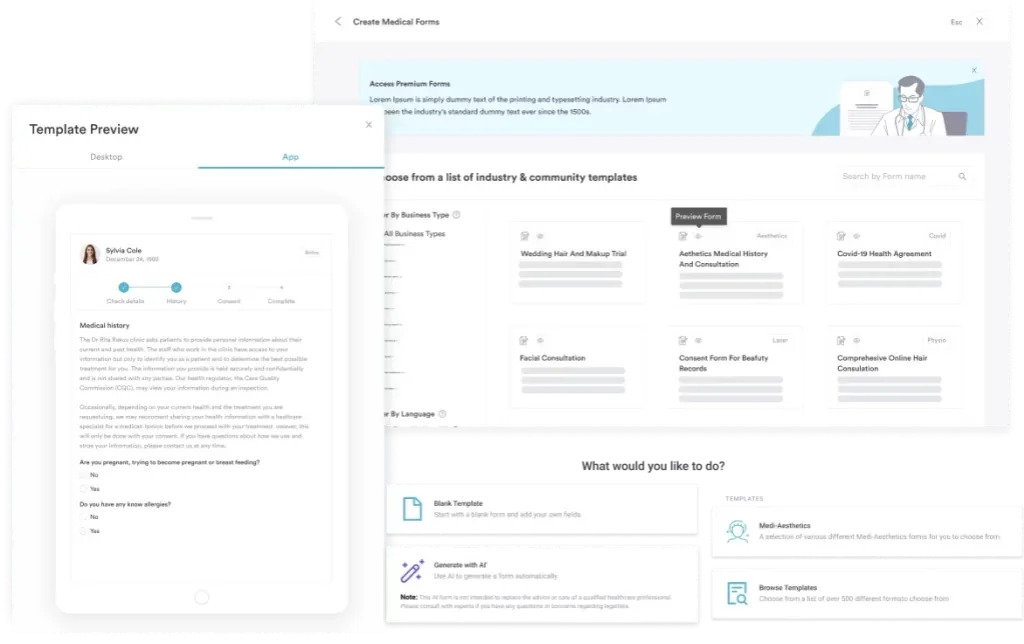
The operation note for a G4010 claim should include all of the following.
Write the operation note on the day of surgery. A same-day note is easier to rely on if the insurer queries the claim later.
Run a documentation checklist before submitting any G4010 claim. Confirm the operation note covers the approach, the myotomy extent, the mucosal integrity check and the consultant’s GMC number. Checking these four points before submission avoids the most common documentation query and the payment delay that follows.
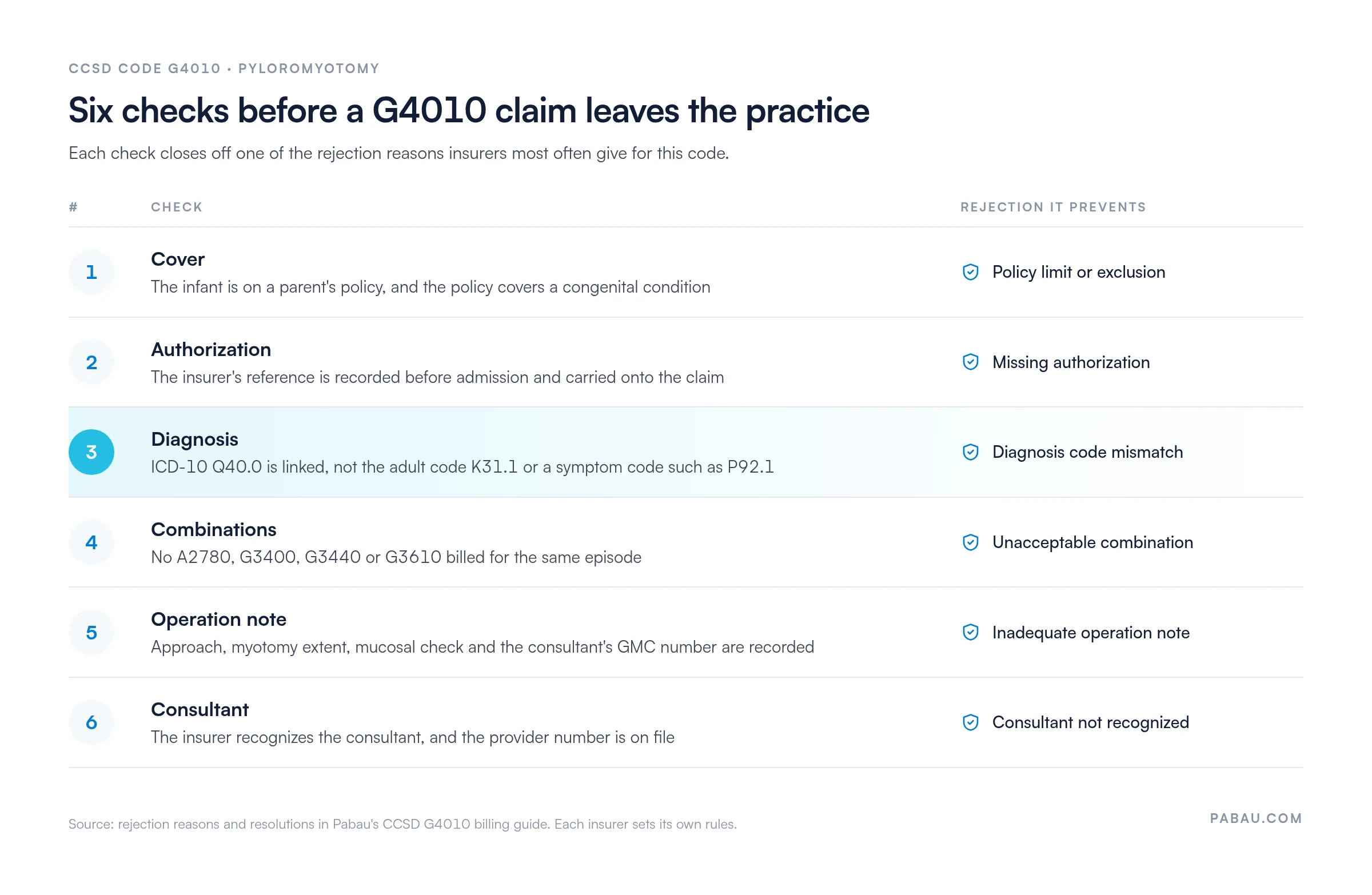
Rejections for G4010 claims follow a predictable set of root causes. The table below lists the most common triggers alongside resolution steps.
Each of these rejections maps to a check the billing team can run before the claim is sent, in the order the episode unfolds.
The CCSD group publishes codes, not fees. Each insurer sets its own fee for G4010, so the amount you can claim depends on the patient’s insurer and policy.
Use this process to check reimbursement before you bill.
Pediatric surgical billing is error-prone because it combines an urgent admission, an infant patient and a procedure the billing team rarely handles. Manual claim preparation under these conditions produces the errors listed above: a wrong ICD-10 code, a missing authorization or an unacceptable combination.
In Pabau’s billing software, these details sit on one patient record. The authorization code, its dates and its sessions sit on the patient’s case, and Pabau warns the team when one is missing. UK practices submit claims through Healthcode and Bupa from Pabau’s claims management software, so the code, the diagnosis and the reference travel together.
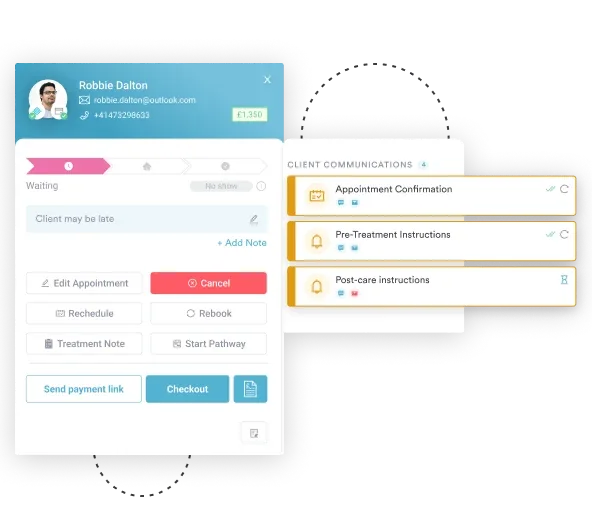
When an insurer asks for clinical notes, the operation note is already on the patient’s record. The administrator can attach it to the reply in minutes rather than searching paper files.

Pabau helps UK private practices track pre-authorizations, submit claims through Healthcode and Bupa, and keep pediatric surgical claims moving.

A G4010 claim is won or lost before the infant reaches the operating room. Confirm the baby is on the policy and get the authorization reference while fluids are being corrected. An urgent admission leaves little time to chase either one later.
After surgery, the operation note carries the claim. If it records the approach, the myotomy extent and the mucosal check, an insurer query becomes a quick reply instead of a payment hold. The family is then spared an unexpected bill during a stressful neonatal admission.
Pabau keeps the authorization, the operation note and the claim in one record for UK private practices. To see how it handles CCSD billing, book a demo and walk through a G4010 claim with our team.

Need a broader view of CCSD procedure coding? Pabau’s CCSD procedure code guide explains how the CCSD schedule is structured and how to look up surgical codes correctly.
Billing a pyloroplasty instead? CCSD code G4030 covers pyloroplasty, a different operation on the pyloric outlet with its own coding rules.
Coding a gastrostomy in the same admission? CCSD code G3400 covers gastrostomy, one of the four unacceptable combinations with G4010.
Closing a gastrostomy instead? CCSD code G3440 covers closure of gastrostomy, another code CCSD lists as an unacceptable combination with G4010.
Sending insurer claims by hand? Pabau’s claims management software sends UK claims through Healthcode and Bupa from the same record as the appointment and invoice.
CCSD code G4010 is the procedure code for pyloromyotomy. The surgeon splits the thickened pyloric muscle to relieve outflow obstruction caused by infantile hypertrophic pyloric stenosis (IHPS). The code covers the surgeon’s fee for the myotomy, by open or laparoscopic approach. Anesthesia, assistant and hospital fees are billed separately.
The correct ICD-10 code is Q40.0 (Congenital hypertrophic pyloric stenosis). Submitting K31.1 (the adult-onset code) or a symptom code such as P92.1 instead is likely to trigger a query or rejection from the insurer.
The CCSD descriptor for G4010 names no approach, so both open and laparoscopic pyloromyotomy are coded G4010. Some insurers still ask for the approach or handle it differently. Check the insurer’s guidance before submitting, and always document the approach in the operation note.
Pre-authorization rules belong to each insurer, so check with Bupa, AXA Health, Aviva or the patient’s own insurer before admission. Confirm that the infant is on the policy and that the policy covers the condition. Retrospective authorization is not guaranteed.
The anesthetist bills separately from the surgeon, under the insurer’s own anesthetic fee rules. CCSD does not set fees, so check the insurer’s schedule for the amount. These fees are not bundled into the surgeon’s G4010 claim.
The most common triggers are a wrong ICD-10 code (K31.1 instead of Q40.0), a missing authorization reference and an incomplete operation note. Billing an unacceptable combination with G4010 for the same episode also leads to rejection: A2780, G3400, G3440 or G3610. Fixing these before first submission removes most of the risk.





