

CCSD code G5100: Bypass of duodenum billing guide
CCSD code G5100 bills a bypass that leaves the duodenum in place CCSD code G5100...

Last Updated: Oct 16, 2026
G0922 is the CCSD code for a VATS oesophageal/oesophagogastric myotomy, a keyhole chest operation that cuts the muscle layer of the lower esophagus. The surgeon works through small ports between the ribs, guided by a camera, and may extend the cut across the junction onto the stomach.
Surgeons most often perform this myotomy for achalasia, where the lower esophageal sphincter fails to relax. UK private insurers list G0922 in Chapter 8 of the schedule, under video-assisted thoracic surgery, as a Major complexity procedure.
Let Pabau's smart automation suggest the right codes, reduce claim denials, and keep your practice compliant—effortlessly.
Automate repetitive tasks and focus on what matters most—your patients.
Reduce coding errors and ensure compliance with the latest regulations.
Clean claims, fewer denials, and faster reimbursements.
Powerful insights and reporting to help your practice thrive.
HIPAA compliant SOC 2 certified GDPR-compliant Trusted by 4,000+ clinics worldwide

CCSD code G0922 is a VATS esophageal or esophagogastric myotomy, a keyhole chest operation most often done for achalasia.
The surgical approach decides the code: Heller’s operation is G0920, robotic Heller’s is G0921, and endoscopic POEM is E2810.
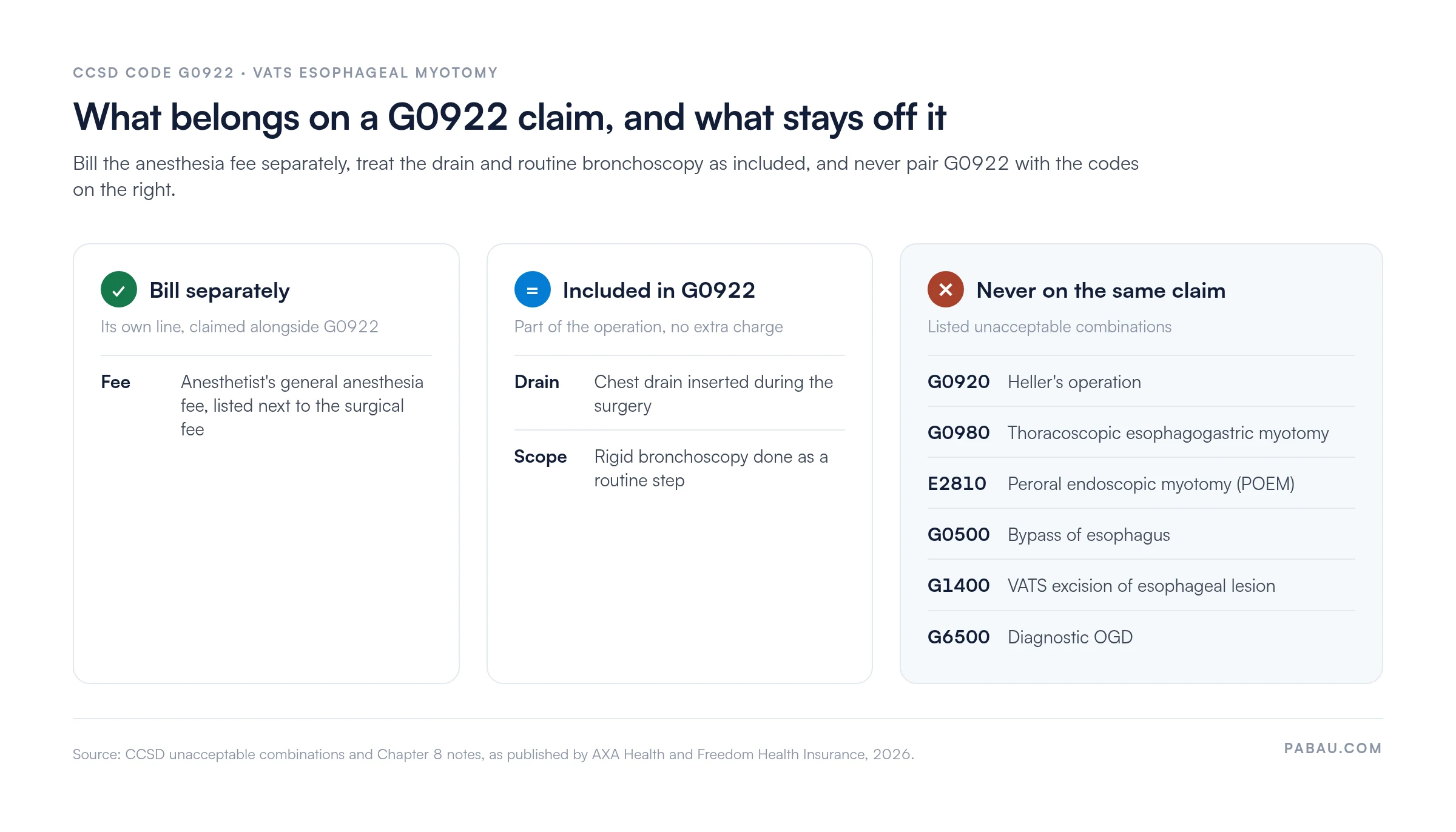
G0922 is never billed with G0920, G0980, E2810 or a diagnostic OGD for the same operation.
A chest drain or a routine rigid bronchoscopy during the operation is part of G0922, not a separate charge.
Pre-authorization rules and fees vary by insurer, so confirm both with the payer before the operation date.
CCSD code G0922 is the UK private insurance code for a VATS oesophageal/oesophagogastric myotomy. VATS stands for video-assisted thoracoscopic surgery. The surgeon reaches the esophagus through small ports between the ribs, guided by a camera, rather than through an open chest incision.
The myotomy divides the muscle layer of the lower esophagus. When the cut continues across the junction onto the stomach, it becomes an esophagogastric myotomy, and the same code applies. Surgeons most often perform it for achalasia, where the lower esophageal sphincter fails to relax and food struggles to pass.
In the schedule, G0922 sits in Chapter 8, Thorax and intra-thoracic organs, under sub-chapter 8.7 for video-assisted thoracic surgery. AXA Health and Freedom Health Insurance both grade it as a Major complexity procedure in their 2026 fee schedules.
The Clinical Coding and Schedule Development group maintains the schedule. It writes the code narratives but does not set fees, so the same code can pay differently from one insurer to the next. Our overview of CCSD codes explains how the chapters fit together.
Several CCSD codes describe a myotomy of the esophagus, and they differ mainly in how the surgeon reaches the muscle. Achalasia can be treated by any of these approaches. So pick the code from the operation note, not from the diagnosis.
Two more neighbors catch out coders who search on the word myotomy. A pharyngeal myotomy at the top of the esophagus is an ENT procedure, billed under E2300. Other codes in sub-chapter 8.7, such as E5591 for bilateral VATS bullectomy, share the approach but treat the lung.
The schedule lists unacceptable combinations for G0922. These are codes that cannot be billed with it for the same operation, because the work overlaps or one procedure replaces the other.
Two further rules come from the Chapter 8 notes that insurers publish with the schedule. A chest drain inserted during intra-thoracic surgery is not charged separately. Neither is a rigid bronchoscopy that forms a routine part of the procedure.
The anesthetist’s work is a separate matter. Insurer schedules list a general anesthesia fee next to the surgical fee for G0922, and the anesthetist bills it separately. The chart below sorts these rules into three groups.
Insurers pay G0922 when the record shows the right operation, done for a clear reason, by a recognized surgeon. A thin note invites a query, especially on a Major procedure with several similar codes nearby.
The operation note carries the most weight here. It is the only document that proves the approach, and the approach is what separates G0922 from its neighbors.
Run through these checks before the operation date, not after the invoice bounces.
Bupa, AXA Health, Aviva and Vitality all base their procedure lists on the CCSD schedule. Each still keeps its own benefit list, so a code in the schedule does not guarantee payment for every indication.
Acceptance and fees change with each policy year, so confirm with the insurer before treating, even if the same code paid last year. For Bupa patients, our guide to Bupa CCSD codes shows how Bupa applies the schedule.
G0922 rejections usually trace back to one of a few causes, and each one can be checked before the claim goes out.
Before you send a G0922 claim, read the first line of the operation note against the code. If it says robotic, open Heller’s or endoscopic, G0922 is the wrong code.
A rejected claim can usually be corrected or appealed. The window for doing so varies by insurer, so check the payer’s terms as soon as the rejection arrives.
In many private surgical practices, a G0922 invoice is still assembled by hand. Someone copies the membership number, authorization reference and code into a separate billing tool, and each copy is a chance to mistype.
Pabau, the practice management platform we build for private practices, connects directly to Healthcode, the clearinghouse most UK private insurers accept. Its claims management software submits CCSD-coded claims straight from the patient record. Before a claim goes out, Pabau checks that required fields, such as the authorization number, are complete.
After submission, Pabau tracks each claim’s status and reconciles payments against the invoice. Your billing team can see which G0922 claims are paid, pending or rejected, and chase the right ones first.
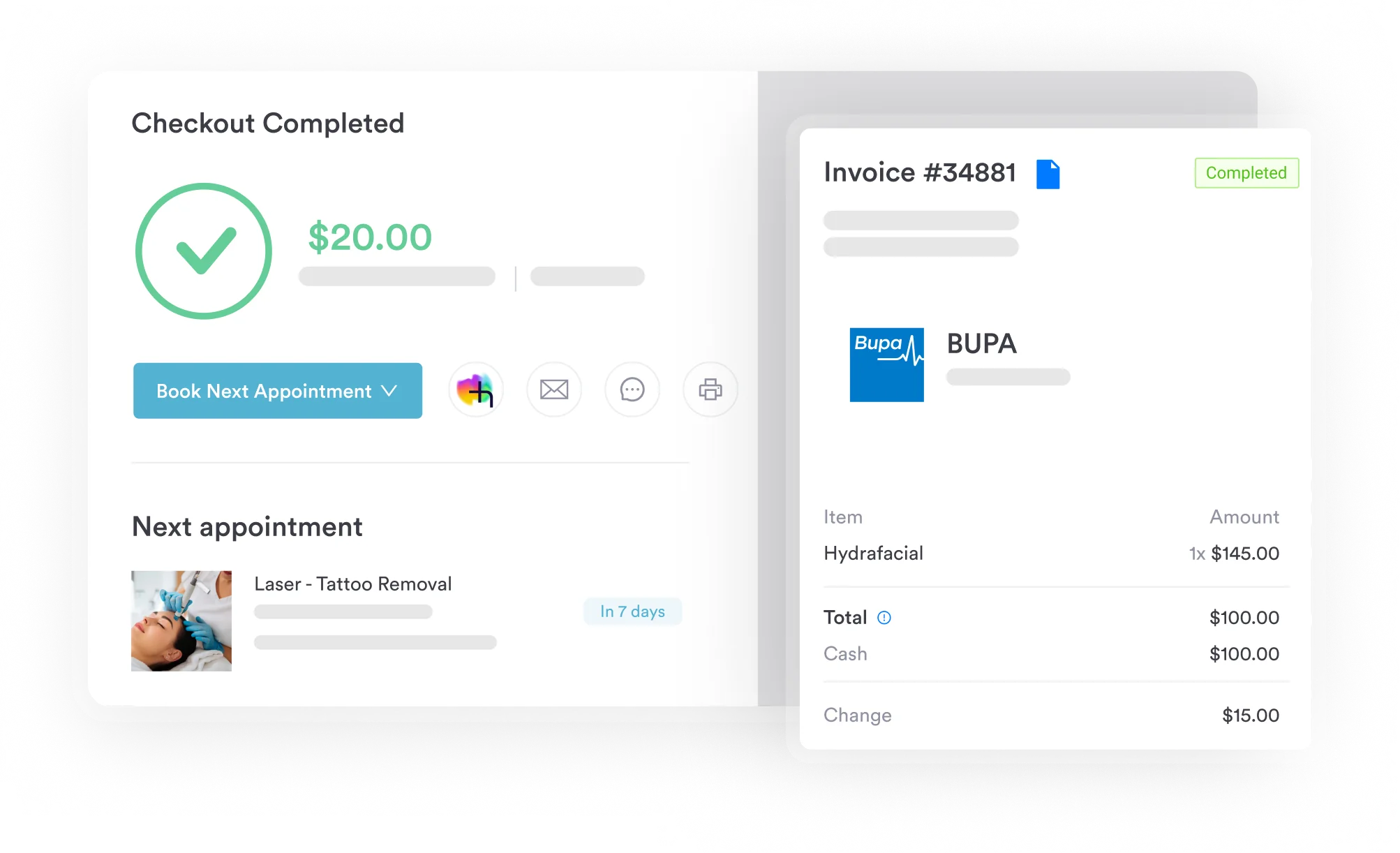

Pabau submits CCSD-coded claims to Healthcode from the patient record and tracks each one until it is paid. Your team spends less time rekeying data and chasing insurers.

G0922 is a narrow code. It fits one operation done one way, and the operation note decides whether it applies. Get the approach right and the rest of the claim follows the schedule’s rules.
The costly errors come from what surrounds it. A robotic or endoscopic case coded as VATS gets rejected, and so does a diagnostic OGD billed on top. Check those two points before you submit, and keep the insurer’s own fee and authorization in the file.
Does your team still retype surgical claims into a separate system? Book a demo to see Pabau send G0922 claims to Healthcode from the patient record.

Coding another procedure in sub-chapter 8.7? CCSD code E5591 explains how bilateral VATS bullectomy is billed to UK private insurers.
Repairing a hiatus hernia instead? CCSD code G2331 covers laparoscopic hiatus hernia repair with an anti-reflux procedure.
Working on a myotomy higher up? CCSD code E2300 walks through pharyngeal myotomy billing for ENT surgeons.
Billing Bupa patients? Bupa CCSD codes shows how Bupa applies the schedule, with chapter context and billing notes.
VATS stands for video-assisted thoracoscopic surgery. The surgeon operates through small ports in the chest wall, using a camera to see inside. In the CCSD schedule, VATS codes sit together in sub-chapter 8.7.
Both divide the same muscle, but the CCSD schedule codes them separately. Heller’s operation is G0920, its robotic version is G0921, and the VATS approach is G0922. Code from the approach in the operation note.
No. OPCS-4 codes record procedures in NHS hospital data. CCSD codes are used to bill UK private medical insurers. The two systems serve different purposes, so one operation can carry both.
Each insurer sets its own fee. The CCSD group writes the code narratives, while insurers publish their own surgeon and anesthetist fees. Check the payer’s current fee schedule before you invoice.
The Clinical Coding and Schedule Development group, formed by UK private medical insurers including Aviva, AXA Health, Bupa and Vitality. It reviews code requests and publishes schedule updates on a set cycle.



