CCSD code G5100: Bypass of duodenum billing guide
CCSD code G5100 bills a bypass that leaves the duodenum in place CCSD code G5100...

Last Updated: Oct 16, 2026
G1900 is the CCSD code for rigid oesophagoscopy, including biopsy, laser or diathermy destruction of lesions. UK private insurers use it for an examination of the oesophagus through a rigid scope, usually under general anesthetic. Any biopsy or lesion destruction done through that scope is part of the same code, so it never appears as an extra line.
The instrument decides the code. A flexible OGD takes one of the OGD codes instead, such as G6500 for a diagnostic OGD. Fees for G1900 come from each insurer's own schedule, not from CCSD.
Let Pabau's smart automation suggest the right codes, reduce claim denials, and keep your practice compliant—effortlessly.
Automate repetitive tasks and focus on what matters most—your patients.
Reduce coding errors and ensure compliance with the latest regulations.
Clean claims, fewer denials, and faster reimbursements.
Powerful insights and reporting to help your practice thrive.
HIPAA compliant SOC 2 certified GDPR-compliant Trusted by 4,000+ clinics worldwide

CCSD code G1900 covers rigid oesophagoscopy, including any biopsy, laser or diathermy destruction of lesions done during it.
Biopsy and lesion destruction are part of the G1900 descriptor, so they never go on the invoice as extra procedure lines.
A flexible scope points to the OGD codes instead, such as G6500 for a diagnostic OGD.
Bupa updated its unbundling rule for G0101, radical oesophagectomy, from 1 April 2026, and G1900 is on that list.
Pabau sends CCSD-coded claims through Healthcode and holds each one until required fields, such as the authorization code, are complete.
CCSD code G1900 is the UK private billing code for rigid oesophagoscopy, including biopsy, laser or diathermy destruction of lesions. It sits in Chapter 10 of the CCSD schedule, the chapter for endoscopic procedures of the gastrointestinal tract.
The word that decides the code is rigid. Surgeons reach for a rigid oesophagoscope for specific jobs, usually under general anesthetic. Most diagnostic upper GI work, by contrast, uses a flexible endoscope.
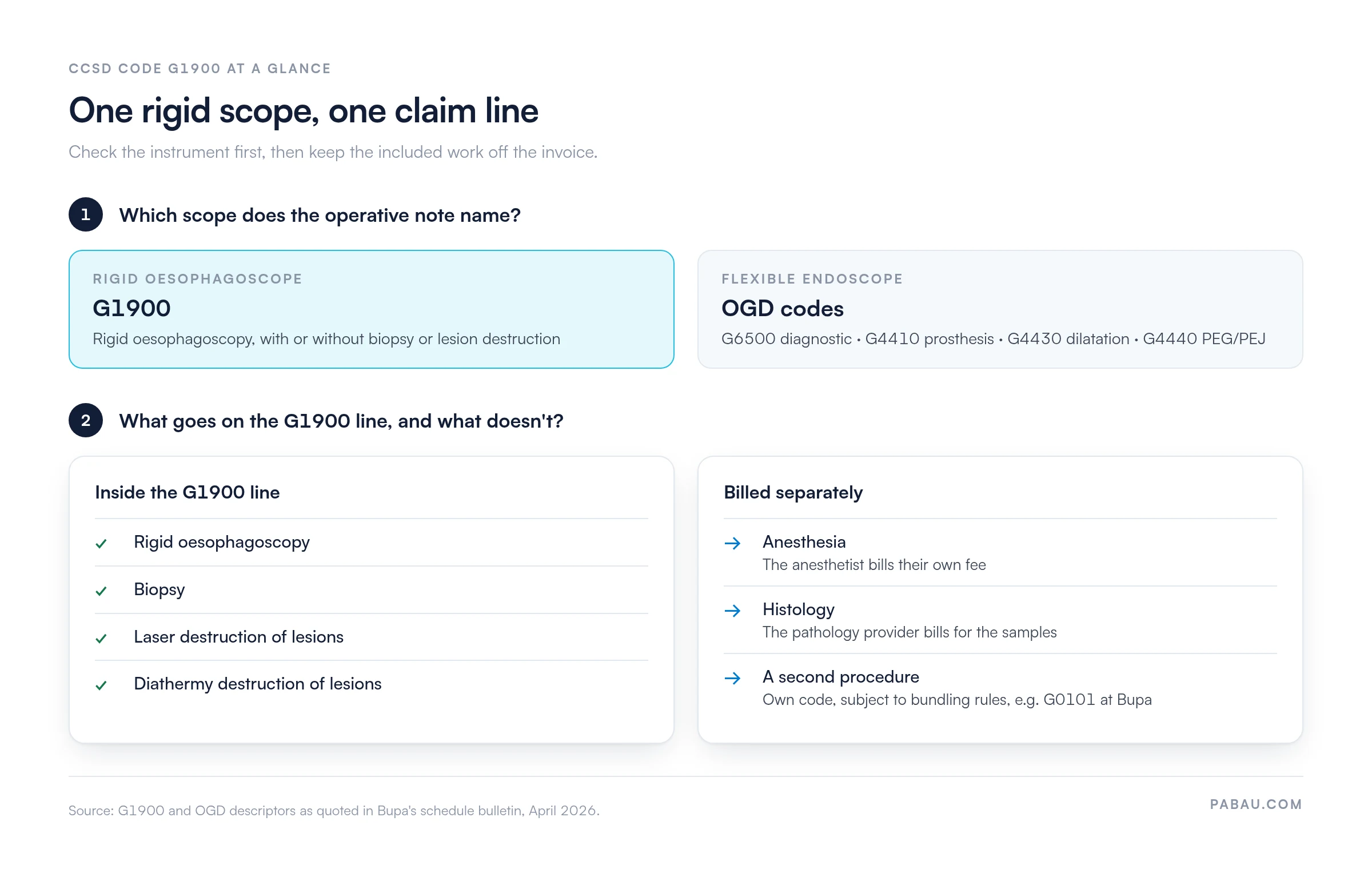
So coding starts with the instrument. If the operative note describes a flexible OGD, G1900 is the wrong code, however similar the findings look. Once the note confirms a rigid scope, a single G1900 line covers the procedure and the treatment done through it.
The G1900 descriptor names three steps inside the code. Biopsy, laser destruction of lesions and diathermy destruction of lesions all belong to the same rigid oesophagoscopy line.
That shapes the invoice. A surgeon who biopsies a lesion and then treats it with diathermy still bills one G1900, not three procedures.
Some work around the procedure still sits outside the code. Each of these is billed by the provider who did it:
Put together, the scope and the descriptor decide what one G1900 line can carry.
G1900 shares the oesophagus with several flexible endoscopy codes and one thoracoscopic code, G1400. Match the code to the instrument first, then to the main therapeutic step in the note.
The descriptors above are quoted from Bupa’s April 2026 schedule bulletin. Confirm each one against the live CCSD schedule before you bill.
Whether two of these codes can share a claim depends on the CCSD list of unacceptable combinations. That list sits behind a CCSD login, so check it in the schedule itself rather than in a summary.
Add a required scope-type field to your endoscopy note template, with rigid and flexible as the only options. Your coders then know whether G1900 or an OGD code applies before they open the schedule.
An insurer’s reviewer needs to match the note to the G1900 descriptor quickly. A note that answers these four questions makes that match easy:
Link each biopsy sample to its pathology request as well. The histology bill and the procedure bill then describe the same episode, which keeps queries short.
Bundling rules decide which codes an insurer will pay together. Bupa’s bulletin of 15 April 2026 lists an updated unbundling rule for G0101. That code covers radical oesophagectomy or oesophagogastrectomy, including dissection of mediastinal lymph nodes.
G1900 appears in that rule, effective 1 April 2026. Other oesophageal endoscopy codes sit on the same list, including G6500, G4410, G4430 and G4440.
In practice, a rigid oesophagoscopy in the same session as a radical oesophagectomy needs a rule check before both lines go to Bupa. The bulletin names its online code search at codes.bupa.co.uk as the current version of the schedule. Our Bupa CCSD codes guide explains how that schedule works.
Other insurers apply their own rules on top of the CCSD schedule. Check each payer’s published schedule before you treat a pairing as payable.
Each of these slips turns a G1900 claim into a query, and each is easy to catch before the claim leaves the practice:
Many UK private practices send insurer claims through Healthcode, the electronic billing exchange for private healthcare. Whichever route you use, run the same checks on every G1900 claim:
Fees come from each insurer’s own schedule, not from CCSD. Check the payer’s current fee for G1900 before invoicing, so a shortfall never surprises the patient.
Endoscopy billing often breaks between two systems. The operative note lives in one place, and someone retypes the details into a claim somewhere else.
Pabau, the practice management platform we build for private practices, holds both on the same patient record. Custom note templates let surgeons record scope type, findings, biopsies and treatment in the same order every time.
When the claim is ready, Pabau’s claims management software sends it to Healthcode from that record. It holds the claim until required fields, such as the membership number and authorization code, are complete. Claim status then shows on the record, so your team can see which claims still need attention.

Pabau keeps endoscopy notes, insurer details and Healthcode claims on one patient record. Your team sends G1900 claims with the authorization reference already in place.

G1900 is a narrow code, and that makes it easy to get right. The scope type, the descriptor and the insurer’s bundling rules settle most coding questions before anyone builds a claim.
The price is discipline in the note. When the surgeon writes rigid and lists any biopsy or diathermy, your coders can bill with confidence. When the note is vague, each claim turns into a query.
Book a demo to see how Pabau links your endoscopy notes to Healthcode claims, so every G1900 claim leaves complete.

Removing an oesophageal lesion through the chest? CCSD code G1400: VATS oesophageal lesion billing guide covers the thoracoscopic alternative to a scope.
Treating oesophageal varices? CCSD code G1440: Injection sclerotherapy for oesophageal varices explains how that endoscopic treatment is billed.
Staging a tumor with endoscopic ultrasound? CCSD code H2220: Endoscopic ultrasound for tumour staging walks through its coding and claims.
Billing Bupa patients? Bupa CCSD codes explains how the Bupa schedule, codes and fees fit together.
Need the wider CCSD schedule? CCSD codes collects our guides to UK private procedure codes in one place.
CCSD code G1900 is the UK private billing code for rigid oesophagoscopy, including biopsy, laser or diathermy destruction of lesions. It sits in CCSD Chapter 10, endoscopic gastrointestinal tract procedures.
Usually, yes. Surgeons tend to use a rigid oesophagoscope under general anesthetic, and the anesthetist bills their own fee for the session.
No. G1900 is for a rigid scope only. A flexible diagnostic OGD uses G6500, and therapeutic OGDs have their own codes, such as G4430 for dilatation.
Check the insurer’s rules first. Bupa updated its unbundling rule for G0101, radical oesophagectomy, from 1 April 2026, and G1900 is on that list.
Bupa’s April 2026 bulletin names its online code search at codes.bupa.co.uk as the current version of its schedule. Check the code and its fee there before you bill.
CCSD stands for Clinical Coding & Schedule Development. The CCSD Group maintains the procedure codes that UK private medical insurers use for billing.