CPT code 28008: Fasciotomy, foot and/or toe
What is CPT code 28008? CPT code 28008 is the surgical code for a fasciotomy per...

Last Updated: Oct 19, 2026
F4210 is the CCSD code for biopsy of lesion of mouth. Consultants use it to bill UK private medical insurers for taking a tissue sample from a lesion inside the mouth. It sits in Chapter 6, Face, mouth, salivary and thyroid, under sub-chapter 6.5.0, Mouth cavity.
The key billing fact is the pairing rule. The CCSD lists unacceptable combinations for F4210, including F3810, F4040, F4050 and F4230. These are the mouth excision, suture, graft and mucosa removal codes. The sections below cover documentation, pre-authorisation and Healthcode claims.
Let Pabau's smart automation suggest the right codes, reduce claim denials, and keep your practice compliant—effortlessly.
Automate repetitive tasks and focus on what matters most—your patients.
Reduce coding errors and ensure compliance with the latest regulations.
Clean claims, fewer denials, and faster reimbursements.
Powerful insights and reporting to help your practice thrive.
HIPAA compliant SOC 2 certified GDPR-compliant Trusted by 4,000+ clinics worldwide

CCSD Code F4210 covers biopsy of a lesion of the mouth. Consultants use it to bill UK private medical insurers, not routine dental plans.
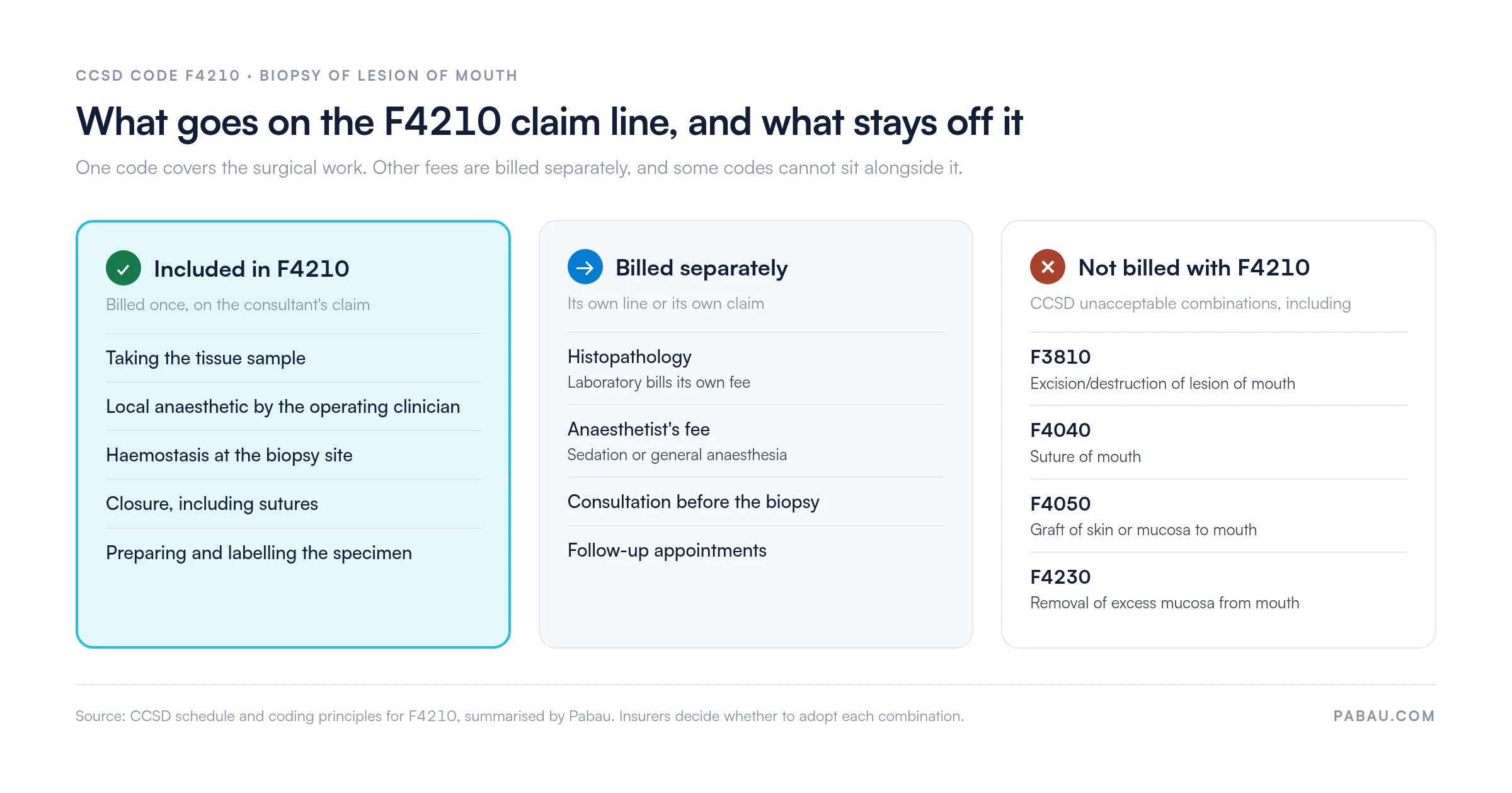
The CCSD lists unacceptable combinations for F4210, including F3810, F4040, F4050 and F4230. Excision, suture, grafting or mucosa removal in the same episode is not billed on top.
Histopathology is billed separately by the laboratory and never belongs on the F4210 claim line.
Pre-authorisation rules vary by insurer and policy, so check each insurer’s current requirement before the biopsy.
Practice software such as Pabau keeps structured biopsy notes in the patient record and tracks each claim through Healthcode.
CCSD Code F4210 covers biopsy of lesion of mouth: taking a tissue sample from a lesion inside the mouth so a pathologist can examine it. Consultants and specialists use it to bill UK private medical insurers such as Bupa, AXA Health, Aviva and Vitality.
The code sits in Chapter 6 (Face, mouth, salivary and thyroid) of the CCSD schedule, under sub-chapter 6.5.0, Mouth cavity. The schedule is maintained by the Clinical Coding & Schedule Development Group, which is run by the UK’s major private medical insurers. Most claims for it travel electronically through Healthcode.
The usual billers are oral and maxillofacial surgeons, ENT surgeons and other insurer-recognised consultants. Some oral and maxillofacial consultants are also registered with the General Dental Council, but routine dental plans do not use CCSD codes.
A biopsy of lesion of mouth billed under F4210 usually follows this sequence:
F4210 covers the surgical work in these steps. The laboratory’s histopathology examination is a separate service with its own fee.
Use F4210 when the procedure note records a biopsy taken to obtain tissue for diagnosis. Use F3810 when the note records excision or destruction of the mouth lesion. The CCSD lists the two codes as an unacceptable combination, so only one of them goes on the claim.
The CCSD descriptor for F4210 is simply “biopsy of lesion of mouth”, and it does not split biopsies by technique. When the note describes complete removal of the lesion, check the CCSD technical guide and the insurer’s guidance before choosing the code. Code what the note says was done, not the diagnosis you expect.
Site matters too. Chapter 6 has separate sub-chapters for the lips, tongue and palate, so a lesion in one of those areas may need a site-specific code instead.
The CCSD lists unacceptable combinations for F4210, including the four mouth codes below. Check exact descriptors against the CCSD code list or Bupa’s CCSD code schedule, as insurers update their schedules.
The CCSD describes its coding principles as guidelines, and each insurer decides whether to adopt a given combination. Check the insurer’s own rules when a case falls outside the standard pairings.
Knowing the scope of CCSD Code F4210 prevents unbundling errors and claim adjustments.
Histopathology is the exclusion with the most money attached. Agree with the laboratory who submits the pathology claim to the insurer. Never fold the laboratory fee into the F4210 line. The panel below sets the claim line, the separately billed fees and the barred pairings side by side.
F4210 fits when an oral lesion cannot be diagnosed on appearance alone and tissue diagnosis will guide management. NICE NG12 (Suspected cancer: recognition and referral) sets out which oral presentations should prompt urgent referral.
Common scenarios that justify F4210 include:
F4210 does not fit a lesion with a clear clinical diagnosis that needs no histology, such as a traumatic ulcer that heals on review. Record the reason for the biopsy in the patient notes either way.
The GMC, or the clinician’s own regulator, expects clear, accurate and contemporaneous records. For an F4210 claim, the record should show:
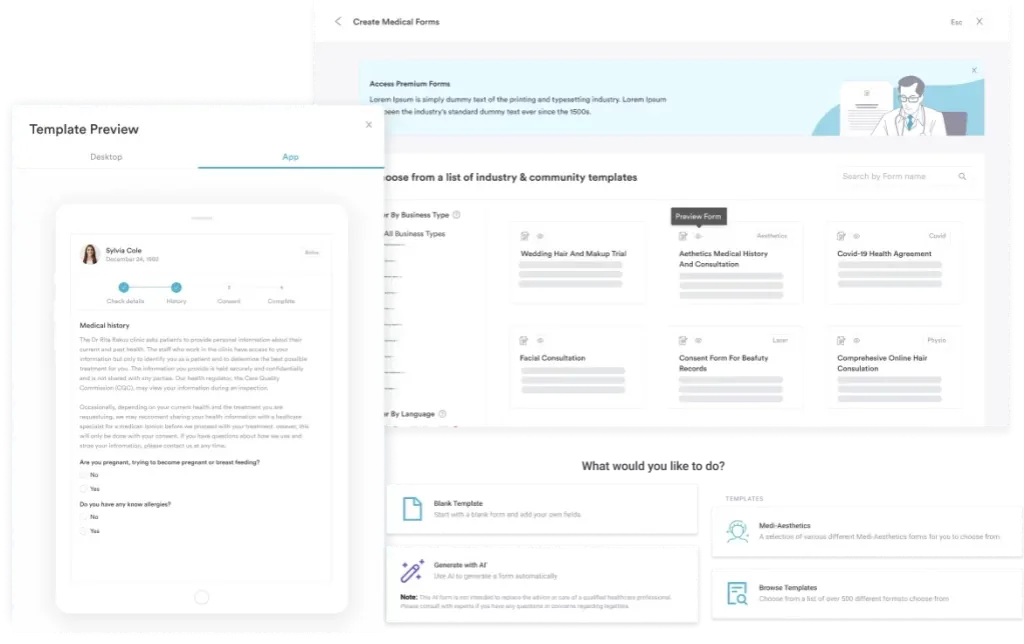
With Pabau, the practice management platform we build, patients complete their history and sign consent on digital forms before the appointment. The claim file is then complete on the day.
Pre-authorisation rules for F4210 vary by insurer and by policy, so check each insurer’s current requirement before the procedure. A claim for a procedure that needed authorisation but did not get it is an avoidable denial.
Before booking the biopsy, confirm these points with the insurer:
Some lesions cannot wait, for example one with features of malignancy. Ask the insurer whether it accepts retrospective authorisation in urgent cases, and record the clinical urgency in the notes. Do not assume approval.
A complete F4210 claim follows these steps:
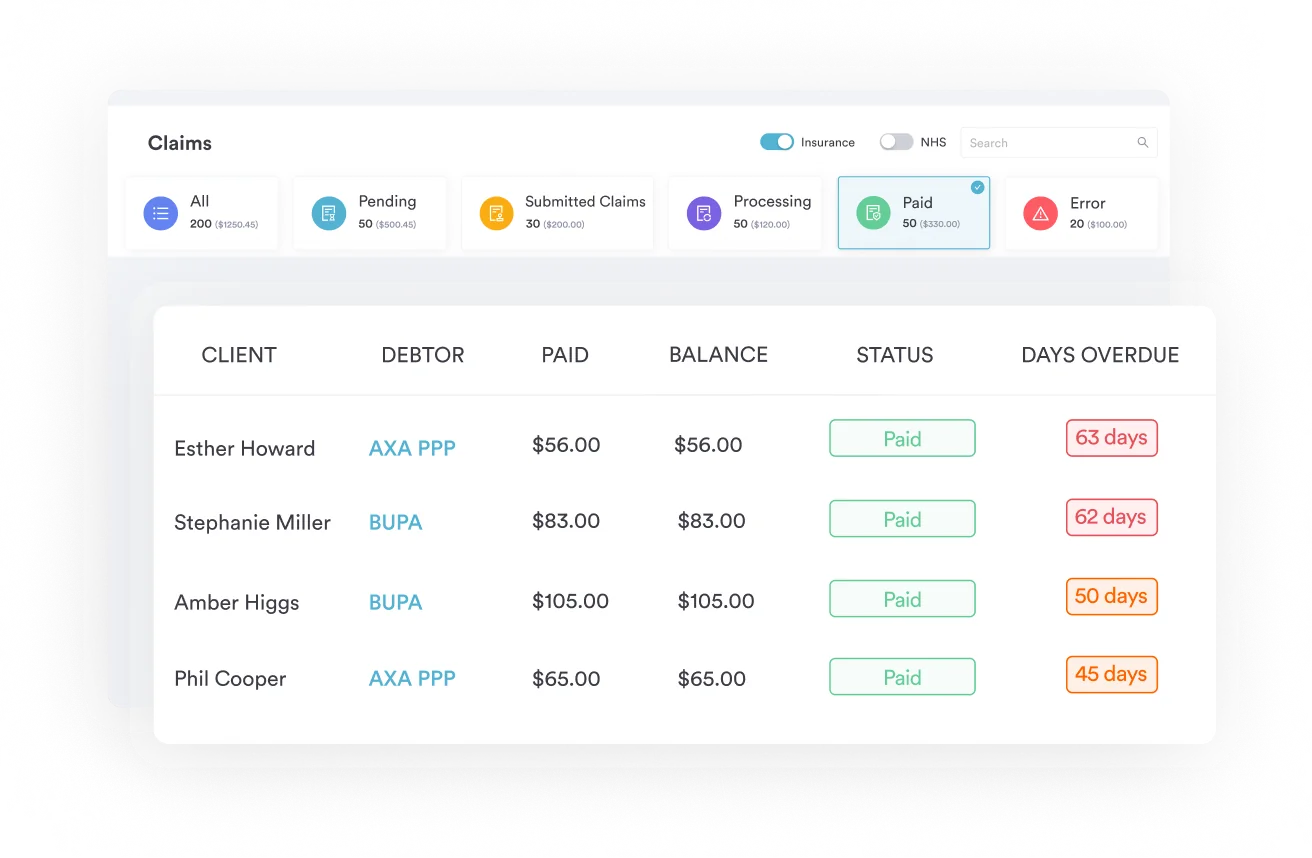
A structured claims management workflow keeps F4210 claims in one queue with your other insurer submissions, so none slip past a deadline.
F4210 claims are denied for a predictable set of reasons. The table maps each one to its fix.
Run a monthly audit of outstanding F4210 claims. Check Healthcode for unanswered insurer queries first, since an open query often explains a claim that has gone quiet.
Histopathology is a separate service that F4210 does not include. The laboratory examines the specimen, issues the report and typically bills the insurer for its own fee.
Agree with your laboratory partner who submits the pathology claim. If the practice pays the laboratory and seeks reimbursement, that fee still goes on its own line, never inside the F4210 claim.
Double-billing, where the practice and the laboratory both claim for the same analysis, leads to recovery of the payment. Repeat cases can put the practice’s standing with the insurer at risk.
Many consultant practices still write biopsy notes as free text, then rebuild the claim details from memory days later. That is where lesion sizes, consent records and specimen references go missing.
Pabau’s structured patient records let clinicians build a biopsy note template that prompts for each field an F4210 claim needs. That covers the lesion site and size, the indication, anaesthetic, specimen reference and histology report.
Claims go to the insurer through Healthcode, and the team tracks each one’s status in Pabau. Unpaid or queried F4210 claims stay visible until they are settled.
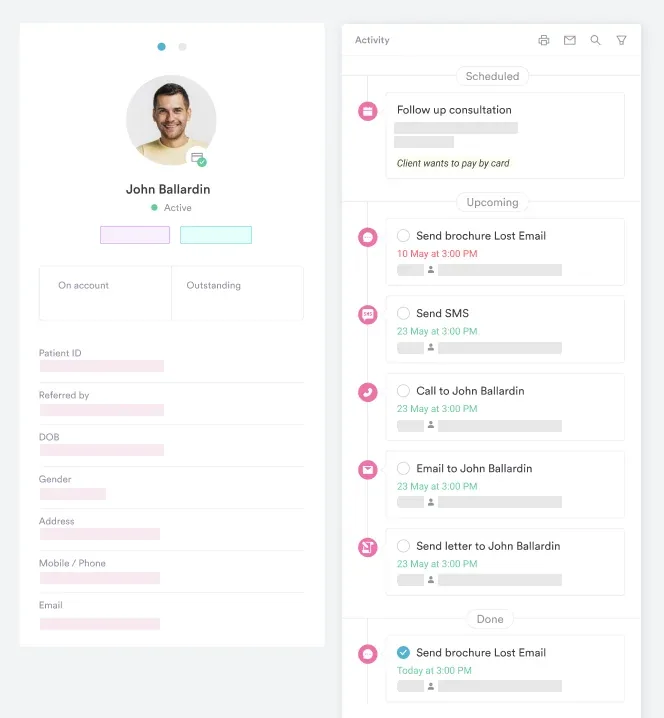

Pabau keeps structured biopsy notes, consent and specimen references in one patient record. Your team submits claims through Healthcode and tracks each one until it is paid.

F4210 is a simple code to pick and an easy one to lose on a claim. Payment usually turns on three points: the pairings, the laboratory fee and the authorisation.
Settle those three before the patient is in the chair. Confirm cover and authorisation with the insurer, agree who bills the histology, and write a note that records the lesion and the reason for sampling. A claim built that way rarely comes back.
Book a demo to see how Pabau keeps biopsy notes structured and insurer claims tracked for UK private practices.

Billing other CCSD codes? CCSD codes lists the schedule’s procedure codes with links to each code’s billing guide.
Removed the whole lesion instead? CCSD code F3810 explains billing excision or destruction of a mouth lesion.
Billing Bupa patients? Bupa CCSD codes covers how Bupa uses the CCSD schedule and what it expects on a claim.
CCSD Code F4210 covers biopsy of lesion of mouth, which means taking a tissue sample from a lesion inside the mouth for histology. It includes local anaesthetic given by the operating clinician, haemostasis and closure. The laboratory’s histopathology fee is billed separately.
No. The CCSD lists F3810, excision or destruction of lesion of mouth, as an unacceptable combination with F4210. Bill the code that matches the procedure recorded in the note. Its other listed combinations include F4040 (suture of mouth), F4050 (graft of skin or mucosa to mouth) and F4230 (removal of excess mucosa from mouth).
No. The histopathology fee is not part of F4210. The laboratory that examines the specimen typically bills the insurer for its own fee. Never include the laboratory fee in the F4210 claim line.
Some policies require pre-authorisation for F4210 and others do not. Check each insurer’s current requirement before the procedure and record any authorisation number. For an urgent biopsy, ask the insurer whether it accepts retrospective authorisation.
Consultants and specialists recognised by UK private medical insurers bill F4210, usually oral and maxillofacial or ENT surgeons. Claims typically go through Healthcode. Routine dental plans do not use CCSD codes.
The record should show the lesion’s site, size and appearance, the reason for the biopsy, consent, how the sample was taken and the specimen reference. File the histology report once it arrives. The GMC, or the clinician’s own regulator, expects these records to be contemporaneous.