CCSD code XR320: Nasolacrimal duct stenting billing guide
CCSD code XR320 is the UK private insurance code for dilatation or stenting of t...

Last Updated: Nov 24, 2026
V1330 is the CCSD code for biopsy of a lesion of facial bone. It covers sampling a lesion in or of a facial bone, such as the mandible, maxilla or zygoma. A pathologist then makes the tissue diagnosis.
UK private medical insurers such as Bupa, AXA Health, Aviva and Vitality use the code to assess consultants' invoices. Bupa rates it MINOR 3. A biopsy of soft tissue in the mouth, with no bone sampled, is coded F4210 instead.
Let Pabau's smart automation suggest the right codes, reduce claim denials, and keep your practice compliant—effortlessly.
Automate repetitive tasks and focus on what matters most—your patients.
Reduce coding errors and ensure compliance with the latest regulations.
Clean claims, fewer denials, and faster reimbursements.
Powerful insights and reporting to help your practice thrive.
HIPAA compliant SOC 2 certified GDPR-compliant Trusted by 4,000+ clinics worldwide

CCSD code V1330 covers biopsy of a lesion of facial bone. A biopsy of soft tissue in the mouth with no bone sampled is F4210.
CCSD is the UK private healthcare coding schedule. Bupa, AXA Health, Aviva, Vitality and WPA use it to assess consultants’ invoices.
Bupa rates V1330 as MINOR 3, and National Friendly lists it as Minor with a £147 fee. Each insurer sets its own fee.
Pair every V1330 claim with a WHO ICD-10 code such as K09, K10, C41, D16 or M85, matched to the indication.
Pabau’s practice software keeps the operative note, authorisation number and histopathology report on one patient record, then sends CCSD claims through Healthcode.
CCSD code V1330 is the procedure code for biopsy of a lesion of facial bone. It belongs to the schedule run by the Clinical Coding & Schedule Development Group, whose members are Bupa, AXA Health, Aviva and Vitality. UK private medical insurers use the CCSD Schedule to read and pay consultants’ invoices.
V1330 sits in Chapter 6 of the schedule, Face, Mouth, Salivary & Thyroid, under the Face and Jaws section. It applies when a lesion in or of a facial bone is sampled for a tissue diagnosis.
The other codes in that chapter are searchable in our CCSD reference for consultants. The quick-reference table below sets out the key facts for V1330.
A biopsy of a lesion of facial bone removes bone or bone-associated tissue from the facial skeleton. The sample goes for histopathological examination to establish a tissue diagnosis. The clinician selects the biopsy technique based on lesion size, location, and suspected pathology.
Three approaches are used under V1330:
All three approaches may be performed under local or general anaesthesia, depending on lesion depth, patient cooperation, and anticipated surgical complexity. The anaesthetist invoices separately, using the same CCSD procedure code on their own claim.
V1330 covers biopsy of lesions affecting any of the recognised facial bones, which form the anterior and inferior regions of the craniofacial skeleton. The anatomical scope matters. Lesions in adjacent craniofacial bones, such as the temporal or frontal bone, may fall outside V1330’s descriptor and need a different code.
Bones outside the facial skeleton, such as the frontal, parietal, temporal or occipital bones, generally fall outside V1330. When a lesion straddles both facial and cranial bones, clinical documentation should clearly specify the primary site biopsied.
Operations on the cranial vault have codes of their own, such as CCSD code V0130 for single-suture craniostenosis. Facial bone injuries are coded apart from biopsies. Open reduction of a fractured zygomatic complex, for example, bills as CCSD code V0980.
CCSD code V1330 applies when a lesion within the facial skeleton cannot be characterised by imaging alone. Histopathology is then needed to confirm the diagnosis. The decision to biopsy rests on clinical judgement. These are the common presenting scenarios.
Send the imaging report (OPG or CBCT) and a clinical letter giving the differential diagnosis with the pre-authorisation request. Insurers query requests that arrive without them.
Every V1330 invoice should carry a diagnosis code. UK insurers use the WHO ICD-10 classification, not the US ICD-10-CM. The code reflects the indication at the time of the biopsy, which may be a working diagnosis before histology returns. These categories are the most common pairings.
The code must match the clinical letter and the operative note. A mismatch between the stated indication and the diagnosis code is a common reason for an insurer query. Once histology returns, update the record if the confirmed diagnosis differs from the working one.
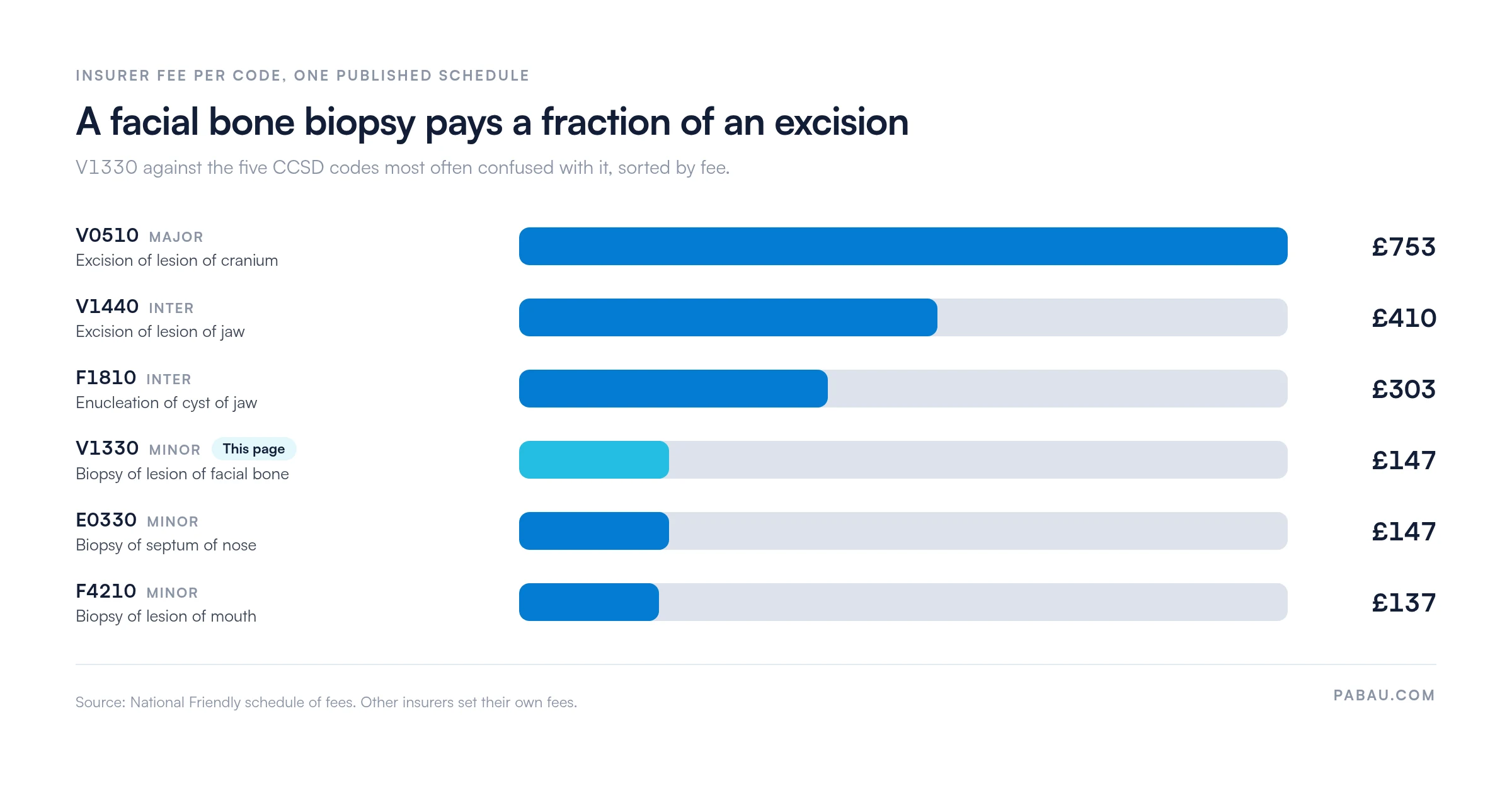
Several CCSD codes sit close to V1330, and the wrong choice is a common rejection. The usual error is billing V1330 for a soft-tissue biopsy where no bone was sampled. The fees below come from the National Friendly schedule of fees, one published insurer schedule.
Sorted by fee, the same codes show why the boundary matters. An excision of a jaw lesion pays almost three times a facial bone biopsy.
Before billing V1330, confirm that bone, not just the overlying mucosa, was the site of the biopsied lesion. When both are sampled, record which site gave the diagnostic specimen. Insurers check the histopathology report against the code, and a report describing only mucosa on a V1330 invoice invites a query.
A clean V1330 claim follows the same sequence each time. Missing pre-authorisation is the most preventable cause of non-payment. The steps below apply to the main UK insurers, though each insurer’s own rules take precedence.
CCSD sets the codes, and each insurer sets its own fees against them. The National Friendly schedule of fees lists V1330 as Minor complexity with a £147 fee. Bupa rates the code MINOR 3 in its Schedule of Procedures. AXA Health, Aviva, Vitality and WPA publish their own schedules, so check the patient’s insurer.
For Bupa’s side of the schedule, the Bupa CCSD codes guide explains how its procedure categories and fees fit together.
A consultant who charges more than the insurer pays leaves the patient with a shortfall. Tell the patient about it in writing before the procedure. When comparing UK medical billing software, check that it holds each insurer’s fee against the CCSD code.
An authorisation confirms the insurer expects to cover the treatment under the patient’s policy. It is not a promise of payment, because the invoice still has to match the code, the notes and the policy limits. The clinical letter for a V1330 request should include the following.
If the plan changes during surgery, for example to a full excision of the lesion, ask the insurer to update the authorisation before you invoice. An authorisation issued for V1330 does not cover V1440.
Run this checklist before you submit any V1330 claim. A missing item usually means the insurer writes back for more information, which delays payment.
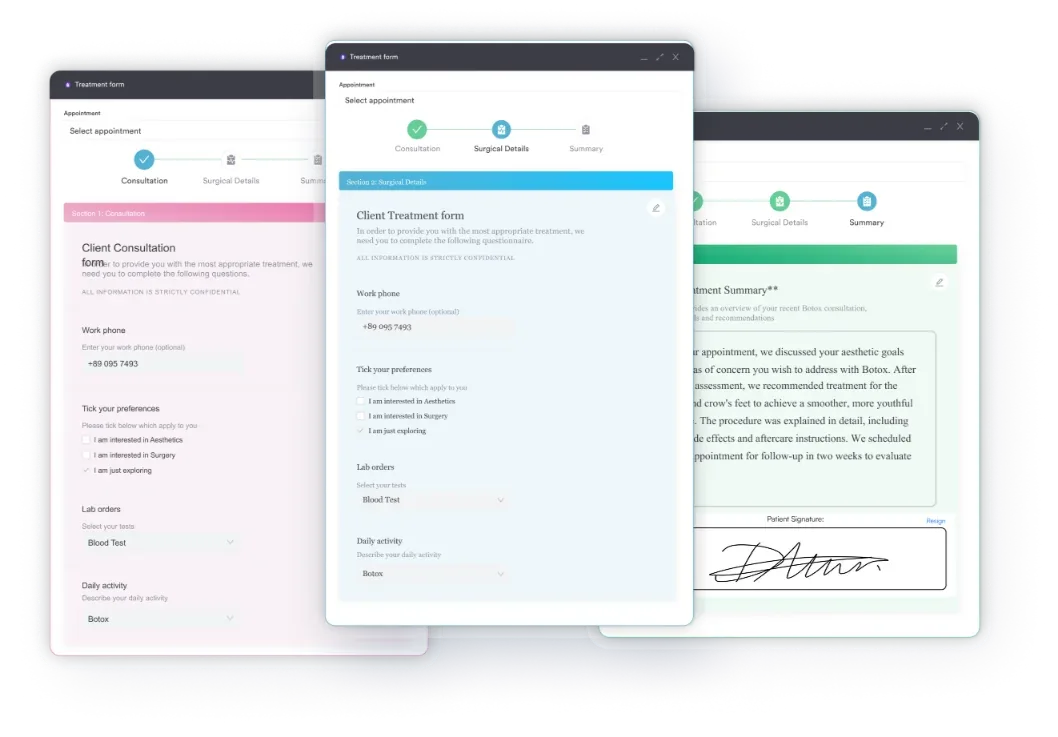
Pabau’s patient records hold imaging referrals, operative notes, lab reports and authorisation numbers in one chart. Its digital intake and consent forms capture the pre-operative history and consent before the patient arrives.
V1330 claims run into the same few problems across UK insurers. Most are preventable with accurate documentation before the procedure, not after the query arrives.
CCSD codes carry no modifiers, unlike US CPT codes. When V1330 is done in the same session as another procedure, the CCSD Schedule decides whether the pair can be billed together. Some combinations are listed as unacceptable because one procedure already includes the other.
Insurer rules on multiple procedures differ, and they change. Check the current guidance from Bupa, AXA Health, Aviva, Vitality or WPA before you submit a multi-code invoice.
Accurate V1330 billing depends on three things. You need the right code, complete documentation on the day of surgery and a claim that links diagnosis to procedure. Each one breaks down when the note, the lab report and the invoice live in different systems.
Pabau keeps all three in one patient record. Its claims management software sends CCSD-coded claims to UK insurers through Healthcode and Bupa, then tracks each claim on one dashboard. The authorisation code and dates sit on the patient’s case, with a warning when one is missing.
Set up a V1330 billing checklist in your practice management system. Include the code, the common WHO ICD-10 pairings (K09, K10, D16.5) and the documentation list above. It cuts claim preparation time and makes a missing histopathology report less likely.

Pabau helps UK oral and maxillofacial surgery practices keep operative notes, histopathology reports and authorisation references together, then sends CCSD-coded claims to insurers through Healthcode.

V1330 is a diagnostic code with a clear boundary. It pays for sampling a lesion of facial bone. It does not pay for a soft-tissue biopsy of the mouth or for removing the whole lesion. Most rejected V1330 claims come down to that boundary, not to the surgery.
So the claim rests on two lines in the operative note: which bone was sampled, and whether the lesion was sampled or removed. Write them plainly, match the authorisation to them and check the insurer’s own fee.
Book a demo to see how UK practices use Pabau to send CCSD claims through Healthcode with the note beside each one.

Choosing billing software for a UK practice? The best medical billing software in the UK compares the options for insurer claims.
Want fewer avoidable rejections? Medical billing compliance covers the checks that keep claims clean.
CCSD code V1330 covers biopsy of a lesion of facial bone, such as the mandible, maxilla or zygoma. Tissue is taken from the lesion and sent for histopathology. The code applies when bone, not just the overlying soft tissue, is the site of the sampled lesion.
CCSD is the procedure coding schedule for UK private healthcare. The CCSD Group, made up of Bupa, AXA Health, Aviva and Vitality, maintains it. Those insurers, WPA and others use it to assess consultants’ and anaesthetists’ invoices.
Insurers usually expect an authorisation number, the operative note, the imaging report and the histopathology report. The invoice also needs a WHO ICD-10 diagnosis code. Requirements vary by insurer, so check the patient’s policy before you submit.
Sometimes. CCSD codes carry no modifiers, and the CCSD Schedule lists combinations that cannot be billed together. Each insurer also sets its own rules on multiple procedures. If the whole lesion was removed at the same sitting, bill the excision code instead.
The usual reasons are a missing authorisation, a vague or US-only diagnosis code and a missing histopathology report. Another is billing V1330 when only soft tissue was sampled, which is F4210. A checklist run before submission prevents most of them.
V1330 is a biopsy of a lesion of facial bone. F4210 is a biopsy of a lesion of the mouth, used when only mucosa or oral soft tissue is sampled. When both are sampled, record which site gave the diagnostic specimen.