

CPT Code 52352: Ureteroscopic stone removal billing guide
CPT Code 52352: Official descriptor and procedure overview CPT Code 52352 descri...

Last Updated: Oct 30, 2026
F4230 is the CCSD code for removal of excess mucosa from mouth. It covers surgical excision of redundant soft tissue inside the mouth, such as hyperplastic folds beneath a denture flange. The code sits in chapter 6, Face, mouth, salivary and thyroid, under sub-chapter 6.5.0 Mouth cavity.
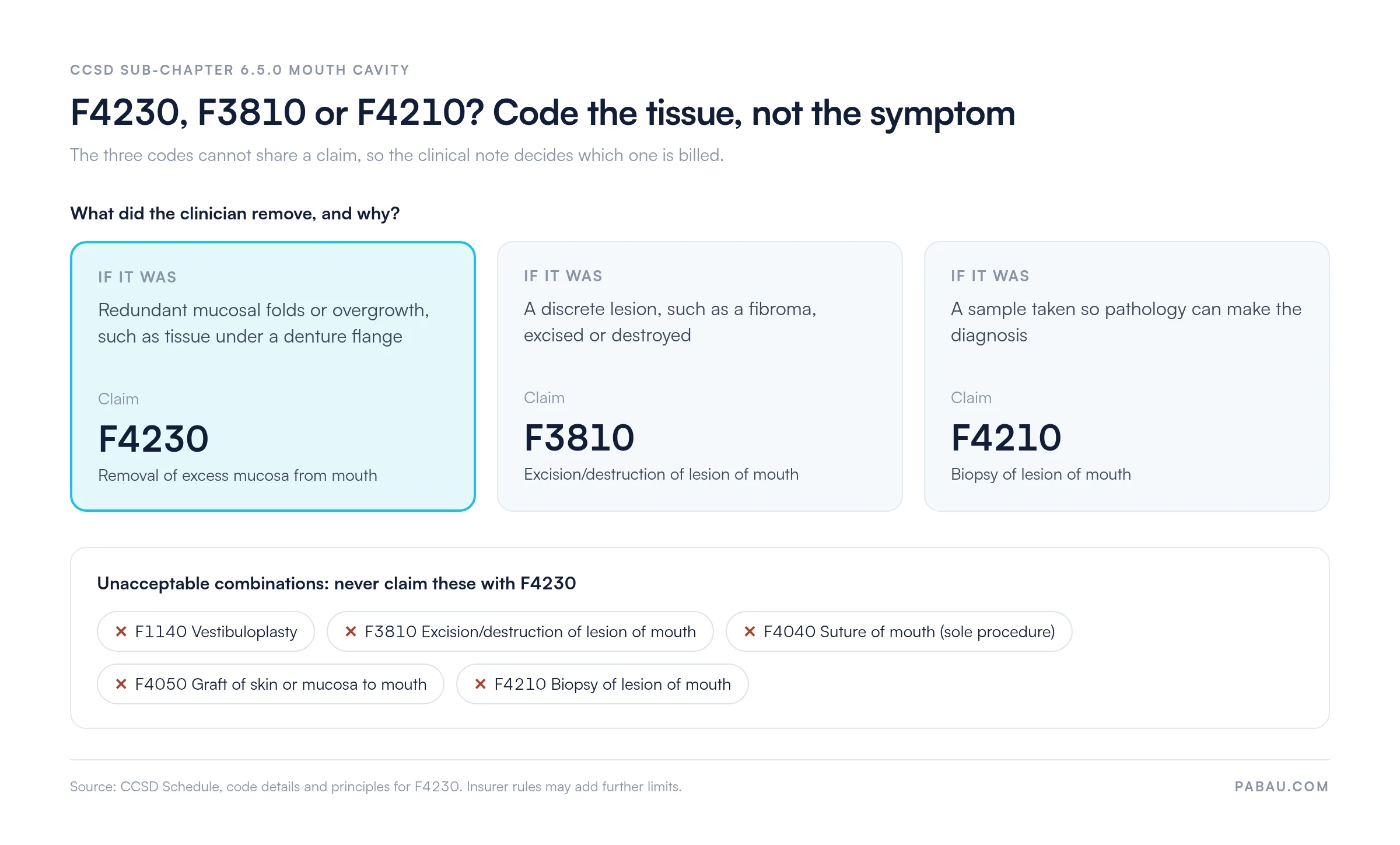
CCSD lists five codes that cannot be claimed with F4230: F1140, F3810, F4040, F4050 and F4210. A discrete lesion such as a fibroma is coded F3810 instead, and a diagnostic sample is coded F4210.
Let Pabau's smart automation suggest the right codes, reduce claim denials, and keep your practice compliant—effortlessly.
Automate repetitive tasks and focus on what matters most—your patients.
Reduce coding errors and ensure compliance with the latest regulations.
Clean claims, fewer denials, and faster reimbursements.
Powerful insights and reporting to help your practice thrive.
HIPAA compliant SOC 2 certified GDPR-compliant Trusted by 4,000+ clinics worldwide

CCSD Code F4230 covers surgical removal of excess oral mucosa, such as redundant folds or overgrowth, rather than a discrete lesion or a diagnostic sample.
A discrete lesion such as an irritation fibroma is usually coded F3810, and a biopsy is coded F4210, so the clinical note decides the code.
CCSD lists F1140, F3810, F4040, F4050 and F4210 as unacceptable combinations, so none of them can be claimed with F4230.
Many insurers require pre-authorisation, so check each insurer’s policy and the CCSD principles before treatment.
Missing clinical justification and the wrong code choice can both lead to an F4230 claim being queried or denied.
CCSD Code F4230 is the procedure code in the CCSD schedule for removal of excess mucosa from mouth. It applies when a dentist or oral surgeon surgically excises redundant mucosal soft tissue, usually under local anaesthesia. It does not cover periodontal surgery on gingival tissue, and it does not cover tissue sampling for diagnosis.
The CCSD (Clinical Coding & Schedule Development) group maintains the schedule, which UK private medical insurers use to identify procedures on claims. F4230 sits in sub-chapter 6.5.0 Mouth cavity, within chapter 6 of the CCSD procedure codes.
Bupa, AXA Health, Aviva, Cigna and WPA recognise CCSD codes, and many claims reach them through Healthcode. The official descriptor sets the scope tightly. The tissue removed must be excess mucosa, and the procedure must be a surgical excision rather than periodontal reshaping.
Removal of excess oral mucosa is a minor oral surgery procedure, most often performed under local anaesthesia in a dental chair or surgery room. The typical clinical sequence runs as follows.
The procedure is routinely completed in a single visit. Cases involving larger tissue volumes or anatomically complex sites may be referred to an oral surgeon or performed under sedation, which may attract additional codes.
F4230 is appropriate when excess oral mucosal tissue causes functional impairment, ulceration or hygiene difficulty, or stops a denture from fitting. The presentations that most often justify the code are listed below.
A discrete lesion is coded differently. An irritation fibroma is a single fibrous nodule, so its excision is usually coded F3810, excision/destruction of lesion of mouth. The two codes cannot share a claim. When excess folds and a separate lesion are treated at one visit, the note must support the code chosen.
Periodontal gingivectomy, diagnostic biopsy and frenectomy also fall outside F4230. Coding a periodontal gingivectomy under F4230 is miscoding.
The codes most often confused with F4230 are its neighbours in sub-chapter 6.5.0, and CCSD bars five of them from the same claim. The table below compares them.
The main confusion is between F4230 and F3810. Excess folds or overgrowth point to F4230, while a discrete lesion points to F3810. When a diagnostic sample is the goal, F4210 applies instead.
None of these codes can be claimed together with F4230, so the practice bills the one code that describes the main procedure. The diagram below maps each finding to its code.
The clinical record must support the medical necessity of the procedure and show why F4230 was the right code. Incomplete documentation can lead an insurer to reject an F4230 claim on audit. The record should include the following.
Pabau, the practice management platform we build for private practices, lets clinicians capture these fields in a structured note at the chairside. The record is complete before the patient leaves, rather than rebuilt later from memory.
Sending excised oral mucosal tissue for histopathology is best practice for most F4230 cases, although CCSD billing rules do not mandate it. The clinical and medico-legal position is as follows.
Submission is strongly advised for any lesion with atypical features. These include irregular margins, induration, colour change, a size over about 1 cm, or a site linked to squamous cell carcinoma risk. Epulis fissuratum specimens are often sent as well, to confirm the diagnosis and exclude dysplasia that clinical inspection can miss.
Professional record-keeping standards expect excised tissue to have a documented fate. The note should show either submission to pathology or a written clinical reason why the specimen was not sent.
An insurer reviewing an F4230 claim may ask whether the specimen went to pathology. If the tissue was not submitted, record the reason explicitly in the clinical note.
Document the specimen destination in the clinical notes on the day of the procedure. Write either the laboratory name and date of submission, or a one-sentence clinical justification for why the specimen was not sent. Insurers reviewing an F4230 claim may request this record. A contemporaneous note is far stronger than a retrospective explanation.
Many insurers require pre-authorisation before a surgical procedure such as F4230. The CCSD group does not decide reimbursement, so each insurer sets its own rules. Check each insurer’s policy and the CCSD principles before the procedure. A typical pre-authorisation runs as follows.
For Bupa claims, the Bupa code search portal shows the current requirements for each code. Our guide to Bupa CCSD codes explains how Bupa processes CCSD claims.
AXA Health, Aviva, Cigna and WPA each publish their own guidance for practitioners, so check the relevant portal before treatment. If the patient pays through a dental payment plan rather than private medical insurance, check with the plan provider whether F4230 is covered at all.
A complete F4230 claim submission requires the following elements in place before the claim is filed.
Tracking claims by spreadsheet is where queried claims get lost. Private practice claims software logs each claim’s status against the patient record and flags the ones still outstanding.
F4230 denials tend to follow a few patterns. Knowing them lets a practice fix the claim before submission rather than after rejection.
Submit appeals in writing within the insurer’s stated appeal window. Include the pre-authorisation reference, the clinical record and a short letter from the treating clinician on medical necessity. A denial based on thin documentation may be overturned once complete records are provided.
F4230 cannot be claimed with F1140, F3810, F4040, F4050 or F4210, which CCSD lists as unacceptable combinations. Other same-day pairings depend on the insurer, as the table shows.
Check the Cigna UK fee schedule or the relevant insurer fee schedule before filing combined claims. Insurer schedules set out which components sit inside a code, and following them avoids an automatic denial.
The CCSD schedule defines what F4230 describes, but it sets no fee. Each insurer publishes its own reimbursement rate and updates it on its own cycle. Verify the current rate in each insurer’s fee schedule rather than relying on last year’s figure.
Three points matter most when managing F4230 reimbursement.
At the start of each financial year, check the CCSD bulletins and download each insurer fee schedule you accept. Replace old fee-schedule PDFs in your billing records straight away. Billing F4230 at a previous year’s rate can result in underpayment that is hard to recover.
Many dental and oral surgery practices still write soft tissue excision notes as free text. The claim details are then rebuilt days later, which is when the lesion size, specimen destination or pre-authorisation reference goes missing.
Pabau lets clinicians set up an F4230 note template. It prompts for the diagnosis, the site and size of tissue removed, anaesthesia, specimen handling and aftercare advice on the day of treatment.
Claims then go to the insurer through Healthcode, and the team tracks each one against the patient record. Queried or unpaid F4230 claims stay visible until they are settled, with the insurer correspondence filed alongside the clinical note.

Pabau keeps the F4230 clinical note, specimen record and pre-authorisation reference in one patient record. Your team submits claims through Healthcode and tracks each one until it is paid.

Code the tissue, not the symptom. If the record describes excess mucosal folds or overgrowth, F4230 fits. A discrete lesion calls for F3810, and a diagnostic sample calls for F4210.
Because those codes cannot share a claim, the clinical note decides which one goes out. A good note names the tissue type, measures the site and states where the specimen went. That is the record an insurer asks for when it queries the claim.
Pre-authorisation and fees are left to each insurer, so confirm both before the procedure rather than after a denial. Book a demo to see how Pabau keeps F4230 notes, specimen records and Healthcode claims in one patient record.

Want to understand how Bupa processes CCSD claims? Bupa CCSD codes guide covers the Bupa procedure code schedule and its claim submission requirements for UK private practices.
Coding a discrete lesion instead? CCSD Code F3810 covers excision or destruction of a lesion of the mouth, the code most often confused with F4230.
Taking a diagnostic sample? CCSD Code F4210 explains how to code and document a biopsy of a lesion of the mouth.
Grafting tissue to the mouth? CCSD Code F4050 covers graft of skin or mucosa to the mouth and why it cannot share a claim with F4230.
Looking up another CCSD code? CCSD procedure codes hub lists the CCSD code guides for UK private practices in one place.
CCSD Code F4230 covers surgical removal of excess mucosal soft tissue from the mouth, such as denture-induced hyperplasia, epulis fissuratum folds and excess opercular tissue. A discrete lesion such as a fibroma is usually coded F3810, and a diagnostic biopsy is coded F4210.
F4230 covers excision of excess oral mucosal soft tissue arising from prosthetic irritation or trauma. A gingivectomy code covers surgical removal of gingival tissue as part of periodontal disease management. F4230 targets excess non-gingival mucosa, while gingivectomy targets diseased gingiva for pocket reduction or crown lengthening.
Common reasons are missing pre-authorisation, thin clinical justification, and the wrong code choice, such as F3810 where F4230 applies. Claiming an unacceptable combination, such as F4040 suturing alongside F4230, also leads to denials. A documentation-based denial may be overturned when complete records are supplied.
F4230 cannot be claimed with F1140, F3810, F4040, F4050 or F4210, which CCSD lists as unacceptable combinations. That rules out adding a biopsy or lesion excision of the same tissue. Suturing and local anaesthesia are generally inclusive, and a same-day consultation may be billable depending on the insurer.



