CCSD code F5010: Parotid duct transposition billing guide
CCSD code F5010 covers parotid duct transposition, one side or both CCSD code F5...

Last Updated: Oct 9, 2026
F3810 is the CCSD code for excision/destruction of lesion of mouth. It covers cutting out or destroying a lesion inside the mouth cavity. The code sits in Chapter 6, Face, Mouth, Salivary and Thyroid, under sub-chapter 6.5.0, Mouth cavity.
The most important billing fact is that CCSD lists seven unacceptable combinations with F3810, including biopsy, suture and graft of the mouth. Matching the code to the lesion's site and leaving those pairings off the claim keeps payment on track. Below, you'll see how to choose the code, document it, secure pre-authorization and appeal a denial.
Let Pabau's smart automation suggest the right codes, reduce claim denials, and keep your practice compliant—effortlessly.
Automate repetitive tasks and focus on what matters most—your patients.
Reduce coding errors and ensure compliance with the latest regulations.
Clean claims, fewer denials, and faster reimbursements.
Powerful insights and reporting to help your practice thrive.
HIPAA compliant SOC 2 certified GDPR-compliant Trusted by 4,000+ clinics worldwide

CCSD code F3810 covers excision or destruction of a lesion of the mouth, in sub-chapter 6.5.0, Mouth cavity.
CCSD lists seven unacceptable combinations with F3810, including F4210 biopsy and F4040 suture of the mouth.
Lesions on the lip, tongue or palate have their own codes, so confirm the exact site before you choose F3810.
Most insurers expect pre-authorization for surgical codes, so confirm it with the patient’s insurer before the procedure.
A procedure note that names the site, method and indication is your best defense against a query or denial.
CCSD code F3810 is the CCSD procedure code for excision/destruction of lesion of mouth. It sits in Chapter 6 of the schedule, Face, Mouth, Salivary and Thyroid. Within that chapter, it belongs to sub-chapter 6.5.0, Mouth cavity.
The descriptor covers two routes to the same outcome. The clinician either cuts the lesion out or destroys it in place. Both are billed as F3810, provided the lesion sits inside the mouth cavity.
The Clinical Coding and Schedule Development (CCSD) Group publishes the schedule. It sets the codes and their descriptors, while each insurer sets its own fee. As a result, the same F3810 procedure can pay differently under Bupa, AXA Health or Aviva. The CCSD technical guide explains how chapters and sub-chapters are organized.
Descriptors can change between schedule releases. So before you bill, check the current entry in the insurer’s code search or your CCSD login.
F3810 fits a lesion inside the mouth cavity. Neighboring sites have codes of their own, and a mismatch between note and code invites a query. Run through these quick questions first.
If the note leaves the site unclear, ask the clinician before you code. When none of these fit, browse our CCSD code library for the closer match.
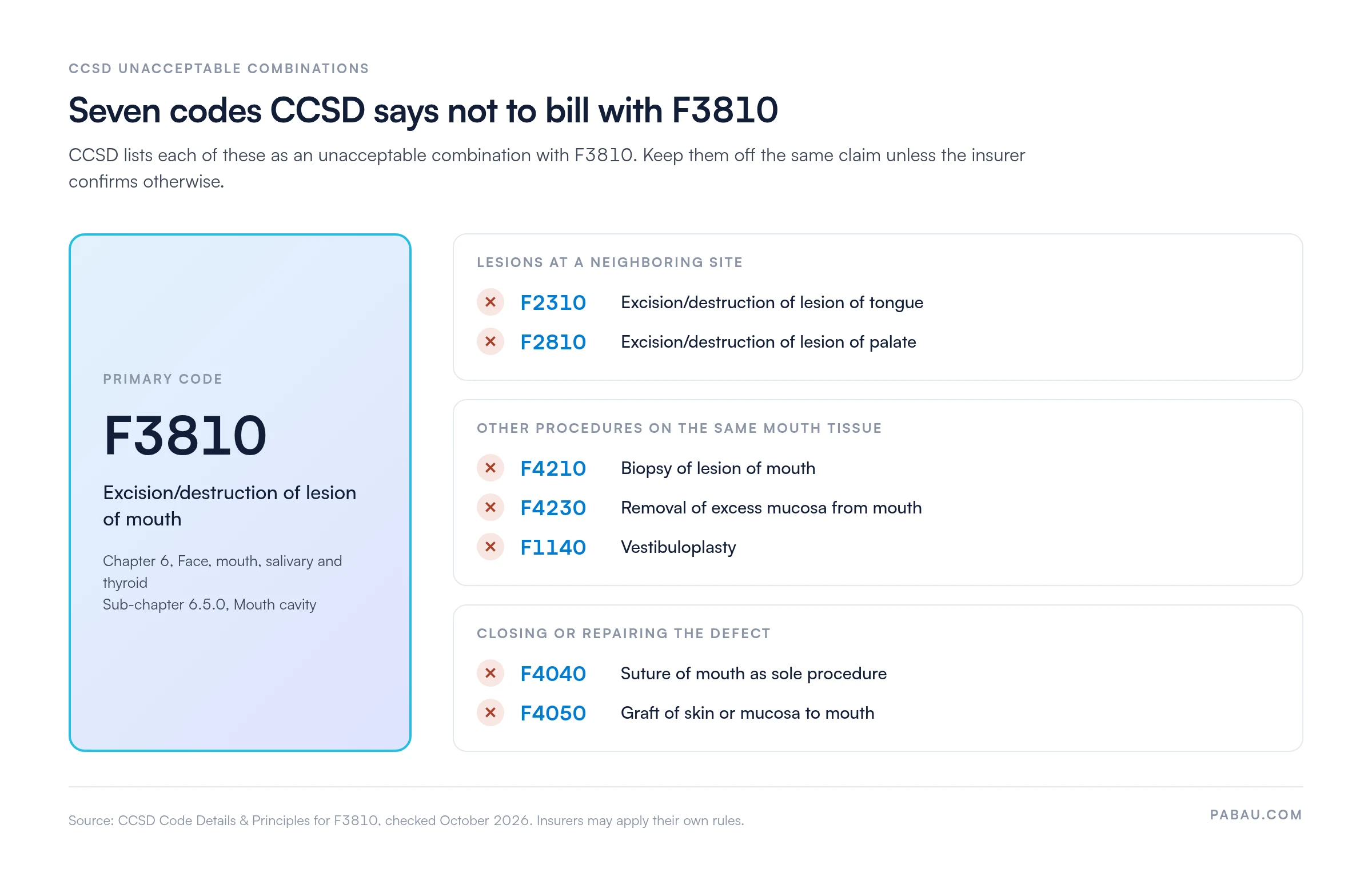
CCSD lists seven unacceptable combinations for F3810. These are F1140, F2310, F2810, F4040, F4050, F4210 and F4230. The principles are guidance, and each insurer decides whether to adopt them.
In practice, treat the list as a hard stop unless the insurer confirms otherwise in writing. The diagram below groups the seven codes by why they overlap with F3810.
Some charges sit outside the code and may still be billed separately. Whether they are depends on the insurer:
Insurers review records to check that the code matches the procedure performed. For F3810, the note should carry these details before the claim goes out:
The GMC expects clinical records to be clear, accurate and made at the time of care. That standard also protects the claim. If an insurer asks for records and the note is vague, payment usually waits for clinical review.
Pre-authorization is the insurer’s approval before treatment goes ahead. For surgical codes such as F3810, most UK insurers expect it. A claim without a required authorization is likely to be rejected, however sound the clinical case.
Requirements vary by insurer and by policy. The table below is a starting point only, so verify each case with the insurer.
When in doubt, treat pre-authorization as required. A phone call before the procedure date costs far less than an appeal afterward. Our guide to Bupa CCSD codes covers that insurer’s process in more detail.
Most CCSD claims go electronically, through Healthcode or the insurer’s own portal. Here is the usual path for an F3810 claim:
Processing times vary by insurer, and claims that need clinical review take longer. If a claim goes quiet, contact provider services with your submission reference.
Most rejections trace back to a short list of avoidable errors. Each one below comes with its fix.
Act quickly, because insurers set deadlines for reconsideration. The denial letter or the insurer’s provider terms will state yours.
Keep a denial log for F3810 and the other CCSD codes you bill often. If one reason appears twice in a quarter, fix the step in your workflow that causes it.
Many practices still copy procedure details from the clinical note into a separate claim form. Each re-keyed field is another chance for the site, date or policy number to drift.
Pabau, the practice management platform we build, keeps the note, the invoice and the insurer claim on one patient record. Its claims management software pre-fills each claim with patient, treatment and insurer details. In the UK, claims then go to Healthcode electronically, without double entry.
Before a claim is sent, background checks confirm that details such as membership numbers and authorization codes are filled in. Afterward, each claim moves through clear stages, from pending to paid. So when an insurer queries an F3810 claim, your team can see where it stands and why.

Pabau pre-fills insurer claims from the patient record and submits them to Healthcode, so your team stops re-keying details. Validation checks flag missing membership numbers and authorization codes before a claim goes out.

Most F3810 problems are settled before the claim is ever written. The code itself is simple. The risk sits in the site, the pairings and the authorization.
So build those three checks into the booking and the note, not the billing desk. A few minutes spent before the procedure is cheaper than any appeal afterward.
Book a demo to see how Pabau links the note, invoice and insurer claim, so your F3810 claims go out complete.

Billing Bupa patients for mouth procedures? Bupa CCSD codes explains how Bupa uses the schedule and what it expects from providers.
Removing a lesion from the lip instead? CCSD code F0200: excision of lesion of lip covers the neighboring lip code.
Coding lesion removal elsewhere on the face? CCSD code E0910: excision of lesion of external nose walks through a similar lesion code.
Working across eyelid procedures too? CCSD code C1210: excision of eyelid lesion covers the eyelid equivalent.
Looking for another CCSD code? The CCSD code library lists every CCSD code guide we publish.
No. F3810 covers the excision or destruction itself. Examining the removed tissue is usually billed separately by the laboratory or pathologist, under their own arrangement with the insurer.
No, the procedure code stays F3810. Where an anesthetist attends, they usually invoice separately using their own fee arrangement with the insurer.
Rules for multiple lesions vary by insurer. Ask the insurer before the procedure, and record each lesion’s site in the note.
CCSD codes are used across UK private healthcare, by insurers and administrators such as Bupa, AXA Health, Aviva, Vitality, WPA and Healix. Cover for F3810 depends on the patient’s policy, so check benefit and pre-authorization each time.
No. Pabau pre-fills claims from the patient record and checks required fields before sending. Choosing the code stays with your clinician and billing team.