HCPCS Code Q4175: Billing, coverage, and documentation guide
HCPCS Code Q4175: Code Description and Product Identity HCPCS Code Q4175 is the ...

Last Updated: Nov 20, 2026
F2810 is the CCSD code for excision/destruction of lesion of palate. It covers removing a lesion from the hard or soft palate. The surgeon either cuts the lesion out or destroys it in place, for example with cryotherapy, laser or electrocautery.
The code sits in Chapter 6 of the CCSD schedule, sub-chapter 6.4.0, Palate. UK private insurers such as Bupa, AXA Health, Aviva and Vitality each pay it at their own fee, and most expect pre-authorization first.
Let Pabau's smart automation suggest the right codes, reduce claim denials, and keep your practice compliant—effortlessly.
Automate repetitive tasks and focus on what matters most—your patients.
Reduce coding errors and ensure compliance with the latest regulations.
Clean claims, fewer denials, and faster reimbursements.
Powerful insights and reporting to help your practice thrive.
HIPAA compliant SOC 2 certified GDPR-compliant Trusted by 4,000+ clinics worldwide

CCSD code F2810 covers excision or destruction of a lesion of the palate, in Chapter 6, sub-chapter 6.4.0, Palate.
CCSD is the UK private healthcare schedule, so F2810 is billed to insurers such as Bupa, AXA Health, Aviva and Vitality.
F2810 has a long list of unacceptable combinations, including F3810, F4210, F3070 and the tonsillectomy codes.
Lesions on the tongue, lip or elsewhere in the mouth have their own codes, so confirm the exact site first.
Confirm pre-authorization with the patient’s insurer before the procedure, and record the reference on the case.
CCSD code F2810 is the CCSD procedure code for excision/destruction of lesion of palate. AXA Health’s Chapter 6 code list files it under Chapter 6 of the schedule, Face, mouth, salivary and thyroid. Within that chapter, it belongs to sub-chapter 6.4.0, Palate.
The descriptor covers two routes to the same outcome. The surgeon either cuts the lesion out or destroys it in place. Both are billed as F2810, provided the lesion sits on the hard or soft palate.
The Clinical Coding and Schedule Development (CCSD) Group publishes the schedule for UK private healthcare. Its members are Bupa, Vitality, AXA Health and Aviva. The schedule sets the codes and descriptors, while each insurer sets its own fee. The CCSD technical guide explains how chapters and sub-chapters are organized.
F2810 is a consultant procedure code. It is billed by GMC-registered consultants and surgeons who are recognized by the patient’s insurer, such as oral and maxillofacial or ENT surgeons. Descriptors can change between schedule releases, so check the current entry in your CCSD login or the insurer’s code search before you bill.
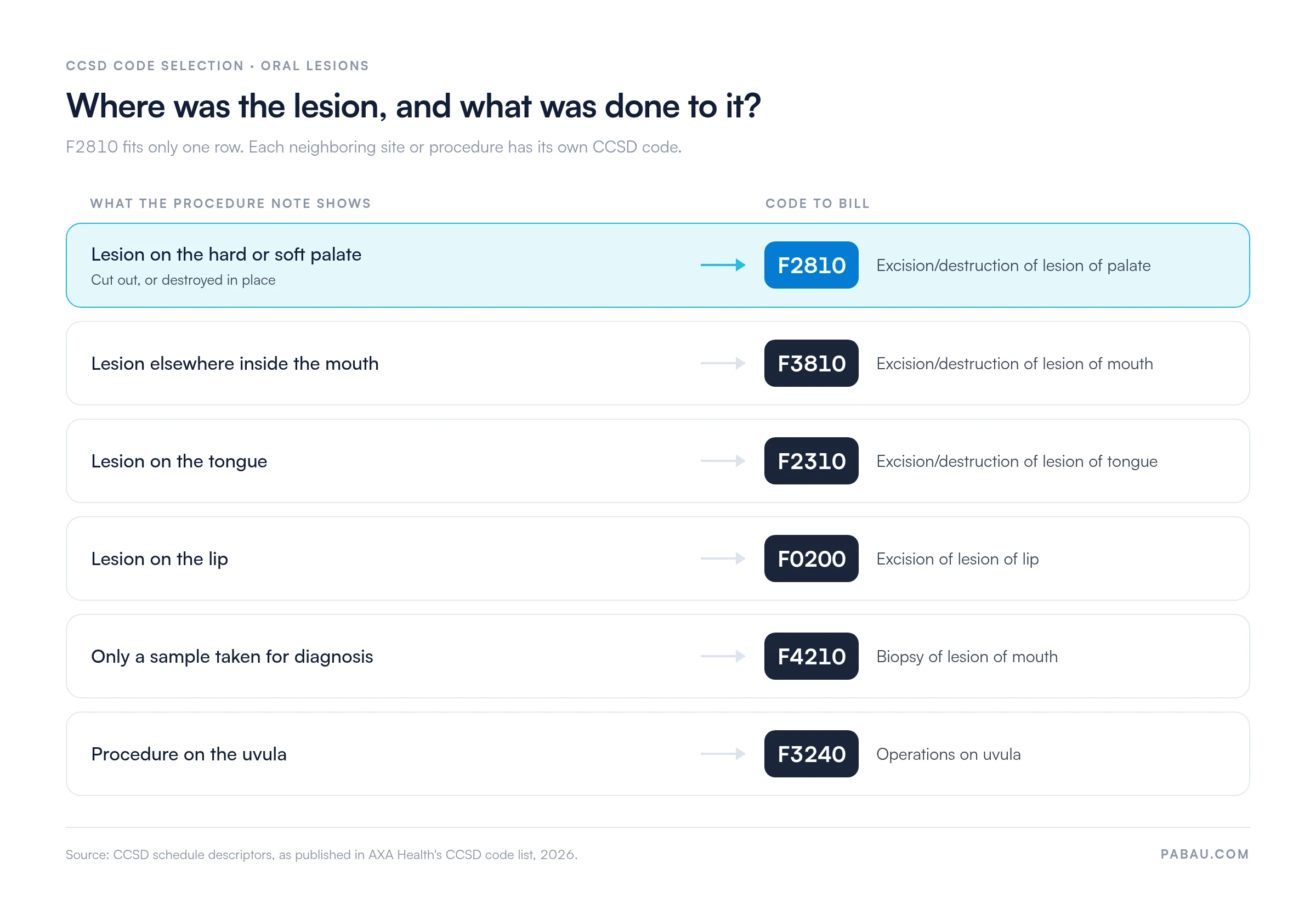
F2810 fits a lesion on the palate. Neighboring sites have codes of their own, and a mismatch between note and code invites a query. Run through these quick questions first.
If the note leaves the site unclear, ask the surgeon before you code. When none of these fit, browse our CCSD code library for a closer match. The chart below sets F2810 beside its five neighbors.
The two methods share one code, but they leave different records behind. That difference matters when an insurer reviews the note.
Excision removes the lesion in full, usually with a margin of healthy tissue. The surgeon closes the wound and sends the specimen for histology. It is the usual choice when the diagnosis is uncertain or malignancy must be excluded.
Destruction eliminates the lesion without removing it, for example with cryotherapy, laser or electrocautery. No specimen is retrieved, so the note should record why histology was not needed.
Name the destruction method in the procedure note, such as cryotherapy, CO2 laser or electrocautery. A bare reference to destruction gives a reviewer nothing to check the code against.
CCSD lists F2810 as an unacceptable combination with neighboring palate, mouth and throat codes. The CCSD principles pages for F3810, F4210 and F2920 all cite F2810. AXA Health’s specialist code list for Chapter 6 publishes the full set it applies to F2810.
The F2920 descriptor comes from CCSD’s own principles page, since AXA Health’s list does not show that code. CCSD says the combinations are guidelines and not exhaustive, and each insurer decides whether to adopt them. In practice, treat the list as a hard stop unless the insurer confirms otherwise in writing.
Some charges sit outside the code and may still be billed separately, depending on the insurer. These include an anesthetist’s own fee and the laboratory’s charge for histology.
The UK records diagnoses in the WHO edition of ICD-10, not the US ICD-10-CM. Where an insurer asks for a diagnosis, these codes cover the palate lesions most often removed. Confirm each one in the WHO ICD-10 browser.
Code the diagnosis the note supports on the day. If histology later changes it, update the record before the claim goes out. Free lookup tools often show the US ICD-10-CM, so check each code against the WHO browser for UK claims.
Insurers review records to check that the code matches the procedure performed. For F2810, the note should carry these details before the claim goes out:
The GMC expects clinical records to be clear, accurate and made at the time of care. That standard also protects the claim. If an insurer asks for records and the note is vague, payment usually waits for clinical review.
Pre-authorization is the insurer’s approval before treatment goes ahead. For surgical codes such as F2810, most UK insurers expect it. A claim without a required authorization is likely to be rejected, however sound the clinical case.
Requirements vary by insurer and by policy, so treat this list as a starting point:
When in doubt, treat pre-authorization as required. A phone call before the procedure date costs far less than an appeal afterward. Our guide to Bupa CCSD codes covers that insurer’s process in more detail.
Most CCSD claims go electronically, through Healthcode or the insurer’s own portal. Each insurer pays F2810 at its own fee, so there is no single national rate. Here is the usual path:
If a claim is rejected, get the reason in writing and answer it with the note, referral and pre-authorization. Send it through the insurer’s formal appeals route, within the deadline its provider terms set.
Keep a denial log for F2810 and the other CCSD codes you bill often. If one reason appears twice in a quarter, fix the step in your workflow that causes it.
Many practices still keep insurer authorizations in emails, spreadsheets or paper files. When a claim is queried months later, nobody can find the reference that approved the procedure.
Pabau, a practice management platform, tracks authorization codes, dates and sessions on the patient’s case. The procedure note sits on the same record. So when an insurer queries an F2810 claim, your team can see what was approved and when. Choosing the CCSD code stays with your surgeon and billing team. Read more about claims management in Pabau.
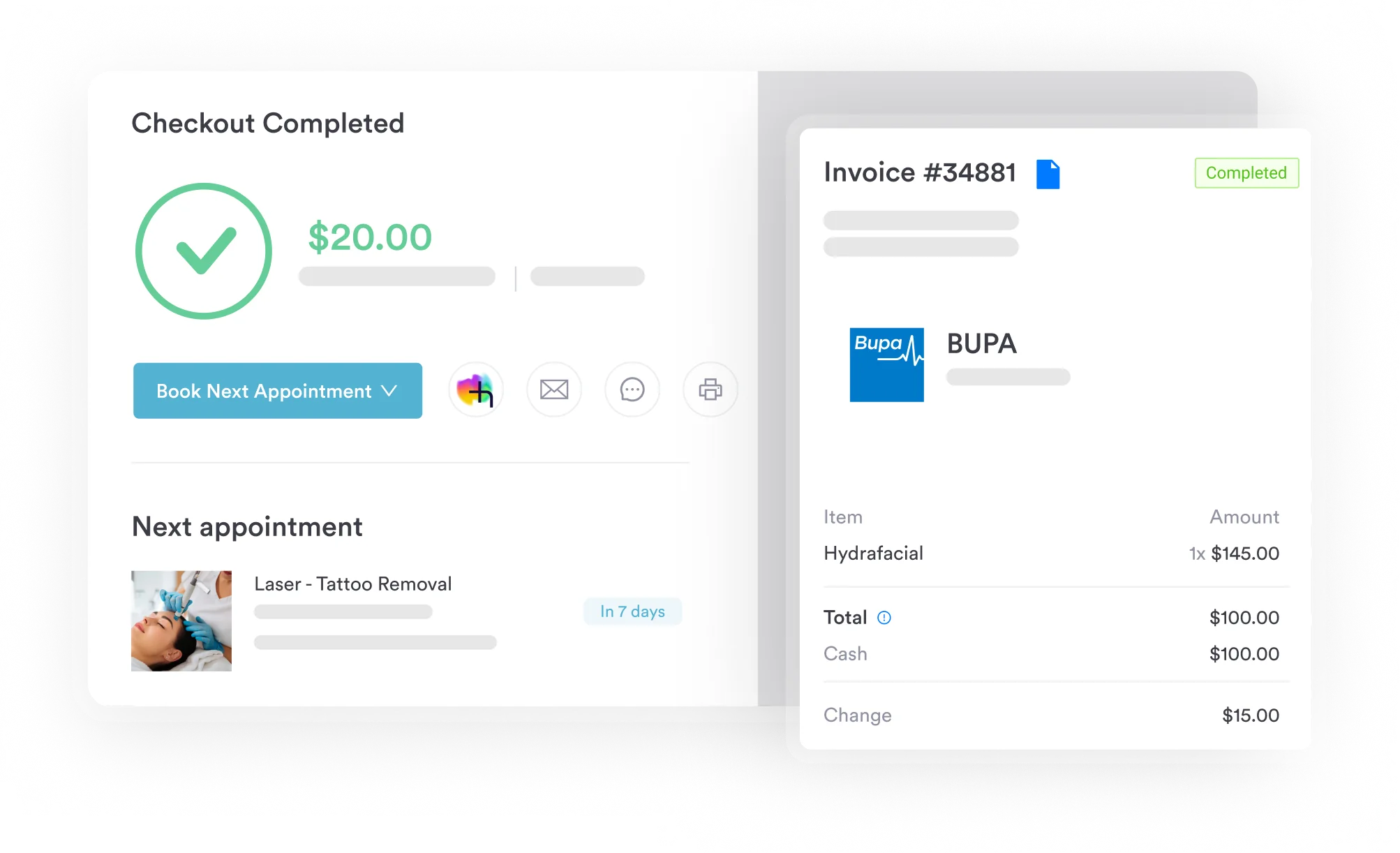

Pabau tracks authorization codes, dates and sessions on the patient’s case, so your team can answer an insurer query about an F2810 claim in minutes.

Most F2810 problems are settled before the claim is ever written. The code itself is simple. The risk sits in the site, the long list of blocked pairings and the authorization.
So build those three checks into the booking and the note, not the billing desk. A few minutes spent before the procedure cost less than any appeal afterward.
Book a demo to see how Pabau keeps authorization codes, dates and sessions on each patient’s case.

Removing a lesion elsewhere in the mouth? CCSD code F3810: excision/destruction of lesion of mouth covers the neighboring mouth code.
Coding a tongue lesion instead? CCSD code F2310: excision/destruction of lesion of tongue explains the tongue equivalent.
Closing a palate wound on its own? CCSD code F3070: suture of palate covers the suture code in the same sub-chapter.
Billing Bupa patients for mouth procedures? Bupa CCSD codes explains how Bupa uses the schedule and what it expects from providers.
Looking for another CCSD code? The CCSD code library lists every CCSD code guide we publish.
F2810 covers excision or destruction of a lesion of the hard or soft palate. Both methods are billed under the one code, and the note should state which method was used.
No. CCSD lists F4210, biopsy of lesion of mouth, as an unacceptable combination with F2810. The same applies to F3810 and to suture of palate, F3070.
No. F2810 covers the excision or destruction itself. Examining the removed tissue is usually billed separately by the laboratory or pathologist, under their own arrangement with the insurer.
CCSD codes are used across UK private healthcare, by insurers such as Bupa, AXA Health, Aviva, Vitality and WPA. Each insurer sets its own fee, so check cover and pre-authorization for each patient.
Usually, yes. Most UK private insurers expect pre-authorization for surgical codes such as F2810. Confirm it with the patient’s insurer before the procedure, and record the reference on the case.
No. Pabau tracks authorization codes, dates and sessions on the patient’s case. Choosing the code stays with your surgeon and billing team.