CPT Code 62284: Injection procedure for myelography
CPT Code 62284: official descriptor and procedure overview The American Medical ...

Last Updated: Oct 19, 2026
E5703 is the CCSD code for thoracotomy bullectomy – bilateral +/– pleurodesis. It covers open surgery that removes bullae from both lungs in one operative episode, with any pleurodesis at the same sitting included in the code.
Approach and laterality decide whether it applies. A VATS operation or a one-lung bullectomy takes a different CCSD code, and a same-sitting pleurodesis is never billed as a separate line.
Let Pabau's smart automation suggest the right codes, reduce claim denials, and keep your practice compliant—effortlessly.
Automate repetitive tasks and focus on what matters most—your patients.
Reduce coding errors and ensure compliance with the latest regulations.
Clean claims, fewer denials, and faster reimbursements.
Powerful insights and reporting to help your practice thrive.
HIPAA compliant SOC 2 certified GDPR-compliant Trusted by 4,000+ clinics worldwide

CCSD code E5703 covers open bilateral thoracotomy bullectomy, not a unilateral or VATS approach.
Pleurodesis performed at the same operative sitting is captured within E5703 and must not be billed separately.
Missing pre-authorization from the insurer before the procedure is a common reason for outright claim rejection.
Pabau’s claims management software helps UK private practices track pre-auth references, attach operative documentation, and submit CCSD-coded invoices to insurers.
CCSD code E5703 is defined by the Clinical Coding and Schedule Development Group as “thoracotomy bullectomy – bilateral +/- pleurodesis.” Every word in that descriptor carries billing significance. Thoracotomy specifies an open surgical approach.
Bullectomy bilateral means bullae are excised from both lungs in the same operative episode. The +/- pleurodesis clause means pleurodesis, when performed, is captured within this code and does not attract a separate billing line.
That clause is newer than many billing templates. CCSD added “+/- pleurodesis” to the E5703 narrative in August 2024. A template built on the older “Thoracotomy bullectomy – bilateral” wording may still prompt a separate pleurodesis line.
Knowing the full scope prevents two expensive coding errors. The first is using E5703 for a video-assisted thoracoscopic surgery (VATS) approach. The second is adding a standalone pleurodesis code on the same claim.
A bilateral bullectomy via open thoracotomy addresses disease in both lungs during a single anesthetic episode. The surgeon makes standard posterolateral thoracotomy incisions on each side, identifies the bullae, and excises them using stapling devices or suture techniques. The operative sequence matters for documentation purposes.
The operative note must confirm bilateral approach and bulla excision. Insurers will reject claims where the note only documents one side or uses the word “thoracoscopic.”
E5703 applies when bilateral lung pathology requires open surgical intervention. The two principal indications are recurrent bilateral spontaneous pneumothorax and bilateral bullous emphysema with significant hemodynamic or respiratory compromise.
The responsible clinician assigns the ICD-10 diagnostic code. Billing teams must not select or alter diagnostic codes independently. Pre-operative CT chest imaging and pulmonary function test results support the medical necessity argument insurers require.
CCSD code E5703 sits within the thoracic surgery chapter alongside several codes that share similar procedural language. Selecting the wrong code is a common reason for upcoding allegations and insurer audits. The critical distinctions are surgical approach (open vs thoracoscopic) and laterality (bilateral vs unilateral), and the grid below pairs each combination with its code.
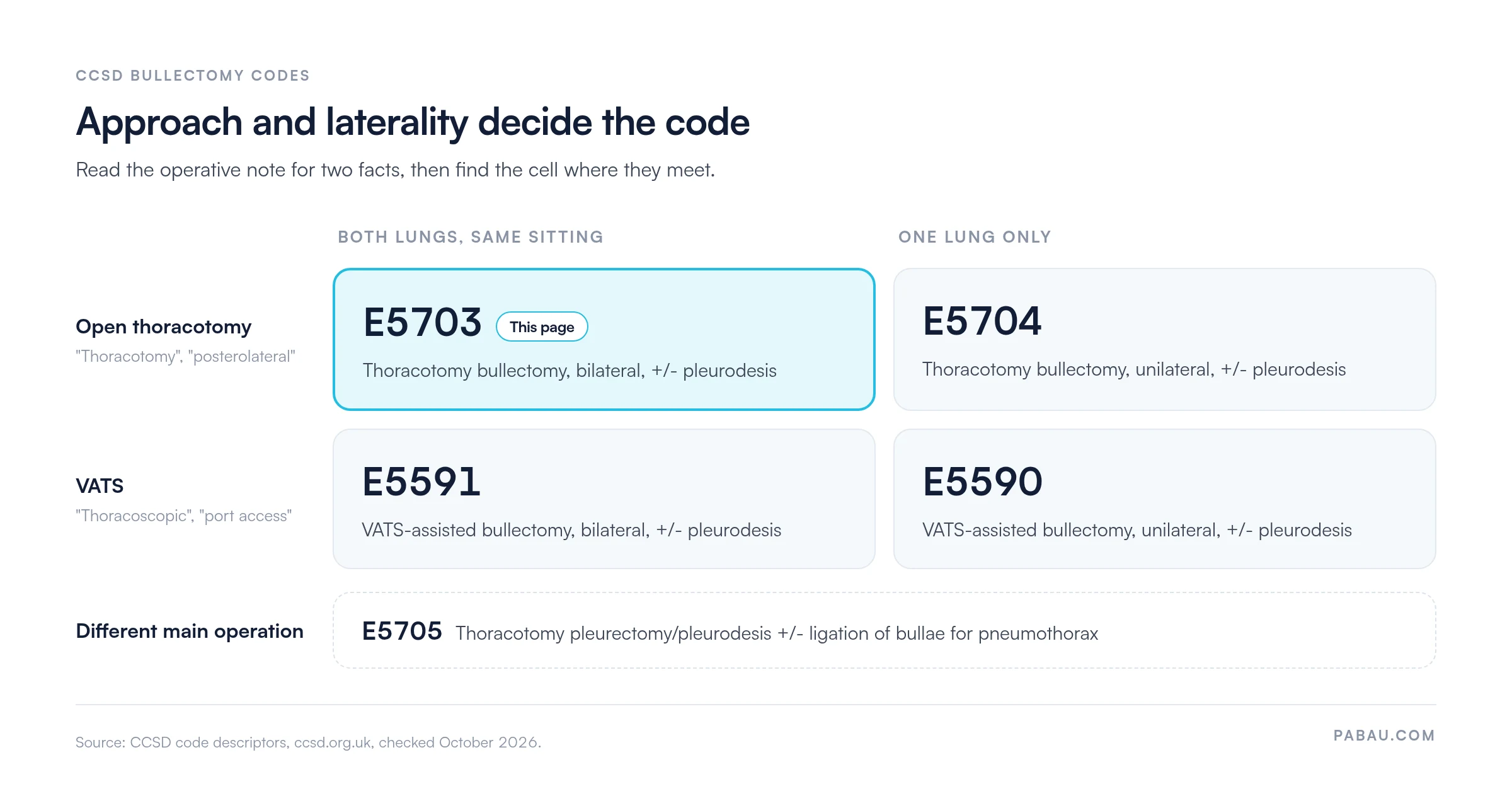
If the note describes one lung only, the open-approach code is E5704. When pleurectomy or pleurodesis for pneumothorax is the main operation, E5705 is the closer match.
Descriptors in this table match the CCSD schedule as checked in October 2026. Verify them against the current CCSD Technical Guide before submitting, because narratives change between editions. For thoracic codes outside the bullectomy family, use the CCSD code index. For Bupa-specific lookups, refer to the Bupa CCSD code guide.
Using E5703 for a VATS bullectomy may constitute upcoding because VATS carries a distinct CCSD code reflecting the thoracoscopic approach. Payers treat open thoracotomy and VATS as different procedures. Open thoracotomy involves a larger incision, longer anesthetic time, greater post-operative morbidity, and a longer inpatient stay. Billing VATS as an open thoracotomy code inflates the claim above what the procedure warrants.
The operative note is the definitive record. If it states “thoracoscopic,” “VATS,” “port access,” or “minimally invasive,” E5703 does not apply. A bilateral VATS bullectomy is coded E5591, and the one-lung version is E5590.
No. When pleurodesis is performed during the same operative sitting as the bilateral bullectomy, it is captured within CCSD code E5703. The +/- notation in the official descriptor signals this. The code covers the bullectomy with or without pleurodesis, and the reimbursement value already accounts for the additional step.
Billing a standalone pleurodesis code alongside E5703 for the same date of service constitutes unbundling. That will trigger claim rejection and may result in an audit.
One legitimate exception applies. If pleurodesis is performed as a staged, standalone procedure on a different date from the bullectomy, a separate pleurodesis code may be appropriate. Confirm with the insurer before submitting in that scenario.
Insurers validate E5703 against the operative note. A note that omits any of the following elements gives the payer grounds to reject, query, or reduce payment. Thoracic surgical teams and billing coordinators should run a structured post-operative documentation checklist before a claim is submitted.
Pre-operative documentation supporting medical necessity must also be filed with the claim. This includes a CT chest report confirming bilateral bullous disease, pulmonary function test results, the consultant referral letter, and the signed anesthetic assessment. Without these, insurers will query the clinical justification even if the code selection is correct.
All major UK private medical insurers require pre-authorization before elective thoracic surgery. Submitting an E5703 claim without a valid pre-auth reference number is the fastest route to a zero-payment outcome. Requirements and time limits vary by insurer, so check each payer’s provider guidance before any procedure.
In a UK private practice, the pre-auth check belongs in the booking workflow, before the theater date is confirmed. The table below reflects general expectations as of publication.
All pre-auth data in this table reflects general industry expectations as of early 2026. Verify current requirements with each insurer before any procedure. Requirements change, and individual policies may impose additional conditions.
E5703 rejections usually trace back to a short list of documentation or code-selection errors. Billing teams see the same patterns again and again with complex thoracic procedures.
Some ancillary procedures and post-operative services attract separate codes alongside E5703. Others are bundled and cannot be billed independently. Claiming a bundled service creates unbundling risk, while missing a legitimately separate service leaves revenue unclaimed.
Review the operative note before building the claim. Confirm whether any ancillary procedure (pleurodesis, drain) occurred at the same sitting or on a different date. Same-sitting services are almost always bundled into E5703, and different-date services usually attract their own code. When in doubt, call the insurer’s provider line before submitting.
Private hospital billing teams and independent consultant rooms follow broadly the same sequence for CCSD code E5703 submissions. Using medical billing software that supports CCSD code submission cuts manual errors at each step.
In many UK private practices, an E5703 claim is assembled from several places. The pre-auth reference sits in an email, the operative note in a hospital system, and the CCSD code in a spreadsheet. Each handoff is a chance to drop the bilateral confirmation or add a pleurodesis line.
Pabau, the practice management and billing platform we build, keeps those pieces on the patient record. The pre-auth reference, the operative documentation and the CCSD-coded invoice sit together. Your billing team can check them against each other before the claim goes to the insurer.
The outcome is fewer claims returned for missing documents, and a clear view of which E5703 invoices are still waiting on payment.

Pabau helps UK private practices attach pre-auth references, submit CCSD-coded invoices, and track claim status across Bupa, AXA Health, and Aviva from one place.

Code E5703 only when the operative note proves two facts. The surgeon used an open thoracotomy, and bullae came out of both lungs in one sitting. If either fact is missing, the claim belongs under a neighboring code, and the insurer will spot it in the note.
Checking the note, the pre-auth reference and the bundled pleurodesis takes minutes before submission. Unpicking a rejected claim afterward costs your team far more time.
Book a demo to see how Pabau carries an E5703 claim from operative note to insurer payment.

Need a starting point for Bupa-specific CCSD code queries? Bupa CCSD code guide covers the code lookup process and common Bupa billing requirements for UK private practice.
Billing a bilateral VATS procedure instead? CCSD code E5593 covers bilateral VATS lung volume reduction and how it differs from a bullectomy claim.
Coding an open chest operation for diagnosis rather than treatment? CCSD code E5532 explains how thoracotomy and lung biopsy are billed.
Working on a thoracotomy for an air leak? CCSD code E4722 covers thoracotomy and closure of a bronchopleural fistula.
Is the lung resection extending into the chest wall? CCSD code E5480 explains how lung resection with chest wall resection is coded.
CCSD code E5703 is the billing code for thoracotomy bullectomy bilateral, with or without pleurodesis. It applies when a surgeon performs an open bilateral thoracotomy to excise bullae from both lungs in a single operative episode. Any pleurodesis at the same sitting is captured within the code rather than billed separately.
Pleurodesis is always captured within E5703 when performed at the same operative sitting as the bilateral bullectomy. The +/- notation means the code applies whether or not pleurodesis is performed. Billing a separate pleurodesis code for the same date of service constitutes unbundling. If pleurodesis is performed as a staged standalone procedure on a different date, a separate code may be appropriate.
No. E5703 specifies open thoracotomy as the surgical approach. A bilateral VATS (video-assisted thoracoscopic surgery) bullectomy is coded E5591, and a unilateral one is E5590. Using E5703 for a VATS procedure may constitute upcoding, and insurers who cross-reference the operative note against the billed code will typically reject it.
Use E5704 for an open bullectomy on one lung, and E5591 or E5590 for a bilateral or unilateral VATS bullectomy. When pleurectomy or pleurodesis for pneumothorax is the main operation, E5705 is the closer match. Use E5703 only when the operative note confirms open thoracotomy and bilateral excision in the same sitting. Verify all descriptors against the current CCSD Technical Guide before submitting.
Common rejection reasons include a missing pre-authorization reference, a VATS approach coded as open thoracotomy, and a separate pleurodesis line creating unbundling. An operative note that does not explicitly confirm bilateral surgery is another. Submitting the claim outside the insurer’s time limit also leads to rejection.
Recurrent bilateral spontaneous pneumothorax (J93.1) and bilateral bullous emphysema (J43.9) are the diagnostic codes most often submitted alongside E5703. The responsible clinician must assign the ICD-10 code based on the confirmed diagnosis. Billing teams should not select diagnostic codes independently.