CCSD code F3070: Suture of palate billing guide
CCSD code F3070 covers stitching a wound in the palate CCSD code F3070 is the co...

Last Updated: Oct 12, 2026
E5705 is the CCSD code for an open thoracotomy with pleurectomy or pleurodesis, with or without ligation of bullae, for pneumothorax. Surgeons use it when a collapsed lung keeps coming back, or when an air leak won't settle with a chest drain.
The approach decides the code. A keyhole VATS operation takes a different code, so the operative note has to show an open incision. If it doesn't, the claim won't match the pre-authorization and payment stalls. The sections below cover blocked code pairs, the records insurers ask for and a checklist to run before you submit.
Let Pabau's smart automation suggest the right codes, reduce claim denials, and keep your practice compliant—effortlessly.
Automate repetitive tasks and focus on what matters most—your patients.
Reduce coding errors and ensure compliance with the latest regulations.
Clean claims, fewer denials, and faster reimbursements.
Powerful insights and reporting to help your practice thrive.
HIPAA compliant SOC 2 certified GDPR-compliant Trusted by 4,000+ clinics worldwide

CCSD code E5705 covers an open thoracotomy with pleurectomy or pleurodesis, with or without ligation of bullae, to treat a pneumothorax.
The code sits in section 8.5.0 of the schedule, Bronchi/Lungs/Pleura, with a MAJOR+ 3 complexity band.
Check the schedule’s unacceptable combinations before you add a second code, such as a VATS pleurodesis or chest drain code.
Pre-authorize the admission, then keep the operative note, consent and imaging on file before the claim goes in.
Before you submit, confirm that the code, the authorization number and the operative note all describe the same open operation.
CCSD code E5705 is the code for a thoracotomy with pleurectomy or pleurodesis, with or without ligation of bullae, for pneumothorax. The surgeon opens the chest, then either strips the parietal pleura or treats the pleural surfaces so the lung stays stuck to the chest wall.
Surgery like this usually follows a pneumothorax that keeps coming back, or an air leak that won’t settle with a chest drain. Ligating bullae deals with the blisters on the lung surface that tend to cause the leak. Because the descriptor includes that step, it doesn’t need a code of its own.
E5705 belongs to the Clinical Coding and Schedule Development (CCSD) schedule that UK private medical insurers use for procedures. Insurers such as Bupa, AXA Health, Aviva and Vitality share the codes, but each one sets its own fee. Our Bupa fee schedule guide shows how one insurer groups its fees.
The CCSD schedule describes E5705 as “Thoracotomy pleurectomy/pleurodesis +/- ligation of bullae for pneumothorax.” The code was added on January 20, 2010. Each part of that wording shapes what the operative note has to show.
You can browse neighboring thoracic codes in our CCSD codes by chapter index. For an open lung biopsy instead, the code is E5532. The complexity band places E5705 among the larger chest operations, and many insurers use bands like this to group fees.
The CCSD schedule lists unacceptable combinations for E5705. These codes describe the same operation, a different route to it, or a step already included in it. Billing one of them on the same claim can get the line rejected.
The list also blocks the robotic bullectomy codes E5707 and E5708, plus needle biopsy of the lung and of the pleura. Check the schedule entry before you add any second thoracic code, because the combination rules change over time.
Say a surgeon books a VATS pleurectomy for a recurrent pneumothorax, then converts to an open thoracotomy partway through. Coding generally follows the operation that was finished, not the one that was booked. So E5705 may fit if the pleurectomy or pleurodesis was completed through the open incision.
Don’t assume it, though. Confirm the coding with the insurer, or check the CCSD coding principles for E5705, before you submit. Either way, the operative note should record the conversion and the reason for it.
The pre-authorization will usually name T1030, the VATS code. Ask the insurer to update it before the claim goes in, because a claim that doesn’t match the authorized code tends to stall.
An E5705 claim passes through five stages, and each one has its own way of going wrong. The common thread is simple. Every stage has to describe the same open operation, as the path below shows.
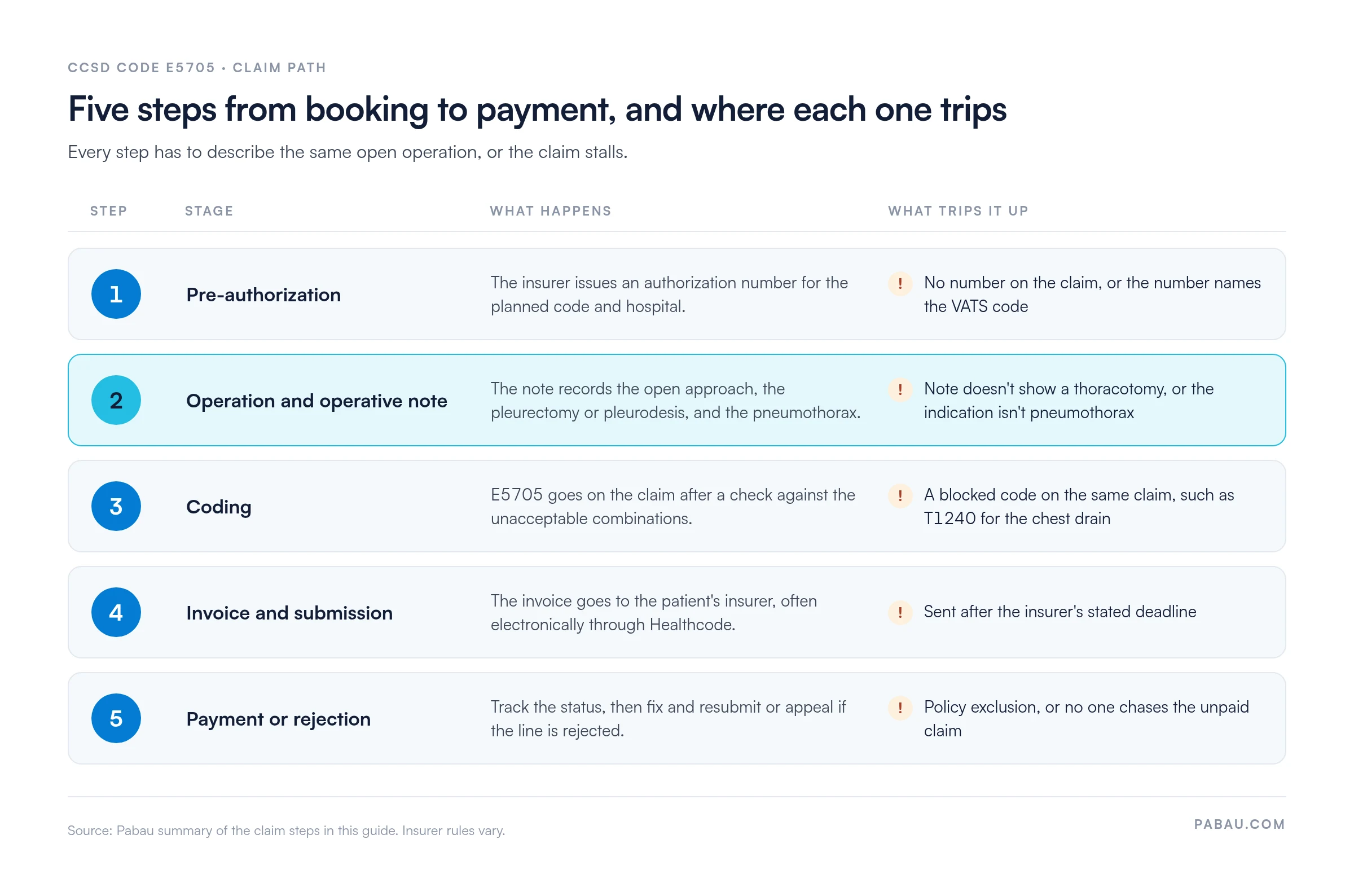
Insurers can ask for clinical records to confirm that the operation billed matches the operation performed. For E5705, these records carry the claim:
A structured operative note template makes these details hard to leave out. Set the approach and the procedure as required fields, and the note can’t be signed off without them.
E5705 is an inpatient operation, so the insurer will expect pre-authorization before the patient is admitted. The patient usually calls the insurer, and the insurer issues an authorization number for the planned procedure and hospital.
Give the insurer the code, the diagnosis, the hospital, the planned date and the consultant’s name. Then add the authorization number to the patient record so it travels with the claim. If the operation date moves, check that the authorization still covers it.
An emergency admission can’t always wait for pre-authorization. In that case, the patient or the hospital should tell the insurer as soon as possible. Check each insurer’s stated window for retrospective notification, because a late call can put the claim at risk.
Bupa publishes its procedure codes and fee details on the Bupa code search. Our Bupa CCSD codes guide explains how its schedule is organized.
Rejections on E5705 usually trace back to a mismatch between the claim, the authorization and the operative note. The table pairs the common causes with the fix.
A short check before submission catches most of the rejection reasons above. Tick each line against the patient record:
Surgical claims often get typed out by hand after discharge, from notes held in several places. Each retyped field is a chance for the code, the authorization number or the date to drift from the record.
Pabau, the practice management platform we build, raises the invoice against the patient’s insurer. It works from the same record that holds the booking and the operative note. Its claims management software then sends the CCSD claim to Healthcode.
Once the claim is out, you can track its status in Pabau. Your team sees which E5705 claims are paid and which need a follow-up call, all in one list.
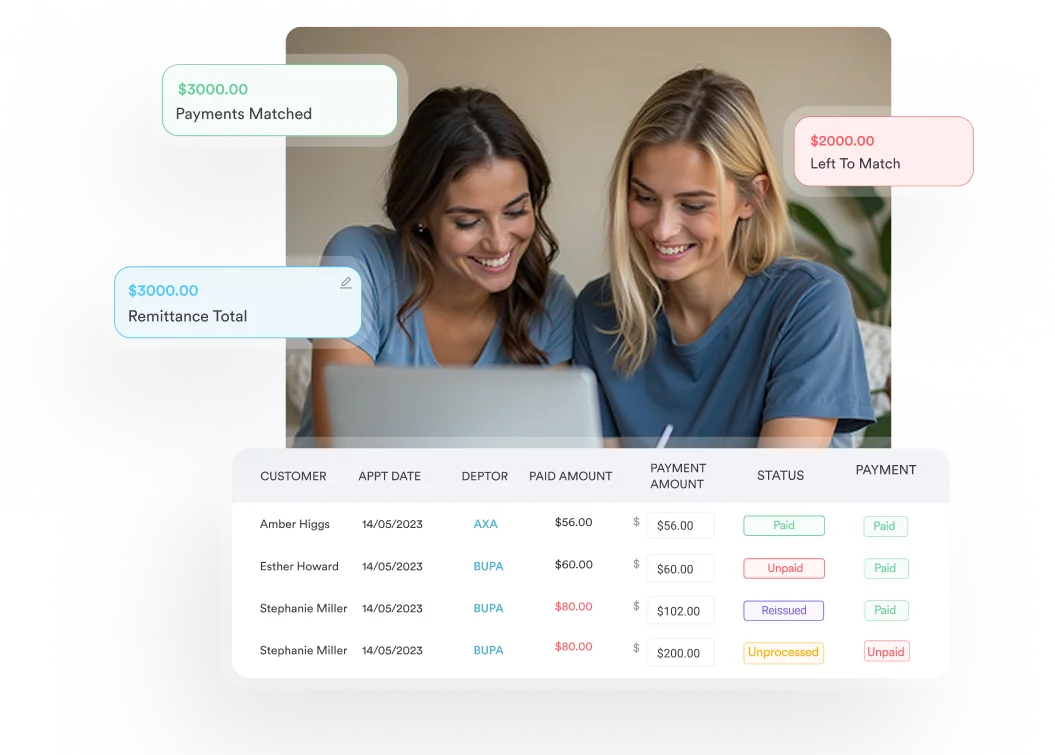

Pabau raises the insurer invoice from the record, submits CCSD claims like E5705 through Healthcode, and tracks each claim’s status in one place.

E5705 is a narrow code. It needs an open thoracotomy, a pleurectomy or pleurodesis, and a pneumothorax as the reason. When the operative note, the authorization and the claim agree on those three points, the claim has little to trip on.
So treat the operative note as the source and make the rest follow it. If a VATS case converts, or a drain code creeps onto the claim, fix it before submission rather than after a rejection. To see how Pabau keeps the invoice and claim tied to one patient record, book a demo.

Billing another open chest operation? CCSD code E5532 covers thoracotomy with lung biopsy and how it is billed.
Working on pleural procedures after surgery? CCSD code Y3811 explains how complex pleural catheter removal is coded.
Looking for neighboring codes by chapter? CCSD codes by chapter lists the schedule section by section.
Want every Bupa code in one place? Bupa CCSD procedure codes sets out the full schedule and how it is organized.
Comparing fees across procedures? Bupa procedure codes fee schedule shows how chapter groupings shape what each code pays.
UK claims usually pair the procedure code with an ICD-10 diagnosis. For pneumothorax, that sits in category J93, such as J93.1 for other spontaneous pneumothorax. Confirm the exact code against the ICD-10 edition the insurer uses.
Pleurectomy removes part of the parietal pleura, the lining of the chest wall. Pleurodesis makes the two pleural layers stick together, using talc or by roughening the surface. Both aim to stop the lung collapsing again.
A bulla is an air-filled space in the lung, usually more than 1 cm across. Bullae near the surface can burst and leak air into the pleural space, which collapses the lung.
The Clinical Coding and Schedule Development group maintains it on behalf of UK private medical insurers. Its website holds each code’s descriptor and coding principles, but searching the codes requires a log-in.