HCPCS code J1439: Ferric carboxymaltose billing guide
HCPCS code J1439: definition and quick-reference facts HCPCS code J1439 is a Lev...

Last Updated: Oct 16, 2026
E5593 is the CCSD code for VATS lung volume reduction – bilateral. It covers keyhole surgery that removes damaged emphysematous tissue from both lungs in one operative episode, so healthier lung tissue can expand. The code bills the operating surgeon's fee only.
UK private medical insurers require pre-authorization before surgery. The operative note must confirm that both lungs were treated thoracoscopically. If only one lung is operated on, or the procedure converts to open surgery, a different CCSD code applies.
Let Pabau's smart automation suggest the right codes, reduce claim denials, and keep your practice compliant—effortlessly.
Automate repetitive tasks and focus on what matters most—your patients.
Reduce coding errors and ensure compliance with the latest regulations.
Clean claims, fewer denials, and faster reimbursements.
Powerful insights and reporting to help your practice thrive.
HIPAA compliant SOC 2 certified GDPR-compliant Trusted by 4,000+ clinics worldwide

CCSD Code E5593 covers VATS lung volume reduction performed on both lungs in a single operative episode.
Insurers require pre-authorization before surgery, and the reference number must appear on the invoice.
The operative note must confirm bilateral access, because submitting E5593 without it is a common cause of denial.
Practice software such as Pabau records the CCSD code, stores the pre-authorization reference, and submits the claim through Healthcode.
CCSD Code E5593 is the UK private healthcare billing code for VATS lung volume reduction – bilateral. It identifies a thoracoscopic operation that removes emphysematous lung tissue from both lungs in the same operative session.
The Clinical Coding and Schedule Development (CCSD) Group lists it in the thoracic surgery chapter of the CCSD schedule, with related VATS procedures.
CCSD codes aren’t assigned by a government body. The CCSD Group, which represents Bupa, AXA Health, Aviva, and VitalityHealth, updates the schedule periodically. Confirm that E5593 is still active in the current edition before invoicing. The CCSD Technical Guide (October 2025) sets the business rules for applying codes in this family.
VATS lung volume reduction surgery (LVRS) removes hyperinflated, non-functional emphysematous tissue so healthier lung tissue can expand. In the bilateral approach covered by E5593, the surgeon reaches both lungs thoracoscopically under one anesthetic. That usually means two or three port sites per side.
The operative note has to reflect each procedural step, so coders need to know what those steps are:
Total operative time for bilateral VATS LVRS typically runs two to four hours, depending on complexity, adhesions, and whether repositioning is required. Insurers weigh that complexity when they assess whether the procedure fits their clinical policy for LVRS.
Surgical LVRS suits only a subset of patients with emphysema. UK private insurers follow selection criteria drawn from the National Emphysema Treatment Trial (NETT). Guidance from the National Institute for Health and Care Excellence (NICE) and British Thoracic Society COPD guidelines endorse them.
Evidence of eligibility against these criteria belongs in the pre-authorization pack. When that evidence is missing, insurers often contest the claim after surgery. Accepted indications include:
Thresholds vary by insurer, so cite the NICE guidance rather than asserting a single cutoff. Contraindications include alpha-1 antitrypsin deficiency, homogeneous emphysema, and previous ipsilateral thoracic surgery with significant adhesion risk.
An FEV1 below the floor threshold also rules a patient out, because the disease is too severe for operative benefit.
NICE guidance IPG114 (“Lung volume reduction surgery for advanced emphysema”) is the primary reference UK insurers cite when assessing clinical policy alignment.
A common CCSD miscoding error in LVRS billing is submitting E5593 for a unilateral procedure. The reverse happens too, when a unilateral code goes in although both lungs were accessed. Two questions, answered from the operative note, settle which code applies.
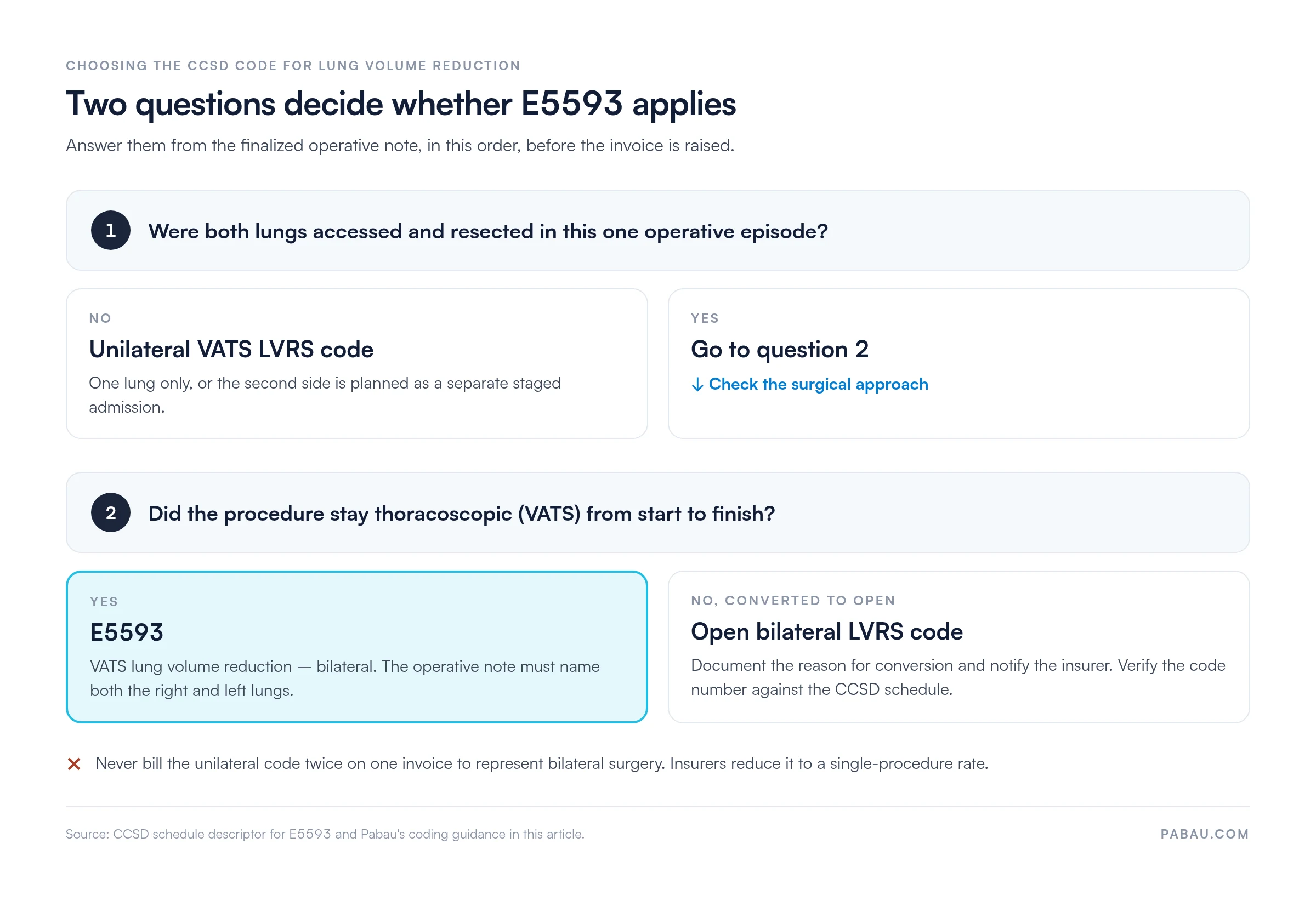
The table below adds the adjacent codes and when each one fits.
*Verify adjacent code numbers directly against the current published CCSD schedule before invoicing.
E5593 has its own discrete fee level that reflects the greater operative complexity, so the bilateral element is built into the code. Never bill the unilateral code twice on one invoice to represent bilateral surgery. UK insurers will reduce the claim to a single-procedure rate and may flag the account.
The operative note decides whether an E5593 claim gets paid. It must be finalized and in the patient record before the invoice is raised. Several UK insurers list early submission, before documentation is complete, as a denial trigger in their provider guidance.
The operative note must contain:
Beyond the operative note, the claim package for CCSD Code E5593 typically includes:
Store these documents against the patient’s episode in your patient records system. When an insurer asks for supporting evidence, the whole pack is then in one place.
Finalize the operative note within 24 hours of surgery, and cross-reference it to the pre-authorization reference before raising the CCSD Code E5593 invoice. Insurers audit timing. A note dated three weeks after surgery, attached to a claim submitted the same day, looks like retrofitted documentation and may trigger a detailed audit.
Every major UK private medical insurer requires pre-authorization before bilateral LVRS, one of the highest-value elective thoracic procedures on the CCSD schedule. Proceeding without confirmed pre-auth risks full claim denial. The only recourse is the insurer’s clinical team deciding afterward that the procedure met its criteria.
The pre-authorization evidence pack typically includes:
Bupa, AXA Health, Aviva, Vitality, and Cigna UK each maintain clinical policy documents for LVRS. Their spirometric thresholds and rehabilitation requirements differ, so confirm against the insurer’s current policy rather than a generic reference.
The Bupa code search portal and similar insurer tools show code-level details, including any pre-auth requirements attached to E5593. Our guide to Bupa CCSD procedure codes explains how that schedule applies to private practice billing.
Claims submitted through Healthcode, the main UK electronic billing network for private medical insurance, must carry the pre-auth reference number in a mandatory field. A claim without it returns an immediate validation error. Consultants moving from NHS work to private billing meet this requirement on nearly every elective surgical code, not just E5593.
E5593 claims fail for a small set of repeatable reasons, and each one is avoidable.
Prolonged air leak is the most common postoperative complication of VATS LVRS, documented in NICE IPG114 and the thoracic surgery literature. It doesn’t change the E5593 billing pathway, and the operative fee for the index procedure stays the same.
It does generate extra inpatient costs, which may need separate invoice lines for extended operating time, additional procedures, or prolonged high-dependency or intensive care. Document any staple-line reinforcement for an intraoperative air leak separately in the operative note, and discuss additional coding with the insurer.
Conversion from VATS to open thoracotomy mid-procedure raises a specific coding question. Dense adhesions or hemorrhage can force the surgeon to convert. E5593 may then no longer fit, because the “VATS” element of the descriptor is no longer met.
In that case, use the open bilateral LVRS CCSD code, verifying the current code number against the CCSD schedule. Document the conversion and its reason in the operative note, and notify the insurer’s provider relations team. Submitting E5593 for a converted procedure leaves the practice exposed if the insurer audits the claim.
Other intraoperative events carry their own coding rules:
Bill for what was done, document each deviation, and query the insurer whenever the operative pathway departed from the pre-authorized procedure. Billing assumptions made without insurer guidance are a common trigger for post-payment audit recovery demands.
The table below lists adjacent codes in the CCSD thoracic surgery chapter. Only E5593 is confirmed here, so verify every other code number against the current CCSD schedule. You can also look up CCSD codes by number in our reference library.
If you’re unsure whether a thoracic procedure falls under E5593 or an adjacent code, raise a coding query with the CCSD Group before invoicing. A formal code guidance response from CCSD is the strongest defense against an insurer’s retrospective coding challenge.
Many private thoracic practices track pre-auth numbers in email, chase operative notes by phone, and key claims into Healthcode by hand. Each handoff is a chance for the reference number or the laterality to drop out of the claim.
Pabau, the practice management platform we build, keeps the episode, the operative note, and the invoice in one patient record. Its private medical insurance billing covers CCSD code entry and direct submission through Healthcode. A typical E5593 workflow runs in six steps.
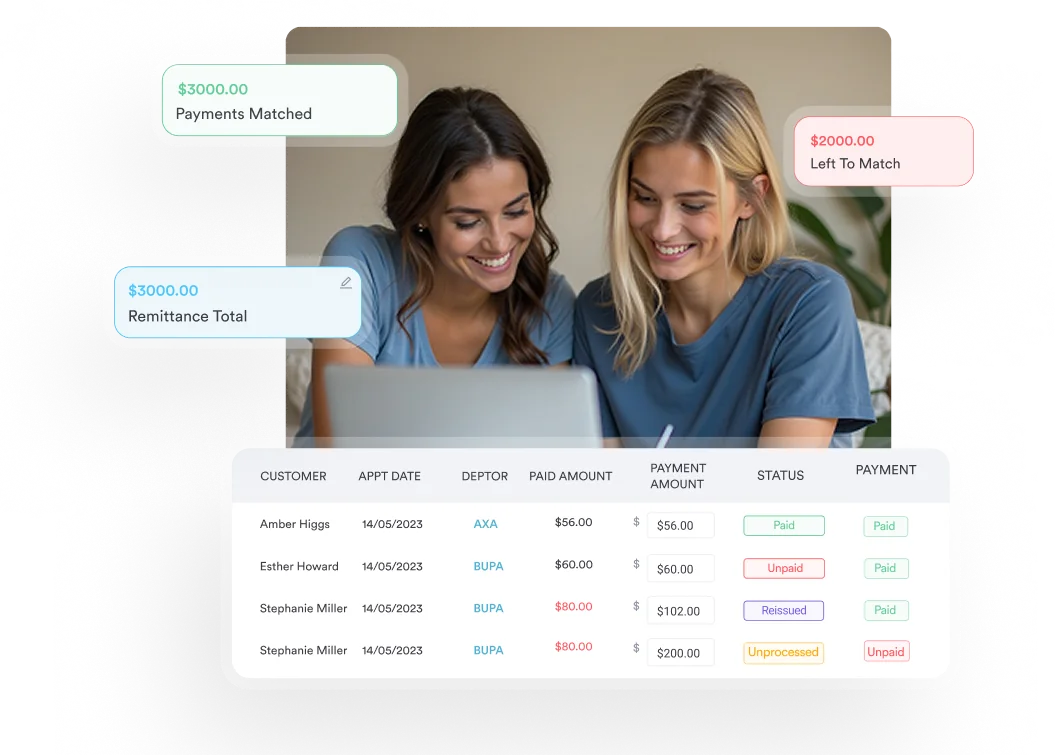
The pre-auth reference, operative note, and invoice sit in the same episode. Your billing team can check all three before a claim goes out, instead of after a denial.

Pabau helps UK consultants manage CCSD invoicing, pre-authorization tracking, and Healthcode submission in one place. Claims go out as soon as the operative note is signed.

E5593 pays in full when three records agree: the pre-authorization, the operative note, and the invoice. Each one has to say bilateral and thoracoscopic, and the note has to be finalized before the claim leaves the practice.
Build that check into your billing routine before the next LVRS list. The trade-off is a short wait on the invoice while the surgeon signs the note. That costs far less than appealing a denied high-value claim.
Book a demo to see how Pabau links pre-auth references, operative notes, and Healthcode claims for private thoracic practices.

Need a guide to CCSD codes for Bupa procedures? Bupa CCSD codes reference covers the Bupa procedure code schedule and how to apply it in private practice billing.
Billing an open thoracic procedure instead? CCSD code E5532 covers thoracotomy and lung biopsy, including documentation and claim requirements.
Coding a lung biopsy done by needle? CCSD code E5910 explains when the needle biopsy code applies and what insurers expect.
Looking to handle private insurance invoices more efficiently? Private medical insurance billing in Pabau walks through CCSD code entry, Healthcode submission, and pre-auth tracking.
CCSD Code E5593 covers video-assisted thoracoscopic surgery (VATS) for lung volume reduction on both lungs in the same operative episode. It covers the operating surgeon’s procedural fee only. Anesthetist and assistant surgeon fees are invoiced separately under their own CCSD codes.
It’s a minimally invasive thoracic procedure that removes hyperinflated, non-functional emphysematous tissue from both lungs under one anesthetic. The surgeon works through keyhole ports on both sides of the chest. Removing the damaged tissue lets healthier lung expand, which improves breathing in patients with severe upper-lobe emphysema.
Yes. UK private medical insurers require pre-authorization before bilateral VATS LVRS takes place. The pre-auth reference number is a mandatory field on Healthcode submissions, and claims without it are rejected at validation. Contact the insurer’s provider relations team well before the operation date, so its clinical team has time to review the eligibility pack.
Bill CCSD Code E5593 once the operative note confirming bilateral access is finalized. Include the pre-authorization reference, the patient’s insurer membership number, and the ICD-10 diagnosis code, typically J43.x for emphysema. Submit electronically via Healthcode. Anesthetist and assistant surgeon fees go on separate invoice lines under their own CCSD codes.
E5593 (bilateral) is a discrete code with a higher fee level that reflects greater operative complexity. Use it only when both lungs are documented as accessed and resected in the same operative episode. If only one lung is operated on, or the second side is planned as a later admission, use the unilateral VATS LVRS code. Verify that adjacent code against the current CCSD schedule. Billing the unilateral code twice on one invoice is incorrect and triggers an insurer reduction.
The most common reasons are a wrong code, a missing pre-authorization reference, and an operative note that doesn’t confirm both lungs were accessed. Incomplete eligibility evidence in the pre-auth pack and invoicing before the note is finalized also cause denials. A structured pre-billing documentation checklist prevents each of them.