

CCSD code G5100: Bypass of duodenum billing guide
CCSD code G5100 bills a bypass that leaves the duodenum in place CCSD code G5100...

Last Updated: Oct 16, 2026
E4722 is the CCSD code for thoracotomy and closure of bronchopleural fistula in UK private healthcare. It covers the surgeon's fee for opening the chest, finding the abnormal channel between the bronchus and the pleural space, and closing it.
The code applies only to an open approach, with the fistula confirmed and closed at surgery. Drainage alone, decortication alone, and thoracoscopic repairs fall outside it. E4722 sits in chapter 8.2.0, Chest Wall, of the CCSD schedule.
Let Pabau's smart automation suggest the right codes, reduce claim denials, and keep your practice compliant—effortlessly.
Automate repetitive tasks and focus on what matters most—your patients.
Reduce coding errors and ensure compliance with the latest regulations.
Clean claims, fewer denials, and faster reimbursements.
Powerful insights and reporting to help your practice thrive.
HIPAA compliant SOC 2 certified GDPR-compliant Trusted by 4,000+ clinics worldwide

CCSD code E4722 describes thoracotomy and closure of bronchopleural fistula (BPF). It applies only when an open approach is used and the fistula is explicitly identified and closed.
Post-pneumonectomy bronchial stump breakdown is the most common clinical scenario. Post-lobectomy dehiscence and infection-related BPF are also valid indications.
The operative note must confirm open thoracotomy, fistula identification, and closure method. Vague notes are the primary cause of claim queries.
Pabau’s claims management software helps private practice billing teams track pre-authorization status and document submission across all major UK insurers.
CCSD code E4722 is the UK private billing code for thoracotomy and closure of bronchopleural fistula (BPF), which is also its official descriptor. It covers an open operation in which the surgeon finds the fistula and closes it.
The code is maintained by the Clinical Coding and Schedule Development Group (CCSD), whose schedule UK private medical insurers use to process surgical invoices. Most major insurers reject an invoice without a valid CCSD code on receipt, whatever the clinical need.
E4722 sits in chapter 8.2.0, Chest Wall, within the thorax and intra-thoracic organs section of the schedule. Like most CCSD codes, it is procedure-specific. It applies only when the thoracotomy was performed to identify and close a BPF. Empyema drainage alone, or decortication without fistula closure, takes a different code, such as T0810 or T0710.
A bronchopleural fistula is an abnormal communication between the bronchial tree and the pleural cavity. Air, and in infected cases pleural fluid, moves through this channel with every breath. That flow stops the tissue from healing and raises the risk of contamination and respiratory compromise.
The most common causes are:
Presentation ranges from a sudden massive air leak with hemodynamic instability, typical of acute postoperative BPF, to an indolent chronic fistula. The chronic form shows up as productive cough, hemoptysis, and recurrent pneumonia, months or years after the original resection. How urgently the patient presents shapes the documentation, particularly whether retrospective notification applies instead of pre-authorization.
The procedure covered by E4722 uses an open thoracotomy approach. The chest is entered through a posterolateral or lateral incision. That gives the surgeon direct access to the pleural space and the bronchial stump or fistula tract.
Core operative steps typically include:
A video-assisted thoracoscopic surgery (VATS) approach to BPF closure is not coded as E4722. The descriptor specifies thoracotomy, so a thoracoscopic approach does not meet the E4722 descriptor. Check the CCSD schedule or the insurer for the appropriate code, and confirm the surgical approach in the operative note before assigning E4722.
Post-pneumonectomy bronchopleural fistula is the indication most often associated with E4722. The procedure is also performed in the following scenarios, each of which is a valid indication for this code:
Acutely unwell patients admitted as emergencies may need immediate surgery. In these cases, most insurers accept retrospective notification within 24 to 48 hours instead of standard pre-authorization. The billing team should record the emergency nature of the admission in the claim submission.
Several thoracic codes are submitted alongside or instead of E4722. Knowing the distinctions prevents downcoding (submitting a lower-complexity code) and claim rejection (submitting the wrong code for the procedure performed). The Bupa CCSD code schedule is a useful cross-reference for fee-band context within this chapter.
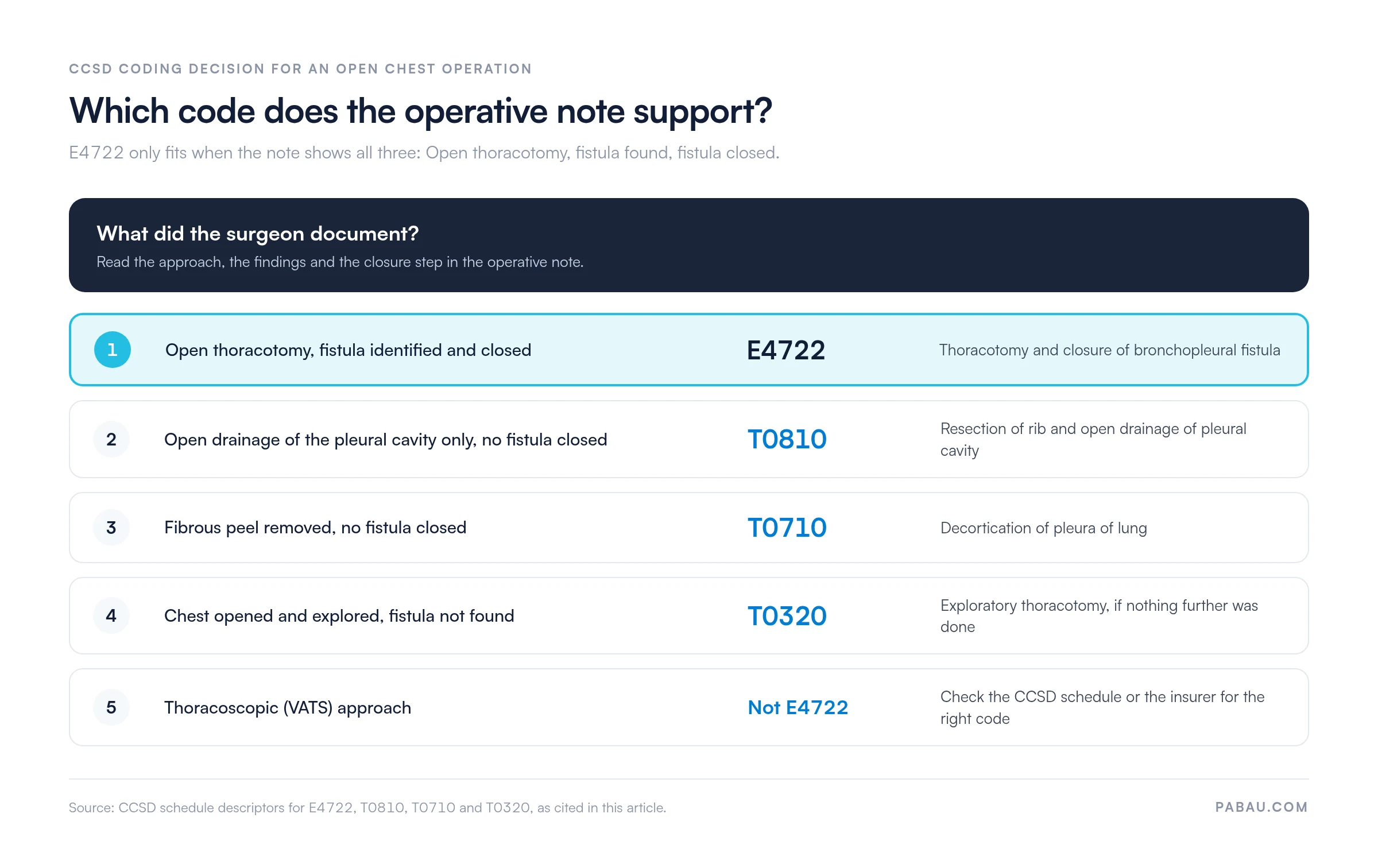
The critical rule is that E4722 requires a bronchopleural fistula positively identified at surgery and then closed. A suspected BPF that is not confirmed, or a thoracotomy where the fistula could not be located, does not meet the code descriptor. Submit the code that matches the procedure performed instead, such as T0320 for an exploratory thoracotomy.
Other open-chest codes work the same way. E5532, for instance, pairs the thoracotomy with a lung biopsy, so the procedure done through the incision decides the code. The chart below maps each documented outcome to its code.
When the same operative episode includes procedures beyond the BPF closure itself, additional CCSD codes may legitimately be submitted. The following combinations commonly apply:
Before submitting combined codes, check the Bupa code search tool and the individual insurer’s schedule. Bundling policies for thoracic procedures vary across Bupa, AXA Health, Aviva, and Vitality.
Run a pre-submission check: Does each code on the invoice correspond to a distinct procedure documented separately in the operative note? If a single operative note describes both procedures, the codes should appear on the same invoice line with the same operative date. Separate operative dates require separate clinical documentation for each.
Strong documentation is the difference between a clean claim and a query. Private practices use claims management software to track what is on file before submission, but the operative note itself is the clinician’s responsibility.
The following elements must be present in the clinical record to support E4722:
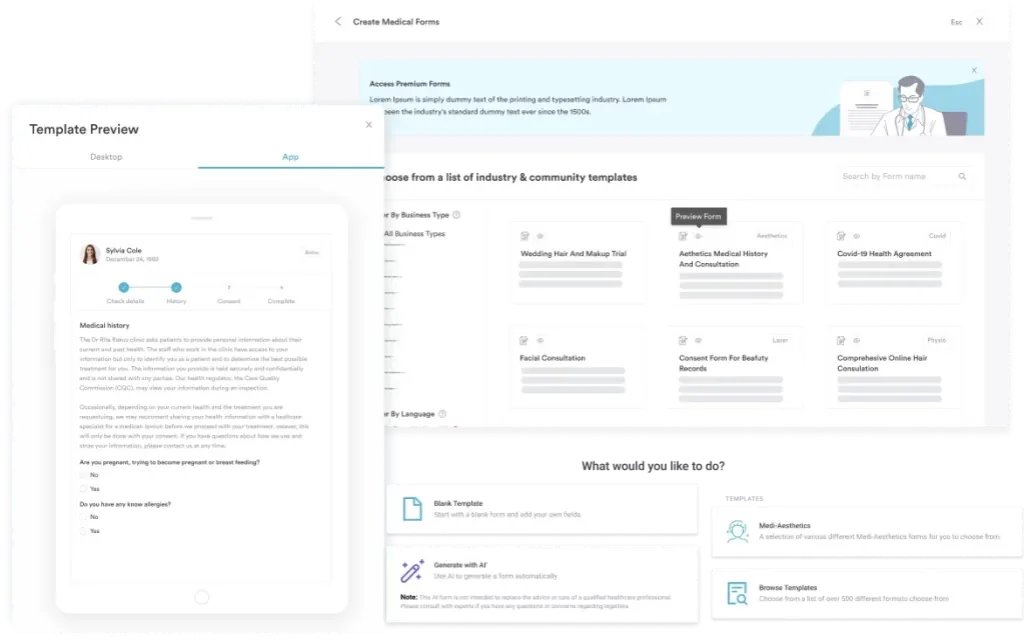
Use digital operative note templates that prompt for each of these elements by name. A note that says “BPF repaired via thoracotomy” without the approach, fistula site, or closure method will draw a query from every major insurer.
Most UK private medical insurers require pre-authorization for major thoracic surgery before it takes place. E4722 falls into the major surgical band at every major insurer. Treat it as needing pre-authorization unless the case is a clinical emergency.
Standard pre-authorization requirements across Bupa, AXA Health, Aviva, and Vitality typically include:
Vitality’s fee finder lets providers check indicative procedure fees and confirm whether a code needs pre-authorization before submitting a request. AXA Health and Bupa have equivalent online portals for their recognized consultants.
For emergency surgery, most insurers accept retrospective notification within 24 to 48 hours of the procedure. The clinical record must document the emergency presentation and the urgency of intervention. The billing team should submit the notification as soon as the patient is stabilized, not at discharge.
Claim rejection for CCSD code E4722 follows a predictable pattern. The errors below are the usual causes of queries and rejections across the major UK insurers.
Practical tip: Always cross-reference the submitted code against the operative note before sending the invoice. If the bronchoscopy report was the primary diagnostic tool, attach it with the first submission instead of waiting for the insurer to ask. A diagnostic bronchoscopy at an earlier, separate session is its own episode, billed under E5180.
CCSD codes are not tied to a single national fee schedule. Each UK private medical insurer maps E4722 to its own fee schedule. Bupa uses its Schedule of Procedures (SOP), and AXA Health publishes its own procedure schedule through its specialist portal.
E4722 sits in the major thoracic surgery band, reflecting the operative complexity, theater time, and postoperative intensity of open BPF repair.
Reimbursement approaches differ between insurers. Some pay a fixed fee regardless of operative duration. Others apply a relative value system where longer or more complex cases attract a higher payment. Neither model is publicly listed at fixed rates, because contracts are negotiated individually with recognized consultants and hospitals.
Consultants moving from NHS to private work should expect CCSD fees for major thoracic procedures to vary substantially across insurers. The Aviva fee schedule is one of the few insurer schedules partly accessible online to recognized providers. It gives a useful benchmark for the major thoracic band. Review your private medical insurance (PMI) contracts before quoting patients their expected costs.
Practices managing both UK and US patient populations sometimes ask whether E4722 maps to a CPT equivalent. It does not, for billing purposes. CCSD and CPT are separate code systems used by different payers in different countries, and they are not interchangeable.
In the US, bronchopleural fistula closure falls within the CPT thoracic surgery range. The closest CPT analogue for open closure is CPT 32815, “Open closure of major bronchial fistula.” Its descriptor language, bundling rules, and payer policies still differ from E4722.
Any team billing a US insurer must use the appropriate CPT code. Submitting E4722 to a US payer, or a CPT code to a UK insurer, will be rejected. The CPT cross-reference is for orientation only and never goes on the claim.
If your practice treats both UK-insured and US-insured thoracic patients, maintain separate billing workflows with separate code reference lists. A coder familiar with CCSD should not cross-apply their knowledge to CPT submissions without training specific to the US system, and vice versa.
Many thoracic billing teams still assemble an E4722 claim by hand. The pre-authorization reference sits in an email, the operative note in the hospital system, and the bronchoscopy report in a scanned PDF. Each missing piece is a query that delays payment on a high-value claim.
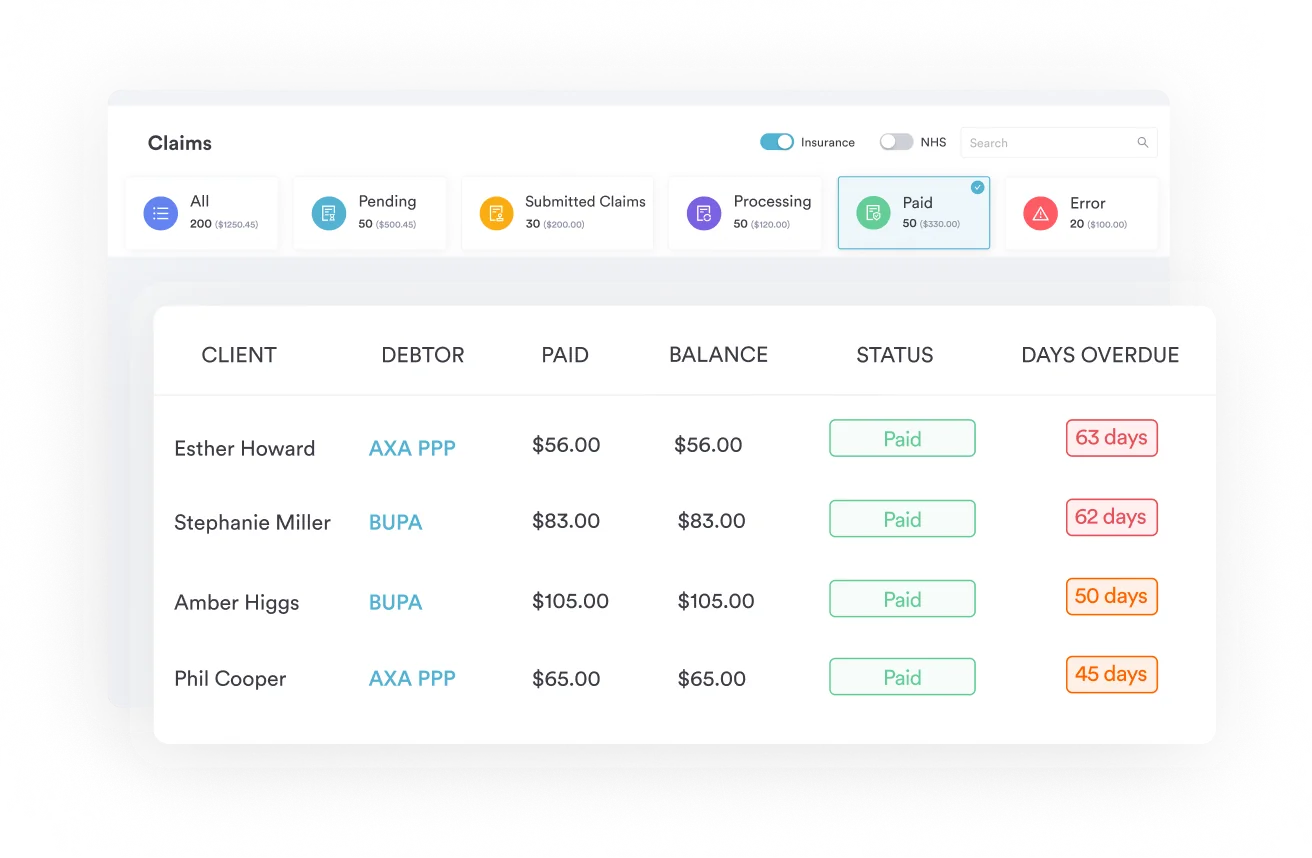
Pabau, the practice management platform we build, keeps those pieces on one patient record. Digital forms prompt the surgeon for the approach, fistula site, and closure method. The invoice carries the CCSD code and the insurer’s details. The claims view shows which Bupa or AXA claims are pending, paid, or in error.
The result is a claim that goes out complete the first time. Your team spends its week on new cases instead of chasing old ones.

Pabau helps UK private practice teams track pre-authorization status, manage CCSD code submissions, and keep clinical documentation linked to each claim. Book a demo to see how billing teams use Pabau to reduce claim queries.

Open bronchopleural fistula repair is a high-acuity operation, and its claim deserves the same care. Before you submit E4722, read the operative note against three tests. Was the chest opened, was the fistula found, and was it closed?
If any answer is no, E4722 is the wrong code, however complex the surgery was. Code what the note supports, secure pre-authorization or emergency notification on time, and attach the diagnostic evidence up front. Those minutes at submission save weeks of insurer queries.
Book a demo to see how Pabau links operative notes, pre-authorization references, and CCSD invoices for your thoracic claims.

Need a full CCSD reference for Bupa submissions? Bupa CCSD codes and billing guide covers how the Bupa schedule is structured and how to navigate code queries with the UK’s largest PMI provider.
Billing an open lung biopsy instead? CCSD code E5532: Thoracotomy and lung biopsy explains how that thoracotomy code is documented and claimed.
Was the fistula confirmed at bronchoscopy? CCSD code E5180: Diagnostic bronchoscopy covers coding and documentation for the diagnostic procedure.
Coding other airway procedures? CCSD code E4840: Tracheal stricture dilatation walks through the stent insertion code and where it sits in the schedule.
CCSD code E4722 covers thoracotomy and surgical closure of a bronchopleural fistula via an open approach. It applies only when the surgeon entered the chest through a thoracotomy incision, positively identified the fistula tract, and performed definitive closure. It does not cover VATS approaches, a suspected BPF that was not confirmed, or a thoracotomy performed solely for empyema drainage.
No. E4722 requires open thoracotomy, as stated in the official CCSD descriptor. A thoracoscopic approach does not meet the E4722 descriptor, so check the CCSD schedule or insurer for the appropriate code. Always confirm the surgical approach in the operative note before assigning a code.
Potentially, yes, when the operative note documents both open drainage (T0810) and BPF closure (E4722) during the same thoracotomy. However, some insurers bundle these procedures and reimburse only the higher-value code. Check each payer’s bundling rules before submitting combined codes, as Bupa, AXA, and Aviva each handle this differently.
Insurers most often request the operative note confirming open thoracotomy, fistula identification, and closure method. They also ask for the preoperative imaging or bronchoscopy report confirming the BPF, the pre-authorization reference number, and the anesthetic record. Histopathology results may be requested when malignancy contributed to the fistula.
Yes, a recurrent BPF requiring repeat open thoracotomy and closure is a new operative episode and may be submitted as a second E4722 claim. The clinical record must document the recurrence, the reason the first repair failed, and any interval investigations. Pre-authorization is required again unless the recurrence presents as an emergency.
Most UK private medical insurers aim to process pre-authorization requests for major surgery within three to five working days. Complex cases, or those needing clinical review, may take longer. Emergency pre-authorization or retrospective notification is typically processed within 24 to 48 hours. Confirm timelines with each insurer’s provider services team.



