CPT Code 62284: Injection procedure for myelography
CPT Code 62284: official descriptor and procedure overview The American Medical ...

Last Updated: Oct 19, 2026
E5592 is the CCSD code for video-assisted thoracoscopic surgery (VATS) assisted lung volume reduction on one lung. It bills the surgeon's fee for removing hyperinflated emphysematous tissue from a single lung through keyhole ports, so healthier tissue can expand.
Bilateral surgery in the same session bills E5593 instead, and bronchoscopic valve or coil procedures take separate codes. UK private medical insurers expect pre-authorization, an operative note naming the treated side, and proof of completed pulmonary rehabilitation.
Let Pabau's smart automation suggest the right codes, reduce claim denials, and keep your practice compliant—effortlessly.
Automate repetitive tasks and focus on what matters most—your patients.
Reduce coding errors and ensure compliance with the latest regulations.
Clean claims, fewer denials, and faster reimbursements.
Powerful insights and reporting to help your practice thrive.
HIPAA compliant SOC 2 certified GDPR-compliant Trusted by 4,000+ clinics worldwide

CCSD code E5592 covers VATS lung volume reduction on a single lung, while bilateral surgery in one session bills E5593.
The operative note must name the treated side and confirm the VATS approach, because laterality is what separates E5592 from E5593.
The NETT trial set the core selection criteria, such as FEV1 of 20–45% predicted and upper-lobe predominant emphysema, that most insurers mirror in pre-authorization.
UK private medical insurers require pre-authorization before LVRS, and a claim without a valid approval reference is typically rejected outright.
Anesthesia is billed separately from E5592 and is not bundled within the surgical code under standard CCSD practice.
CCSD code E5592 is the procedural billing code for video-assisted thoracoscopic surgery (VATS) lung volume reduction on one lung, as defined in the CCSD schedule. Its official descriptor is Video-assisted thoracoscopic surgery (VATS) assisted lung volume reduction – unilateral, the wording the CCSD adopted in August 2024.
The surgeon passes thoracoscopic instruments through small port incisions in the chest wall. Hyperinflated emphysematous tissue is then resected from one lung under general anesthesia with single-lung ventilation.
Three elements decide whether E5592 is the correct code. First, the approach must be VATS, because an open thoracotomy is not covered by this code. Second, the surgeon must resect emphysematous lung tissue rather than only inspect or drain the chest. Third, the procedure must be unilateral, treating one lung in a single operative session.
The exclusions matter as much as the inclusions. CCSD code E5592 does not cover endobronchial valve procedures, bronchoscopic coil placement, or any other form of bronchoscopic lung volume reduction. It also does not cover bilateral VATS LVRS performed in the same session. Coders who apply E5592 to either of those procedure types are miscoding and risk upcoding allegations.
E5592 sits in section 8.7.0 of the schedule, Video Assisted Thoracic Surgery (VATS). The neighboring bullectomy and wedge resection codes in that section are covered in our CCSD codes library.
VATS lung volume reduction surgery removes the most diseased, hyperinflated segments of lung tissue. The remaining healthier lung can then expand and function more efficiently. Understanding the surgical steps helps coders verify that the operative report contains the right elements to substantiate E5592.
The procedure follows a consistent sequence in most thoracic centers:
The operative report must reflect each of these steps explicitly. A report that describes the procedure as a “VATS biopsy” or “VATS exploration” without documenting resection volume and stapling does not support E5592.
VATS LVRS is indicated for a narrow subset of patients with severe emphysema who have failed maximum medical and rehabilitation management. The National Emphysema Treatment Trial (NETT) was published in the New England Journal of Medicine in 2003 (Fishman et al.). Its results form the evidence base most UK private medical insurers draw on when they set pre-authorization criteria.
The NETT-derived selection criteria most commonly referenced by insurers include:
These thresholds derive from NETT, and individual insurers may set their own FEV1 cut-offs or require additional assessments. Check each insurer’s current pre-authorization guidelines before submitting a claim. In the UK, NICE guideline NG115 on COPD sets out when a patient should be referred for a lung volume reduction assessment.
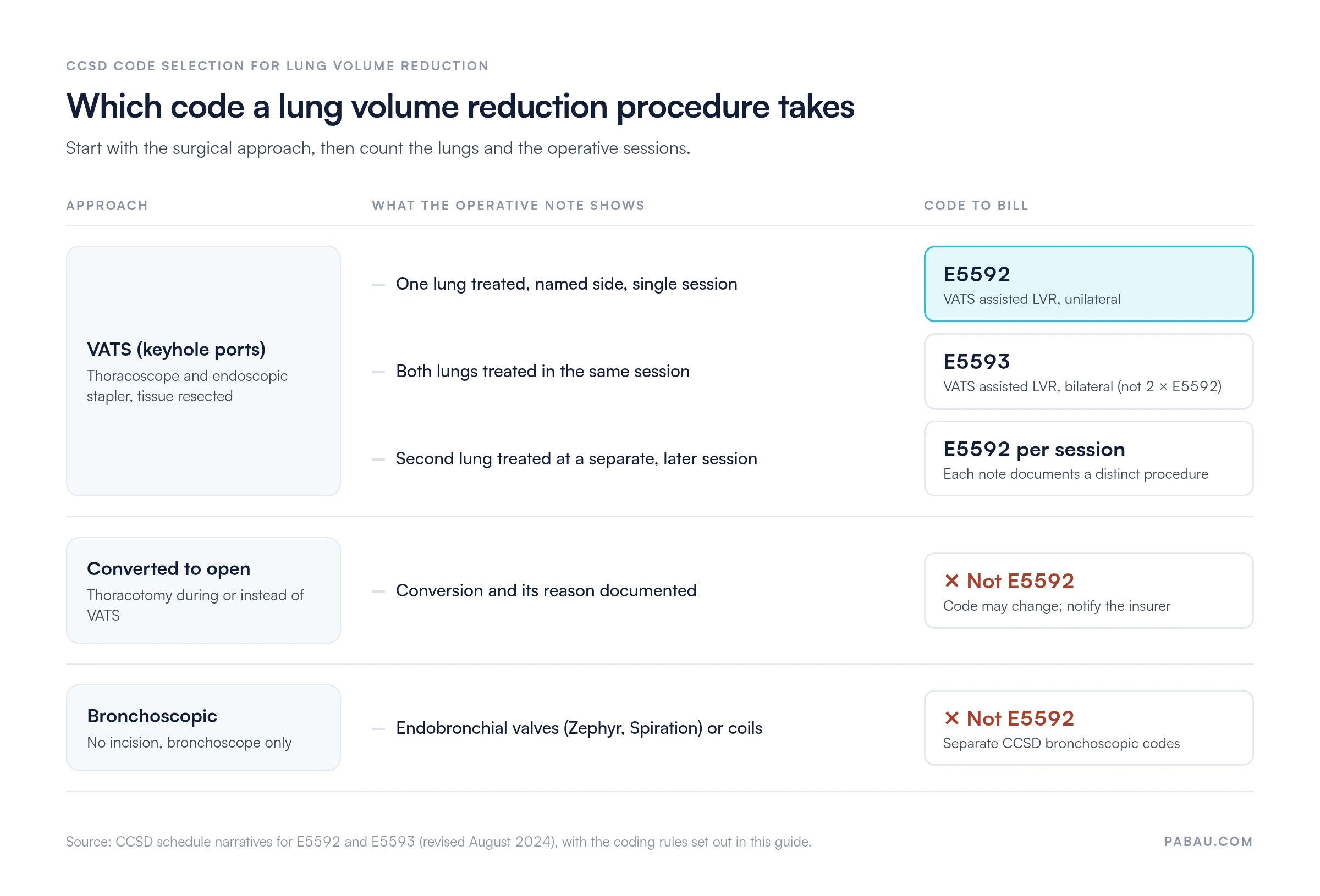
Choosing between the unilateral and bilateral LVRS codes is a common source of error in thoracic billing. The table below maps the key distinctions.
Bilateral LVRS in a single session: When both lungs are treated at the same operative visit, bill E5593. That is the CCSD code for VATS assisted lung volume reduction on both lungs. Do not bill two E5592 codes for bilateral procedures performed in a single operative session.
Staged bilateral LVRS: When the second lung is treated at a separate operative session, each session is coded independently with E5592. Surgeons often stage the two sides to reduce operative risk. The operative report must document each session as a distinct procedure.
Bronchoscopic LVRS (endobronchial valves): E5592 specifically requires a VATS (surgical) approach. Procedures using endobronchial valves such as the Zephyr or Spiration device, or bronchoscopic coil placement, are categorized separately in the CCSD schedule. Applying CCSD code E5592 to a bronchoscopic procedure constitutes miscoding. Identify the correct CCSD bronchoscopic codes from the current schedule before billing valve or coil-based LVRS.
The decision path below runs each LVRS scenario from the surgical approach to the code it takes.
For staged bilateral LVRS, request pre-authorization for each operative session separately and keep each operative note self-contained. A second E5592 claim that relies on the first operation’s note for its laterality or findings invites an insurer query.
The operative report is the primary document that substantiates E5592 on a claim. A note that fails to describe the specific elements of a VATS unilateral approach will not survive insurer review. Digital operative documentation forms help your surgical team capture these elements the same way every time.
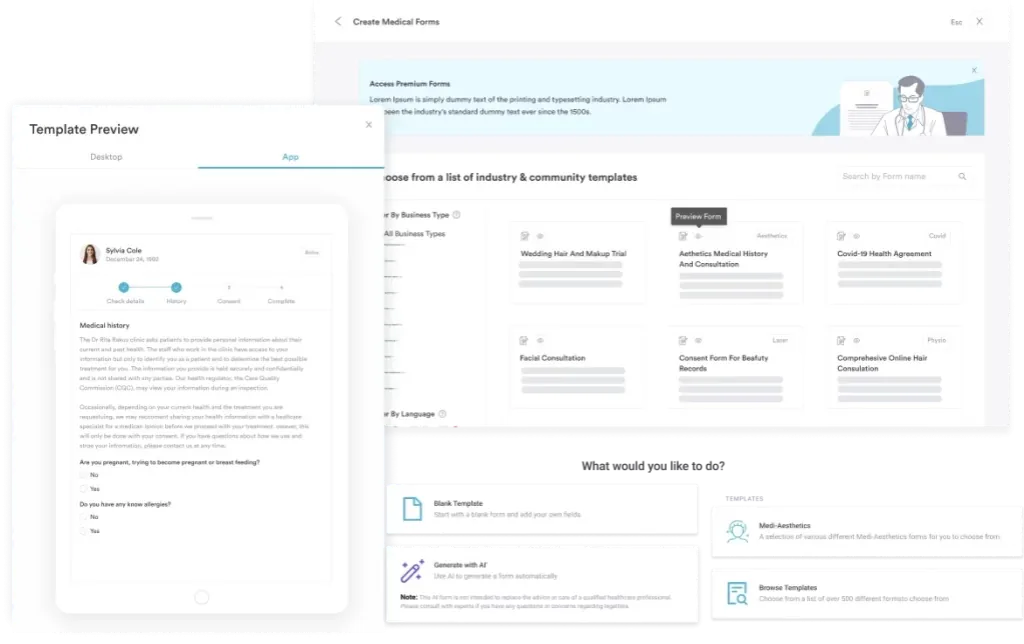
The operative report for a unilateral VATS LVRS must include all of the following:
Pre-operative documentation is equally important. The claim file should contain:
LVRS is a high-cost elective procedure, and every major UK private medical insurer requires pre-authorization before it is performed. A claim for CCSD code E5592 without confirmed prior approval is typically denied outright. Insurer rules vary by policy and year, so verify current requirements directly with each insurer. The table below summarizes the typical requirements across the major insurers.
For Bupa claims, use the Bupa code search tool to confirm the current procedure fee and any fund-specific conditions attached to E5592. Vitality members can be checked via the Vitality fee finder.
The Healix fee schedule and Aviva fee schedule both publish CCSD-coded fee tables that include E5592 procedure categories. Always check the insurer’s current schedule, as fees and conditions are revised annually.
Keep the insurer’s approval reference on the patient record before the procedure is listed. For a broader view of how Bupa handles CCSD billing, see our guide to Bupa CCSD codes.
Every claim for CCSD code E5592 requires a primary ICD-10 diagnosis code that establishes medical necessity. ICD-10 uses J43 and J44 as the primary emphysema and COPD categories. Sequencing matters, because the primary diagnosis code should reflect the condition directly driving the surgical decision.
Code the emphysema subtype to the highest level of specificity the clinical record supports. Picture an E5592 claim paired only with J43.9 (unspecified emphysema) while the CT and operative report document centrilobular upper-lobe disease. The insurer will often query whether the documentation supports surgical candidacy. Code to J43.2 when the record supports it.
Anesthesia codes are billed separately from CCSD code E5592 under standard CCSD practice. The surgical code does not bundle the anesthetic. The anesthetist submits their own claim using the relevant CCSD anesthesia code for thoracic surgery under general anesthesia with double-lumen intubation.
Confirm there is no specific bundling restriction for E5592 in the current CCSD technical guide or your insurer’s schedule before billing.
The following codes are commonly associated with a unilateral VATS LVRS episode and may be co-billed where clinically performed and separately documented:
Payer-specific bundling rules for anesthesia and assistant surgeon co-billing differ by insurer and must not be assumed to be universal. Confirm each insurer’s position before submitting co-billed claims.
LVRS claims attract closer scrutiny than most elective thoracic procedures because of the cost, the narrow patient selection criteria, and the pre-authorization requirement. The following denial patterns appear most frequently in CCSD E5592 claims.
Build a pre-submission checklist for CCSD code E5592 claims. It should confirm a valid pre-auth reference on file and the pulmonary rehab certificate in the claim file. It should also confirm the operative note records laterality and the VATS approach. It should also check that the emphysema subtype is sequenced as the primary diagnosis.
LVRS paperwork usually lives in several places. The pre-authorization reference sits in an insurer portal, the operative note in the hospital system, and the rehab certificate in an inbox. Claims often go out before anyone checks that all three match.
Pabau, the practice management platform we build, holds the approval reference, the operative note and the supporting documents in one patient record. Its medical billing software tracks each claim from submission to payment. Your team can also record co-billing and bundling rules by insurer, so conflicts surface before the claim is sent.
The result is fewer outright rejections for missing approvals and fewer laterality queries, because the checks happen inside the practice instead of at the insurer.
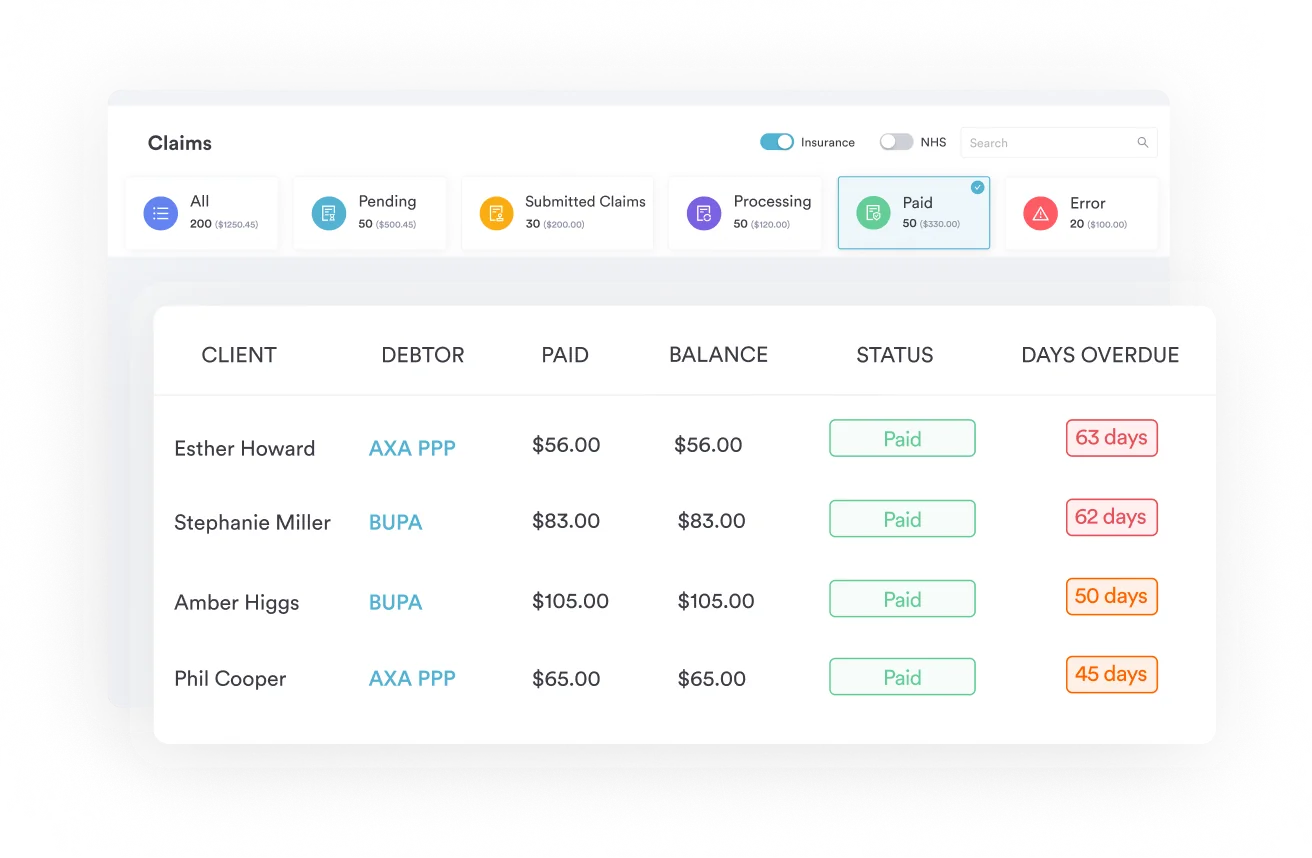

Pabau helps thoracic surgery practices manage pre-authorization documentation, operative records, and claim submissions in one place. See how practices reduce denial rates and speed up LVRS claim resolution.

E5592 claims rarely fail on clinical grounds. They fail when the paperwork cannot prove what the surgeon did: One named lung, treated by VATS, after an approved pre-authorization.
Treat the operative note and the pre-authorization file as one package. If your team cannot point to the treated side, the stapling detail and the rehab certificate, hold the claim until it can. A short delay costs far less than a rejected LVRS claim and the appeal that follows.
Book a demo to see how Pabau keeps pre-authorization, operative notes and CCSD claims in one patient record.

Treating both lungs in one session? CCSD code E5593 covers bilateral VATS lung volume reduction, its documentation and pre-authorization requirements.
Resecting a lesion rather than reducing volume? CCSD code E5442 explains how VATS wedge resection of lung is coded and documented.
Removing bullae instead of diffuse emphysema? CCSD code E5591 walks through billing bilateral VATS bullectomy, with or without pleurodesis.
Need a structured approach to CCSD billing with Bupa? Bupa CCSD codes covers code submission, fee schedules, and insurer-specific requirements for Bupa-recognized practitioners.
CCSD code E5592 is the billing code for VATS lung volume reduction performed unilaterally on a single lung. It covers the video-assisted thoracoscopic approach, in which an endoscopic stapler resects emphysematous, hyperinflated tissue from one lung in a single operative session. It does not cover bilateral procedures or bronchoscopic (non-surgical) lung volume reduction approaches.
Yes, E5592 is unilateral only. A separate CCSD code, E5593, covers bilateral VATS lung volume reduction performed in the same operative session. For staged bilateral procedures where each lung is treated at a separate operative visit, each session is billed independently with E5592.
The operative report must explicitly state the VATS approach and identify which lung was treated. It must also describe the stapling technique and tissue resected, and confirm the procedure was unilateral. Most insurer reviews also require the pre-operative CT thorax, pulmonary function test results, the pulmonary rehabilitation completion certificate, and the specialist referral.
Yes, completion of pulmonary rehabilitation is a standard pre-authorization condition for most major UK private medical insurers before approving LVRS. NETT required all patients to complete pulmonary rehabilitation before randomization, and insurers carry that requirement into pre-authorization. Attach the rehabilitation completion certificate to both the pre-authorization submission and the claim file.
Yes, anesthesia codes are billed separately from CCSD code E5592 under standard CCSD practice and are not bundled within the surgical code. The anesthetist submits their own claim. Payer-specific bundling rules vary, so confirm with each insurer’s current schedule that no bundling restriction applies to this code before submitting co-billed claims.
The most frequent denial reasons are missing pre-authorization and absent pulmonary rehabilitation evidence. An operative note that does not confirm the VATS approach or laterality is another. So is billing E5592 for a bilateral procedure. Incorrect ICD-10 diagnosis code sequencing and bundling errors with co-billed codes also cause denials.