HCPCS Code Q4175: Billing, coverage, and documentation guide
HCPCS Code Q4175: Code Description and Product Identity HCPCS Code Q4175 is the ...

Last Updated: Nov 20, 2026
T1100 is the CCSD (Clinical Coding and Schedule Development) code for diagnostic thoracoscopy (+/- biopsy). The surgeon inspects the pleural cavity through a thoracoscope and may take biopsies in the same session. Bupa’s February 2026 schedule lists it under Video Assisted Thoracic Surgery, in band INTER 4.
The code covers diagnosis only. Drainage with chemical pleurodesis at thoracoscopy has its own code, T1032.
Let Pabau's smart automation suggest the right codes, reduce claim denials, and keep your practice compliant—effortlessly.
Automate repetitive tasks and focus on what matters most—your patients.
Reduce coding errors and ensure compliance with the latest regulations.
Clean claims, fewer denials, and faster reimbursements.
Powerful insights and reporting to help your practice thrive.
HIPAA compliant SOC 2 certified GDPR-compliant Trusted by 4,000+ clinics worldwide

CCSD code T1100 covers diagnostic thoracoscopy, with or without biopsy, under one code used by UK private medical insurers.
Bupa’s February 2026 schedule places T1100 in band INTER 4, with a fee of £369. Other insurers set their own fees.
A pleural biopsy taken at the same thoracoscopy is part of T1100. Drainage with chemical pleurodesis moves the claim to T1032.
Insurers expect pre-authorisation, a WHO ICD-10 diagnosis code and an operative note that shows the procedure stayed diagnostic.
CCSD code T1100 is the UK private-insurance procedure code for diagnostic thoracoscopy (+/- biopsy). AXA Health’s chapter 8 schedule lists T1100 under exactly that descriptor. CCSD stands for Clinical Coding and Schedule Development.
The CCSD Group maintains the schedule that UK private medical insurers use to identify procedures. They include Bupa, AXA Health, Aviva, Cigna, WPA and Vitality.
The code sits in chapter 8, Thorax and intra-thoracic organs, in the Video Assisted Thoracic Surgery (VATS) section. Our Bupa CCSD codes reference lists it in band INTER 4.
T1100 pays for looking inside the pleural cavity and sampling what the surgeon finds. Once the operation turns therapeutic, the claim needs a different code. Thoracoscopic plication of a paralysed diaphragm, for example, is billed as CCSD T1620. Thoracoscopic ligation of the thoracic duct to stop a chylothorax bills under CCSD code T8900. The table sets out where the line falls.
The “+/- biopsy” wording settles the most common question. A pleural biopsy taken at the same diagnostic thoracoscopy is part of T1100, not an add-on. A separate pleural biopsy code for the same session is likely to be queried by the insurer.
T1100 applies when the purpose of the thoracoscopy is diagnosis. Common indications include:
If the operative note records drainage with talc or another sclerosant, the procedure was not diagnostic only. Check the note before you assign T1100.
The patient usually lies on their side under general anaesthesia. The surgeon makes one to three small incisions and passes a thoracoscope into the pleural space. A camera relays the view to a monitor, which is why the schedule groups it with VATS.
The surgeon drains fluid enough to see clearly, then inspects the parietal and visceral pleura. Abnormal areas are sampled with biopsy forceps and sent for histology. A chest drain is often left in place at the end, and the patient stays in for monitoring.
UK private insurers code diagnoses with WHO ICD-10, not the US ICD-10-CM. Each T1100 claim needs a diagnosis code that matches the indication in the notes. These are the codes most often paired with it.
Code from the referral at authorisation, then update the claim if histology changes the diagnosis. A vague code where the notes support a specific one is a common reason for a query.
These neighbouring codes cover what happens when the procedure goes beyond inspection and pleural biopsy. Bands and fees are from Bupa’s February 2026 schedule, and our CCSD codes library indexes the rest of chapter 8.
Read as a decision, the six codes turn on two questions: how the surgeon reached the pleura, and what happened once inside. The chart sets them out in that order.
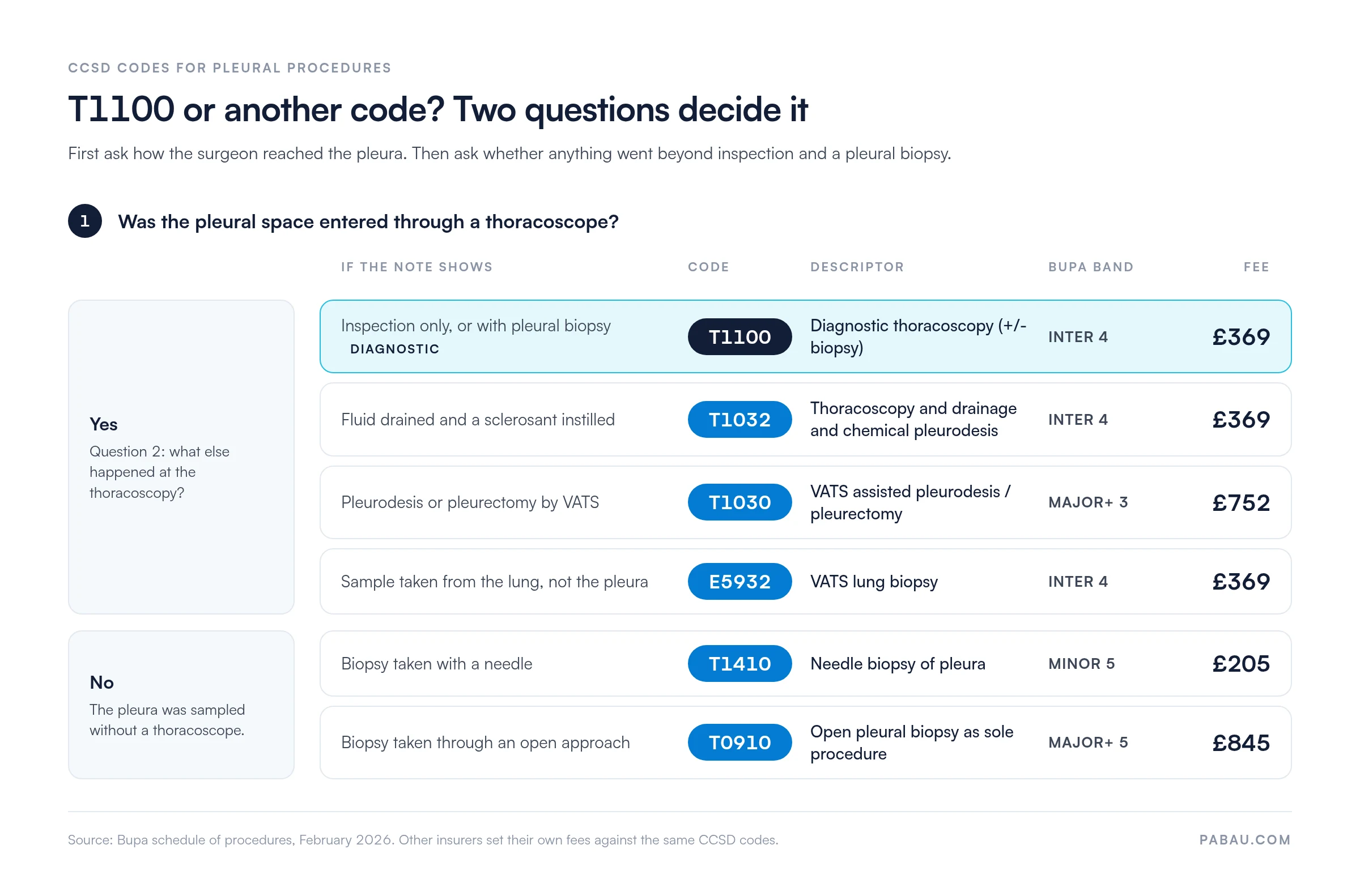
CCSD sets the codes, and each insurer sets its own fee schedule against them. Bupa’s February 2026 schedule places T1100 in band INTER 4, with a fee of £369. AXA Health’s specialist schedule lists the same code at £200, with £142 for the anaesthetist. Aviva, Vitality and other insurers publish their own schedules and benefit maximums.
A surgeon who charges more than the insurer pays leaves the patient with a shortfall. Tell the patient about any shortfall in writing before the procedure. When comparing UK medical billing software, check that it holds each insurer’s schedule against the CCSD code.
Check the T1100 fee in each insurer’s current schedule whenever it is republished. Bupa pays £369 and AXA Health £200, so record the shortfall conversation whenever your charge sits above the patient’s insurer rate.
Most UK private medical insurers expect pre-authorisation before a planned procedure. Requirements differ between insurers, policies and settings, so confirm them for each patient before you book. Bupa’s codes can be checked in the Bupa code search tool. Other insurers handle authorisation through their provider portals or phone lines.
When you request authorisation, have the following ready:
Record the authorisation reference in the patient’s file and quote it on the invoice. An invoice without one, where the insurer required it, is likely to be rejected.
Clean T1100 claims start with a complete operative note. It must show the insurer that the thoracoscopy was indicated, stayed diagnostic and produced specimens for histology. Capture each field at the time of the operation, rather than rebuilding it at billing time.
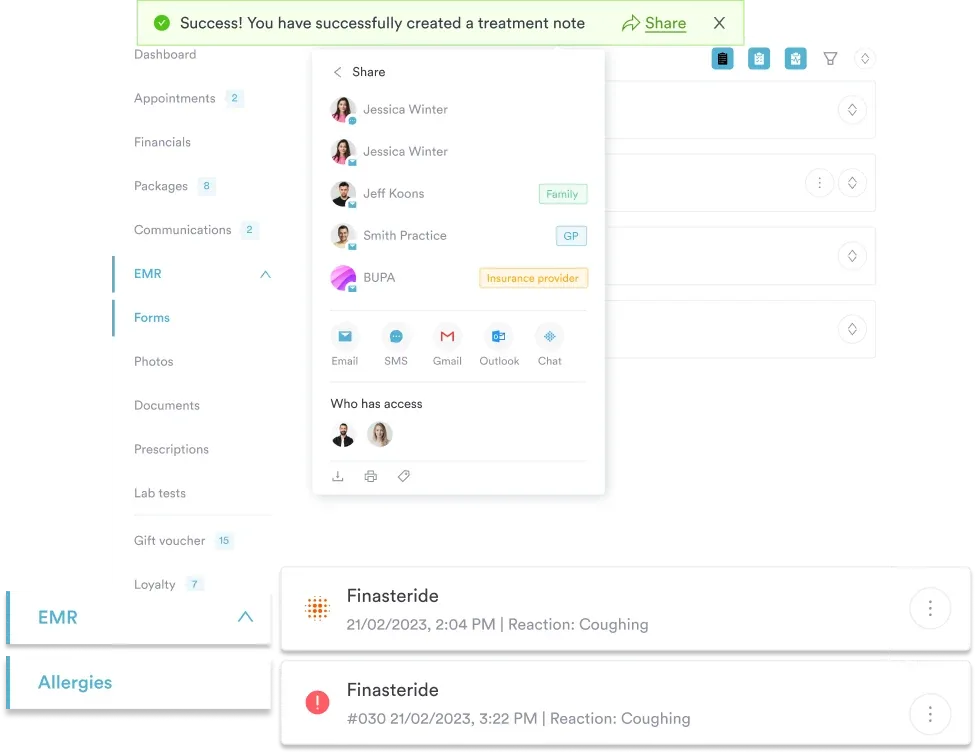
The operative note should record each of the following:
T1100 covers the operating surgeon’s fee only. These are the situations billing teams meet most often with it:
When you are unsure how an insurer handles a combination, ask its provider services team before you submit. Keep each insurer’s answer on file to save the same query next time.
Most T1100 denials are predictable, and most can be caught before submission. The table maps each common reason to its fix.
If a claim is declined, raise it with the insurer’s provider services team first. A patient whose claim is still refused can use the insurer’s complaints process, then the Financial Ombudsman Service. The same steps apply to wider denial management in healthcare: find the cause, correct it, then resubmit.
Run a short check on every T1100 claim before it goes out. Confirm the authorisation reference, the specific ICD-10 code, one procedure code that matches the note and the pathology reference.
Private thoracic and respiratory practices billing T1100 need each claim to reach the insurer complete. Pabau submits CCSD-coded claims through Healthcode, with the operative note in the same patient record.
With Pabau’s claims management software, your team tracks each claim and reconciles the insurer’s payment. Structured medical records keep the histology report beside the note, ready if an insurer asks for clinical support.

Pabau helps UK private practices record operative notes, authorisation references and ICD-10 codes at the point of care, then submits CCSD-coded claims through Healthcode.

T1100 pays for a look inside the pleural space and the samples taken there. The claim holds only while the note shows the operation stayed diagnostic.
Before the invoice goes out, check the note for laterality, findings, biopsy sites and the pathology reference. Then confirm the insurer’s authorisation and its own fee, since Bupa’s £369 and AXA Health’s £200 show how far schedules differ.
Book a demo to see how Pabau sends CCSD claims through Healthcode and keeps the operative note beside each one.

Sampling the pleura with a needle instead? CCSD code T1410 covers billing for needle biopsy of pleura.
Inspecting the mediastinum rather than the pleura? CCSD code E6300 covers diagnostic mediastinoscopy.
CCSD code T1100 covers diagnostic thoracoscopy, with or without biopsy. The surgeon inspects the pleural cavity through a thoracoscope and may sample abnormal tissue in the same session. Therapeutic work, such as pleurodesis, pleurectomy or decortication, has its own CCSD codes.
The descriptor reads “+/- biopsy”, so a pleural biopsy taken during the diagnostic thoracoscopy is part of T1100. Billing a separate pleural biopsy code for the same session is likely to be queried. A VATS lung biopsy has its own code, E5932.
Bupa’s February 2026 CCSD schedule lists T1100 in band INTER 4, with a fee of £369. AXA Health’s schedule lists it at £200, and Aviva, Vitality and other insurers publish their own. Check each insurer’s current figure before you quote a patient.
UK insurers use WHO ICD-10. Common pairings are J90 (pleural effusion, not elsewhere classified), C45.0 (mesothelioma of pleura), C38.4 (malignant neoplasm of pleura) and C78.2 (secondary malignant neoplasm of pleura). Use the most specific code the notes and histology support.
Most UK private medical insurers expect pre-authorisation before a planned thoracoscopy. Requirements differ between insurers and policies. Confirm cover with the patient’s insurer before you book, and quote the authorisation reference on the invoice.
Bupa lists T1100 under Video Assisted Thoracic Surgery (VATS). The descriptor itself names diagnostic thoracoscopy and does not specify the technique. If the patient had a local anaesthetic pleuroscopy, confirm with the insurer that it accepts T1100.
The usual reasons are a missing authorisation reference, a vague ICD-10 code, and an extra biopsy code for the same session. A note that does not show the procedure stayed diagnostic causes queries too, as does a policy exclusion. Each one can be checked before the invoice goes out.