HCPCS Code V5095: Semi-implantable middle ear hearing prosthesis
HCPCS Code V5095: Definition and clinical descriptor HCPCS Code V5095 is the Lev...

Last Updated: Nov 25, 2026
E5932 is the CCSD code for a VATS lung biopsy. This keyhole procedure takes a small lung tissue sample through ports in the chest wall for diagnosis. It covers the surgeon's operative fee for the biopsy only.
The code sits in sub-chapter 8.7.0, Video Assisted Thoracic Surgery (VATS), of the CCSD schedule. A VATS wedge resection is coded E5442 and a lobectomy E5432, so the operative note decides which code applies.
Let Pabau's smart automation suggest the right codes, reduce claim denials, and keep your practice compliant—effortlessly.
Automate repetitive tasks and focus on what matters most—your patients.
Reduce coding errors and ensure compliance with the latest regulations.
Clean claims, fewer denials, and faster reimbursements.
Powerful insights and reporting to help your practice thrive.
HIPAA compliant SOC 2 certified GDPR-compliant Trusted by 4,000+ clinics worldwide

CCSD code E5932 covers a VATS lung biopsy only, so a VATS wedge resection (E5442) or lobectomy (E5432) needs its own code.
Each claim needs a paired ICD-10 diagnosis code, an operative note confirming the thoracoscopic approach, and insurer preauthorization in most cases.
Missing or mismatched diagnosis codes and thin operative notes are the leading reasons E5932 claims get denied.
In Pabau’s practice management software, billing teams record the CCSD code against the invoice and submit UK claims through Healthcode.
CCSD code E5932 is the Clinical Coding and Schedule Development (CCSD) procedure code for a VATS lung biopsy in UK private healthcare. Its official descriptor in the CCSD schedule reads VATS lung biopsy, under sub-chapter 8.7.0, Video Assisted Thoracic Surgery (VATS). Thoracic surgeons and their billing teams use it to invoice private insurers and self-paying patients. Those insurers include Bupa, AXA Health, Aviva, Cigna, Vitality and WPA.
E5932 covers the biopsy only. A VATS wedge resection is coded E5442 and a VATS lobectomy is coded E5432, and CCSD lists both as unacceptable combinations with E5932. Billing a resection code when only a biopsy was performed is upcoding and a common audit trigger. Surgical intent, confirmed in the operative note, draws the line. A biopsy removes a small specimen for diagnosis, while a resection removes a portion of lung parenchyma as treatment or staging.
A VATS lung biopsy is performed under general anesthesia, with the patient lying on their side (lateral decubitus). The thoracic surgeon makes two or three small port incisions, each typically 1–2 cm, in the chest wall. A thoracoscope goes through one port and the biopsy instruments through the others. This avoids the larger incision of an open thoracotomy and generally means a shorter hospital stay and faster recovery.
For coding, the size of the specimen matters. If the surgeon removes a wider wedge of lung parenchyma, the procedure becomes a VATS wedge resection and E5932 no longer applies. The operative note must confirm a thoracoscopic approach and a biopsy-sized specimen.
E5932 is appropriate when a thoracic surgeon performs a VATS lung biopsy to diagnose, stage or characterize a pulmonary abnormality. The clinical scenario also decides which ICD-10 diagnosis code goes on the claim. For suspected interstitial lung disease, J84.9 covers the unspecified disease until the biopsy names the pattern. A diagnosis code that doesn’t match the indication is one of the most common reasons E5932 claims are denied.
E5932 covers the surgeon’s operative fee for the VATS lung biopsy. Anesthesia, assistant surgeon fees and certain consumable or facility charges are billed under separate codes. Leaving out a required paired code, or bundling items that should be billed separately, are both common reasons for claim adjustments.
The costliest VATS lung biopsy error is swapping the biopsy and resection codes. Insurers cross-check the operative note against the submitted CCSD code. Billing a resection code for a biopsy triggers audit queries and can lead to recovery action. Two questions from the operative note settle which code applies.
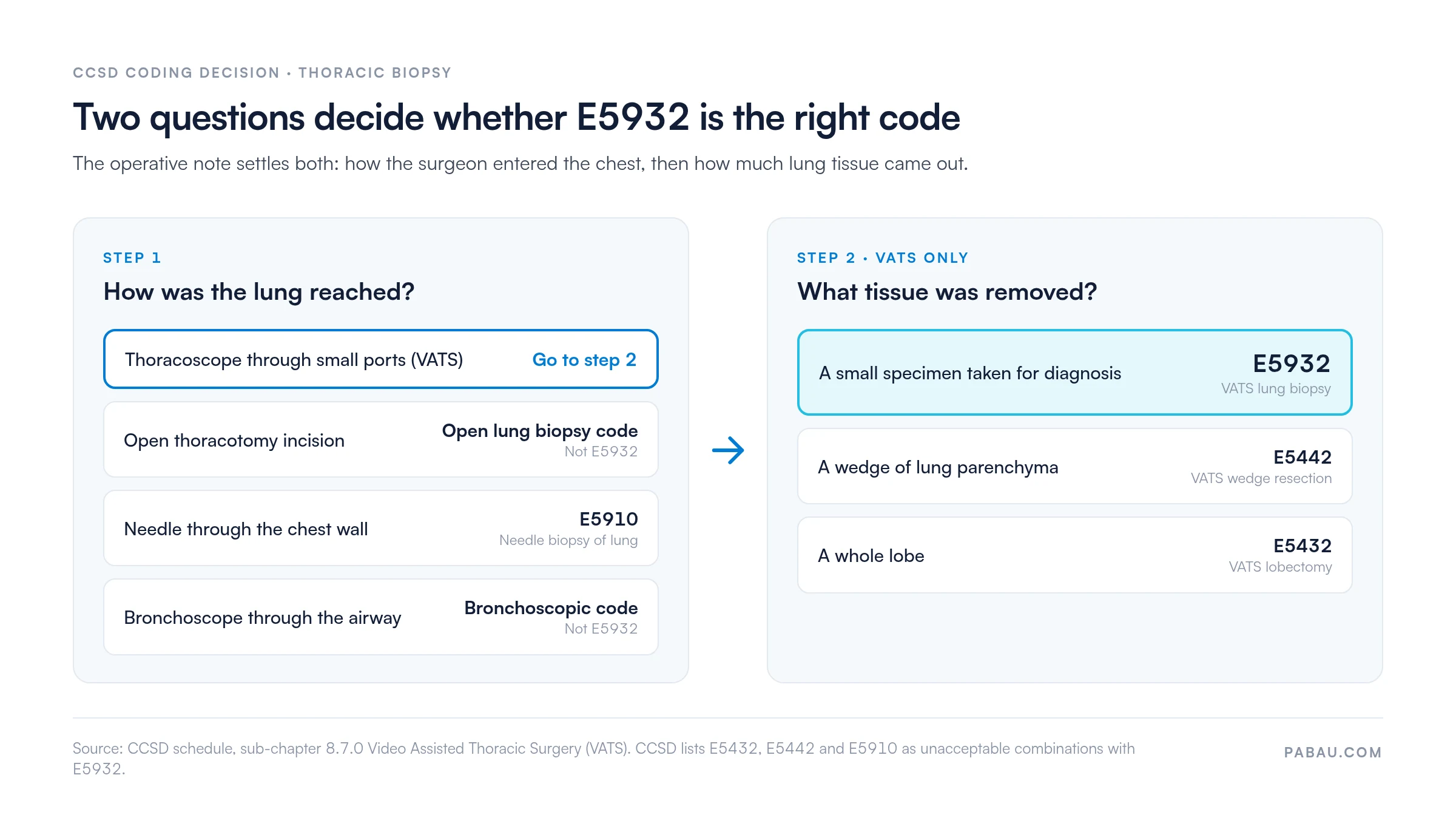
The table below sets out the boundary between E5932 and the codes most often confused with it.
A planned VATS biopsy is sometimes converted to an open thoracotomy during the operation. The billing code should then reflect the approach performed. The operative note must document the reason for conversion and confirm the final approach.
Check the operative note before coding. If it describes a wedge of lung parenchyma removed as a resection, E5932 is the wrong code and E5442 applies. A stapler used only for hemostasis at the biopsy site doesn’t change the code. If the note is unclear, ask the surgeon to clarify before you submit the claim.
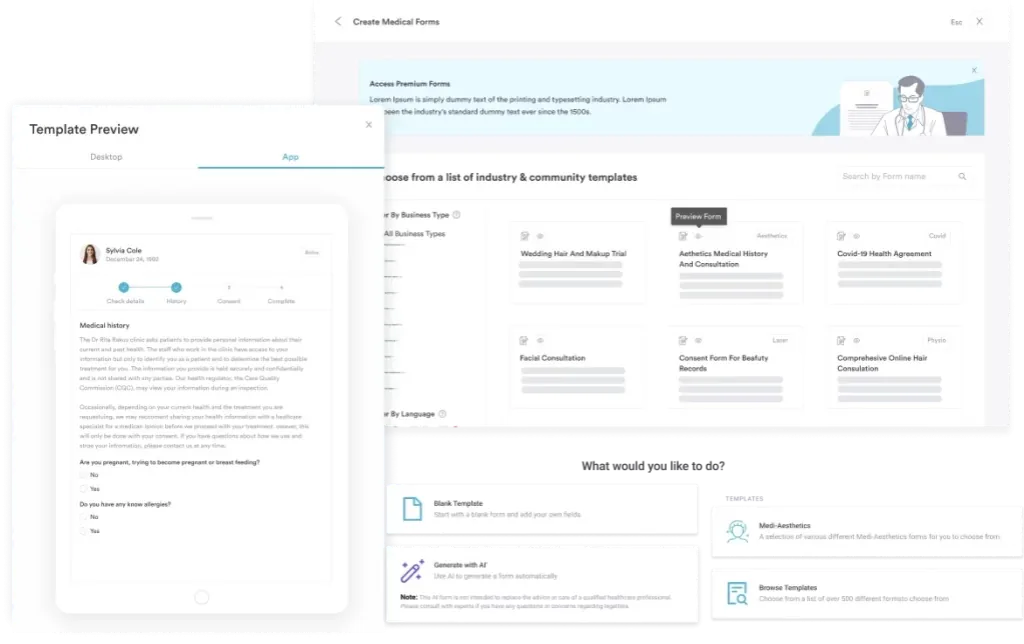
A complete operative note is the strongest protection against an E5932 denial. Insurers audit procedure notes for specific elements before authorizing payment. A claim submitted without them is likely to be queried or refused. Capturing the note on a structured digital form makes those elements harder to miss.
The operative note for E5932 must contain all of the following:
Beyond the operative note, insurers also need the preauthorization reference where applicable, the ICD-10 diagnosis code and the consultant’s recognition details. The invoice date must match the date of surgery. Each insurer sets its own submission rules, and our guide to Bupa CCSD codes covers Bupa’s.
Most major UK private insurers require preauthorization before they pay for a VATS lung biopsy. The referring clinician or the consultant’s billing team submits the proposed code (E5932), the clinical indication and supporting imaging reports. Requirements vary by insurer and can change without notice. Always check the relevant insurer portal before the procedure date.
These requirements were checked at the time of writing but can change without notice, so confirm them with each insurer before the procedure date. Emergency VATS lung biopsies follow separate insurer pathways. Contact the insurer’s emergency authorization line before submission.
E5932 claims are denied for a consistent set of reasons, and most are preventable with checks before submission. Teams that track their denial codes usually fix these at the documentation stage rather than at appeal.
Reimbursement for E5932 comes from two fee schedules: the insurer’s and the consultant’s own. CCSD maintains the codes but doesn’t set fees, and each insurer decides what it pays for each code. No single published figure applies across insurers, so check rates with each one directly.
Consultants new to private practice should request each insurer’s current fee schedule and review it at least once a year, as rates are updated periodically.
VATS lung biopsy billing runs through four time-sensitive steps, and each one can fail on its own:
In Pabau’s claims management software, billing teams record the CCSD code against the invoice and pair a diagnosis code at invoice creation. The team also records the insurer’s preauthorization code and dates on the patient’s case, and Pabau warns when one is missing. Claims go to UK insurers through Healthcode, so nobody re-keys them into a second system.
Operative notes written in Pabau’s clinical records are available to the billing team from the patient record. Coders can check the approach, laterality and specimen type before they submit, without chasing the surgeon for a paper note.
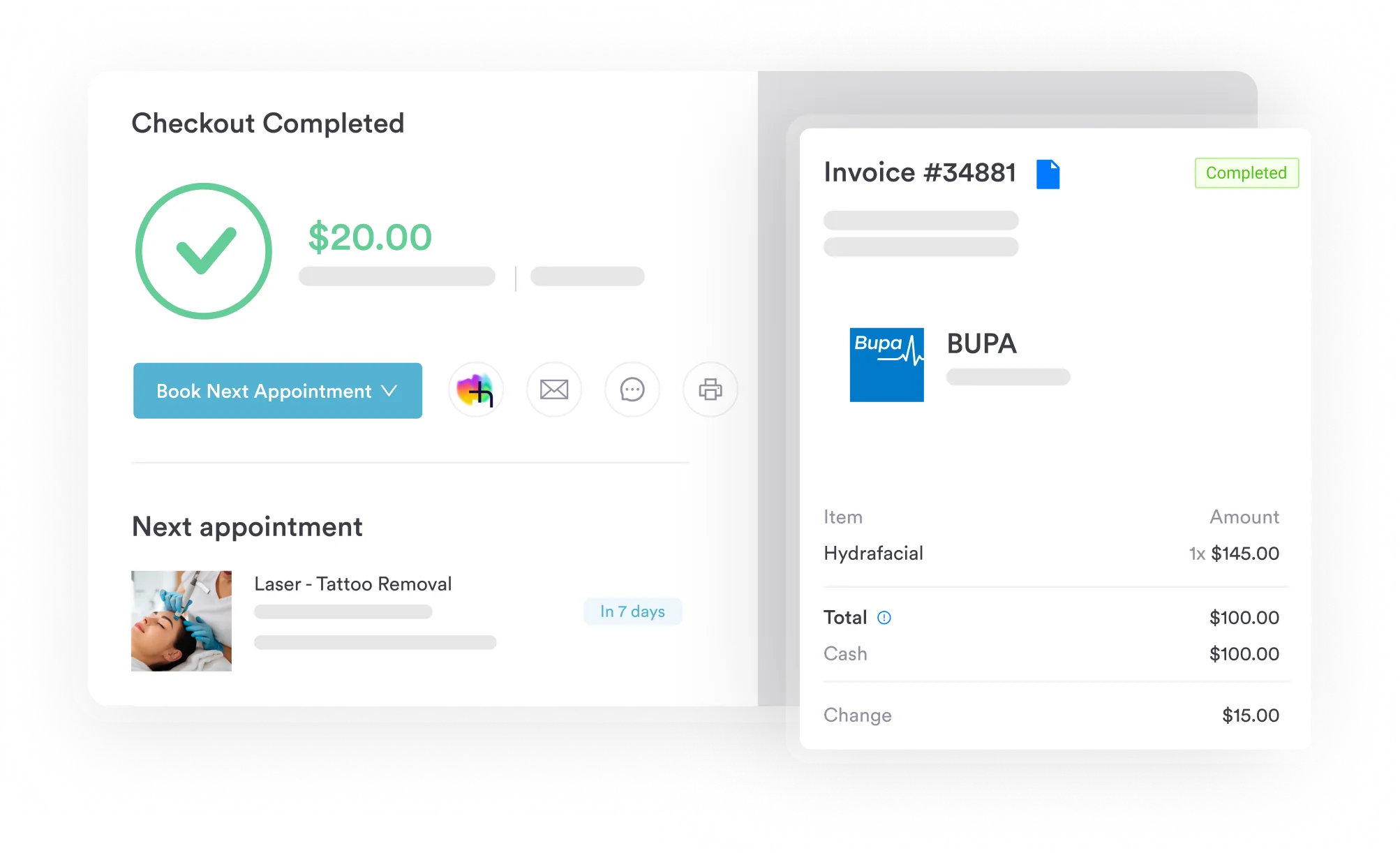

Record CCSD codes against the invoice, pair an ICD-10 diagnosis code at invoice creation, and submit claims to UK insurers through Healthcode. See how it works for private thoracic practices.

Treat E5932 as a narrow code. Before a claim leaves the practice, read the operative note for two facts: a thoracoscopic approach and a biopsy-sized specimen. If either is missing, send the note back to the surgeon rather than guessing at the code.
That single check prevents the swaps with E5442 and E5910 that insurers query. Add the preauthorization reference and a diagnosis code that matches the indication, and the claim can stand up to an audit.
Book a demo to see how Pabau keeps operative notes, diagnosis codes and Healthcode claims together for private thoracic practices.

Need a full reference for Bupa CCSD codes? Bupa CCSD codes covers the complete Bupa procedure code set with billing and submission guidance for UK private practice.
Coding a VATS wedge rather than a biopsy? CCSD code E5442 explains when a VATS wedge resection takes its own code.
Chasing denied insurer claims? Denial codes in medical billing explains the common insurer denial codes and what each one means.
Looking to streamline insurer claim submission? Claims management software shows how Pabau records CCSD codes on invoices and submits UK claims through Healthcode.
CCSD code E5932 covers a VATS lung biopsy. In this keyhole procedure, a thoracic surgeon takes a lung tissue sample through small ports for histology. The code covers the surgeon’s operative fee only. Anesthesia, histopathology and facility charges are billed separately.
Yes, Bupa requires preauthorization for elective VATS lung biopsy. Submit the proposed CCSD code (E5932), the clinical indication and supporting imaging reports through the Bupa provider portal or Healthcode before the procedure date. A missing preauthorization reference is one of the most common reasons E5932 claims are denied.
Pair E5932 with the ICD-10 code for the clinical indication. Use R91 for an abnormal lung finding on imaging (such as an undiagnosed infiltrate), J84.9 for unspecified interstitial lung disease, or D86.0 for sarcoidosis. Once histology confirms malignancy, use the appropriate C34 code. If histology changes the diagnosis, update the code before you submit.
E5932 is for biopsy only. A VATS wedge resection is coded E5442, and billing the wrong one of the two is an audit trigger. The operative note must confirm that only a biopsy specimen was removed. If the note describes removal of a wedge of lung parenchyma as a resection, E5932 is not the correct code. A stapler used only for hemostasis at a biopsy site does not change the code.
The most common triggers are a missing preauthorization reference and an absent or mismatched ICD-10 diagnosis code. An operative note that doesn’t confirm the thoracoscopic approach and biopsy nature is another. So is billing E5932 alongside the needle biopsy code E5910 for the same episode. A checklist applied before the claim reaches Healthcode prevents most of these denials.
E5932 applies only to the thoracoscopic (VATS) approach. An open lung biopsy through a thoracotomy uses a different CCSD code that reflects the open access. The operative note decides it: port-based thoracoscopic access is E5932, and an open chest incision takes the open biopsy code.