CPT Code 62284: Injection procedure for myelography
CPT Code 62284: official descriptor and procedure overview The American Medical ...

Last Updated: Oct 19, 2026
E1742 is the CCSD code for lateral rhinotomy into sinuses. The surgeon makes an external incision along the side of the nose to reach the maxillary, ethmoid, frontal, or sphenoid sinuses under direct vision.
The code sits in section 5.5 (nasal sinuses) of the ear, nose and throat chapter, and Freedom Health Insurance bands it as Intermediate complexity. Purely endoscopic sinus surgery, done through the nostril with no skin incision, takes a different code, such as E1432 for bilateral FESS.
Let Pabau's smart automation suggest the right codes, reduce claim denials, and keep your practice compliant—effortlessly.
Automate repetitive tasks and focus on what matters most—your patients.
Reduce coding errors and ensure compliance with the latest regulations.
Clean claims, fewer denials, and faster reimbursements.
Powerful insights and reporting to help your practice thrive.
HIPAA compliant SOC 2 certified GDPR-compliant Trusted by 4,000+ clinics worldwide

CCSD code E1742 covers lateral rhinotomy into sinuses, an open external approach to the paranasal sinuses that differs from endoscopic surgery such as FESS.
It fits sinonasal tumors, inverted papilloma, and complex chronic rhinosinusitis where endoscopic access isn’t enough.
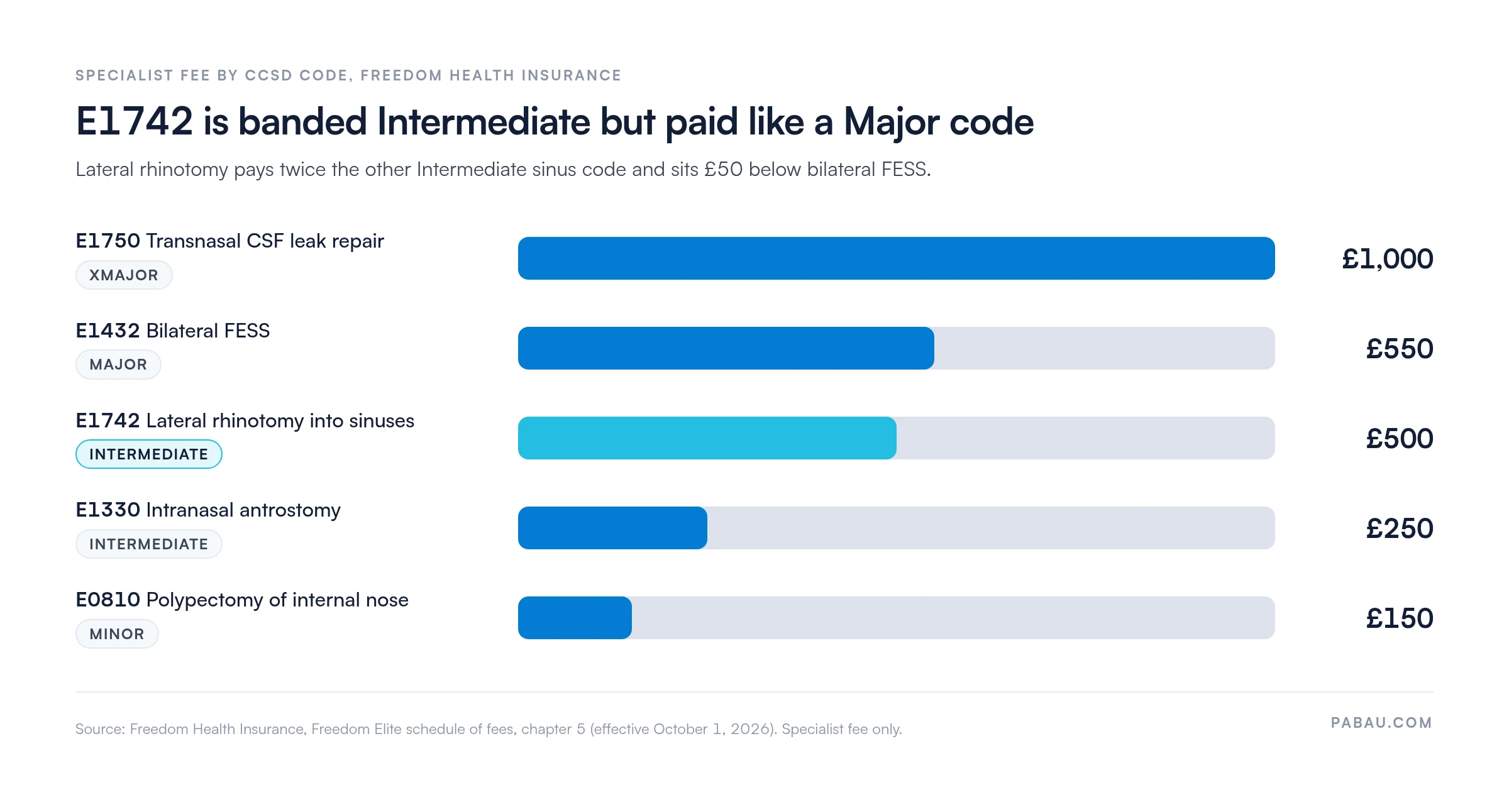
Freedom Health Insurance bands E1742 as Intermediate complexity but pays £500 for it, close to the £550 it pays for Major-band bilateral FESS.
UK private medical insurers require pre-authorization first, and a claim without an authorization reference is usually declined.
Operative notes must record the sinuses entered, the external approach, the pathology addressed, and whether surgery was unilateral or bilateral.
CCSD code E1742 is the code UK private medical insurers (PMIs) use for lateral rhinotomy into sinuses. The surgeon makes an external incision along the side of the nose and opens one or more paranasal sinuses: the maxillary, ethmoid, frontal, or sphenoid.
The code sits in section 5.5 (nasal sinuses) of the ear, nose and throat chapter of the CCSD schedule. Its official descriptor is Lateral rhinotomy into sinuses. The Freedom Health Insurance fee schedule bands it as Intermediate complexity, with a £500 specialist fee and a £285 anesthetist fee.
Section 5.5 also holds the endoscopic sinus surgery codes, external frontoethmoidectomy (E1410), and transnasal repair of a cerebrospinal fluid (CSF) leak (E1750). The CCSD code index lists the rest of the chapter.
Each insurer applies the schedule with its own fees and rules. The Bupa CCSD codes guide shows how one major insurer does it. Because the neighboring codes describe similar operations, picking the wrong one is a common reason auditors query or reject an ENT claim.
Lateral rhinotomy is an open operation. The surgeon cuts from the inner corner of the eye (the medial canthus) down the side of the nose to the nasal ala. That external incision is what separates E1742 from the endoscopic sinus codes. The surgeon works under direct vision through an open field instead of through a telescope passed up the nostril.
After the incision, the surgeon lifts the soft tissue to expose the nasal bone and the sinonasal structures beneath it. Part of the lateral nasal wall is then removed to reach the sinuses. When the maxillary sinus is the target, this is often done through a medial maxillectomy approach.
Key procedural steps the operative note should capture:
The operation is done under general anesthesia. The anesthetist bills separately under the applicable CCSD anesthetic codes, so anesthesia is never bundled into E1742.
Lateral rhinotomy is reserved for cases where endoscopic access isn’t enough, or where the extent of disease calls for open visualization. Accepted clinical indications that support this code include:
The indication in the operative note and on the claim form must match a valid ICD-10 diagnosis code. Insurers check the CCSD procedure code against that ICD-10 code to confirm medical necessity. A mismatch between the two is a common denial trigger.
Lateral rhinotomy into sinuses is often confused with nearby codes for endoscopic sinus surgery or polypectomy. The table below shows how E1742 differs from its closest neighbors.
Descriptors and complexity bands above come from the Freedom Health Insurance schedule of fees (chapter 5, effective October 1, 2026). E1750 is sometimes mislabeled as medial maxillectomy, but maxillectomy codes sit in chapter 6, which covers the face, mouth, salivary glands, and thyroid.
The complexity band doesn’t predict the fee as neatly as you might expect. Freedom pays £500 for E1742, twice the £250 for intranasal antrostomy and only £50 below bilateral FESS.
For billing, the deciding factor is the approach. FESS (functional endoscopic sinus surgery) is done entirely through the nostril with no skin incision, and bilateral FESS is billed under E1432. If an external lateral nasal incision was made and a sinus was entered, E1742 is the correct code.
Billing a FESS code for an open rhinotomy, or billing both without separate documentation of each, risks a duplicate billing rejection. Freedom’s schedule also states that FESS already includes polyp removal, antrostomy, and turbinate reduction, so those aren’t charged as extra procedures.
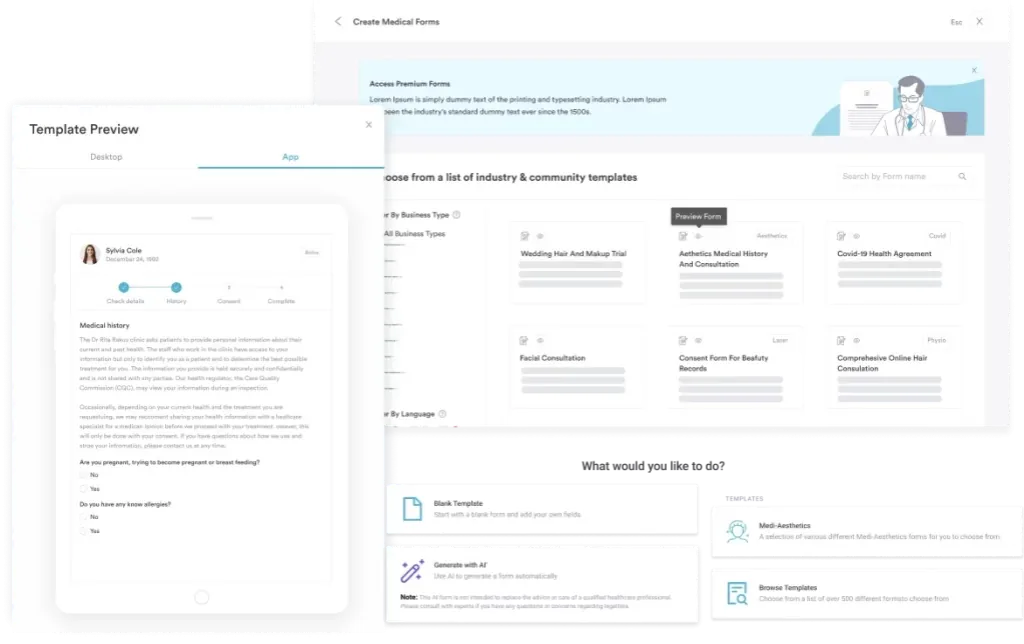
Private medical insurers routinely audit ENT surgical claims. An E1742 claim with a thin operative note is likely to be queried or paid at a reduced rate. Structured digital forms for operative notes make it much harder to leave out a required element before the claim goes out.
The operative note must include all of the following to support a valid claim:
The Royal College of Surgeons of England sets out what an operative note should contain in its Good Surgical Practice guidance. A note written to that standard gives an insurer’s auditor very little to query.
UK GDPR also governs how patient data in operative notes is stored and shared. Make sure your practice’s data handling policy covers surgical records as well as the clinical file.
UK private medical insurers require pre-authorization before lateral rhinotomy is performed. That holds even though fee schedules band E1742 as Intermediate complexity rather than Major. Proceeding without an authorization reference number from the insurer almost always gets the claim declined, however medically necessary the surgery was.
Individual insurer requirements vary. The general framework across Bupa, AXA Health, Vitality, Aviva, and WPA is as follows:
Check each insurer’s requirements before you submit the pre-authorization request. The Bupa code search portal and the Vitality fee finder show whether a CCSD code needs pre-authorization and what each insurer pays. Requirements change, so rely on the live insurer portal over old paperwork.
Before you send the pre-authorization request for E1742, ask the insurer in writing whether it needs proof that FESS was tried or ruled out. Some PMIs treat that as a condition for approving an open rhinotomy. Put the clinical rationale in the referral letter as well as the operative note, so the authorization team sees it before deciding.
For CCSD code E1742, these are the denial triggers to plan around:
Lateral rhinotomy is usually unilateral, with one side of the nose opened to reach the affected sinus. Watch the wording of the descriptor here. Most section 5.5 codes include “and bilateral,” meaning one code covers both sides, but E1742’s descriptor does not.
So when both sides are operated on in one session, billing depends on the insurer’s contract and current CCSD guidance. The general approach across most UK private medical insurers is:
When in doubt, call the insurer’s provider line before billing. A pre-submission query costs nothing. A rejected bilateral claim means resubmission delays and a possible shortfall in the practice’s revenue.
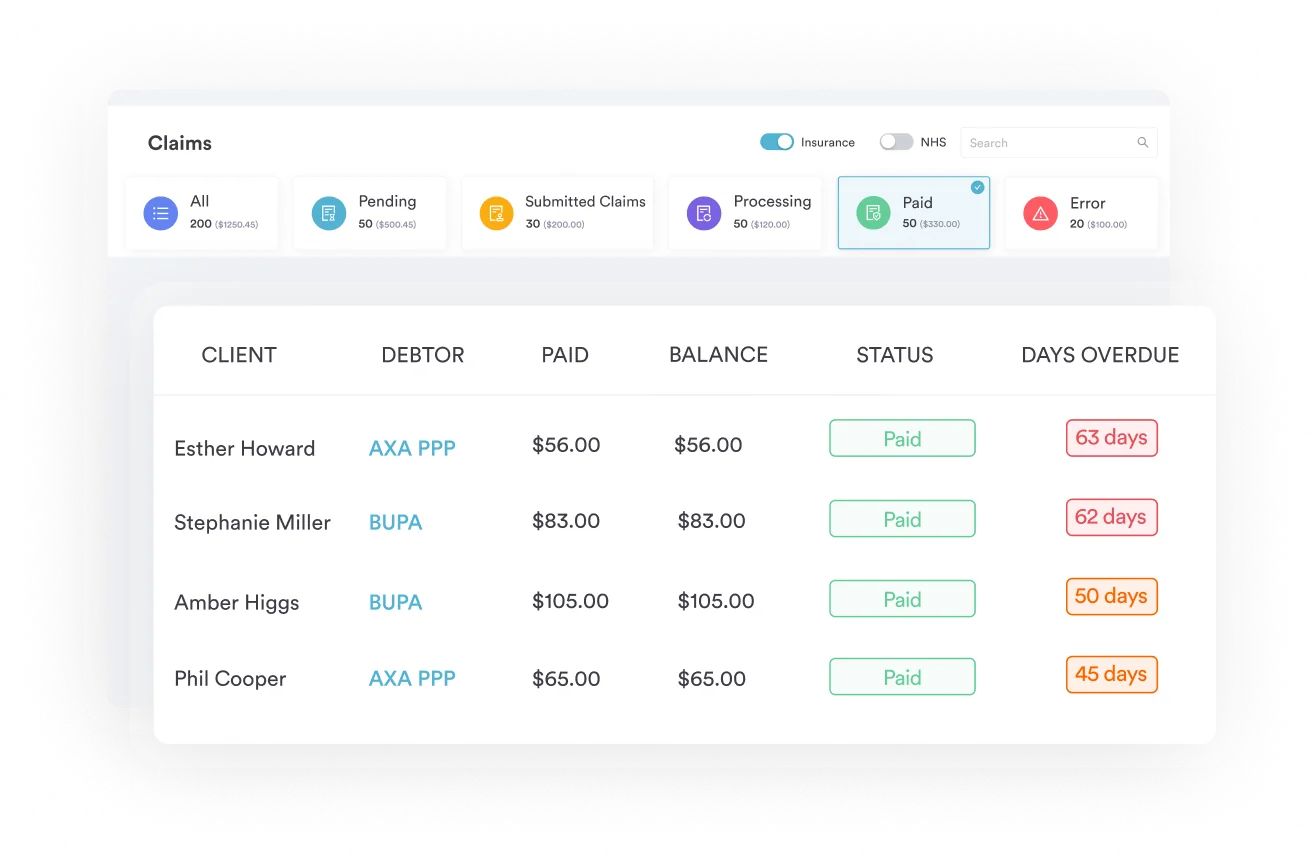
Private ENT practices juggle pre-authorization status, operative notes, and claim submission across several insurers, each with its own rules and fees. Pabau keeps those pieces together on one patient record. Its private practice claims software tracks each claim from the pre-authorization request to payment, with an audit trail for any insurer query.
For CCSD billing workflows, Pabau supports:
When the authorization reference, CCSD code, and ICD-10 code sit on the same invoice, the insurer’s claims team has fewer reasons to send it back. Your team spends less time resubmitting paperwork and more time on the next patient.

Pabau helps private ENT and surgical practices track CCSD codes, pre-authorization status, and claim submissions, so every invoice reaches the insurer complete.

E1742 claims rarely fail because of the surgery itself. They fail on paperwork: a missing authorization reference, a note that never mentions the external incision, or a FESS code billed alongside it. Every one of those is fixed before the patient reaches the operating room.
Check the patient’s insurer schedule for the fee and the bilateral rule first, because the Intermediate band on E1742 says little about what it pays. Then write the operative note to the standard an auditor expects.
Book a demo to see how Pabau keeps pre-authorization references, operative notes, and CCSD invoices together for private ENT practices.

Reaching the ethmoids through the maxillary sinus? CCSD code E1440 explains billing for transantral ethmoidectomy.
Exploring the frontal sinus endoscopically? CCSD code E1480 covers endoscopic frontal sinus exploration and its documentation.
CCSD Code E1742 is the UK private healthcare procedure code for lateral rhinotomy into sinuses. The surgeon makes an external incision along the side of the nose to reach and operate on one or more paranasal sinuses. UK private medical insurers use it under the CCSD schedule to process claims from ENT surgeons.
E1742 requires an open external incision along the side of the nose. Endoscopic sinus surgery codes, such as those covering FESS, describe procedures done entirely through the nostril with no skin incision. Bill E1742 when an external rhinotomy approach was used. Billing an open and an endoscopic code for the same episode without documenting two distinct procedures risks a duplicate billing rejection.
Yes. UK private medical insurers, including Bupa, AXA Health, Vitality, Aviva, and WPA, require pre-authorization before lateral rhinotomy is performed. Fee schedules band E1742 as Intermediate complexity, not Major, but the pre-authorization rule still applies. Without a valid authorization reference number, the claim will typically be declined, however clinically necessary the surgery was.
The operative note must confirm the external lateral nasal incision, the sinuses entered, and the pathology addressed. It must also state whether the procedure was unilateral or bilateral and list any additional procedures with their own CCSD codes. Include a valid ICD-10 diagnosis code that justifies the open approach. The surgeon’s name, GMC number, and date of surgery must also appear on the claim form.
Bill E1742 twice (one unit per side) and document both sides fully in the operative note. Many UK insurers reduce the fee for the second procedure in a bilateral pair, so check the insurer’s current fee schedule before submitting. For staged procedures at separate encounters, submit a separate claim for each, with its own pre-authorization reference.
No. The anesthetist bills anesthesia separately under the applicable CCSD anesthetic code, so it isn’t bundled into E1742. Putting the surgical and anesthetic fees on a single claim line is incorrect bundling, and the insurer’s claims team will query or reject it.