CCSD code A2720: Proximal gastric vagotomy billing guide
What is CCSD code A2720? CCSD code A2720 is the procedure billing code assigned ...

Last Updated: Oct 8, 2026
E1410 is the CCSD code for external frontoethmoidectomy. This open surgery clears the ethmoid cells and frontal recess through an incision between the inner eye and the nose. It covers one side or both. Ear, nose and throat (ENT) surgeons use it when endoscopic access isn't enough, such as after failed endoscopic surgery or for a mucocele.
E1410 sits in Chapter 5 under section 5.5 Nasal sinuses, and Bupa bands it as MAJOR 5. The claim turns on the access route, so the operative note has to state the external incision.
Let Pabau's smart automation suggest the right codes, reduce claim denials, and keep your practice compliant—effortlessly.
Automate repetitive tasks and focus on what matters most—your patients.
Reduce coding errors and ensure compliance with the latest regulations.
Clean claims, fewer denials, and faster reimbursements.
Powerful insights and reporting to help your practice thrive.
HIPAA compliant SOC 2 certified GDPR-compliant Trusted by 4,000+ clinics worldwide

CCSD code E1410 covers external, open-approach frontoethmoidectomy only. Endoscopic sinus surgery uses separate CCSD codes and is never billed under E1410.
The official descriptor reads “External frontoethmoidectomy and bilateral”, so one E1410 covers one side or both.
J32.1 (chronic frontal sinusitis) and J32.2 (chronic ethmoidal sinusitis) are the main ICD-10 codes that establish medical necessity for E1410.
Most UK private medical insurers expect preauthorization before E1410 surgery, and claims sent without it are often denied.
Pabau’s claims management lets ENT secretaries attach the operative note, add the anesthetic code and send the E1410 claim through Healthcode.
CCSD code E1410 is the Clinical Coding and Schedule Development code for external frontoethmoidectomy. The surgeon removes diseased ethmoid air cells and clears the frontal sinus through an open incision beside the eye, rather than through an endoscope.
The code sits in Chapter 5 (ear, nose and throat) of the CCSD schedule, alongside the other CCSD sinus codes in section 5.5 Nasal sinuses. Its official descriptor reads “External frontoethmoidectomy and bilateral”, so one code covers one side or both. Bupa bands it as MAJOR 5 in its fee schedule.
The key distinction in E1410 is the surgical access route. External frontoethmoidectomy uses a Lynch-Howarth incision, a curved cut running from the inner brow down beside the nose. It exposes the ethmoid labyrinth and frontal recess directly.
That open exposure separates E1410 from the endoscopic codes in the same chapter. Your operative note has to establish it beyond doubt for the claim to pay.
External frontoethmoidectomy reaches the sinuses through the medial wall of the orbit (the lamina papyracea) rather than through the nostrils. The surgeon makes a Lynch-Howarth incision and retracts the periorbita laterally.
The anterior and posterior ethmoid cells are then removed under direct vision. Where the frontal sinus is involved, the frontal ostium and recess are cleared in the same operative field.
Three anatomical structures define this procedure and should appear explicitly in the operative note:
E1410 does not include orbital decompression or dacryocystorhinostomy (DCR) performed in the same sitting. If either is carried out at the same time, list its own CCSD code separately on the claim form.
E1410 is indicated in three situations:
The operative note should record which scenario applies. Insurers assess medical necessity against the ICD-10 diagnosis code you submit.
Confirm ICD-10 pairing rules in each insurer’s coding guide before submission. Medical necessity decisions are payer-specific. A diagnosis code that satisfies Bupa may need extra supporting documentation under AXA Health’s policy.
Coding errors on E1410 almost always involve confusion with the endoscopic sinus surgery codes. External frontoethmoidectomy and functional endoscopic sinus surgery (FESS) carry different CCSD codes, fee bands and documentation standards.
Bilateral FESS, for example, bills under E1432, and endoscopic frontal sinus exploration under E1480. Submitting an endoscopic code for an external procedure invites a denial. Submitting E1410 for an endoscopic procedure invites an audit.
The operative note is the decisive document. If it doesn’t say “external incision”, “Lynch-Howarth approach” or equivalent, the coder can’t safely assign E1410, whatever the surgeon intended.
E1410 shares section 5.5 with other sinus operations, including the open E1450 bone flap to the frontal sinus. Knowing the neighbors helps coders spot when an extra code is needed.
It also shows when bundling rules block a second code in the same session. Those rules differ between Bupa, Aviva and Vitality, so check Bupa CCSD codes before you add a secondary code.
Anesthesia billing needs care. Check the exact CCSD anesthetic code against the current schedule before you submit, because the code for a given procedure can change between contract years.
An E1410 claim stands or falls on the operative note. Insurers read it for proof that the surgeon used an external approach, and a note that only names the procedure won’t pass. These elements must appear explicitly.
Build an operative note checklist for ENT procedures so these elements are captured before the note is finalized. Correcting a note after the procedure creates audit risk.
Most UK private medical insurers require preauthorization for E1410 before surgery. A procedure carried out without it is a common denial reason, even when the clinical indication is clear. The request typically includes:
Preauthorization rules differ between Bupa, AXA Health, Vitality and Aviva, so check each insurer’s provider portal before submission. Vitality’s fee finder and the Aviva fee schedule both list what each insurer pays per CCSD code.
Most E1410 denials come from errors a pre-submission review would catch. The table below lists the denial patterns UK private practice billing teams report, with the fix for each. No insurer publishes denial rates for E1410, so these categories come from general ENT surgical claim patterns.
Each of these denials traces back to one stage of the claim, which tells you where to put your checks.
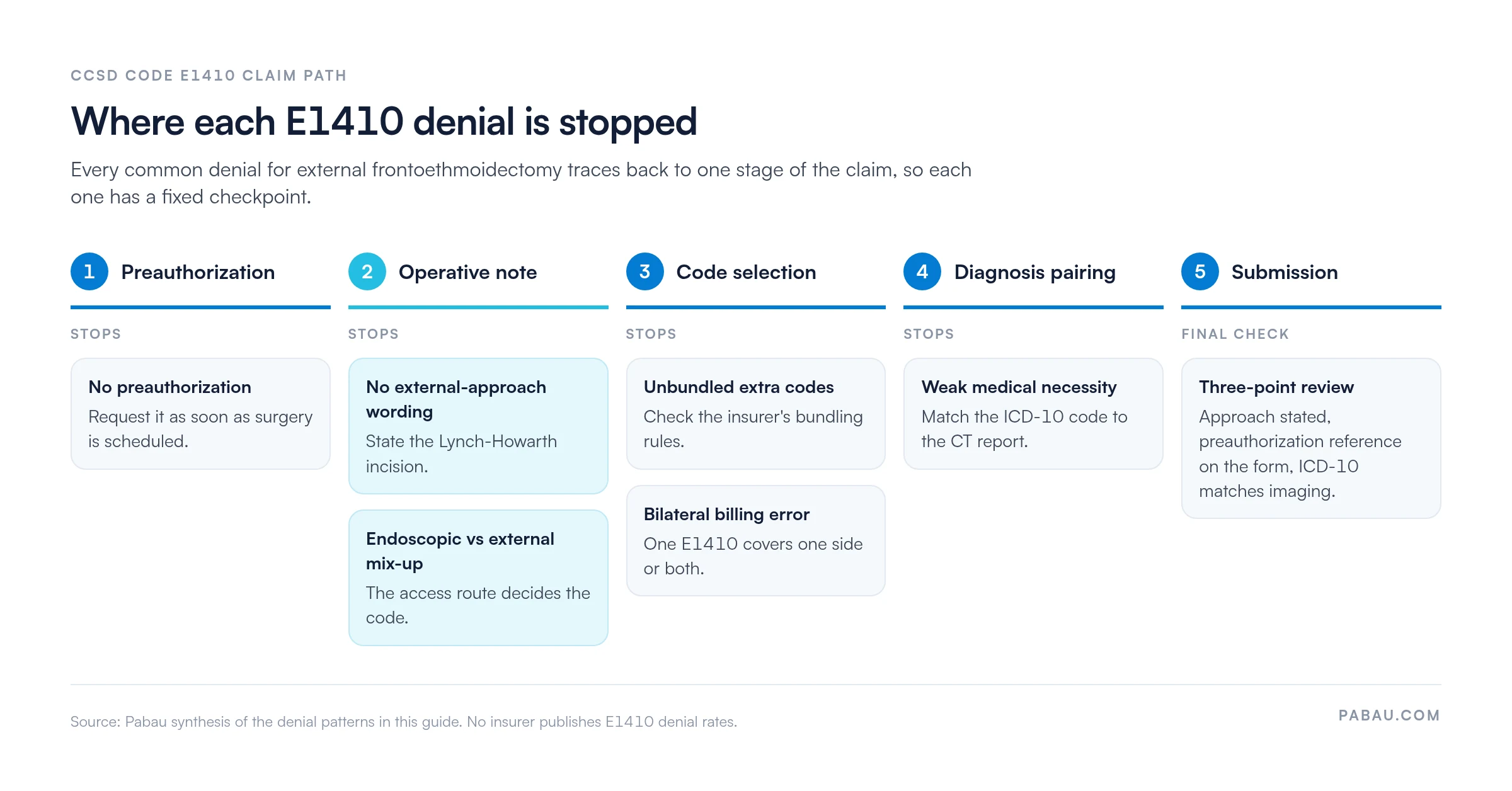
Practices with high ENT claim volumes benefit from a structured denial review cycle. Log denial reasons by code as each one arrives. Waiting for month-end lets one coding error repeat across a whole batch of claims.
Before you submit any E1410 claim, run a three-point check. Confirm the operative note states the external approach, the preauthorization reference is on the claim form, and the ICD-10 code matches the imaging report. It takes under two minutes and catches the three most common denial reasons in one pass.
Once the operative note is finalized and preauthorization is confirmed, submitting E1410 follows a predictable sequence.
In many ENT practices, the claim gets typed twice. The secretary copies the code, preauthorization reference and diagnosis from the patient file into Healthcode. The operative note follows by email when the insurer asks for it.
Pabau, the practice management platform we build, connects to Healthcode, so the claim builds from the patient record instead. With claims management without retyping, the CCSD code, ICD-10 code and preauthorization reference carry across. The operative note sits in the same record, ready for any audit request.
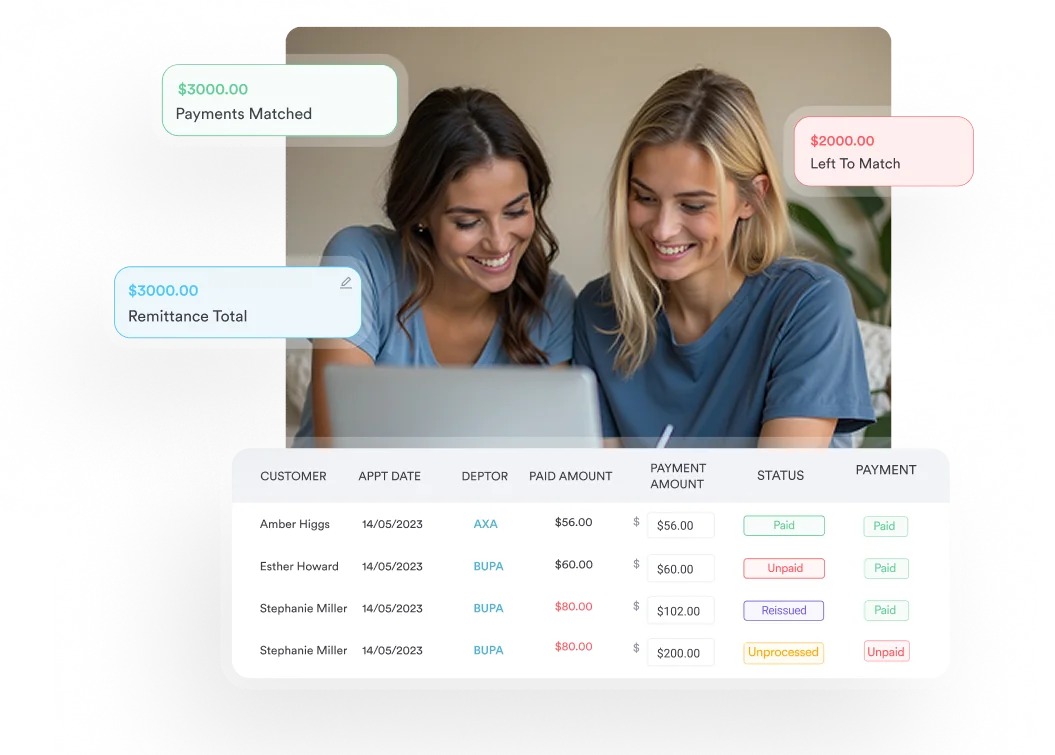
When an insurer pays, the remittance view matches the payment to the invoice. An unpaid or short-paid E1410 claim shows up while there’s still time to chase it.

Build each E1410 claim from the patient record, with the operative note attached. Pabau sends it through Healthcode without retyping, so it goes out clean the first time.

The biggest gain on E1410 comes before the claim exists. Add an external-approach line and a laterality field to your ENT operative note template before the next case. Coders can then assign the code from the note alone, without chasing the surgeon.
Pair that with preauthorization requested on the day surgery is booked. Those two habits close off the denials that take longest to appeal. The cost is a few minutes of template setup, set against an appeal on every claim that goes out without them.
Book a demo to see how Pabau carries the CCSD code, preauthorization reference and operative note from the patient record into each Healthcode claim.

Was the operation done endoscopically after all? CCSD code E1260 covers image-guided endoscopic sinus surgery, the code to check when the note shows no external incision.
Want to see what E1410’s MAJOR 5 band pays? Bupa procedure codes and fee schedule explains how each CCSD code maps to a maximum reimbursable amount.
Coding other nasal operations from the same ENT chapter? CCSD code E1240 covers vidian neurectomy, including the endoscopic approach, for UK private insurers.
Sending CCSD-coded claims to UK insurers every week? The best medical billing software in the UK compares tools that submit claims to Bupa and AXA Health through Healthcode.
CCSD code E1410 covers external frontoethmoidectomy, on one side or both. The surgeon removes ethmoid air cells and clears the frontal sinus through a Lynch-Howarth incision. It excludes endoscopic sinus surgery, anesthesia, orbital decompression and dacryocystorhinostomy, which each carry their own codes.
External frontoethmoidectomy (E1410) reaches the sinuses through an open incision beside the nose. Endoscopic ethmoidectomy uses a transnasal endoscope with no external incision. The two carry different CCSD codes, fee bands and documentation requirements. Mixing them up is the most frequent coding error on sinus surgery claims, so the operative note must confirm the access route.
The CCSD anesthetic code is always billed separately. A frontal sinus drainage code applies when that work goes well beyond the ethmoid clearance. A DCR code or an orbital decompression code applies when either procedure is done in the same session. Bundling rules vary by insurer, so confirm with each payer before adding secondary codes.
The most frequent reasons are the wrong code (endoscopic instead of external, or the reverse) and an operative note without external-approach wording. Missing preauthorization and an ICD-10 code that doesn’t match the imaging come next. Bilateral billing errors and unbundled concurrent procedures also cause denials.
A separate CCSD anesthetic code is always required, because E1410 covers the surgical procedure only. Check the anesthetic code against the current CCSD anesthetic schedule for each claim year.
E1410’s official descriptor reads “External frontoethmoidectomy and bilateral”, so one code covers one side or both. Bupa’s schedule lists it once, with a single fee band. Other insurers set their own bilateral fee rules, so confirm with AXA Health, Vitality and Aviva before submitting a bilateral claim.