CPT Code 25210: Excision of a single carpal bone
CPT Code 25210: Official descriptor and quick-reference data CPT Code 25210 is a...

Last Updated: Nov 26, 2026
V0700 is the CCSD code for cranio-facial resection, a combined transcranial and transfacial operation. It covers en-bloc removal of a tumor involving both the anterior skull base and the nasal cavity or sinuses. A neurosurgeon and an ENT surgeon usually operate together.
The code sits in sub-chapter 5.5.0 Nasal Sinuses of chapter 5.0.0 Ear, Nose & Throat, with CCSD reference Fe.085. UK private insurers such as Bupa use the CCSD schedule to pay claims.
Let Pabau's smart automation suggest the right codes, reduce claim denials, and keep your practice compliant—effortlessly.
Automate repetitive tasks and focus on what matters most—your patients.
Reduce coding errors and ensure compliance with the latest regulations.
Clean claims, fewer denials, and faster reimbursements.
Powerful insights and reporting to help your practice thrive.
HIPAA compliant SOC 2 certified GDPR-compliant Trusted by 4,000+ clinics worldwide

CCSD code V0700 is the UK code for cranio-facial resection, a combined transcranial and transfacial operation on the anterior skull base and sinuses.
It sits in chapter 5.0.0 Ear, Nose & Throat, sub-chapter 5.5.0 Nasal Sinuses, with CCSD reference Fe.085.
The other codes that start V07 are V0721 and V0722, which cover jaw joint surgery. Codes V0710, V0720 and V0730 do not exist.
Each insurer sets the fee, the pre-authorization rules and the rules for a second surgeon or a second code. Check them with the payer before the operation.
Pabau’s claims management software keeps the authorization and both operation notes on the patient record, so the claim goes out complete.
CCSD code V0700 is the code UK private insurers use for cranio-facial resection. It belongs to the schedule kept by the Clinical Coding & Schedule Development (CCSD) Group. The CCSD technical guide describes that schedule as a common language shared by insurers, providers and consultants.
The operation removes a tumor that crosses the anterior skull base, from the brain side above and the nasal or sinus side below. Surgeons reach it through a craniotomy and a facial or endonasal approach in the same sitting.
Some guides online describe CCSD as a South African coding system for medical aids. CCSD is a UK schedule. South African practices bill procedures with a separate code set, CCSA.
Pabau’s CCSD code library lists the other procedure codes we cover.
Cranio-facial resection is a major cancer operation for tumors that cross from the sinonasal space into the anterior skull base. No single specialty can safely reach both compartments alone. A neurosurgical team usually works from above through a craniotomy. An ENT or head and neck team works from below, through facial degloving, a lateral rhinotomy or an endonasal route.
The main surgical steps are:
It is a long operation under general anesthesia, and the anesthetist bills separately for it.
V0700 fits when imaging and histology confirm a lesion involving the skull base that can be resected with curative or cytoreductive intent. The most common indications are:
Patient selection goes through a multidisciplinary team (MDT). Keep the MDT decision record with the case, because insurers often ask for it at pre-authorization.
When an insurer asks for a diagnosis, UK claims use WHO ICD-10 codes. The table lists the codes most often paired with cranio-facial resection.
Code to the subsite the histology report names. An ethmoid adenocarcinoma is C31.1, for example. Use the unspecified code C31.9 only when the report cannot say which sinus is involved.
The other two codes that start V07 have no link to the skull base. V0721 and V0722 cover eminectomy of the temporomandibular joint, in sub-chapter 6.1.0 Face and Jaws. Arthroplasty of that joint has its own code in the same sub-chapter, V2030. Codes V0710, V0720 and V0730 have no record in the CCSD schedule at all.
The closer neighbors sit beside V0700 in sub-chapter 5.5.0 Nasal Sinuses. The table shows when each one fits instead.
If the note shows no transcranial stage, V0700 is the wrong code, and the diagram below maps each finding to its code. Pabau’s guides to CCSD code E1742 and CCSD code E1750 cover two of those neighbors. Look any code up in the CCSD schedule before you bill it, because some online lists carry codes that were never issued.
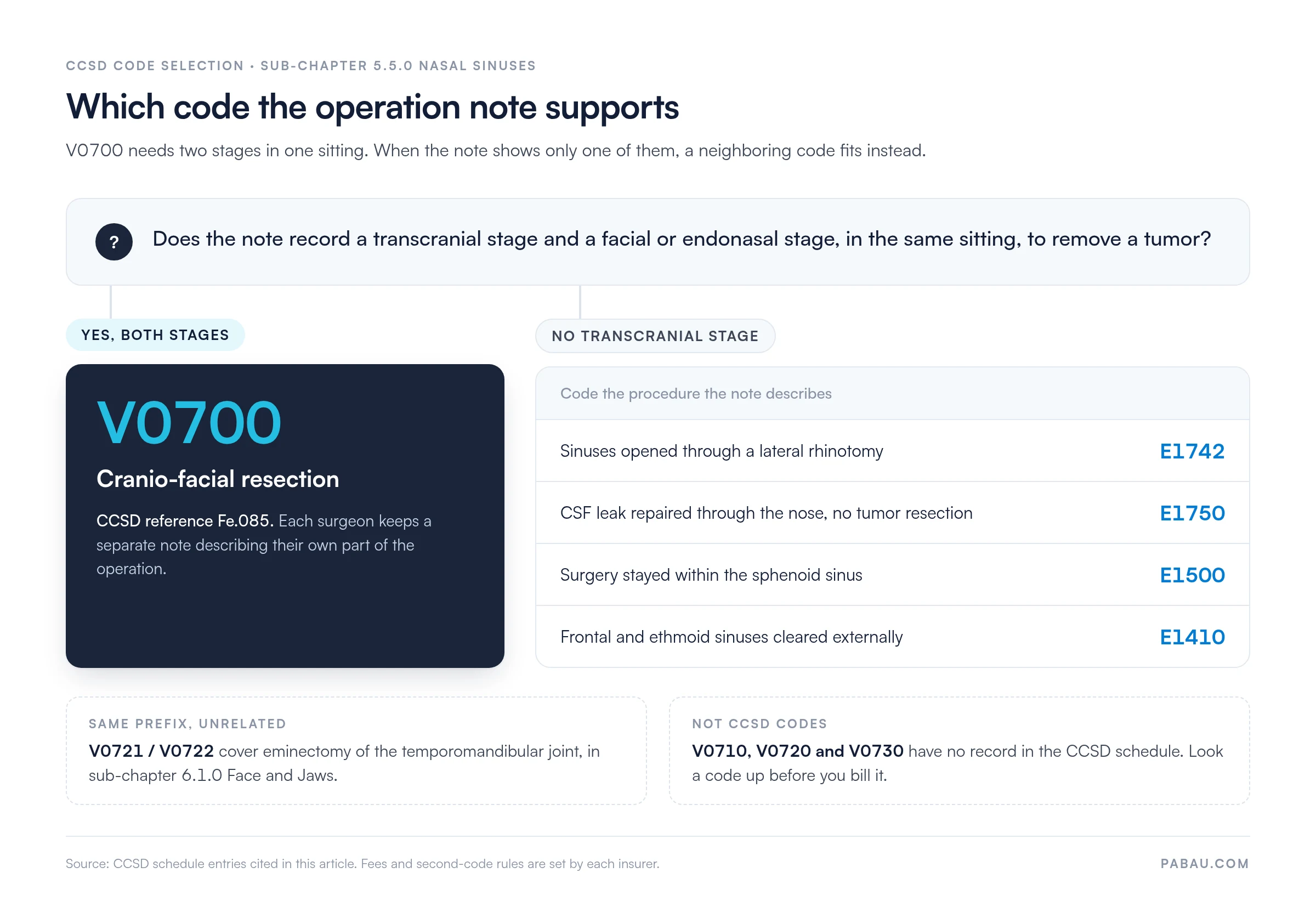
The operation note is the main evidence behind a V0700 claim. A note that only says “craniofacial resection performed” leaves the insurer to guess, and a query usually follows.
The note should record these six points:
Cranio-facial resection usually has a neurosurgeon and an ENT or head and neck surgeon operating together. Each surgeon should keep a separate operation note that describes their own part of the procedure. Identical notes for both surgeons make the claim harder to defend.
How a second surgeon or an assistant is paid comes from the insurer’s contract rules and the CCSD guidance, not from the code itself. The CCSD Group leaves the fee and complexity band for each code to the funder and provider. Ask the insurer how it wants a two-surgeon V0700 claim submitted before the operation.
Skull base reconstruction is often done in the same sitting. CCSD codes aim to capture the most significant intervention, not every stage of it. The CCSD technical guide adds that each insurer has its own rules for billing two procedure codes. The CCSD website also flags code pairs that should not be billed together.
Check both sets of rules before you add a reconstruction or dural repair code to V0700. Record in the note why the extra procedure was needed.
Before a V0700 claim goes out, check three points. The authorization reference is on the claim, and each surgeon’s note describes their own part. The ICD-10 code also has to match the histology report.
Most UK insurers expect planned surgery to be authorized in advance, and the patient’s policy decides what is covered. Pre-authorization runs through the insurer, so start it once the MDT has agreed the plan.
The request usually needs:
Once the operation is done, the claim follows the same five steps whichever insurer pays it.
The anesthetist bills their own fee for the same operation, so share the authorization reference with them. Our guide to Bupa CCSD codes explains how Bupa’s procedure list and claim process work.
Most stalled V0700 claims trace back to a short list of avoidable slips. The table pairs each one with its fix.
On a cranio-facial case, the authorization sits in one inbox and two operation notes sit with two surgeons. The claim is then keyed in by hand. Every handoff is a chance to lose the reference number or send the wrong fee.
Pabau, a practice management platform for private practices, keeps those steps on the patient record. Its claims software for consultants sends each claim electronically through Healthcode and to Bupa. The authorization code, dates and sessions sit on the patient’s case, with a warning when one is missing.
Both surgeons’ notes and the MDT record stay attached to the same case. Your team sends a complete claim the first time and spends less time chasing insurers.

Pabau keeps the authorization, both operation notes and the claim on one patient record. Claims go out electronically through Healthcode and to Bupa, and you can see each one’s status.

V0700 is a UK CCSD code for one operation, a combined transcranial and facial resection of the anterior skull base. The claim holds up when the note shows both approaches and each surgeon records their own part. It also needs a diagnosis that names the subsite.
Before the next case, confirm the insurer’s rules for a second surgeon and a second code, and check its current fee. Book a demo to see how Pabau keeps the authorization, the notes and your Healthcode claim on one patient record.

Need a full Bupa CCSD billing reference? Bupa CCSD codes covers Bupa’s procedure list and how its claims work.
Billing a CSF leak repair on its own? CCSD code E1750 covers transnasal repair of leaking CSF, endoscopic repair included.
Opening the sinuses without a craniotomy? CCSD code E1742 covers lateral rhinotomy into the sinuses.
Looking up another procedure? The CCSD codes index lists the CCSD procedure codes Pabau covers.
CCSD code V0700 covers cranio-facial resection. It is a combined transcranial and transfacial operation to remove a tumor involving the anterior skull base and the sinonasal space or facial skeleton. The code sits in sub-chapter 5.5.0 Nasal Sinuses, with CCSD reference Fe.085.
No. CCSD is the schedule of the UK Clinical Coding & Schedule Development Group, used by UK private insurers such as Bupa. South African practices bill procedures with a different code set, CCSA.
The neurosurgeon and the ENT or head and neck surgeon can each bill for their part of the operation. The insurer’s rules for a second surgeon apply, and each one needs their own operation note. The insurer must also recognize each surgeon for that specialty.
Most UK insurers expect pre-authorization for planned surgery, and it runs through the insurer. Send the MDT decision, imaging, histology and a letter naming V0700. Then put the reference number on the claim.
The most common are C30.0 (nasal cavity), C31.0 (maxillary sinus), C31.1 (ethmoidal sinus), C41.0 (bones of skull and face) and D32.0 (cerebral meninges). Use the subsite the histology report names, and keep C31.9 for cases where it names none.
No. The CCSD schedule has no record of V0710, V0720 or V0730. The only other codes that start V07 are V0721 and V0722, which cover eminectomy of the temporomandibular joint.
Sometimes. Each insurer sets its own rules for billing two procedure codes, and the CCSD website flags pairs that should not be billed together. Check both before you add a flap or dural repair code, and record why it was needed.