CCSD code E1750 – Transnasal repair of leaking CSF
Code Definition
E1750 is the CCSD code for transnasal repair of leaking CSF (including endoscopic). It covers closing a skull base cerebrospinal fluid leak through the nose, and the endoscopy is already part of the code.
E1750 sits in Chapter 5, section 5.5 Nasal sinuses, of the CCSD schedule that UK private medical insurers use. A repair that ends as an open craniotomy takes a different code, and B0410 transsphenoidal hypophysectomy is a listed unacceptable combination.
Related Information
Group
5 Ear, nose and throat
Category
5.5.0 Nasal Sinuses
Subcategory
E1750 Transnasal repair of leaking CSF (including endoscopic)
Billable
No
Code also known as
CSF rhinorrhoea repair, endoscopic skull base repair, transnasal endoscopic CSF fistula closure, endonasal CSF leak surgery
Save time. Improve accuracy. Get paid faster.
Automate coding with Pabau
Let Pabau's smart automation suggest the right codes, reduce claim denials, and keep your practice compliant—effortlessly.
Automate repetitive tasks and focus on what matters most—your patients.
Improve accuracy
Reduce coding errors and ensure compliance with the latest regulations.
Get paid faster
Clean claims, fewer denials, and faster reimbursements.
Grow with confidence
Powerful insights and reporting to help your practice thrive.
HIPAA compliant•SOC 2 certified•GDPR-compliant•Trusted by 4,000+ clinics worldwide
Key takeaways
CCSD code E1750 covers transnasal repair of leaking CSF, and the endoscopy is part of the code, so it is never billed separately.
Insurers expect a diagnosis that supports a CSF leak, usually G96.0, so confirm the diagnosis rules with the individual PMI.
Major UK PMIs generally require pre-authorisation for surgery of this value, so confirm each insurer’s current rules before theatre is booked.
Check the E1750 unacceptable-combinations list in the CCSD schedule before co-billing, because it includes B0410 transsphenoidal hypophysectomy.
Pabau’s claims management sends UK private claims through Healthcode, using the documents already on the patient record.
What CCSD code E1750 covers
CCSD Code E1750 is the UK private billing code for transnasal repair of leaking CSF, including endoscopic technique. It covers one operative episode in which an ENT surgeon or neurosurgeon reaches the skull base defect through the nose. The surgeon then seals the CSF fistula with graft material, using an endoscope to see the operative field.
The code belongs to the schedule maintained by the Clinical Coding and Schedule Development (CCSD) Group. UK private medical insurers, including Bupa, AXA Health, Aviva and Vitality, use it for procedure billing. E1750 sits in Chapter 5, ear, nose and throat, under section 5.5 Nasal sinuses.
The words “including endoscopic” in the descriptor tell you the endoscopy is already part of E1750. It is never coded as a separate procedure on the same claim. Our CCSD coding guides cover the rest of the schedule, and the Bupa CCSD codes page explains how one major insurer applies it.
How the transnasal repair is performed
Transnasal endoscopic CSF leak repair runs from leak confirmation to post-operative pressure management. Each stage below leaves a record that insurer clinical review may ask to see.
Leak confirmation: Beta-2 transferrin assay of the nasal fluid is the gold-standard biochemical confirmation that the discharge is CSF. CT or MRI cisternography locates the defect, such as the cribriform plate, fovea ethmoidalis, sphenoid planum or posterior frontal sinus wall.
Pre-operative planning: Imaging review determines the approach and graft strategy. It also settles whether intrathecal fluorescein will be used to highlight the leak site under endoscopic light.
Transnasal endoscopic approach: The surgeon introduces a rigid nasal endoscope and navigates to the skull base defect without craniotomy or external incision. This distinguishes E1750 from open skull base repair codes.
Defect preparation and graft placement: Mucosal flaps around the defect are elevated. Graft layers (fat, fascia lata, mucosal flap, and tissue sealant or synthetic dural substitute) are applied in a multi-layer closure sequence.
Lumbar drain consideration: Where raised intracranial pressure (ICP) contributes, a lumbar drain may be placed to reduce CSF pressure across the repair. Check the E1750 unacceptable-combinations list in the CCSD schedule before co-billing it.
Post-operative monitoring: Care includes nasal packing, head-of-bed elevation and a period of avoiding Valsalva manoeuvres. Recurrence monitoring continues for several weeks.
Indications: when is E1750 the correct code?
E1750 is correct when the repair is performed through a transnasal (endonasal) route with an endoscope. It covers both traumatic and spontaneous CSF rhinorrhoea, provided the approach meets the descriptor.
Clinical scenario
E1750 correct?
Note
Traumatic CSF rhinorrhoea (anterior skull base fracture)
Yes
Transnasal approach and endoscope use must be documented
Confirm beta-2 transferrin result in documentation
Post-surgical CSF rhinorrhoea (e.g. after pituitary surgery)
Yes
Note the prior surgical history. The insurer may request operative notes from the original procedure
CSF leak repaired via craniotomy (open approach)
No
Use the appropriate open-approach CCSD code from the schedule, because E1750 is transnasal-only
Intraoperative conversion from transnasal to open craniotomy
No
The final approach determines the code, so E1750 cannot be billed if the procedure ended as an open craniotomy
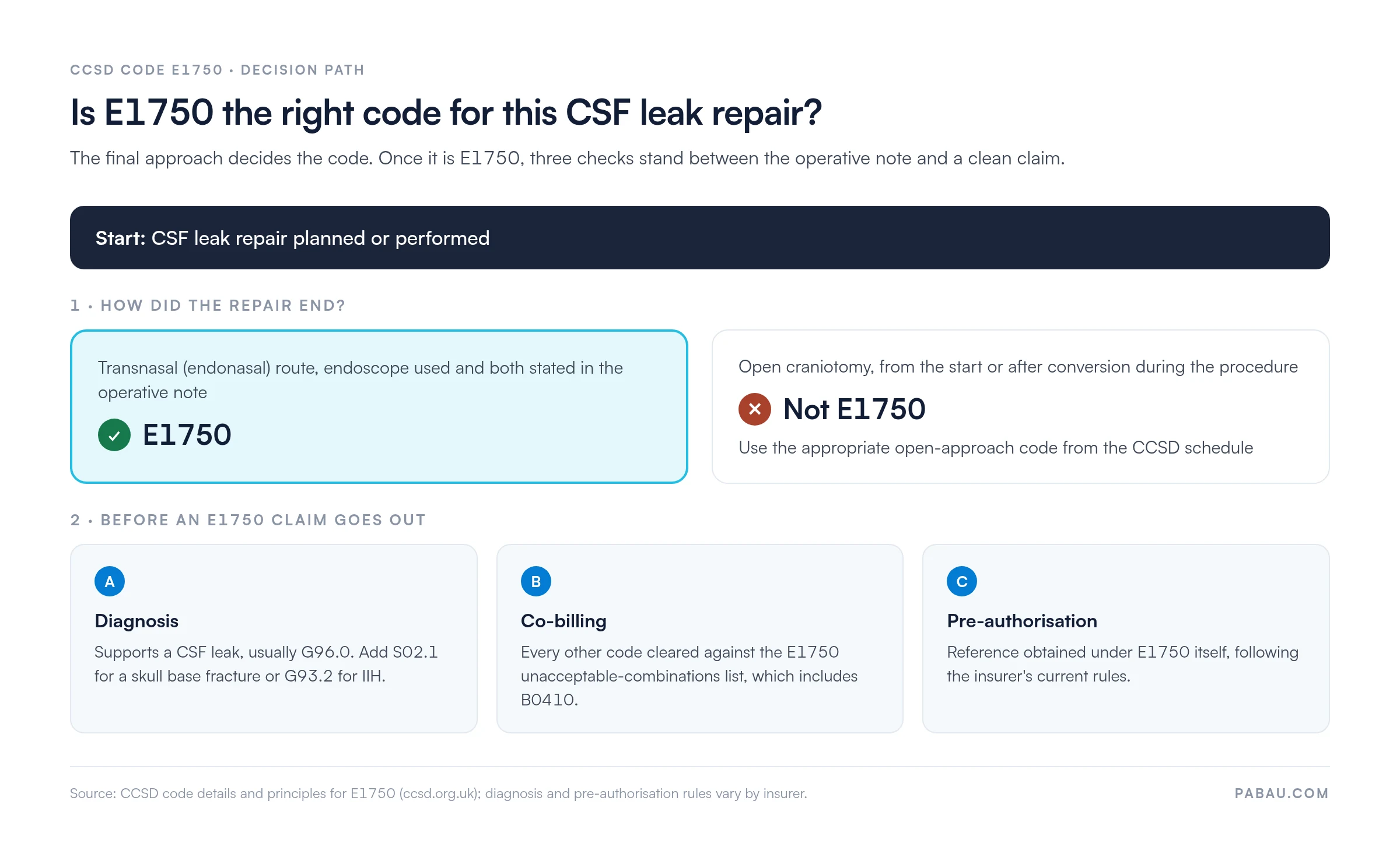
Choosing the code is only the first decision, and the path below adds the three checks that every E1750 claim needs.
The approach the repair ended with decides the code, and three checks follow before the claim goes out. Based on the CCSD code principles for E1750.
What E1750 includes and what it excludes
The descriptor’s “including endoscopic” wording means the items marked “Yes” below are part of the E1750 fee. They are not billed separately on the same claim.
Item
Bundled in E1750?
Billing guidance
Nasal endoscopy (operative)
Yes
Never add a separate endoscopy code, such as E1780, alongside E1750
Standard graft application (fat, fascia, mucosal flap)
Yes
Verify insurer-specific rules before separately billing synthetic dural substitutes
Intraoperative fluorescein use
Yes
Document its use in operative notes even though it is bundled, because omitting it raises review queries
Tissue sealant / glue
Typically yes
Some insurers allow separate billing of high-cost sealants, so confirm with the individual PMI before submitting
Check the E1750 unacceptable-combinations list in the CCSD schedule before co-billing
Concurrent functional endoscopic sinus surgery (FESS)
Check first
Check the E1750 unacceptable-combinations list in the CCSD schedule before co-billing, and separate the two procedures in the operative note
Complex skull base reconstruction beyond simple defect closure
Check first
Check the CCSD schedule and Technical Guide for the code that matches the full procedure
Neighbouring CCSD codes: avoiding confusion
E1750 sits in section 5.5 Nasal sinuses of the CCSD schedule. The confirmed codes below are the ones most likely to appear beside it on a claim or be mistaken for it. Two have their own billing guides: E1432 for FESS and B0410 for transsphenoidal pituitary surgery.
Code
Descriptor (summary)
Key distinction from E1750
E1432
FESS: excision of uncinate process and anterior ethmoid bulla, antrostomy or antral puncture, simple polypectomy and attention to turbinates (bilateral)
Sinus surgery rather than CSF repair. Check the E1750 unacceptable-combinations list before co-billing
E1780
Diagnostic endoscopy of sinus and bilateral (as sole procedure)
Diagnostic only and billed as a sole procedure. The endoscopy in E1750 is already part of the code
B0410
Transsphenoidal hypophysectomy (including total)
CCSD lists it as an unacceptable combination with E1750
Section 5.5 holds one more code that is easy to confuse with E1750. Where the surgeon opens or drains the sphenoid sinus but seals no leak, the claim belongs under E1500 instead.
If the surgeon converts from a transnasal to a craniotomy approach, E1750 no longer applies. The operative note must reflect the final approach, and the claim uses the appropriate open-approach CCSD code from the schedule.
Supported ICD-10 diagnosis codes for E1750
Every E1750 claim submitted to a UK PMI includes an ICD-10 diagnosis code. UK private claims use the WHO ICD-10 classification, so avoid US ICD-10-CM codes. The codes below are the usual diagnostic supports for this procedure.
ICD-10 code
Description
Notes
G96.0
Cerebrospinal fluid leak
Usual primary code for spontaneous or post-surgical CSF rhinorrhoea and the preferred pairing for most E1750 claims
S02.1
Fracture of base of skull
Use for traumatic CSF rhinorrhoea from a skull base fracture, with G96.0 as a secondary code. S02.8 applies only where another facial bone is fractured
G93.2
Benign intracranial hypertension
Code idiopathic intracranial hypertension (IIH) as the underlying cause when it drives spontaneous CSF leak, and pair it with G96.0
J34.8
Other specified disorders of nose and nasal sinuses
Secondary code when post-surgical sinus changes are a documented complicating factor. Do not use it instead of G96.0
Insurers expect a diagnosis that supports a CSF leak, usually G96.0. A claim carrying only J34.8 or a sinusitis or rhinitis code may be queried, because those diagnoses do not explain a skull base repair. Confirm the diagnosis rules with the individual PMI.
Documentation requirements for a valid E1750 claim
E1750 is a high-value code, so insurers may apply clinical review to the claim. The checklist below covers the documentation to have ready before submission.
Beta-2 transferrin result: Laboratory confirmation that the nasal fluid is CSF. This is the objective test that justifies surgical intervention. Insurers expect it referenced in the consultant letter or pre-auth request.
Imaging report: CT or MRI cisternography identifying the anatomical site of the defect. The report must confirm skull base pathology consistent with a CSF fistula.
Pre-authorisation reference number: Obtained before the procedure. Major UK PMIs generally require pre-authorisation for surgery of this value, so confirm each insurer’s current rules.
Operative note specifying approach: Must state that the approach was transnasal (endonasal) and that an endoscope was used. These two elements confirm E1750 is the correct code and should appear verbatim in the note.
Graft description: The type and layers of graft material used (fat, fascia, mucosal flap, tissue sealant), with anatomical placement described.
Intraoperative fluorescein use: If intrathecal fluorescein was used to localise the leak site, note it in the operative record. Omitting it does not void the claim, but recording it strengthens the clinical narrative.
Post-operative outcome: A brief note on immediate post-op status, nasal packing and any CSF pressure management, including lumbar drain placement if applicable.
Pro Tip
Build an E1750 documentation checklist into your pre-theatre workflow. Confirm the beta-2 transferrin result, imaging report and pre-auth reference are on file before the patient goes to theatre. A missing item can hold up payment even when the operative note is complete.
Pre-authorisation: what UK insurers require before E1750
Major UK PMIs generally require pre-authorisation for surgery of this value. Confirm each insurer’s current rules before the operation is booked.
Pre-auth requirements vary by insurer but typically include:
A consultant letter giving the diagnosis, usually G96.0 with biochemical and imaging evidence. It also names the planned procedure as E1750 and explains why surgery is preferred over conservative treatment
Evidence of failed conservative management where applicable, such as bed rest, acetazolamide for raised ICP or nasal packing. Some PMIs require this before approving repair
Beta-2 transferrin assay result referenced in the request
Imaging report from CT or MRI cisternography
The E1750 CCSD code stated explicitly in the pre-auth request, rather than a generic skull base code
Bupa’s code search portal allows consultants to confirm current coverage status and any clinical criteria attached to E1750. Aviva’s fee schedule and Vitality’s fee finder provide reimbursement rate lookups by CCSD code.
For an emergency repair, retrospective authorisation is possible, but the window varies by insurer. Check each PMI’s rules so the request goes in on time.
Common reasons E1750 claims are denied
E1750 claims can be denied when the pre-authorisation, operative note and diagnosis code do not line up. These are the usual causes, grouped by type.
Missing or mismatched pre-auth code: The pre-auth was obtained under a different CCSD code, such as a generic skull base code. The submitted code must match the pre-auth reference exactly.
Diagnosis that does not support a CSF leak: G96.0 or another CSF-leak diagnosis is absent. A sinusitis or rhinitis code was used instead, which does not show the need for a CSF repair.
Operative note omits transnasal approach or endoscope: If the note does not state both, the insurer cannot verify that E1750 is the correct code. The claim may then be queried or denied.
Endoscopy billed separately: Adding a nasal endoscopy code alongside E1750 is an unbundling error. The “including endoscopic” descriptor means endoscopy is already in the fee.
No biochemical confirmation of CSF: A claim without a beta-2 transferrin result is likely to be queried by an insurer applying clinical review. The test is the objective evidence for the whole surgical episode.
Post-service claim submitted without pre-auth: Where the insurer requires pre-authorisation, skipping it can lead to denial however complete the rest of the claim is.
Can E1750 be billed alongside a lumbar drain?
Only after you check the E1750 unacceptable-combinations list in the CCSD schedule. That list sits behind the CCSD login, so confirm the drain code and its status there before co-billing.
If the drain is co-billed, the operative note should describe it as a separate step with its own indication. Record the clinical reason, such as raised ICP on pre-operative imaging, and its placement as a distinct procedure. Check the Healix CCSD fee schedule for current reimbursement values on combined claims.
Billing E1750 in practice: a step-by-step workflow
A structured workflow checks each handover between the clinical and administrative teams before the claim goes out.
Confirm code selection with the surgeon. Before requesting pre-authorisation, confirm the planned approach is transnasal endoscopic. If conversion to an open approach is possible, note that the appropriate open-approach CCSD code may be needed.
Request pre-authorisation using E1750 explicitly. Submit the request citing E1750 by name and number, with the consultant letter, beta-2 transferrin result and imaging report. Keep the pre-auth reference number on file before theatre is booked.
Apply the documentation checklist before theatre. Confirm the lab result, imaging report, pre-auth reference and any conservative management evidence the insurer requires are on the patient record.
Receive the operative note and review it. Before submission, confirm the note states the transnasal approach and endoscope use explicitly. If either is missing, ask the surgeon for an addendum before the claim goes out.
Submit with matched ICD-10 codes. Use a diagnosis that supports a CSF leak, usually G96.0. Add documented secondary codes, such as G93.2 for IIH or S02.1 for a skull base fracture. Pabau’s medical claims management sends the claim through Healthcode and tracks its status.
Respond to clinical queries promptly. High-value codes attract insurer clinical review. Keep the consultant’s contact details to hand, because slow replies push back payment.
Appeal denied claims with the operative note addendum. Attach a surgeon addendum confirming the transnasal approach and endoscope use, along with the pre-auth reference and lab result.
How Pabau keeps E1750 claims tied to the patient record
A consultant’s billing team often builds an E1750 claim from four sources. They are the lab portal, the imaging report, the operative note and the insurer’s pre-auth email. When the insurer queries the claim, someone has to find each document again.
Pabau, the practice management platform we build, keeps those documents on one patient record. Its claims management uses the details already on that record and sends UK private claims through Healthcode.
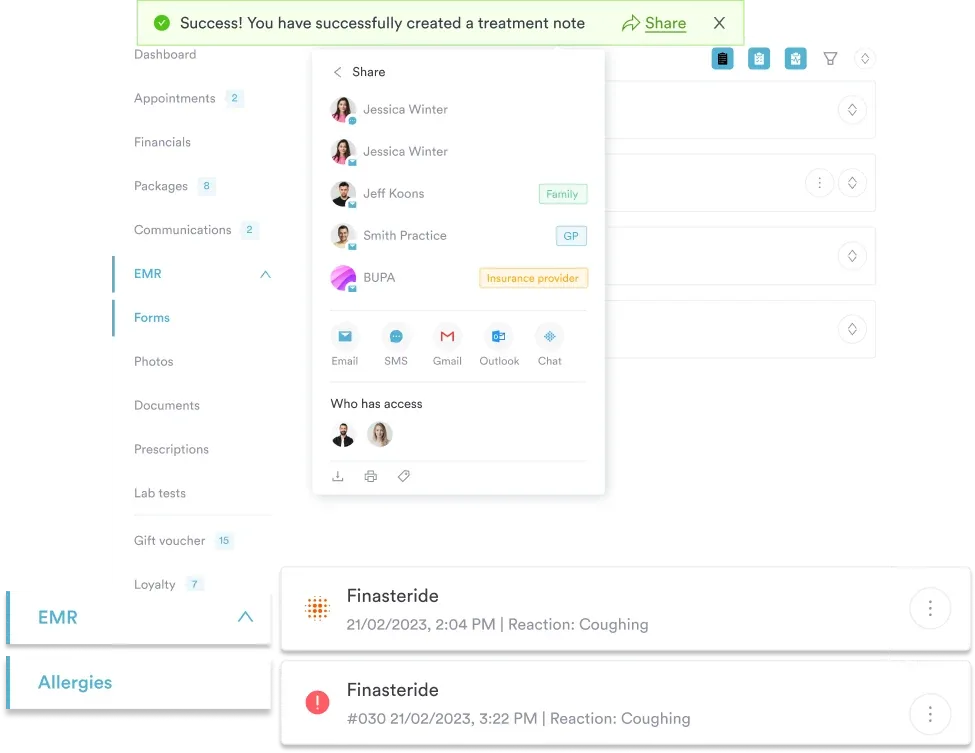
Pabau’s EMR shares a treatment note with the patient’s insurer, so the E1750 operative note reaches clinical review without a separate email.
The result is a claim built from the same record the clinical reviewer will ask about. Your team answers a query by sharing a document from that record.
Keep E1750 claims and records together
Pabau keeps the lab result, imaging report and operative note on one patient record. Its claims management then sends UK private claims through Healthcode and tracks their status.
Treat E1750 as a claim decided before theatre. Confirm the transnasal approach, the CSF diagnosis and the pre-authorisation while there is still time to change them.
The judgment call sits in co-billing. Lumbar drains, FESS and pituitary surgery all need checking against the E1750 unacceptable-combinations list, and that list sits behind the CCSD login. Make the check part of booking, so a conversion to open surgery only means changing the code before submission.
Book a demo to see how Pabau keeps E1750 documentation and claims on one patient record.
Continue your research
Want a full overview of CCSD billing rules for Bupa?Bupa CCSD procedure codes guide covers the Bupa CCSD schedule, fee structure and submission requirements for UK private consultants.
Coding FESS on the same patient?CCSD code E1432 explains how bilateral FESS sinus surgery is billed to UK private insurers.
Billing pituitary surgery?CCSD code B0410 walks through transsphenoidal hypophysectomy billing, a listed unacceptable combination with E1750.
Working on other sinus procedures?CCSD code E1440 covers transantral ethmoidectomy billing in the same CCSD nasal sinuses section.
Looking for another CCSD code?CCSD coding guides collects Pabau’s billing guides for UK private procedure codes.
Frequently asked questions
What does CCSD Code E1750 cover?
CCSD Code E1750 covers transnasal repair of a cerebrospinal fluid (CSF) leak, including the endoscopic technique used to see and seal the skull base defect. It is a UK private medical insurance code, and the approach must be transnasal (endonasal) rather than via craniotomy.
Is E1750 used for both traumatic and spontaneous CSF leaks?
Yes. E1750 applies to traumatic CSF rhinorrhoea, typically from an anterior skull base fracture, and to spontaneous CSF rhinorrhoea. Spontaneous cases include leaks related to idiopathic intracranial hypertension and post-surgical rhinorrhoea. The aetiology does not change the code, provided the repair uses the transnasal endoscopic route.
Do UK private insurers require pre-authorisation for E1750?
Generally, yes. Major UK PMIs generally require pre-authorisation for surgery of this value, and E1750 is a high-value code. Confirm each insurer’s current rules before the procedure, because a claim missing a required pre-auth reference can be denied.
Can E1750 be billed alongside a lumbar drain procedure?
Check before you co-bill. The CCSD schedule lists unacceptable combinations for E1750, including B0410, and the full list sits behind the CCSD login. Confirm the lumbar drain code and its status there. If it is co-billed, the operative note should describe the drain as a separate step with its own indication.
What happens if the surgeon converts from transnasal to open craniotomy during the procedure?
E1750 is no longer the correct code. Change it to the appropriate open-approach CCSD code from the schedule before the claim is submitted, because the descriptor specifies the transnasal approach. The operative note must record the final approach used.
Why do E1750 claims get denied by private medical insurers?
The usual reasons are a missing pre-authorisation reference and an operative note that does not state the transnasal approach and endoscope use. Others include a diagnosis that does not support a CSF leak, endoscopy billed separately, and no beta-2 transferrin result. Insurers expect a diagnosis that supports a CSF leak, usually G96.0, so confirm the rules with the individual PMI.